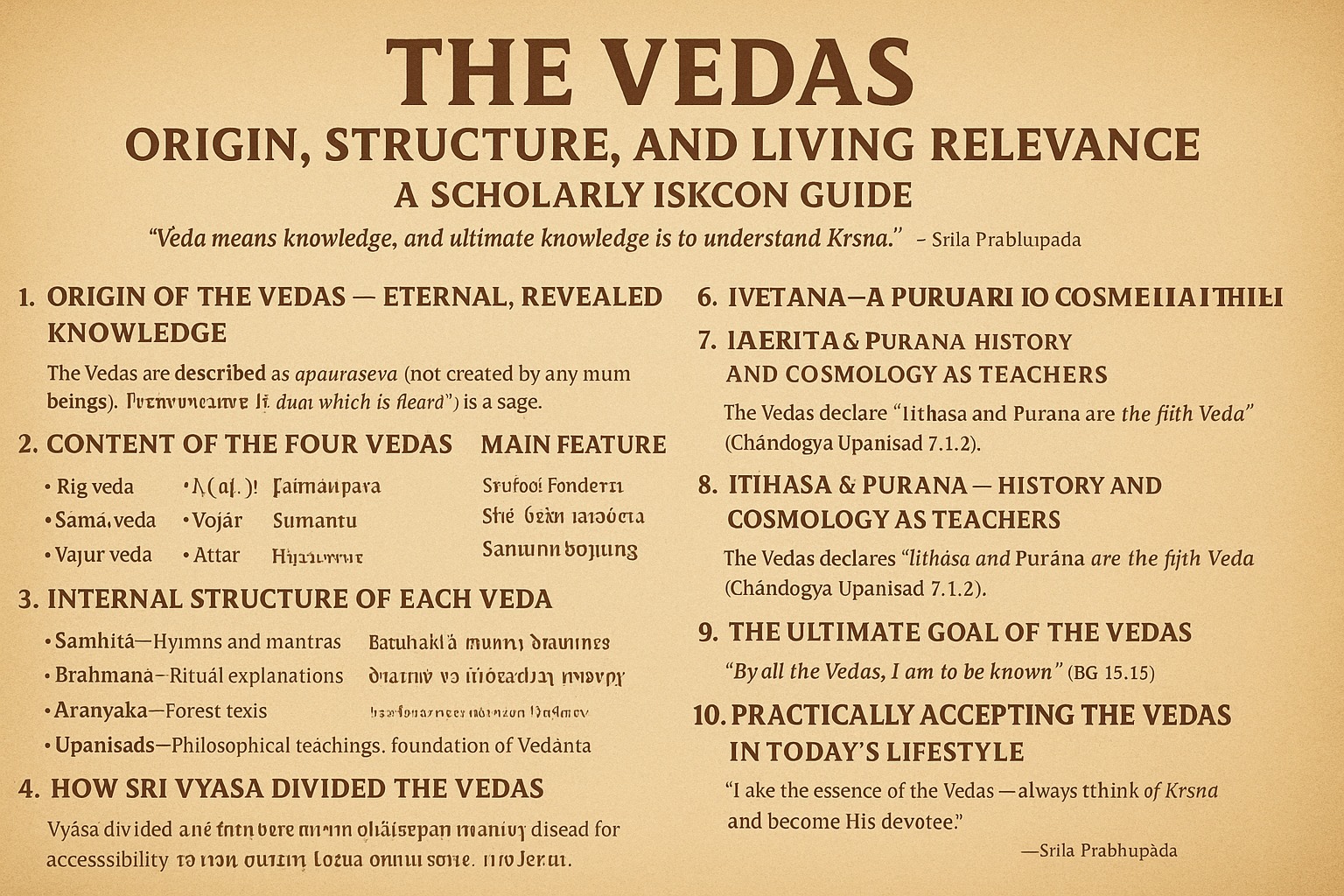
ORIGIN, STRUCTURE, AND LIVING RELEVANCE — A SCHOLARLY ISKCON GUIDE
“Veda means knowledge, and ultimate knowledge is to understand Kṛṣṇa.” — Śrīla Prabhupāda (Bhagavad-gītā 15.15, Purport)
Introduction
The Vedas are the foundational scriptures of Sanātana-dharma — a vast, sacred body of knowledge guiding humanity in spirituality, ethics, ritual, society, and the science of self-realization. Within the ISKCON tradition, the Vedas are understood not merely as ancient literature but as apauruṣeya — eternal, authorless revelation, received by liberated ṛṣis and systematically preserved for millennia.
This article presents a scholarly, well-cited, ISKCON-aligned overview of the Vedas: their origin, content, Vyāsa’s division, discipleship lines, Śruti–Smṛti framework, Vedānta, Itihāsa, their ultimate goal, and their practical application in modern life.
1. ORIGIN OF THE VEDAS — ETERNAL, REVEALED KNOWLEDGE
The Vedas are described as apauruṣeya — not created by any human being.
Śruti (“that which is heard”) was first perceived by fully purified sages at the beginning of creation.
Scriptural foundation
- Śrīmad-Bhāgavatam 1.1.1 describes the Lord as He “from whom all Vedic knowledge emanates.”
- Bhagavad-gītā 3.15: “The Vedas come directly from the Supreme Personality of Godhead.”
Prabhupāda
“Vedic knowledge is not a question of research. It is perfect because it comes from the perfect source — Kṛṣṇa.” (Lecture, BG 15.15)
Thus, the Vedas are considered the world’s oldest continuous spiritual tradition, preserved with exact oral methods such as ghanas, pāṭhas, and meticulous phonetic rules.
2. CONTENT OF THE FOUR VEDAS
Traditionally there are four Vedas, each with a distinct focus:
Rig-veda
- Oldest Vedic text.
- Hymns to deities such as Agni, Indra, Soma.
- Emphasizes cosmic order (ṛta).
Sāma-veda
- Melodic chanting, derived largely from the Rig-veda.
- Used by udgātṛ priests during yajñas.
Yajur-veda
- Ritual manuals in verse and prose.
- Guiding the adhvaryu priests in sacrificial procedures.
Atharva-veda
- Everyday prayers, rituals, healing hymns, and philosophical reflections.
3. INTERNAL STRUCTURE OF EACH VEDA
Each Veda has four complementary layers:
- Saṁhitā — Hymns and mantras
- Brāhmaṇa — Ritual explanations
- Āraṇyaka — Meditative “forest texts”
- Upaniṣads — Philosophical teachings; foundation of Vedānta
Vedic evolution
The journey from ritual (karmakāṇḍa) to philosophy (jñāna-kāṇḍa) naturally culminates in bhakti, as Śrīmad-Bhāgavatam declares:
“The essence of all Vedic literatures is pure devotional service to the Supreme Lord.” — SB 3.33.7
4. HOW ŚRĪ VYĀSA DIVIDED THE VEDAS
Originally the Veda was one unified body of knowledge.
As human memory and lifespan declined in the current age (Kali-yuga), the great sage Śrī Kṛṣṇa Dvaipāyana Vyāsa divided it for accessibility.
Bhāgavatam’s testimony
SB 1.4.14–15: Vyāsa divided the single Veda into four for the welfare of people with reduced intelligence in Kali-yuga.
5. TO WHOM VYĀSA TAUGHT EACH VEDA
Vyāsa entrusted different disciples with different Vedas to maintain purity through distinct lineages (śākhās).
| Veda | Disciple |
|---|---|
| Rig-veda | Paila Ṛṣi |
| Yajur-veda | Vaiśampāyana |
| Sāma-veda | Jaimini |
| Atharva-veda | Sumantu |
(Ref: SB 12.6.52–57; various Purāṇas)
Additionally, Vyāsa’s son Śukadeva Gosvāmī became the primary speaker of the Bhāgavatam, the “spotless Purāṇa”.
6. ŚRUTI AND SMṚTI — TWO LEVELS OF VEDIC AUTHORITY
Śruti (“heard revelation”)
- The four Vedas
- Upaniṣads
- Brāhmaṇas
- Āraṇyakas
Highest theological authority.
Smṛti (“remembered tradition”)
- Itihāsa (Rāmāyaṇa & Mahābhārata)
- Purāṇas
- Dharma-śāstras
- Commentaries such as Bhagavad-gītā and Vaiṣṇava śāstras
Śruti gives the *principles; Smṛti offers *application.
Prabhupāda
“Smṛti is the practical explanation of śruti.” (Lecture on SB 1.2.6)
7. VEDĀNTA — THE PHILOSOPHICAL SUMMIT
Vedānta (“the end of the Vedas”) refers to the Upaniṣads, Brahma-sūtra, and Bhagavad-gītā.
Vyāsa compiled the Brahma-sūtras to summarize Vedic metaphysics.
Gaudiya Vaiṣṇava conclusion
Following Lord Caitanya Mahāprabhu, ISKCON accepts:
Śrīmad-Bhāgavatam as the natural commentary on Vedānta-sūtra.
Śrīla Prabhupāda states:
“Bhāgavatam is the essence of all Vedānta philosophy.” (SB Preface)
8. ITIHĀSA & PURĀṆA — HISTORY AND COSMOLOGY AS TEACHERS
The Vedas declare:
“Itihāsa and Purāṇa are the fifth Veda.” — Chāndogya Upaniṣad 7.1.2
Narratives carry profound ethics, devotion, and philosophy:
- Rāmāyaṇa teaches ideal character and devotion.
- Mahābhārata contains the Bhagavad-gītā, the world’s most influential spiritual dialogue.
- *Purāṇas, especially *Śrīmad-Bhāgavatam, offer theistic philosophy culminating in pure bhakti.
9. THE ULTIMATE GOAL OF THE VEDAS
Kṛṣṇa clearly states:
“By all the Vedas, I am to be known.” — BG 15.15
Śrīla Prabhupāda repeatedly emphasizes:
“The purpose of the Vedas is to understand Kṛṣṇa and engage in His devotional service.”
(BG 15.15, Purport)
Thus, ritual, ethics, meditation, yoga, and philosophy all ultimately aim to awaken love for the Supreme Personality of Godhead.
10. PRACTICALLY ACCEPTING THE VEDAS IN TODAY’S LIFESTYLE
A common misconception is that Vedic wisdom requires archaic rituals. ISKCON makes Vedic practice accessible, practical, and joyful.
1. Daily study of śāstra
- Bhagavad-gītā As It Is
- Śrīmad-Bhāgavatam
- Upaniṣads (with Vaiṣṇava commentaries)
2. Chanting the holy names
The most important Vedic recommendation for Kali-yuga:
Hare Kṛṣṇa Hare Kṛṣṇa Kṛṣṇa Kṛṣṇa Hare Hare Hare Rāma Hare Rāma Rāma Rāma Hare Hare
— Bṛhan-Nāradiya Purāṇa
3. Simple devotional practices
- Attend kīrtana and Sunday feasts
- Offer food to the Lord
- Worship at home (simple ārati)
- Practice ahimsa and sattvic living
4. Ethical Vedic values
- Truthfulness
- Compassion
- Self-discipline
- Responsibility
- Charity
5. Learning from authentic paramparā
Avoid self-made interpretations and rely on guru, sadhu, śāstra — especially Śrīla Prabhupāda’s books.
Conclusion
The Vedas are not fragmentary ancient texts but a living, universal, spiritual tradition culminating in pure devotion to Śrī Kṛṣṇa. Through the tireless work of Śrī Veda-Vyāsa and the mercy of Śrīla Prabhupāda, this wisdom has become accessible to all — regardless of background.
By integrating Vedic values with modern lifestyles — through study, chanting, community, and devotion — anyone can experience the timeless guidance and transformative power of the Vedas.
“Take the essence of the Vedas — always think of Kṛṣṇa and become His devotee.”
— Śrīla Prabhupāda