A Vaiṣṇava Guide to Karma, Time, and the Path Back to Krishna
1. Introduction
Astrology—known in Sanskrit as *Jyotiṣa-śāstra—is one of the most ancient sciences of humanity. Rooted in the Vedas, it is traditionally respected as the *“eye of the Vedas” (Vedacakṣuḥ) because it illuminates how time (kāla) influences human life, karma, and destiny.
In the modern world, astrology has become commercialized, distorted, and often reduced to entertainment. Therefore, devotees frequently ask:
How much should a Vaiṣṇava rely on astrology? What is its purpose? How do we balance karma, free will, and devotion?
This article provides a clear, authentic, and spiritually grounded ISKCON-style perspective on Jyotiṣa.
2. What Is Jyotiṣa? The Vedic Purpose of Astrology
2.1. Jyotiṣa: One of the Six Vedāṅgas
According to the Vedas, Jyotiṣa is one of the six limbs of knowledge required for understanding Vedic rituals and dharma:
- Śikṣā – phonetics
- Chandas – meter
- Vyākaraṇa – grammar
- Nirukta – etymology
- Kalpa – ritual procedures
- Jyotiṣa – astrology & astronomy
Thus Jyotiṣa was originally designed to:
- Calculate auspicious timings (muḥūrtas)
- Align human activities with cosmic rhythms
- Discern individual karmic tendencies
- Support dharmic decision-making
- Understand the influence of grahas (planets)
It was never meant to be a tool for fear, superstition, or exploitation.
3. Types of Astrology: Vedic and Global Traditions
Astrology exists worldwide, but the Vedic system is the most ancient and comprehensive.
3.1. Vedic (Indian) Astrology – Jyotiṣa
Primary branches:
- Siddhānta – mathematical astronomy
- Horā Śāstra – predictive astrology (birth charts, karma)
- Sāmudrika – physiognomy (face, palm readings)
Key texts:
- Bṛhat Parāśara Horā Śāstram
- Jaimini Sutras
- Bṛhat Jātaka (Varāhamihira)
3.2. Outside India: Global Systems
1. Western Astrology
- Based on tropical zodiac
- More psychological and personality-focused
- Emphasizes Sun sign
- Influenced by Babylonian, Greek, and Roman traditions
2. Chinese Astrology
- Based on lunar cycles and 12-year animal zodiac
- Integrates yin–yang and five-element theory
3. Tibetan Astrology
- Blend of Indian, Chinese, and Bon traditions
4. Mayan Astrology
- Advanced calendrical calculations (Tzolkin)
- Predictive cycles based on solar and galactic cycles
Vedic astrology is the most dharma-oriented, integrating karma, past lives, and liberation.
4. What Is the Purpose of Astrology in Spiritual Life?
4.1. To Understand One’s Karma
Astrology reveals:
- Your starting point (past karmic baggage)
- Your nature (svabhāva)
- Your tendencies (vāsanās)
- Your likely challenges
- Your opportunities for spiritual growth
4.2. To Align with Dharma
For householders:
- Marriage compatibility
- Financial tendencies
- Health risks
- Career inclinations
- Times of challenges (daśā/bhukti periods)
4.3. To Make Better Moral and Spiritual Decisions
Not to override free will, but to support it.
4.4. To Understand Time (Kāla)
Śrīmad-Bhāgavatam states:
kālo ’smi — “I am Time.”
(Bhagavad-gītā 11.32)
Astrology helps one respect the Lord’s time-energy.
5. Should Devotees Use Astrology? The ISKCON Siddhānta
Śrīla Prabhupāda never discouraged astrology when:
- It is Vedic
- Applied rationally
- Not used to replace bhakti
- Not used for controlling others
- Not used to become anxious or fatalistic
Prabhupāda said:
“Astrology is a science. But our main business is to become Krishna conscious.”
(Morning Walk, 1975)
Thus: Astrology is allowed, but devotion is essential.
6. How Much Should Devotees Accept Astrology?
1. Accept its guidance, not its control. – Astrology identifies tendencies, not unchangeable destiny.
2. Don’t let astrology weaken faith. – If your chart says “danger”, chant louder.
3. Don’t ask astrologers to solve spiritual problems. – Graha-doṣas cannot block bhakti.
4. Use astrology for practical matters only. – Marriage, health tendencies, timing, travel, investments.
5. Reject fear-based remedies. – Prabhupāda discouraged gemstone-selling, tantrik rituals, and commercial remedies.
7. How Is Astrology Used Today? Practical Applications
Modern uses (good and bad):
- Good: muhurta, marriage, health warnings, natural inclinations
- Neutral: personality analysis
- Misused: fear-based remedies, gem trade, money-making
- Degraded: daily newspaper horoscopes
Devotees should prefer:
- Vaiṣṇava astrologers, Scriptural remedies (chanting, charity, good conduct), Astrology used to facilitate better sādhana
8. What Are True Remedies for Bad Karma According to Bhāgavatam?
Śrīmad-Bhāgavatam 6.2.10 says:
“The highest atonement is loving devotional service to the Lord.”
True remedies:
- Nāma-japa
- Hearing Bhāgavatam
- Charity to devotees
- Service to cows
- Tulasi worship
- Fast on Ekādaśī
- Avoiding sin (anartha-nivṛtti)
No gemstone can override karma the way bhakti can.
9. What Is the Best Way to Progress in Life? (Vaiṣṇava Conclusion)
Regardless of your birth chart:
- Chanting purifies the planets (grahas)
- Hearing purifies the mind
- Service purifies the heart
- Association purifies tendencies
- Mercy of Guru and Krishna purifies destiny
Krishna is stronger than your horoscope.
As Bhāgavatam states:
“Devotional service defeats destiny.”
(SB 3.25.38 – paraphrased)
The planets may push you — but Krishna can pull you out.
10. Conclusion: The Balanced ISKCON Approach
- Use astrology as a map, not as a master.
- Honor Jyotiṣa as a sacred Vedic science.
- Don’t let it generate fear or superstition.
- Let bhakti be your compass.
- Make life decisions with Guru, Sādhu, and Śāstra, not just planets.
- Daily remember:
The grahas influence—Krishna controls.
11. Call-to-Action
“Real guidance comes from the lotus feet of Guru and Krishna. If you wish to deepen your spiritual life, join our weekly Gītā classes, Bhāgavata study groups, and japa workshops.”
Śrīla Prabhupāda taught:
“A devotee is not under the influence of the planets.”
(Lecture, LA 1976)
Are Palmistry, Face Reading, etc. Part of Vedic Astrology (Jyotiṣa)?
The answer is partially yes and no, depending on the system.
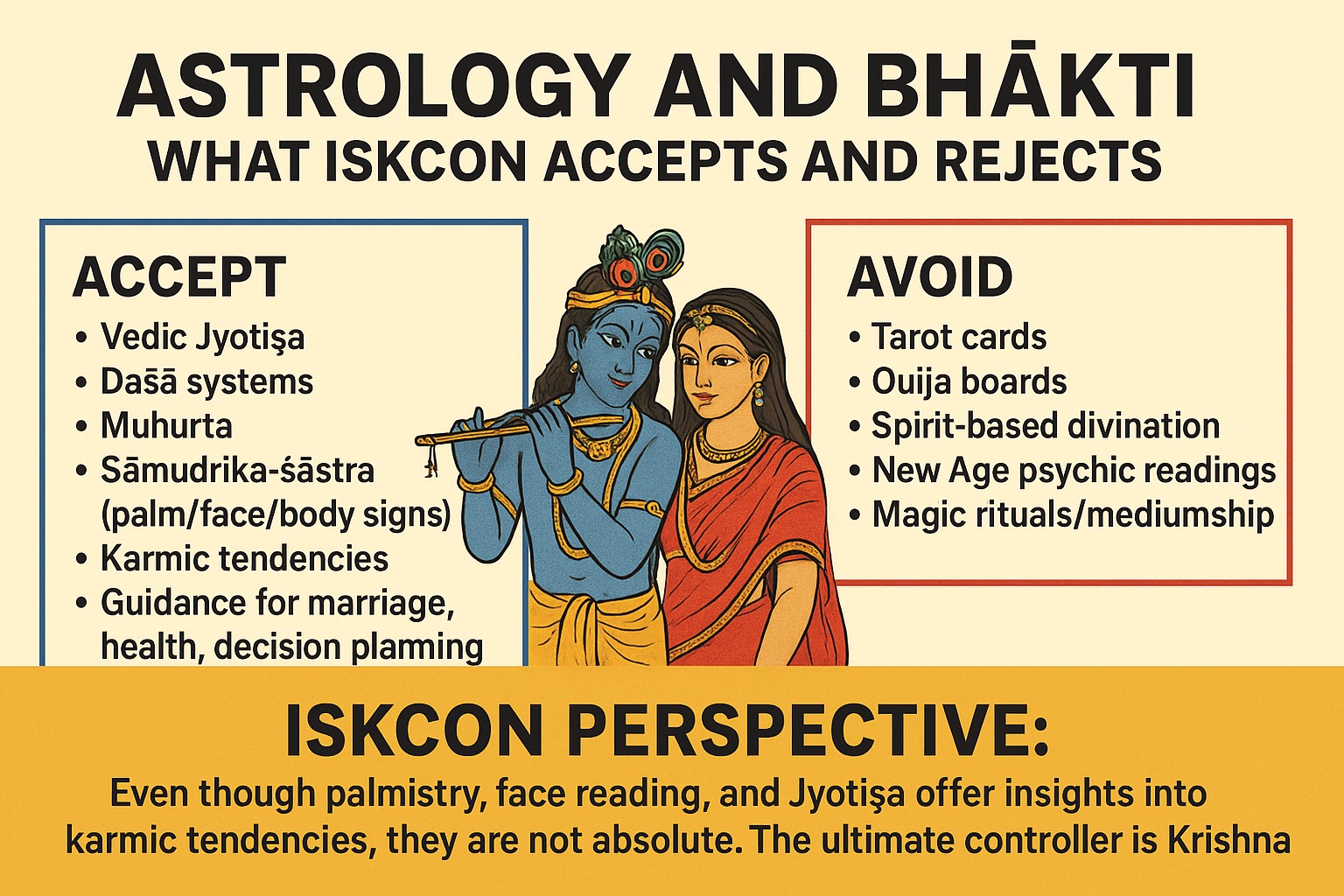
1. Samudrika-śāstra (Palmistry & Face Reading) – YES, part of Vedic tradition
In the Vedic system there is a science called:
Sāmudrika-śāstra = The assessment of a person’s nature, tendencies, and karmic impressions through
- Palmistry (hasta-sāmudrika)
- Face reading (mukha-sāmudrika)
- Body signs (aṅga-lakṣaṇa)
This is genuine, scripturally referenced, and traditionally connected with Jyotiṣa.
References in Vedic literature
- Parts of Sāmudrika-śāstra are attributed to sages like Samudra Rishi.
- The *Mahābhārata, **Rāmāyaṇa, and *Purāṇas use descriptions of bodily signs to indicate character and destiny.
- Kaśyapa Saṁhitā and Gārgi Saṁhitā mention bodily characteristics related to karma.
Thus: ### Palmistry + Face Reading = Traditional, Vedic, and related to Jyotiṣa.
But still secondary, not primary.
2. Tarot Cards – NOT Vedic, NOT part of Jyotiṣa
Tarot originates from:
- Medieval Europe
- Western esotericism
- Non-dharmic occult systems
Therefore, not recommended for devotees.
3. Western Astrology – NOT Vedic, but a separate global system
Western astrology is:
- Based on tropical zodiac
- Sun-sign based
- Influenced by Greek and Roman traditions (Ptolemy)
It is *astrology, but not *Jyotiṣa.
Vaiṣṇavas may acknowledge it as another cultural system, but we do not treat it as authoritative spiritually.
4. Chinese, Tibetan, Mayan Astrology – Separate systems
These are:
- Cultural/astronomical
- Have their own logic
- Not connected to Vedic karmic theory
They are *astrology, not *Jyotiṣa.
5. Numerology – Semi-Vedic, but mostly modernized
Classic Vedic texts mention numbers (ankashastra) but not the modern numerology widely practiced today.
Most modern numerology is commercial and speculative.
Thus:
- Accept with caution
- Not central to spiritual life
Avoid (unscriptural / occult):
- Tarot cards
- Ouija boards
- Spirit-based divination
- New Age psychic readings
- Magic rituals
- Mediumship
These do not align with Vedic teachings and may create fear, confusion, or dependency.