
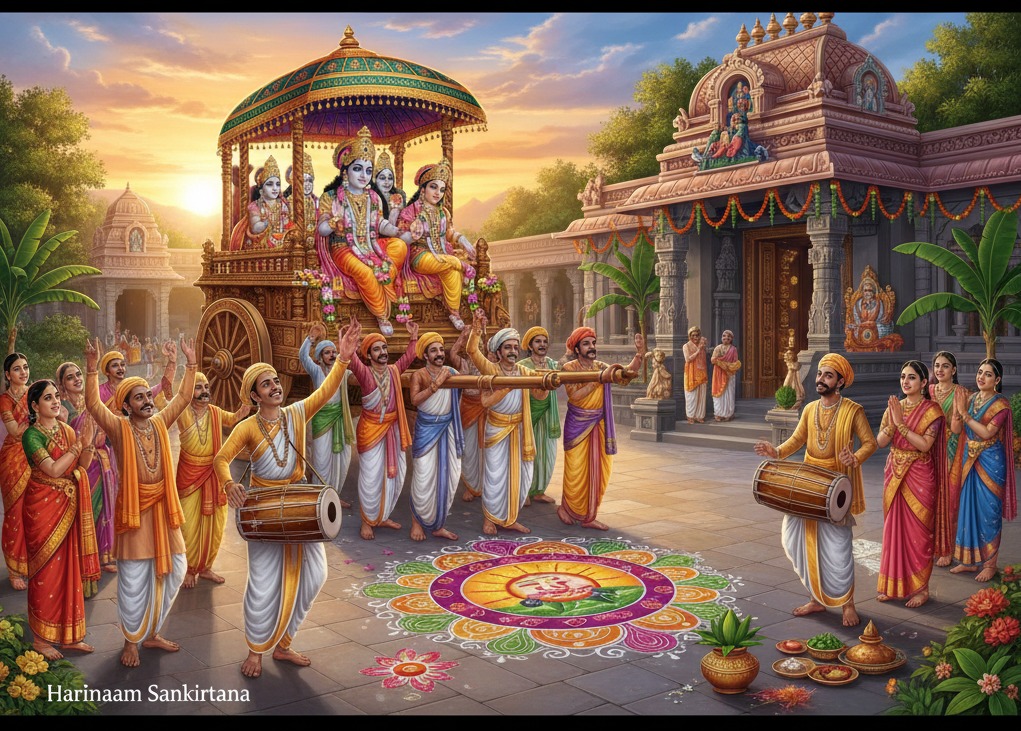
The Vaishnava Understanding of a New Beginning Under the Shelter of Krishna
Ugadi is one of India’s most ancient and culturally rich New Year celebrations. Rooted in Vedic cosmology, regional calendars, and devotional traditions, it marks a powerful moment to remember that all auspiciousness flows from the Supreme Lord, Śrī Krishna. For devotees, Ugadi becomes meaningful when aligned with śāstra, sādhana, and a life centered on bhakti.
1. A Vedic New Year Rooted in the Lunar Calendar
The word Ugadi (or Yugādi) comes from yuga (age) and ādi (beginning)—the start of a new cycle of time.
Ugadi marks the *Chandramāna (lunar) New Year, particularly celebrated across South India. According to tradition, it commemorates the day when Lord Brahmā began creation. *Ugadi / Yugādi derives from Sanskrit yuga (age) + ādi (beginning) — the “beginning of a new age.” Classical calendars record this day as Vatsarārambha (start of the year) or Chaitra Śukla Pratipadā. Traditional Puranic references associate the day with creation motifs and with the renewal of social and religious duties expected at the start of a new year. The festival thus combines cosmological symbolism with practical renewal.
Although celebrated regionally, its philosophical foundation is universal: Time is an energy of the Supreme Lord.
Bhagavad-gītā 10.30:
“Among subduers I am time.”
Śrīla Prabhupāda writes:
“Time is Krishna’s representative… no one can check time.”
Thus, the New Year becomes a reminder of Krishna’s supreme control and our opportunity to realign ourselves with His service.
2. Names of Ugadi Across India and Their Regional Observances
Although the essence is the same—a new year dedicated to auspiciousness—the festival carries various names across India:
| Region | Name | Basis |
|---|---|---|
| Andhra Pradesh | Ugadi | Lunar New Year |
| Telangana | Ugadi | Lunar calendar |
| Karnataka | Ugadi | Lunar calendar |
| Maharashtra | Gudi Padwa | Lunar New Year |
| Kashmir | Navreh | Lunar calendar |
| Manipur | Sajibu Nongma Panba | Lunar calendar |
| Rajasthan & parts of North India | Cheti Chand (Sindhi New Year) | Lunar |
| Goa & Konkan | Gudi Padwa | Lunar |
These celebrations typically fall in *March–April, on the *first day of the bright fortnight (Śukla Pratipadā) in the month of Chaitra.
3. Chandramāna vs. Sauramāna Ugadi – Why Two New Years?
Chandramāna (Lunar) Ugadi
- Based on the waxing and waning of the moon.
- Observed widely in southern, western, and parts of northern India.
- Used for most Hindu festival calculations.
- Date generally falls in March–April.
Sauramāna (Solar) New Year
- Based on the Sun’s transit (Saura māna).
- Known as Vishu (Kerala), Puthandu (Tamil Nadu), Baisakhi (Punjab), Maha Vishuva Sankranti (Odisha).
- Occurs when the Sun enters Mesha (Aries).
- Date is around April 14 every year.
- Considered more astronomically fixed.
Which Is More Significant?
Sauramāna is:
- astronomically precise
- tied to solar transit
- less variable
Chandramāna Ugadi, while widely celebrated, is not as astronomically fixed. It is primarily cultural and regional, not a universally Vedic mandate.
In *Vaiṣṇava perspective, *the real significance lies not in lunar vs. solar, but in how the day is used for bhakti.
Śrīla Prabhupāda emphasized:
“For devotees, every day is New Year when they make new progress in Krishna consciousness.”
4. Spiritual Significance of Ugadi in the Life of a Devotee
Despite regional diversity, all New Year celebrations ultimately remind us of:
- Krishna as the controller of time
- Our limited lifespan
- The urgency to purify consciousness
- The opportunity to realign our goals
- Gratitude for spiritual shelter
Bhāgavatam (11.3.29) directs:
“One should take shelter of devotees and engage constantly in hearing and chanting Hari-kīrtana.”
This is the real purpose of any New Year for a devotee.
5. Traditional Ugadi Practices and Their Inner Meaning
*1. Ugadi Pachadi (Six-Taste Preparation): Represents *six experiences of life—happiness, sorrow, fear, anger, disgust, and surprise—teaching acceptance of Krishna’s plan.
2. Cleaning Home and Altar: Symbolizes cleansing the heart.
3. Decorating with mango leaves and rangoli: Represents invoking auspiciousness, Lakṣmī, and purity.
*4. Panchanga Shravanam (Hearing the annual predictions): A cultural practice—devotees accept it only as *secondary, not authoritative.
5. Charity and Annadāna: Vedic principle of cultivating compassion.
6. Should Devotees Rely on New Year Predictions? (Svarūpa of a Vaiṣṇava View)
Śrīla Prabhupāda consistently discouraged dependence on astrology for decision-making: “A devotee does not care for planetary influences. Krishna takes charge of His devotee.”
Therefore:
- Predictions may be respected culturally
- But devotees do not rely on them for life choices
- True auspiciousness comes from chanting and service
7. How a Devotee Should Celebrate Ugadi
1. Begin with Śrīmad-Bhāgavatam reading: Start the year with transcendental sound.
2. Extra attentive japa : Renew commitment to chanting.
3. Offer a special bhoga preparation to the Deities : Express gratitude.
4. Take personal sankalpa (spiritual resolutions): Such as:
- Reading one chapter of Gītā daily
- Increasing rounds
- Committing to seva
- Supporting temple programs
*5. Reflect on your life mission: Align goals with Śrīla Prabhupāda’s instruction: *“Make your life perfect by Krishna consciousness and help others do the same.”
This is the true New Year resolution.
8. The Ultimate ISKCON Perspective on Ugadi
Regional calendars may differ—*Ugadi, **Gudi Padwa, **Navreh, **Vishu, *Baisakhi—but for devotees of Krishna, the deeper truth is:
- Time belongs to Krishna
- Every day is an opportunity for devotion
- Festivals help us remember Him
- The real New Year begins when we turn our heart toward bhakti
As Śrīla Prabhupāda says:
“Krishna consciousness is the real auspicious activity. Everything becomes successful when Krishna is remembered.”
🚩 Seva Opportunities
Contribute towards:
✨ Temple Construction
✨ Maha Abhishek, Annadanam, Flowers & Decorations, Goshala Seva
💰 Donation Details:
Account Name: ISKCON
Bank: Canara Bank
A/c No.: 0519101043190
IFSC: CNRB0000519
🌐 Online Donations: give.iskconraichur.com