
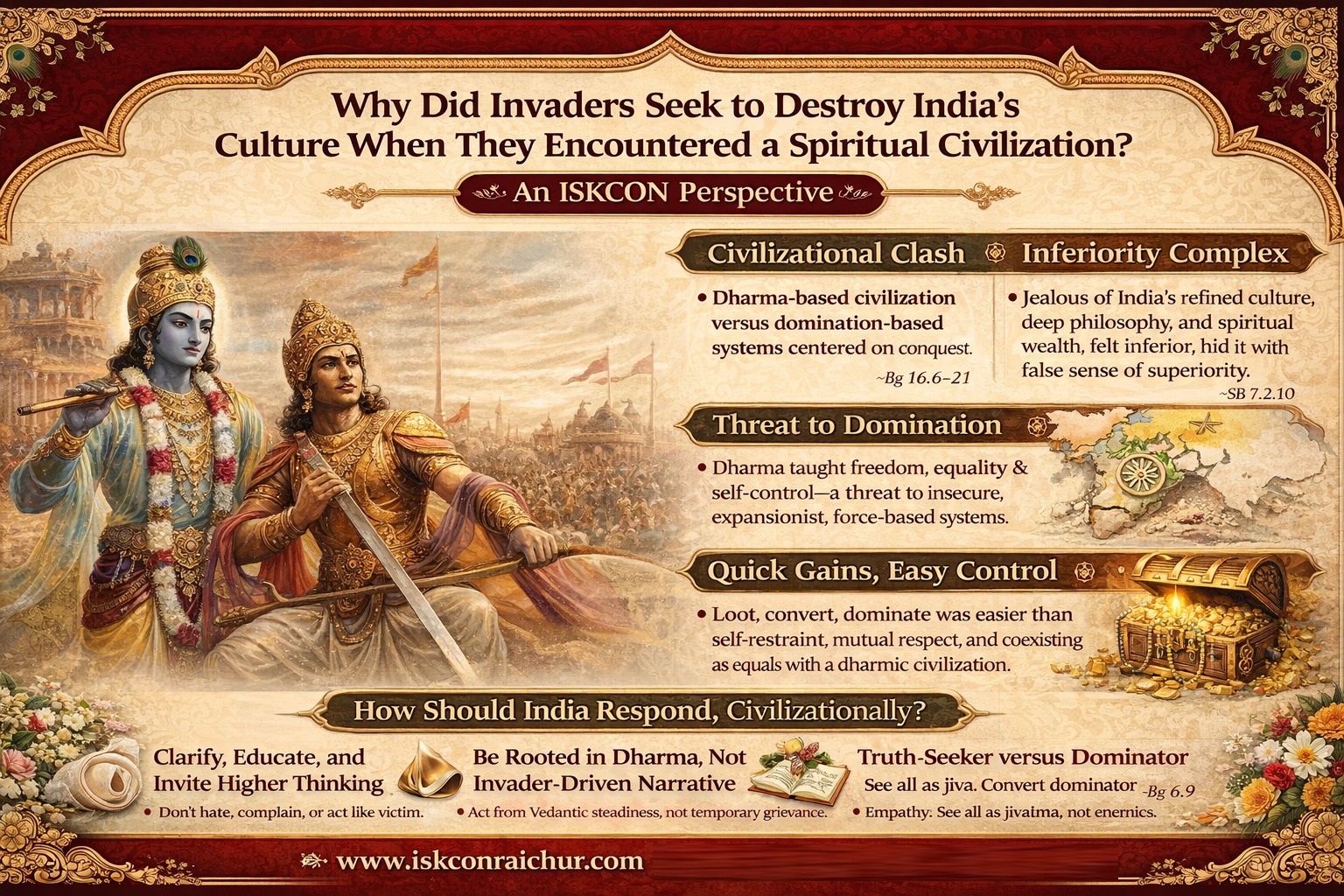
One of the most painful and persistent questions in Indian civilizational discourse is this: when invaders encountered India—a prosperous, spiritually sophisticated, pluralistic, and cultured civilization—why did many of them choose destruction instead of learning, friendship, and self‑elevation? Was there no shame in desecrating temples, suppressing knowledge systems, and brutalizing a society rooted in dharma?
This is not merely a political or historical question. It is fundamentally a question of consciousness, worldview, and civilizational psychology. To understand it deeply, we must go beyond surface narratives and examine it through the lens of Bhagavad‑gītā, Śrīmad Bhāgavatam, and dharmic philosophy.
Two Civilizational Worldviews: Dharma vs Domination
Indian civilization evolved on the principle that human life is meant for self‑realization, not mere survival or conquest:
athāto brahma‑jijñāsā — “Now, therefore, one should inquire into Brahman.” (Vedānta‑sūtra 1.1.1)
In contrast, many invading cultures operated on a conquest‑centric worldview, where:
- Power equals truth
- Fear ensures obedience
- Identity must be uniform
Śrī Krishna describes this mentality succinctly:
āsuraṁ bhāvam āśritāḥ — “Those who take shelter of demoniac mentality…” (Bhagavad‑gītā 16.6)
Such a mentality cannot coexist comfortably with a civilization that values inner freedom, diversity, and spiritual autonomy.
Why Destruction Felt Easier Than Assimilation
1. Inferiority Before Spiritual Sophistication
India’s civilization did not merely possess wealth; it possessed epistemic confidence—astronomy, medicine, metaphysics, ethics, aesthetics, and governance rooted in śāstra. For a conquest‑driven psyche, this created an uncomfortable mirror.
The Bhāgavatam explains that those dominated by rajas and tamas feel threatened by sattva:
tamaso mā jyotir gamaḥ — “Do not remain in darkness; go toward light.”
Rather than rise to the light, it is psychologically easier to extinguish it.
2. Dharma Restrains Power; Adharma Glorifies It
Indian warfare itself was regulated by ethics—rules of combat, protection of civilians, women, elders, and temples. In Mahābhārata, even enemies observed codes of honor.
For invaders accustomed to unrestrained violence, dharma was not noble—it was an obstacle.
Krishna explains:
pravṛttiṁ ca nivṛttiṁ ca janā na vidur āsurāḥ — “The demoniac do not know what should be done and what should not be done.” (Gītā 16.7)
A society that refuses to worship brute force cannot be ruled without being broken first.
3. Temples as Civilizational Pillars
Temples were not merely religious structures. They were:
- Universities
- Economic hubs
- Cultural memory banks
- Centers of social welfare
Śrīmad Bhāgavatam repeatedly describes temples as places where kīrtana, knowledge, charity, and community converge.
Destroying temples meant:
- Disrupting education
- Erasing history
- Demoralizing society
This was strategic cultural warfare, not spontaneous barbarism.
Did They Feel Ashamed?
Shame arises only when conscience is alive. Krishna explains that when lust and pride dominate consciousness:
kāma eṣa krodha eṣa rajo‑guṇa‑samudbhavaḥ — “It is lust only, born of passion, which becomes wrath.” (Gītā 3.37)
When identity is built on conquest and ideological absolutism, remorse is interpreted as weakness. Hence, there was often no shame—only justification.
What Was Gained Short‑Term
- Political control
- Material wealth
- Forced conversions or compliance
- Temporary dominance
These align with what the Gītā describes as preyaḥ—immediate but inferior pleasure.
What Was Lost Long‑Term
1. Spiritual Advancement
By rejecting dharma, invaders lost access to the very knowledge that could have elevated them beyond violence.
nāyaṁ deho deha‑bhājāṁ nṛloke… tapo divyaṁ putrakā yena sattvaṁ śuddhyet (Bhāgavatam 5.5.1)
Human life is meant for purification—not domination.
2. Moral Legitimacy
Civilizations remembered only for destruction never command reverence, only fear.
3. Historical Reputation
Time is the ultimate judge. Cultures that destroy knowledge are remembered as regressors, not builders.
How Indian Civilization Survived Despite Everything
Śrīmad Bhāgavatam describes bhakti as ahaitukī and apratihatā—unmotivated and unstoppable.
Indian civilization survived because:
- Dharma lived in households, not just institutions
- Bhakti movements decentralized spirituality
- Oral traditions preserved knowledge
- Saints revived society repeatedly
You can burn buildings; you cannot burn lived wisdom.
A Mature Dharmic Blueprint for Modern India
1. No Hatred
Hatred binds us to the same consciousness we criticize.
adveṣṭā sarva‑bhūtānāṁ — “A devotee is non‑envious toward all.” (Gītā 12.13)
2. No Victimhood
Victimhood weakens civilizational confidence. Dharma is not fragile.
3. No Apology for Being Dharmic
India need not apologize for its civilizational identity. Offering dharma to the world is not arrogance—it is responsibility.
4. Rebuild Through Excellence
- Education rooted in śāstra and science
- Temples as cultural centers again
- Youth trained in philosophy, not slogans
- Bhakti as character formation
Krishna’s instruction is clear:
uddhared ātmanātmānaṁ — “Elevate yourself by your own effort.” (Gītā 6.5)
Conclusion: The Real Victory
The real answer to past destruction is not revenge, but renaissance.
When India stands firmly in dharma—confident, compassionate, and competent—it offers the world what conquest never can: a path from power to purpose.
Frequently Asked Questions (FAQs)
1. Is this analysis promoting hatred against any group?
No. This article critiques mindsets and historical patterns, not modern individuals or communities.
2. Does Bhagavad‑gītā justify violence?
Only as a last resort to protect dharma, without hatred or greed (Gītā 2.31–33).
3. Why focus on invasions now?
Because unresolved civilizational amnesia weakens cultural confidence.
4. Was India always peaceful?
India understood warfare but subordinated it to ethics and restraint.
5. How should youth engage with this topic?
With clarity, study, self‑confidence, and commitment to character—not anger.
6. What is the biggest lesson from history?
That civilizations survive not by destroying others, but by living their highest values consistently.