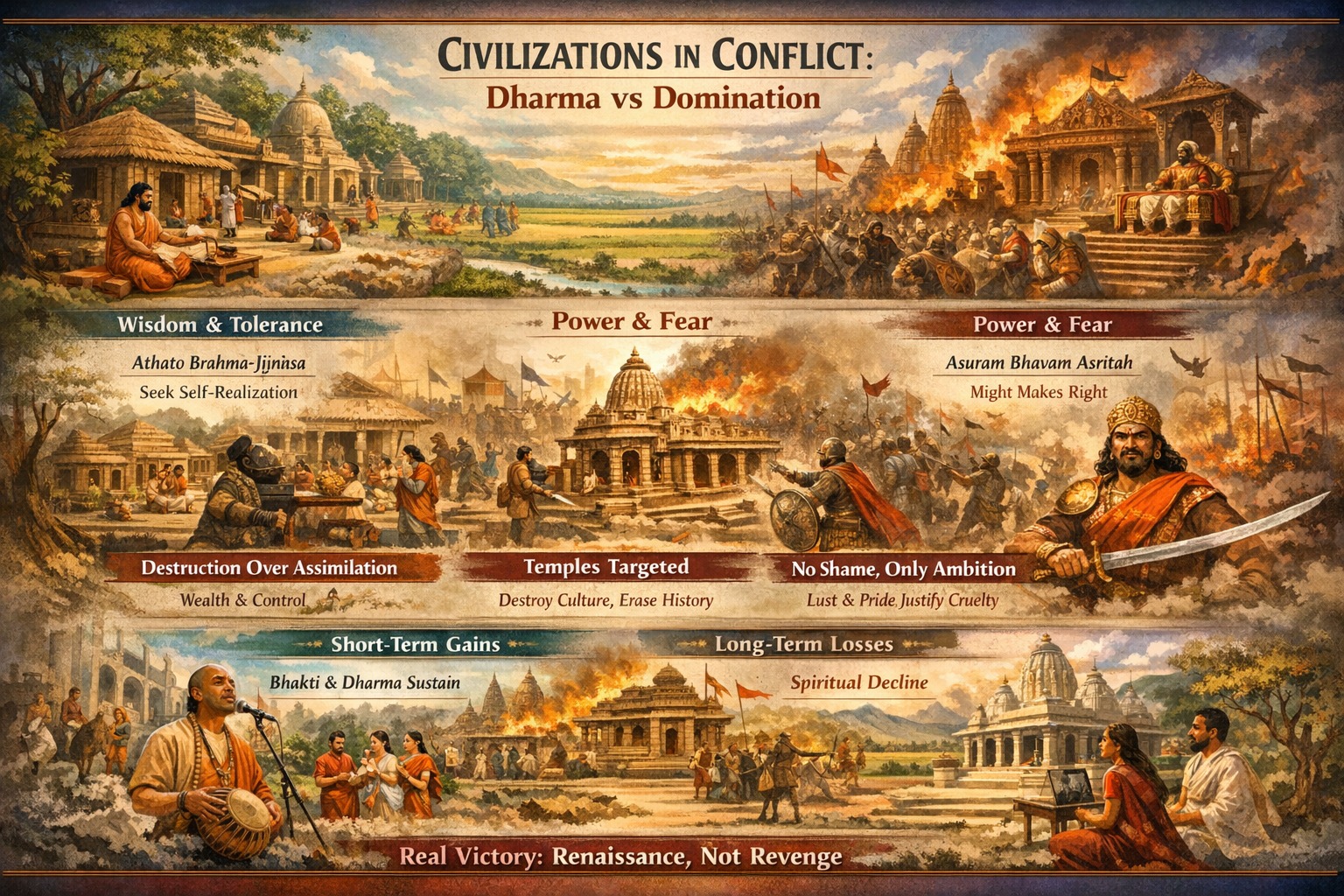
Recent acts of extreme violence, including barbaric actions witnessed in Bangladesh, have shaken the conscience of society. Many sincere seekers ask:
- Krishna asked Arjuna to fight adharma. Why can we not do the same today?
- Did ISKCON have an Arjuna in Bangladesh?
- Who is Arjuna in modern India?
How should devotees and spiritually inclined people respond to such brutality?
Who Was Arjuna — And Why Krishna Instructed Him to Fight
Arjuna was not a generic devotee. He was:
- A qualified kṣatriya
- Acting within rāja-dharma (state duty)
- Directly responsible for protecting society
- Reluctant to fight, not eager for violence
Krishna’s instruction was role-specific, not universal:
svadharmam api cāvekṣya na vikampitum arhasi (BG 2.31)
There is no scriptural support for monks, temples, or spiritual movements taking up arms.
Even on the Side of Dharma, People Were Killed
Mahābhārata was not a celebration of violence.
On the side of the Pāṇḍavas themselves, great souls were lost:
- Abhimanyu and 5 sons of Draupadi
- Ghaṭotkaca
- Drupada
- Virāṭa and Uttara
- Śikhaṇḍī
- Thousands of unnamed soldiers
Key lesson:
Even a dharmic war causes immense suffering. This is precisely why Krishna never presents Kurukṣetra as a template for Kali-yuga.
Why ISKCON Does Not Have — and Should Not Have — an “Arjuna”
ISKCON is a brahminical movement, not a kṣatriya institution.
Its mandate is defined by Kali-yuga śāstra:
kalau tad dhari-kīrtanāt (SB 12.3.52)
Śrīla Prabhupāda repeatedly emphasized:
- Chanting is the weapon
- Character is the protection
- Consciousness is the battlefield
When spiritual institutions imitate political or militant roles, adharma multiplies instead of reducing.
Then Who Is Arjuna Today?
1. The State as Arjuna
Protection of citizens is state responsibility, not temple responsibility:
rājā dharmeṇa prajāḥ pāti (SB 1.9.27)
If violence occurs and citizens are unprotected, it represents failure of governance, not failure of bhakti movements.
2. Law, Constitution, and Institutions
In modern society, the kṣatriya function operates through:
- Armed forces
- Police
- Courts
- Constitutional mechanisms
Krishna’s instruction today flows through systems, not spontaneous vigilantism.
3. Devotees as Moral Arjuna
For devotees, Arjuna means:
- Speaking truth without hatred
- Educating society about dharma
- Resisting adharma without becoming adharmic
- Preserving values under pressure
This role requires greater courage, not less.
How Should We Respond to Extreme Barbaric Actions (e.g., Bangladesh)?
A dharmic response must operate on multiple levels:
1. Condemn Clearly, Not Selectively
Violence and barbarism must be named honestly, without dilution or appeasement.
2. Demand Lawful and Firm Action
Justice must be delivered through legal, diplomatic, and state mechanisms — not mobs.
3. Support Victims Practically
Relief, rehabilitation, documentation, and international awareness are essential duties.
4. Do Not Let Hatred Replace Dharma
Krishna condemns anger-driven action:
akrodhaḥ (BG 16.2)
Barbarism must be resisted, not mirrored.
Kali-yuga’s Real Battlefield: Consciousness
Śāstra is unambiguous about Kali-yuga:
kṛte yad dhyāyato viṣṇuṁ… kalau tad dhari-kīrtanāt (SB 12.3.52)
The correction of Kali-yuga does not come from more bloodshed, but from:
- Strong sādhana
- Clear philosophy
- Cultural confidence
- Fearless truthfulness
A Message for Students and Devotees Struggling Today
When chaos rises externally, sādhana often feels harder internally.
Remember:
Struggle in sādhana is not failure; it is evidence of sincerity.
Even one honest round, one sincere prayer, one refusal to give up — that itself is victory in Kali-yuga.
Final Conclusion
Krishna empowered Arjuna because Arjuna was qualified, authorised, and restrained by dharma.
In Kali-yuga:
- The State must act like Arjuna
- Devotees must act like conscience-keepers
- ISKCON must remain firmly brahminical
Dharma is not protected by rage, but by strength guided by restraint.
That restraint is not weakness.
It is the highest intelligence.