Śiva, Mahāśivarātri
Among all personalities described in Vedic literature, Lord Śiva stands in a category that defies simplistic classification. He is at once deeply renounced and yet a householder, the presiding deity of destruction yet the embodiment of compassion, feared by the materialistic yet adored by the spiritually inclined. To meaningfully approach Śivarātri, one must first understand Śiva-tattva—the precise ontological position of Lord Śiva.
Śiva Tattva: Who is Lord Śiva?
The question “Who is Śiva?” cannot be answered merely through mythology or sentiment. It requires śāstric grounding.
In the Śrīmad Bhāgavatam (12.13.16), a definitive statement is given:
vaiṣṇavānāṁ yathā śambhuḥ
“Among all Vaiṣṇavas, Śambhu (Śiva) is the greatest.”
This single line establishes two critical points. First, Śiva is not independent of the Supreme Lord. Second, his greatness lies not in supremacy over Viṣṇu, but in his unparalleled devotion to Him.
Yet, Śiva is not an ordinary living entity (jīva). Nor is he identical with the Supreme Lord in all respects. The ontological nuance is beautifully explained in the Brahma-saṁhitā (5.45):
kṣīraṁ yathā dadhi vikāra-viśeṣa-yogāt
sañjāyate na hi tataḥ pṛthag asti hetoḥ“Just as milk is transformed into yogurt by a particular process, yet yogurt is neither the same as milk nor entirely different, similarly Śambhu (Śiva) is a transformation of the Supreme.”
This analogy is foundational in Gauḍīya Vaiṣṇava theology. Milk and yogurt are chemically related, yet functionally distinct. In the same way, Lord Śiva represents a transformation of the Supreme Lord when He comes into contact with material nature for the purpose of cosmic management.
Thus, three ontological categories emerge:
- Viṣṇu-tattva: The Supreme, fully transcendental reality
- Jīva-tattva: The innumerable atomic conscious beings
- Śiva-tattva: A unique intermediary principle
Śiva presides over the mode of ignorance (tamo-guṇa), yet he himself is never touched by ignorance in his pure form as Sadāśiva. His association with destruction is not malevolent—it is functional. Just as destruction is necessary for renewal, Śiva’s role is integral to cosmic balance.
The Bhāgavatam further illuminates his identity in another profound verse (4.24.30), where Śiva himself declares devotion to the Supreme Lord:
“I am always engaged in meditation upon the Supreme Personality of Godhead.”
This is crucial. Śiva is not merely a cosmic administrator—he is the ideal devotee.
The Devotional Greatness of Śiva
Within the tradition of Śrī Caitanya Mahāprabhu, Lord Śiva is deeply revered precisely because of his devotion. He constantly glorifies:
- Kṛṣṇa
- Viṣṇu
He chants their names, meditates upon their form, and guides conditioned souls toward them.
His famous act of drinking poison during the cosmic churning (samudra-manthana) is not merely a mythological episode. It reveals his defining characteristic: self-sacrifice for the welfare of others. He absorbs the universe’s toxicity without hesitation—hence the name Nīlakaṇṭha.
Śiva lives in cremation grounds, smeared with ashes, surrounded by ghosts. To the materialist, this appears terrifying or uncivilized. To the spiritualist, it is a powerful teaching: everything material ends in ashes. Detachment is not theoretical—it is existential.
Transition to Śivarātri: Why This Night Matters
Once Śiva-tattva is properly understood, Śivarātri naturally takes on deeper meaning.
Śivarātri, especially Mahāśivarātri, is not merely a ritual observance dedicated to a powerful deity. It is a sacred opportunity to connect with the consciousness Śiva embodies—detachment, absorption, and devotion.
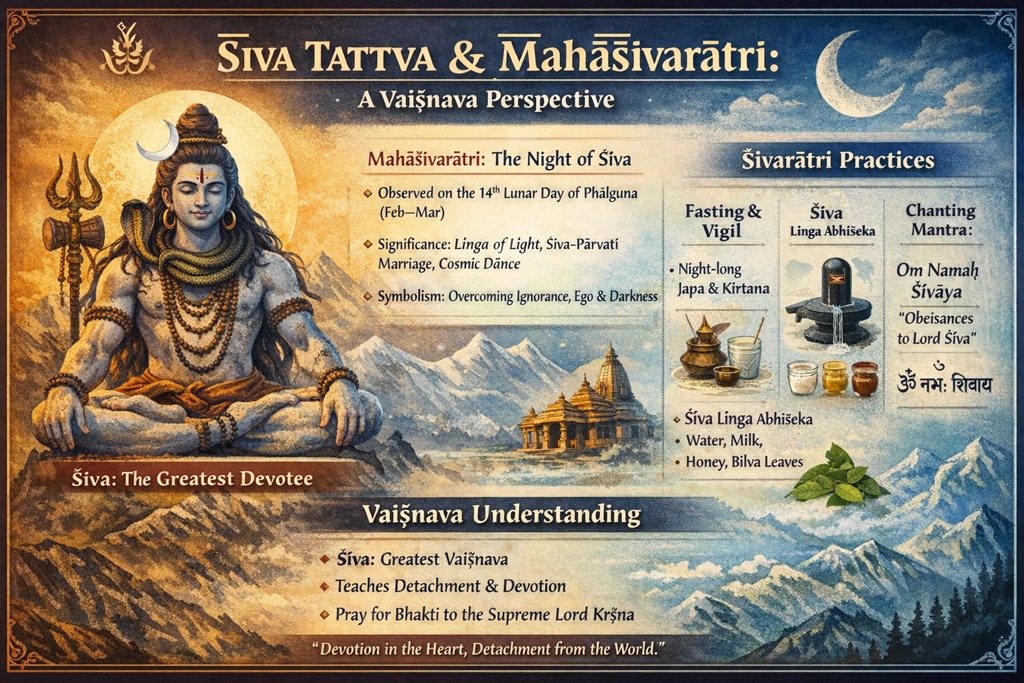
The term Śivarātri literally means “the Night of Śiva.” It is observed on the fourteenth day of the dark fortnight (Kṛṣṇa Pakṣa Caturdaśī) in the month of Phālguna (February–March), the darkest phase of the lunar cycle. Symbolically, this night represents the conditioned state of the soul—covered in ignorance, struggling in darkness.
Remaining awake on this night is not just physical discipline; it is philosophical. It signifies awakening from spiritual ignorance.
The Inner Meaning of Mahāśivarātri
Various Purāṇas describe events associated with this night—the appearance of the infinite liṅga of light, the divine marriage of Śiva and Pārvatī, and Śiva’s cosmic dance. While these narratives are significant, their inner meaning is more transformative.
Śivarātri represents:
- The dissolution of ego
- The confrontation with inner darkness
- The awakening of higher consciousness
Śiva, as the lord of dissolution, destroys not only the universe at the end of time but also the false ego within the heart of the sincere practitioner.
Worship and Practice on Śivarātri
Traditional observance includes fasting, night vigil, and abhiṣeka (ritual bathing) of the Śiva-liṅga. Offerings such as water, milk, yogurt, honey, and bilva leaves are made while chanting:
Om Namaḥ Śivāya
This mantra, known as the pañcākṣarī-mantra, is both a salutation and a meditation. It acknowledges Śiva as the auspicious guide who leads one beyond material entanglement.
However, from a Vaiṣṇava perspective, the external ritual finds its perfection in internal mood. The purpose is not merely to receive material blessings, but to purify the heart.
Vaiṣṇava Understanding of Śivarātri
In Vaiṣṇava traditions, Śivarātri is observed with respect and philosophical clarity.
Śiva is honored as:
- The greatest Vaiṣṇava
- The embodiment of renunciation
- The guardian of devotional integrity
But he is not worshiped as the ultimate source of everything—that position belongs to the Supreme Lord.
This balanced understanding avoids two extremes:
- Minimizing Śiva as a mere demigod
- Equating him entirely with the Supreme
Instead, one approaches him as guru-tattva in a unique form—a guide who directs souls toward devotion.
A sincere Vaiṣṇava prayer on this day is not for material gain, but for spiritual advancement:
“O Lord Śiva, please bless me with unwavering devotion to the Supreme Lord.”
Conclusion: The Real Observance
Śivarātri is ultimately about transformation.
It is a night meant not just for ritual, but for introspection. Not merely for offerings, but for surrender. Not simply for worshiping Śiva, but for understanding what he represents.
Śiva stands as a reminder that the highest spiritual position is not dominance, but devotion.
To truly observe Śivarātri is to imbibe his qualities:
- Fearlessness in truth
- Detachment from illusion
- Compassion for all beings
- Constant remembrance of the Supreme
In this way, Śivarātri becomes not just a festival on the calendar, but a milestone in one’s spiritual journey.
FAQ
1. Who is Lord Śiva according to śāstra?
Lord Śiva occupies a unique ontological category called Śiva-tattva. He is neither an ordinary jīva nor fully identical with the Supreme Lord. The Śrīmad Bhāgavatam (12.13.16) establishes him as the greatest devotee:
“vaiṣṇavānāṁ yathā śambhuḥ.”
The Brahma-saṁhitā (5.45) explains him as a transformation of the Supreme—like milk becoming yogurt.
2. Is Śiva the same as Viṣṇu or Kṛṣṇa?
No, but the relationship is intimate.
Śiva is a transformation of Viṣṇu for interaction with material nature. He is not a jīva, yet not the original source like Kṛṣṇa. This is why Gauḍīya theology places him in a distinct category.
3. Why is Śiva called the greatest Vaiṣṇava?
Because he constantly meditates on and glorifies the Supreme Lord. His life exemplifies pure devotion, renunciation, and humility. Even powerful beings approach him for spiritual elevation.
4. What is Mahāśivarātri?
Mahāśivarātri is the most sacred night dedicated to Lord Śiva, observed on the Kṛṣṇa Pakṣa Caturdaśī of Phālguna (Feb–Mar). It symbolizes transcendence over darkness and ignorance.
5. What is the deeper meaning of Śivarātri?
Beyond rituals, Śivarātri represents:
- Dissolution of ego
- Awakening of spiritual consciousness
- Inner transformation through vigilance (staying awake)
Śiva, as the lord of dissolution, helps destroy ignorance within the heart.
6. Why do devotees fast on Śivarātri?
Fasting (upavāsa) minimizes bodily distractions and increases sattva (clarity). It supports deeper meditation, mantra chanting, and introspection.
7. What is the significance of staying awake (jāgaraṇa)?
Remaining awake symbolizes spiritual alertness. Just as the night represents ignorance, wakefulness represents awareness and transcendence.
8. What is the meaning of “Om Namaḥ Śivāya”?
It is the primary Śiva mantra, meaning:
“I offer my obeisances to Lord Śiva.”
It invokes auspiciousness, purification, and inner stability.
9. Why is the Śiva-liṅga worshipped?
The liṅga represents:
- The formless, all-pervading aspect of divinity
- The infinite nature of reality
- The source of creation beyond material limitation
It is not merely a symbol, but a profound theological representation.
10. What offerings are made on Śivarātri?
Common offerings include:
- Water
- Milk
- Yogurt
- Honey
- Bilva leaves
These symbolize purification of consciousness and devotion.
11. What are the benefits of observing Śivarātri?
According to Purāṇas:
- Removal of sins
- Peace of mind
- Freedom from fear
- Spiritual purification
However, the highest benefit is growth in devotion.
12. How do Vaiṣṇavas observe Śivarātri?
Vaiṣṇavas honor Śiva as the greatest devotee. They may:
- Fast and chant
- Offer respects to Śiva
- Pray for bhakti to the Supreme Lord
The mood is respect, not competition or confusion.
13. Is it correct for Vaiṣṇavas to worship Śiva?
Yes—with proper understanding. Śiva is revered as a great devotee and spiritual authority, but not as the ultimate source. Worship is offered with the prayer for devotion to the Supreme.
14. What can we learn from Lord Śiva’s life?
Śiva teaches:
- Detachment from materialism
- Compassion (e.g., drinking poison for others)
- Simplicity and humility
- Constant remembrance of God
15. What is the best prayer on Śivarātri?
A Vaiṣṇava-oriented prayer would be:
“O Lord Śiva, greatest Vaiṣṇava, please bless me with pure devotion to Kṛṣṇa.”
16. Is Śivarātri only for Śiva devotees?
No. It is a universal spiritual observance. Anyone seeking purification, discipline, and deeper consciousness can benefit from observing it.