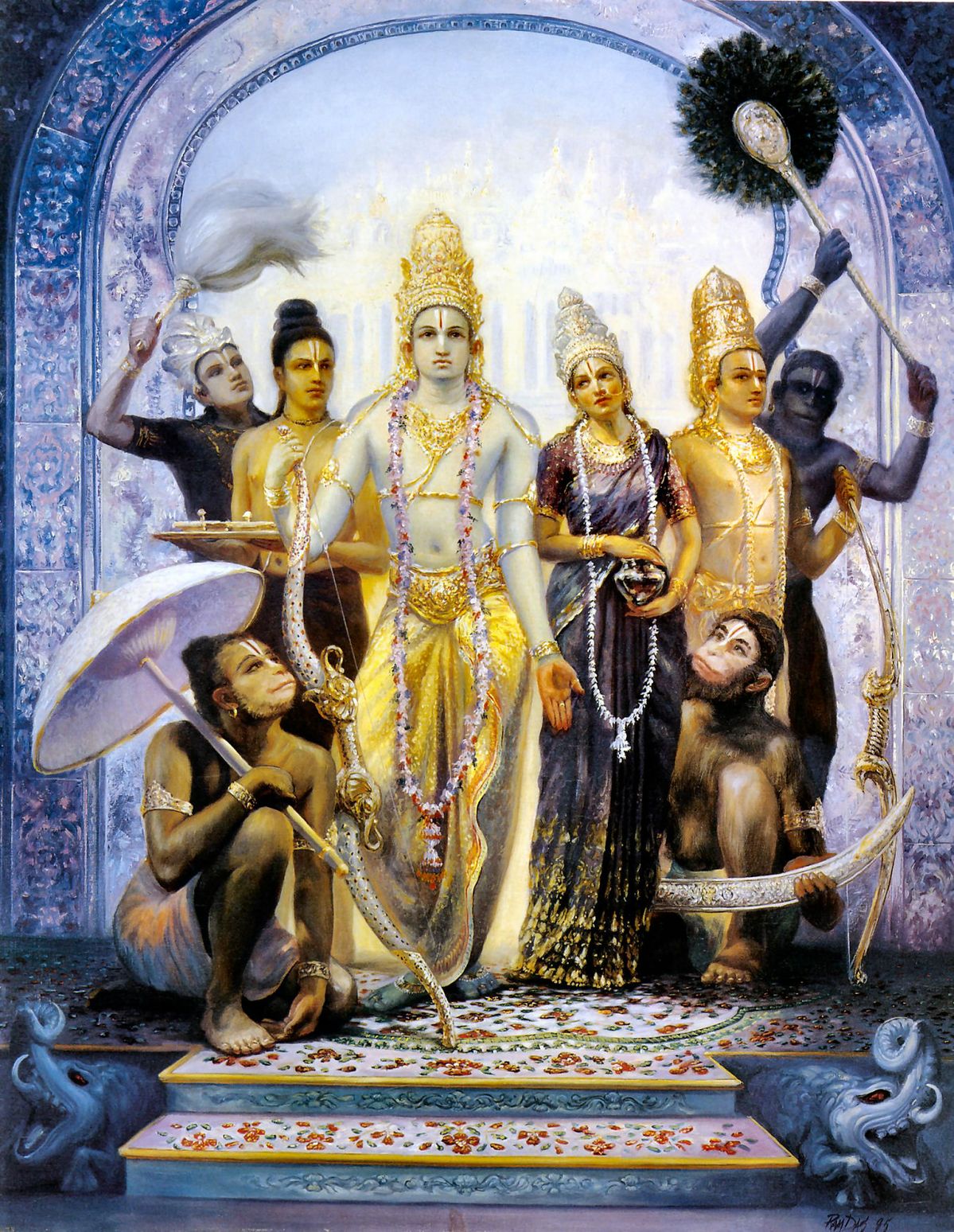
The personality of Rama occupies a central place in the theological, cultural, and ethical tradition of Hindu civilization. Revered as the seventh avatāra of Vishnu, Sri Rama represents the embodiment of dharma, righteous kingship, and ideal human conduct. The life and activities of Lord Rama are primarily narrated in the ancient Sanskrit epic Ramayana composed by the sage Valmiki, and elaborated further in various Puranic and devotional traditions. Within the Vaishnava theological framework, Rama is worshipped not merely as a heroic historical figure but as the Supreme Personality of Godhead who appeared on earth to establish dharma and demonstrate the principles of divine leadership and moral order.
Biodata
According to the Ramayana and the Puranas, Lord Rama appeared in the illustrious Ikshvaku dynasty, also known as the Solar dynasty (Suryavamsa). His divine birth took place in the sacred city of Ayodhya, the capital of the Kosala kingdom. His father was the noble king Dasharatha and His mother was Kausalya. The appearance of Lord Rama occurred on the ninth lunar day (Navami) of the bright fortnight (Shukla Paksha) in the month of Chaitra according to the traditional lunar calendar. This sacred occasion is commemorated annually as Rama Navami. Sri Rama was the eldest among four brothers—Rama, Lakshmana, Bharata, and Shatrughna—all of whom exemplified loyalty, devotion, and adherence to dharma. From His childhood, Rama exhibited remarkable virtues such as humility, truthfulness, compassion, valor, and unwavering commitment to righteousness, qualities that would later establish Him as the ideal ruler and moral exemplar.
Early Activities and Education
The early life of Lord Rama includes rigorous training in martial arts, Vedic knowledge, and royal responsibilities under the guidance of great sages. One of the most important mentors in His youth was the sage Vishvamitra, who took Rama and Lakshmana to protect sacrificial rituals from demonic disturbances. During this period, Rama defeated powerful demons such as Tataka and restored peace to the hermitages of the sages. These episodes highlight Rama’s role as the protector of dharma and the guardian of spiritual culture. While accompanying Vishvamitra, Rama also attended the swayamvara of Princess Sita, the daughter of Janaka. In this assembly of kings, Rama successfully lifted and broke the divine bow of Lord Shiva, thereby winning Sita’s hand in marriage. Their marriage symbolizes the harmonious union of divine virtue and devotional purity.
The Exile and the Demonstration of Dharma
A pivotal episode in the Ramayana occurs when Rama willingly accepts fourteen years of exile from Ayodhya in order to honor the promise given by King Dasharatha to Queen Kaikeyi. Despite being the rightful heir to the throne, Rama renounced the kingdom without hesitation, accompanied by Sita and His devoted brother Lakshmana. This event stands as one of the greatest demonstrations of filial obedience, self-sacrifice, and adherence to dharma in world literature. During their exile, Rama lived in forest hermitages, interacting with sages and protecting them from demonic forces, thereby reinforcing the role of divine leadership in safeguarding spiritual culture.
The War with Ravana and Restoration of Dharma
The exile narrative reaches its climax with the abduction of Sita by the powerful demon king Ravana, the ruler of Lanka. In response, Rama formed an alliance with the vanara king Sugriva and the incomparable devotee Hanuman. The heroic journey of Hanuman to Lanka and the eventual battle between Rama’s army and Ravana’s forces constitute one of the most celebrated narratives of triumph of righteousness over tyranny. Rama ultimately defeated Ravana and restored Sita, symbolizing the victory of dharma over adharma and divine justice over arrogance and oppression.
Rama Rajya: The Ideal Model of Governance
After completing His exile and returning to Ayodhya, Rama was crowned king, inaugurating the celebrated era known as Rama Rajya. The Ramayana describes this period as one of unparalleled prosperity, justice, and harmony where citizens lived free from suffering, crime, and exploitation. Rama Rajya has since become a philosophical and political ideal representing righteous governance grounded in compassion, integrity, and responsibility toward all citizens.
The Tattva of Sri Rama in Vaishnava Theology
In the theological framework of Vaishnavism, Lord Rama is not merely a historical king but a divine manifestation of the Supreme Reality. The Srimad Bhagavatam describes the various incarnations of the Supreme Lord who descend to protect devotees and annihilate miscreants. Within this framework, Rama represents the perfect exemplar of maryada, or divine etiquette and moral order. Whereas other incarnations may display more spontaneous divine pastimes, Rama’s life emphasizes adherence to duty and righteous conduct. This aspect of Rama is often referred to as Maryada Purushottama, meaning the supreme exemplar of ethical perfection.
Date and Astronomical Timing of Rama Navami
The festival of Rama Navami commemorates the appearance day of Lord Rama. According to the traditional Hindu lunar calendar, Rama appeared on the ninth day (Navami) of the bright fortnight in the month of Chaitra. This usually falls in March or April in the Gregorian calendar. Devotees observe this sacred day with great devotion, recognizing it as the divine descent of the Supreme Lord to establish dharma and guide humanity.
Religious Significance of Rama Navami
Rama Navami is not merely a commemorative festival but a profound spiritual observance. Devotees reflect on the life, teachings, and virtues of Lord Rama, seeking inspiration for their own spiritual and ethical development. The festival symbolizes the triumph of righteousness, the protection of devotees, and the divine assurance that whenever dharma declines, the Supreme Lord appears to restore balance.
Rituals and Observances of Rama Navami
The observance of Rama Navami includes various devotional practices across temples and households. Devotees often observe fasting throughout the day, engage in recitation of the Ramayana, and participate in congregational chanting of the holy names of Rama. Temples conduct elaborate worship ceremonies, including abhisheka (ritual bathing) of the deity, devotional singing, and discourses on the life of Lord Rama. Many devotees also perform special prayers at noon, which is traditionally believed to be the time of Rama’s appearance. The chanting of the sacred mantra “Sri Rama, Jaya Rama, Jaya Jaya Rama” and the reading of the Ramayana are central to the devotional mood of the festival.
Conclusion
The life of Sri Rama continues to inspire spiritual seekers, scholars, and leaders across generations. His biography illustrates the highest standards of moral conduct, leadership, and devotion. Through His divine activities, Rama demonstrates that righteousness, compassion, and adherence to duty form the foundation of a harmonious society. The annual celebration of Rama Navami invites devotees to remember the timeless teachings of Lord Rama and to cultivate the virtues that He so perfectly embodied. In doing so, individuals and societies alike can aspire to recreate the ideals of Rama Rajya, where justice, spiritual wisdom, and devotion to the Supreme guide every aspect of life. Hare Rama.
1. From the Upanishads
Kali-Santarana Upanishad
हरे राम हरे राम, राम राम हरे हरे ।
हरे कृष्ण हरे कृष्ण, कृष्ण कृष्ण हरे हरे ॥
This maha-mantra destroys the contamination of Kali-yuga and delivers the living being from material bondage.
Rama Tapaniya Upanishad
रामो विग्रहवान् धर्मः
“Rama is dharma personified.”
This statement is widely quoted in Vaishnava literature to explain that Sri Rama embodies perfect righteousness.
2. From the Puranas
Padma Purana
राम रामेति रामेति, रमे रामे मनोरमे ।
सहस्रनाम तत् तुल्यं, रामनाम वरानने ॥
“O beautiful one, chanting the name ‘Rama’ once is equal to chanting the thousand names of Vishnu.”
Srimad Bhagavatam 9.10.51
रामो राजमणिः सदा विजयते
रामं रमेशं भजे ।
रामेणाभिहता निशाचरचमू
रामाय तस्मै नमः ॥
“Lord Rama, the jewel among kings, always triumphs. I worship that Lord Rama who destroyed the armies of demons.”
3. From the Epic Ramayana
Valmiki Ramayana
रामो विग्रहवान् धर्मः, साधुः सत्यपराक्रमः ।
राजा सर्वस्य लोकस्य, देवानामिव वासवः ॥
“Rama is righteousness personified. He is virtuous, truthful and powerful, and the king of all people just as Indra is king of the gods.”
Valmiki Ramayana – Rama’s Character
सत्यं दानं तपस्त्यागो
मित्रता शौचमार्जवम् ।
This describes the qualities of Rama such as truthfulness, charity, austerity, simplicity and friendship.
4. From Bhagavad Gita 4.8 (quoted by Prabhupada in relation to Rama)
परित्राणाय साधूनां
विनाशाय च दुष्कृताम् ।
धर्मसंस्थापनार्थाय
संभवामि युगे युगे ॥
“To protect the devotees, annihilate the miscreants and re-establish dharma, I appear millennium after millennium.”
Vaishnava acharyas explain that Sri Rama appeared to fulfill this purpose.
5. Verse Glorifying Rama-nāma
श्रीराम राम रामेति
रमे रामे मनोरमे ।
सहस्रनाम तत् तुल्यं
रामनाम वरानने ॥
6. Teachings emphasized by Srila Prabhupada
- Lord Rama as Maryada Purushottama (the perfect ideal king).
- Chanting Hare Rama as the recommended process for Kali-yuga.
- The life of Rama as a perfect example of dharma, leadership and devotion.
🚩 Seva Opportunities
Contribute towards:
✨ Temple Construction
✨ Maha Abhishek, Annadanam, Flowers & Decorations, Goshala Seva
💰 Donation Details:
Account Name: ISKCON
Bank: Canara Bank
A/c No.: 0519101043190
IFSC: CNRB0000519
🌐 Online Donations: give.iskconraichur.com