A Śāstric, Theological, and Devotional Analysis
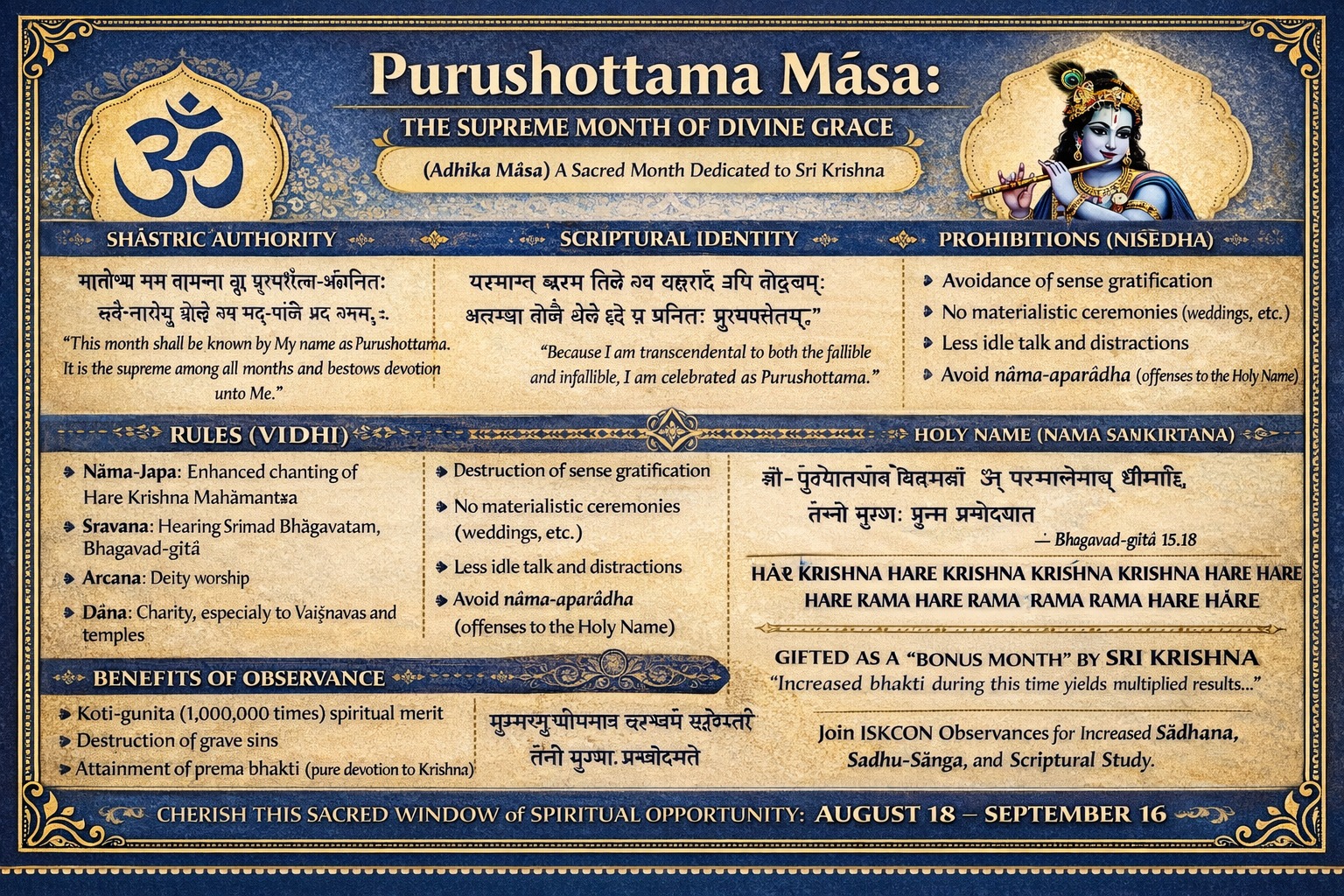
Within the sophisticated calendrical system of Vedic timekeeping, there appears periodically an extraordinary spiritual opportunity known as *Purushottama Māsa, also called **Adhika Māsa. Unlike ordinary months, this sacred period is directly dedicated to the Supreme Personality of Godhead, Śrī Krishna, who is glorified as *Purushottama—the Supreme Person beyond both kṣara (perishable) and akṣara (imperishable).
1. Cosmological Basis of Adhika Māsa
The Vedic calendar harmonizes lunar (cāndra) and solar (saurya) cycles. Due to their discrepancy, an additional month is inserted approximately every 32.5 months to maintain alignment. This intercalary month is termed Adhika Māsa.
According to Suryasiddhanta text,
1 Lunar year = 29.5305 X 12 = 354.366 days
1 Solar year = 365.2587 days.
Thus one lunar year lags behind the solar year and one lunation has to be added after 3 years to fit the lunar year into the solar one. Astronomers have called this intercalary lunation as adhika month, and have asserted that this month is to be added to the lunar year.
Adhika (Purushottam) Maase Since the calendar is based on the phases of the Moon, the transits take 354 days, 8 hours and 34.28 seconds. This creates a difference of 10 days, 21 hours and 35.16 seconds from the actual solar year (365 days, 6 hours, 9.54 seconds) When the accumulated difference exceeds 29 days, 12 hours, 44 minutes and 2.865 seconds, an adjustment is made with an extra month (Adhika Maas), which carries the name of the previous or the next month, depending on the proximity of the month.
However, beyond astronomical necessity, śāstra reveals a profound spiritual narrative.
2. The Śāstric Identity of Purushottama Māsa
2.1 Narrative from Purāṇas
According to the Padma Purāṇa, Adhika Māsa was initially neglected, considered inauspicious because it did not align with solar saṅkrānti transitions. Distressed, this month approached Lord Vishnu for shelter.
The Lord declared:
“māso ’yaṁ mama nāmnā tu puruṣottama-saṁjñitaḥ sarva-māseṣu śreṣṭho ’yaṁ mad-bhakti-prada uttamaḥ”
“This month shall be known by My name as Purushottama. It is the श्रेष्ठ (supreme) among all months and bestows devotion unto Me.”
Thus, what was once rejected became the most exalted by divine sanction.
2.2 Krishna as Purushottama
The ontological foundation is given in the Bhagavad-gītā (15.18):
“yasmāt kṣaram atīto ’ham akṣarād api cottamaḥ ato ’smi loke vede ca prathitaḥ puruṣottamaḥ”
“Because I am transcendental to both the fallible and infallible, I am celebrated as Purushottama.”
Lord Sri Krsna: “Purusottama month has all the power I have to bless its observer. One who follows Purusottama vrata will destroy all his past sinful reactions. Without performing Purusottama vrata, one cannot perform pure devotional service. The value of Purusottama month is far more valuable than all other types of austerities and religious activities mentioned in the Vedas. Anyone who observes Purusottama vrata will return to my abode, Goloka, at the end of his life”.
Valmiki Muni: “By observing Purusottama vrata, one attains more benefit than performing one hundred horse sacrifices. All holy places live within the body of a Purusottama month vrati. Anyone who faithfully performs Purusottama vrata will go to Goloka Vrndavana”.
Thus, this month is not merely sacred—it is non-different from the Lord’s mercy.
3. Theological Significance in Gauḍīya Vaiṣṇavism
Purushottama Māsa represents:
- Kṛṣṇa-anugraha-kāla (a special time of divine mercy)
- A period where bhakti yields multiplied results
- A gateway to accelerate progress from sādhana-bhakti to bhāva
Śrīla Prabhupāda emphasized increased chanting, hearing, and devotional service during this month.
4. Prescribed Observances (Vidhis)
4.1 Primary Practices
The Skanda Purāṇa recommends:
“snānaṁ dānaṁ japaḥ homaḥ svādhyāyo devatārcanam adhike māsi kartavyaṁ sarva-pāpa-praṇāśanam”
“Bathing, charity, japa, sacrifice, study of scriptures, and worship of the Lord should be performed in this month, destroying all sins.”
Core Disciplines:
- Nāma-japa (increased chanting of Hare Krishna Mahāmantra)
- Śravaṇa (hearing Śrīmad Bhāgavatam, Bhagavad-gītā)
- Arcana (Deity worship)
- Dāna (charity, especially to Vaiṣṇavas and temples)
* Upavāsa (regulated fasting)
4.2 Saṅkalpa mantra
śrī-śrī-rādhā-kṛṣṇayoḥ prīty-arthaṁ śrī-puruṣottama-māse mamopāta-samasta-durita-kṣaya-dvāra śrī-kṛṣṇa-anugraha-prāpty-arthaṁ vrataṁ ahaṁ kariṣye
- mamopāta-samasta-durita-kṣaya-dvāra
→ “For the destruction of all my accumulated sins and faults” - śrī-kṛṣṇa-prīty-artham
→ “For the pleasure of Lord Śrī Krishna” - puruṣottama-māsa-vratam ahaṁ kariṣye
→ “I shall observe the vow of Purushottama Māsa” - śrī-kṛṣṇa-anugraha-prāpty-artham
→ “For attaining the mercy of Lord Krishna”
🪔 How to Perform the Saṅkalpa
- Sit before the Deities, picture of Guru and Śrī Śrī Rādhā-Kṛṣṇa
- Take a small amount of water in the right palm
- Chant the saṅkalpa mantra
- Offer the water to the ground (or a clean vessel)
- Begin your vrata with prayer and japa
- Hari-bhakti- vilasa (Vol 4, Vs 437): “During Purusottama month, one should remember Lord Krsna and then donate thirty three milk cakes cooked in ghee to grhastha brahmanas, who are well versed in sastras. Failing to do so, one loses all the piety he accumulated in the previous year.”
- Acaryas say chant daily some japa of Kaundinya Muni’s mantra: govardhana dharam vande, gopalam gopa rupinam / gokulutsava ne isanam,govindam gopika priyam. I worship the lifter of Govardhana Hill, Who has the beautiful form of a cowherd boy, and who continually plays with the gopas. He is the Lord of Gokula wherein everyday is a festival. (By chanting this mantra with devotion during Sri Purusottama month, one will attain Sri Purusottama Himself.)
- dhyayen-navaghana-syamam dvibhujam muralidharam
lasat pita-patam ramyam sa-radham purosottamam
One should devote Purusottama month to constantly meditating upon nava-ghana dvibhuja muralidhara pitambara Sri Krsna with Sri Radha. (Those who do this with devotion will have all their cherished desires fulfilled.”) - Daily offer 33 dandavats to Bhagavan Sri Krsna or the vaisnavas.
- Bhakti Vinoda Thakura’s P.M. vrata: Perform the Nirapeksa Vrata, which means 30 days of concentrated, one pointed worship and service to Radha-Govinda Yugala by hearing, chanting, remembering Their divine names, forms, qualities, pastimes. All day and night, hear about Bhagavan Sri Krsna, chant the Hare Krsna Mahamantra, take mahaprasada.
- Charity: Best days — Ekadasi, Dvadasi, Purnima, Amavasya, Sravana Naksatra Day; DO offer money, gold, cloth, shoes, fruits, etc. to brahmanas and vaisnavas ; Also offer 33 plantains or mangoes plus dana and daksina —when giving dana (diff. items) to a brahmana, one must simultaneously donate daksina (money equal to the monetary value of the dana).
4.3 Breaking (completing) Vrata
🕉️ Purushottama Māsa Vrata Samāpana (udyāpana) Mantra
anena puruṣottama-māsa-vratena śrī-kṛṣṇaḥ suprīto suprasanno varado bhavatu yat-kṛtaṁ tu mayā deva vrataṁ etat sudurlabham tat sarvaṁ tvat-prasādena sampūrṇaṁ kuru mādhava
- anena … vratena
→ “By this observance of Purushottama Māsa vrata” - śrī-kṛṣṇaḥ suprīto suprasanno varado bhavatu
→ “May Lord Krishna be pleased, satisfied, and bestow His blessings” - yat-kṛtaṁ tu mayā deva…
→ “Whatever has been performed by me, O Lord” - tat sarvaṁ tvat-prasādena sampūrṇaṁ kuru mādhava
→ “Please make it complete by Your mercy, O Mādhava”
🌸 Kṣamā-Prārthanā (Prayer for Forgiveness)
aparādha-sahasrāṇi kriyante ’har-niśaṁ mayā dāso ’yam iti māṁ matvā kṣamasva madhusūdana
“Thousands of offenses I commit day and night. Considering me Your servant, please forgive me, O Madhusūdana.”
🪔 Procedure for Final Day (Udyāpana)
- Perform snāna (purificatory bath) early morning
- Worship Śrī Śrī Rādhā-Kṛṣṇa / Lord Krishna with devotion
- Chant extra rounds of the Mahāmantra
- Recite the samāpana mantra
- Offer:
- Dāna (charity) to Vaiṣṇavas or temple
- Prasāda distribution – Feed and give charity to 3, 5, 7, 9, 11 brahmanas to the best of your ability (e.g., new clothes, two pairs of shoes, Laksmi). The best charity is to give a Srimad Bhagavatam to a qualified grhastha vaisnava brahmana. This act will deliver all your ancestors to the spiritual world and award them the association of Lord Purusottama !
- Dīpa (lamp offering)
6. Pray for continued devotion beyond the month
Final Offering Mantra (Phala-Samarpana)
kāyena vācā manasendriyair vā buddhyātmanā vā prakṛteḥ svabhāvāt karomi yad yat sakalaṁ parasmai nārāyaṇāyeti samarpayāmi
“Whatever I do with body, speech, mind, or senses, I offer everything unto the Supreme Lord.”
Special Breaking actions
- If you ate fruits, ghee, rice, wheat etc, donate the same to brahmanas.
- If you slept on the floor, give a bed and pillows to a brahmana.
- If you ate on a leaf plate, feed brahmanas with ghee and sugar.
- If you didn’t cut nails or hair, donate a mirror to a brahmana.
- If you offered ghee lamps, give new lamps and pots to a brahmana.
- If you broke any rules or regulations during Purusottama vrata, feed different sweet juices to brahmanas.
- Lord Siva says that the best charity is: “Fill a bell metal pot with thirty malpuas, bind the pot with seven new threads and give to a worthy brahmana”.
5. Prohibitions (Niṣedhas)
Śāstra also outlines restrictions:
- Avoidance of sense gratification and indulgence
- No performance of materialistic ceremonies (e.g., marriages, housewarmings)
- Reduction of idle talk, gossip, and distractions
- Strict avoidance of nāma-aparādha (offenses to the holy name)
The emphasis is on internal purification and devotional focus.
6. Unique Spiritual Advantages
6.1 Exponential Merit
“adhike māsi yat kiñcit kṛtaṁ puṇyaṁ janārdane tat koṭi-guṇitaṁ proktaṁ”
“Any devotional activity performed in Adhika Māsa yields millions of times the result.”
6.2 Destruction of Sins
Even grave karmic reactions are mitigated:
- Accumulated sins are neutralized
* One becomes eligible for higher spiritual realization
6.3 Attainment of Bhakti
Unlike ordinary piety, this month grants:
- Bhakti-latā-bīja (seed of devotion)
- Advancement toward prema-bhakti
6.4 All the holy places in the world come to reside in your body.
7. Central Practice: Chanting the Holy Name
The essence of all observances culminates in nāma-saṅkīrtana:
“harer nāma harer nāma harer nāmaiva kevalam kalau nāsty eva nāsty eva nāsty eva gatir anyathā”
— Bṛhan-nāradīya Purāṇa
Mahāmantra:
Hare Krishna Hare Krishna Krishna Krishna Hare Hare Hare Rama Hare Rama Rama Rama Hare Hare
During Purushottama Māsa, devotees are encouraged to:
- Increase japa intensity
- Participate in kīrtana
- Cultivate nāma-ruci (taste for the holy name)
8. Recommended Mantras and Prayers
8.1 Purushottama Prayer
“śrī-puruṣottama govinda lakṣmī-pate jagat-pate anugrahaṁ kuru me deva adhika-māse viśeṣataḥ”
“O Purushottama Govinda, Lord of Lakshmi and the universe, kindly bestow Your special mercy upon me in this sacred month.”
8.2 Bhagavad Gītā Chapter 15 Purushottama Yoga meditation, Sri Jagannathashtaka, Sri Nanda Nandanashtaka, Yugakashtaka
9. Conclusion: The Month of Divine Opportunity
Purushottama Māsa stands as a *rare spiritual convergence, where time itself becomes sanctified by the Supreme Lord. It is not merely an adjustment in the calendar, but a *divinely ordained window for accelerated God-realization.
Those who neglect it lose a priceless opportunity; those who embrace it attain immeasurable benefit.
Therefore, with humility and determination, one should take shelter of this sacred period and fully engage in devotional service to Śrī Krishna, the Supreme Purushottama.
Chant, hear, and serve with increased sincerity:
Hare Krishna Hare Krishna Krishna Krishna Hare Hare Hare Rama Hare Rama Rama Rama Hare Hare
Join ISKCON programs during Purushottama Māsa for guided sādhana, scriptural study, and devotional association rooted in authentic paramparā.