The Sacred Doab of Divine History, Hidden Science, and Timeless Spiritual Legacy
Introduction: A Forgotten Jewel of Bharata-varsha
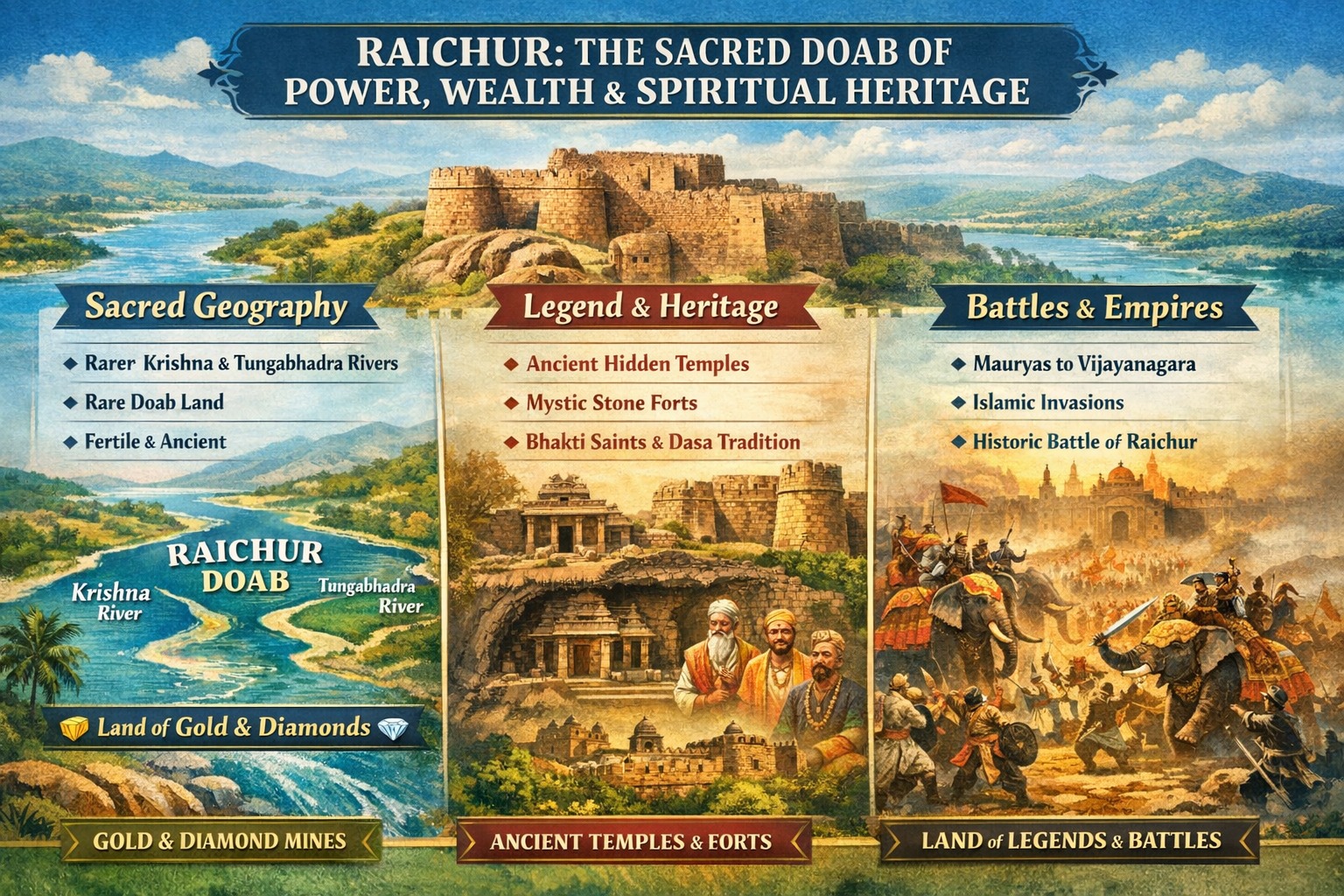
In the northern expanse of Karnataka lies *Raichur, a land often overlooked in modern discourse yet deeply embedded in the civilizational, spiritual, and geopolitical history of India. Known historically as the *Raichur Doab, this sacred region rests between two mighty rivers—Krishna River and Tungabhadra River—forming one of the most fertile and contested landscapes in the Deccan.
From Vedic antiquity to medieval warfare, from hidden temples to gold and diamond wealth, Raichur stands as a living testimony to divine providence and human ambition.
Etymology: The City of Kings and Radiance
The name “Raichur” is derived from ancient forms such as Rachavoor, Rachooru, and Rayachuru, meaning “the king’s place” (Raya = king).
Another interpretive tradition suggests:
- Raya → divine king or ruler
- Chur → peak or fortified height
Thus, Raichur signifies “the royal fortified seat”, reflecting its long-standing role as a strategic and sacred center.
The Sacred Geography: The Rare Land Between Two Rivers (Doab)
Raichur forms part of the Raichur Doab, a triangular landmass between the Krishna and Tungabhadra rivers.
Why the Doab is Unique:
- “Doab” literally means “land between two rivers”, a term of Persian origin.
- Extremely fertile due to alluvial deposits
- One of the oldest continuously inhabited regions since Neolithic times.
- Strategically vital—leading to centuries of warfare
Spiritually, such confluences (sangama-bhumi) are considered highly auspicious in Vedic tradition, symbolizing the meeting of divine energies.
Raichur in Pauranic and Ancient Times
Although not always explicitly named in extant Puranas, the Raichur region was part of the Dakshina Bharata sacred geography, connected to:
- The Mauryan Empire under Ashoka (3rd century BCE), evidenced by rock edicts at Maski
- Satavahanas, Chalukyas, Rashtrakutas—dynasties deeply linked with Vedic culture
Archaeological evidence suggests:
- Human habitation since Paleolithic and Neolithic ages
- Cultural continuity spanning over 3000 BCE, with links to ancient trade networks
Remarkably, gold from this region may have reached the Indus Valley Civilization, indicating Raichur’s role in early global exchange.
Land of Wealth: Gold, Diamonds, and Divine Prosperity
Raichur’s earth is not merely fertile—it is mineral-rich and historically opulent.
Gold Legacy
- Hatti Gold Mines
- Among the oldest gold mines in the world (~4000 years)
- Possibly supplied gold to ancient civilizations
Diamond Heritage
- The Krishna valley (within Raichur Doab) was historically associated with:
- Koh-i-Noor
- Great Mogul Diamond
- Regent Diamond
This immense wealth made Raichur:
A battlefield not merely of kings—but of destiny.
Forts and the Mystery of Ancient Engineering
The majestic Raichur Fort stands as a symbol of architectural brilliance.
Key Features:
- Built in 1294 CE by the Kakatiya dynasty
- Constructed using massive granite blocks without mortar
- Multi-layered defensive walls, bastions, and inscriptions in multiple languages
Interpretive Perspective (Speculative)
Some researchers and alternative historians suggest:
- Precision stone fitting resembles techniques seen in ancient global civilizations
- Comparisons are sometimes drawn with Mayan and Egyptian pyramid construction
Hidden Temples and Subterranean Heritage
Within Raichur’s forts and surrounding regions:
- Ruins of ancient temples and irrigation systems exist
- Archaeological layers indicate multiple older settlements beneath current structures
Traditional narratives speak of:
- Buried temples beneath forts
- Hidden chambers and treasures in places like Malliabad
These echo a broader Indian phenomenon where:
Successive civilizations build over sacred sites, preserving sanctity while concealing antiquity.
The Battlefield of Empires: A Timeline of Power
Raichur’s strategic location made it one of the most contested lands in Indian history.
Major Dynasties:
- Mauryas
- Satavahanas
- Chalukyas
- Rashtrakutas
- Kakatiyas
- Vijayanagara Empire
- Bahmani Sultanate
- Mughals & Nizams
The Legendary Battle of Raichur (1520 CE)
One of the most decisive battles in Indian history:
- Fought between Krishnadevaraya and Bijapur Sultanate
- Result: Decisive Vijayanagara victory
- Integrated into India in 1948 and Karnataka in 1956
This period saw:
- Cultural synthesis
- Persian, Arabic inscriptions in forts
- Architectural fusion
Spiritual Roots and Bhakti Tradition
Raichur and its surrounding regions have nurtured many saints and devotional traditions:
Haridasa Influence
The broader Karnataka region is the land of:
- Purandara Dasa
- Kanaka Dasa
Though not all born in Raichur city itself, the Raichur Doab region was deeply influenced by:
- Nama-sankirtana tradition
- Bhakti movement centered on Lord Krishna
This makes Raichur spiritually aligned with:
The Gaudiya Vaishnava emphasis on nama-bhakti and kirtana
Raichur: A Confluence of Karma, Wealth, and Dharma
Raichur’s history reveals a profound pattern:
| Dimension | Manifestation |
|---|---|
| Geography | Fertile Doab between sacred rivers |
| Wealth | Gold mines, diamonds |
| Power | Constant battles and empire shifts |
| Spirituality | Bhakti traditions and sacred geography |
This aligns with Vedic understanding:
Wherever Lakshmi (wealth) resides, there must be dharma to sustain balance.
Conclusion: Reclaiming Raichur’s Spiritual Identity
Today, Raichur is not merely a historical district—it is a living spiritual landscape waiting to be rediscovered.
For devotees and seekers:
- It is a land of hidden temples and sacred rivers
- A battlefield reminding us of the temporality of material power
- A fertile ground for reviving Krishna consciousness
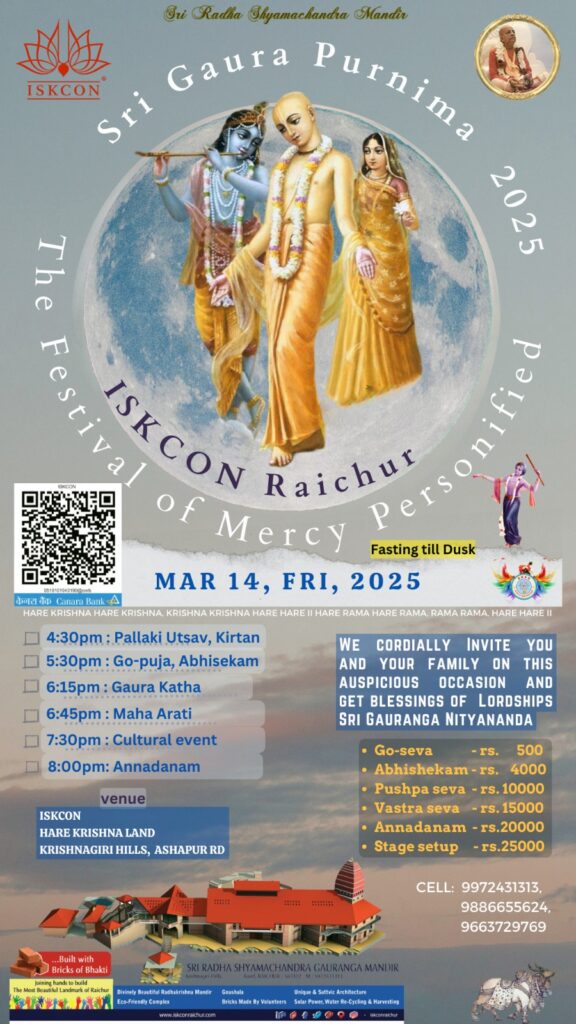
ISKCON Vision for Raichur
By reconnecting Raichur with:
- Harinama Sankirtana
- Bhagavatam culture
- Devotional education
This ancient land can once again become:
A Dharmic center of spiritual illumination in the modern age.