A Spiritual Blueprint for Society
Introduction: A Forgotten Framework for Human Civilization
In the present age of chaos, identity crisis, ecological imbalance, and spiritual emptiness, humanity is desperately searching for sustainable models of living. The Vedic system of *Varnāśrama Dharma—society organized according to *guṇa (qualities) and karma (work)—offers not merely a cultural relic, but a functional blueprint for holistic human progress.
Śrīla Prabhupāda repeatedly emphasized that restoring Varnāśrama is essential for the success of Kṛṣṇa consciousness:
“Fifty percent of my work is not complete… I have not established varṇāśrama.”
This statement alone underscores the urgency and gravity of the mission.
Scriptural Foundation of Varnāśrama
The foundation of Varnāśrama is clearly given in Bhagavad-gītā (4.13):
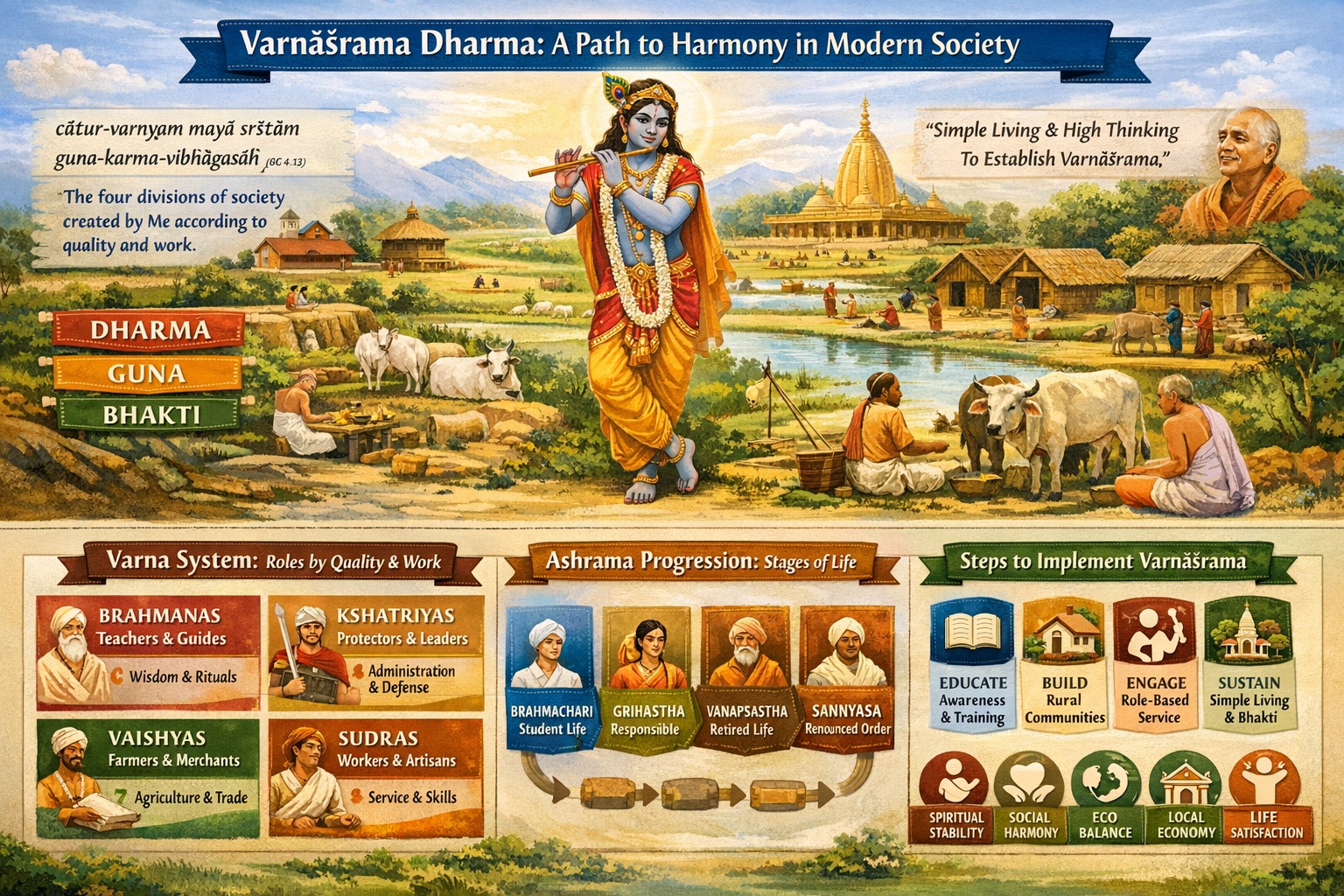
cātur-varṇyaṁ mayā sṛṣṭaṁ guṇa-karma-vibhāgaśaḥ
“The four divisions of human society were created by Me according to quality and work.”
Similarly, Śrīmad Bhāgavatam (9.10.50) describes ideal society under Lord Rāma:
People were peaceful because they followed their duties within varṇa and āśrama. ([Akincana Gocara][2])
Śrīla Prabhupāda explains:
“This is actual human civilization.”
Thus, Varnāśrama is not optional—it is the structural basis of dharmic society.
Why Varnāśrama is Necessary Today
Modern civilization has deviated from natural living principles. Śrīla Prabhupāda diagnosed this condition sharply:
“Your society is headless.”
Key Structural Problems Today
1. Absence of Brahminical Guidance
- No class of selfless, truthful spiritual intellectuals
- Knowledge is commercialized, not sanctified
2. Collapse of Kṣatriya Leadership
- Leaders driven by power and profit, not dharma
3. Economic Exploitation (Vaiśya Distortion)
- Wealth concentrated in few hands
- Society driven by consumerism and rajo-guṇa
4. Mass Śūdra Mentality
- Dependency culture
- Lack of skills, discipline, and higher purpose
Śrīla Prabhupāda observed:
“There are a few vaiśyas and everyone else is śūdra.”
Consequences of Absence of Varnāśrama
Without Varnāśrama, society becomes structurally unstable:
1. Spiritual Degradation
- Irregular sādhana
- Increased fall-downs in devotional life
2. Psychological Instability
- Identity confusion (“Who am I?”)
- Stress due to unnatural occupations
3. Family Breakdown
- No clear āśrama progression
- Gṛhastha life becomes sense gratification
4. Ecological Crisis
- Industrial exploitation vs. simple living
- Disconnection from land and cows
5. Social Chaos
- No cooperation between classes
- Competition replaces service
Śrīla Prabhupāda warned that modern industrial civilization is “artificial, unnatural, and harmful”
Śrīla Prabhupāda’s Vision of Varnāśrama
Śrīla Prabhupāda’s model is Daivī Varnāśrama (Divine System):
Key Principles
✔ Based on quality and work, not birth
✔ Centered on Kṛṣṇa consciousness
✔ Supported by self-sufficient rural communities
✔ Guided by trained brāhmaṇas
✔ Sustained by strong gṛhasthas
He emphasized:
“Simple living and high thinking.”
Challenges in Implementing Varnāśrama Today
Implementation is not theoretical—it is deeply practical and complex.
1. Urbanization & Industrial Economy
- People disconnected from land and cow protection
- Dependency on global supply chains
2. Lack of Training Systems
- No gurukulas producing qualified brāhmaṇas
- Even initiated devotees lack systematic education
3. Misunderstanding as Casteism
- Resistance due to historical misuse
- Need to re-educate: guna-karma, not janma
4. Institutional Hesitation
- Focus on preaching over social structuring
- Fear of complexity in execution
5. Personal Resistance
- Ego: “I don’t want to be classified”
- Lack of surrender to natural role
Śrīla Prabhupāda acknowledged:
“It is not so easy to become Vaiṣṇava… Varnāśrama is required.”
Strategic Plan for Implementation (Actionable Model)
Phase 1: Education & Awareness
- Teach Bhagavad-gītā based social science
- Establish Bhakti-śāstrī level compulsory training
- Identify individual guṇa & karma profiles
Phase 2: Community Structuring
- Develop pilot Varnāśrama communities
- Encourage:
- Cow protection (go-rakṣa)
- Agriculture (kṛṣi)
- Local economies
Phase 3: Role-Based Engagement
- Assign services according to nature:
- Brāhmaṇas → teaching, guidance
- Kṣatriyas → administration
- Vaiśyas → farming, trade
- Śūdras → skilled support
Phase 4: Āśrama Reinforcement
- Strong brahmacārī training
- Responsible gṛhastha culture
- Gradual vānaprastha transition
Phase 5: Integration with Bhakti
- Ensure all roles support:
- Nāma-saṅkīrtana
- Deity worship
- Śāstra study
Advantages of Varnāśrama Society
1. Spiritual Stability
- Regulated life → steady sādhana
- Natural progression toward bhakti
2. Social Harmony
- Cooperation replaces competition
- Clear responsibilities
3. Economic Sustainability
- Local production
- Reduced dependency
4. Psychological Satisfaction
- Work aligned with nature
- Reduced anxiety
5. Ecological Balance
- Cow protection
- Land-based living
6. Strong Leadership
- Brāhmaṇas guide society spiritually
As defined:
Varnāśrama provides a society where one can maintain physical, mental, and spiritual well-being.
Conclusion: The Urgent Mission Ahead
Śrīla Prabhupāda did not envision ISKCON as merely a preaching institution—but as a model civilization.
The modern world is increasingly unstable—economically, morally, and ecologically. Without Varnāśrama, even spiritual movements struggle to sustain long-term transformation.
The mission is clear:
- Not to impose a system
- But to recreate a natural, dharmic society centered on Kṛṣṇa
Varnāśrama is not a regression—it is a progression toward divine order.
Comparative Classification Table
| Dimension | Varnāśrama Dharma | “Hinduism” | RSS |
|---|---|---|---|
| Category Type | Socio-spiritual system | Civilizational / religious umbrella | Socio-cultural / nationalist organization |
| Origin | Vedic śāstra (apauruṣeya) | Historical-geographical term (post-Vedic) | Founded 1925 (modern India) |
| Primary Source | Bhagavad-gita, Srimad Bhagavatam | No single unified scripture | Organizational literature, ideological texts |
| Foundational Principle | Guṇa (qualities) + Karma (work) | Birth, culture, tradition (varies widely) | Cultural unity & national identity |
| Scope | Universal (applies to all humanity) | Primarily Indian-origin traditions | Indian national context |
| Core Structure | 4 Varṇas + 4 Āśramas | No fixed universal structure | Organizational hierarchy (shakhas, cadres) |
| Social Organization Basis | Functional & psychological classification | Often birth-based (in practice) | Identity-based mobilization |
| View of “Hindu” Identity | Not required | Central identity marker | Central organizing concept |
| Spiritual Goal | Mokṣa / Bhakti (God realization) | Varies (karma, jñāna, bhakti, etc.) | Not primary focus |
| Role of Religion | Central and regulating | Diverse interpretations | Cultural and integrative |
| Economic Model | Simple living, agrarian, cow protection | Diverse (traditional to modern) | No fixed model; supports national development |
| Authority System | Śāstra + qualified brāhmaṇas | Guru lineages, traditions | Organizational leadership |
| Flexibility | Dynamic (based on guṇa-karma) | Highly fluid and diverse | Structured but adaptive |
| Misinterpretation Risk | Confused with caste system | Seen as monolithic religion | Seen as purely political (partial view) |
| Śrīla Prabhupāda’s Position | Essential for society | Secondary label, not emphasized | Not central to ISKCON mission |
| End Result | Harmonious, God-centered society | Depends on practice | Strong, unified nation |
High-Level Classification Insight
*1. Ontological Level (What it *is)**
- Varnāśrama → System (Operating Framework)
- Hinduism → Identity (Civilizational Label)
- RSS → Organization (Mobilization Mechanism)
2. Functional Analogy
| Concept | Analogy |
|---|---|
| Varnāśrama | Operating System (how society runs) |
| Hinduism | Brand / Identity (what people call themselves) |
| RSS | Institution / Engine (how people organize collectively) |