A Krishna Conscious Vision of a Loving Husband–Wife Relationship
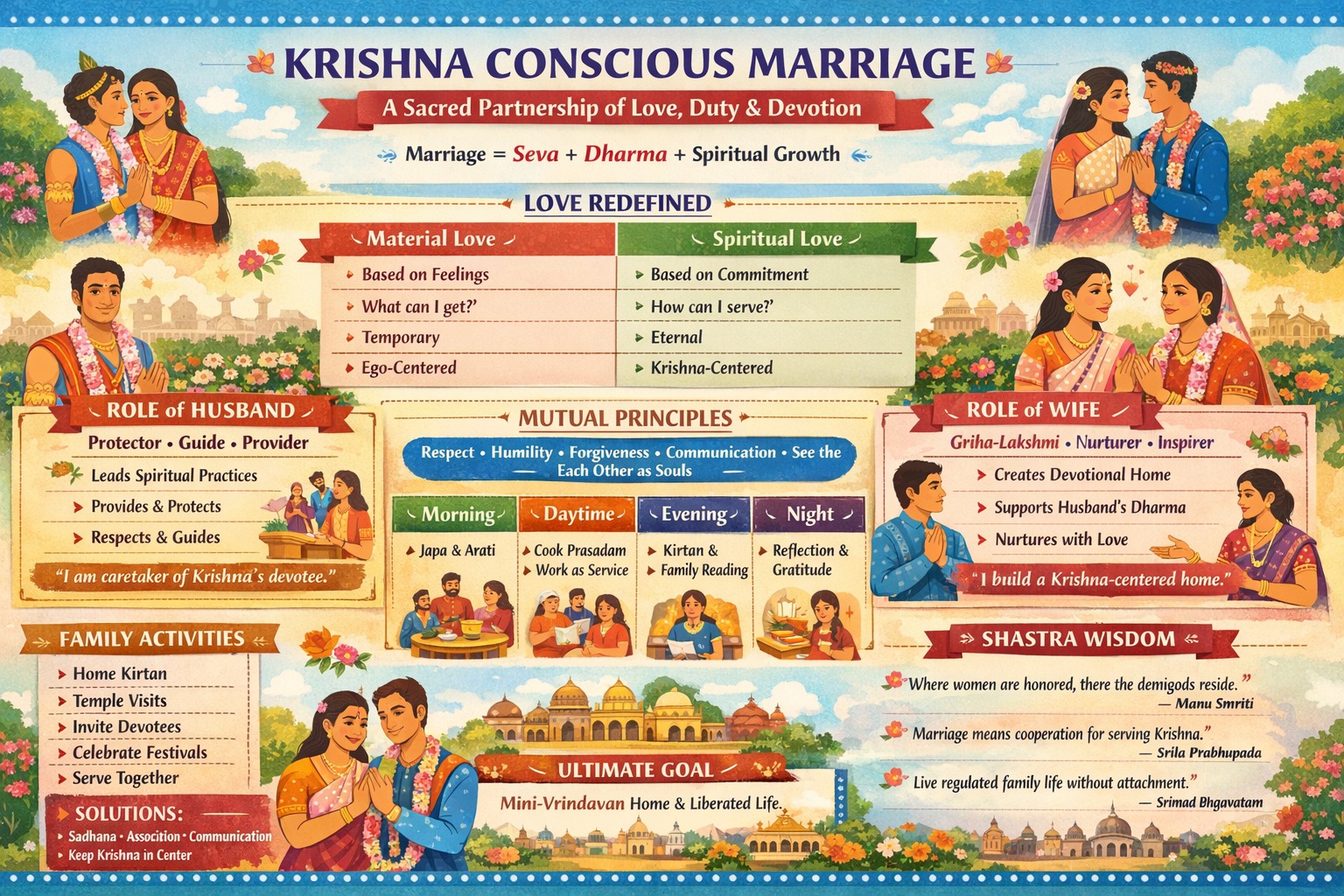
In a world where relationships are increasingly transactional and fragile, the Vedic tradition presents a deeply spiritual, purpose-driven model of marriage. A husband–wife relationship is not merely a social contract—it is a sacred partnership meant to elevate both individuals toward self-realization and divine love.
A Krishna conscious marriage transforms ordinary companionship into a spiritual mission, where love is rooted not in fleeting emotions but in eternal service to the Supreme.
🌸 The Foundation: From Romance to Responsibility
Modern culture often glorifies feeling, but Vedic wisdom emphasizes commitment.
A strong marriage is not sustained by attraction alone—it thrives on:
- Dharma (duty)
- Seva (service)
- Shraddha (faith)
- Mutual spiritual growth
General Wisdom Quotes
- “Love is not about how much you feel, but how much you are willing to serve.”
- “A successful marriage requires falling in love many times—always with the same person.”
- “In true partnership, ego dissolves and service begins.”
📖 Scriptural Vision of Marriage
The Vedic scriptures describe marriage as a sacred yajña (sacrifice), where both partners cooperate for spiritual advancement.
Key Shastra Quotations
1. Srimad Bhagavatam (7.14.3)
“One who desires to advance in spiritual life must live with a wife and family in a regulated way, without attachment.”
2. Bhagavad Gita (3.21)
“Whatever action a great person performs, common people follow.”
👉 In family life, husband and wife become role models for society.
3. Manu Smriti (3.56)
“Where women are honored, there the demigods are pleased; where they are not honored, no sacred act yields results.”
4. Srila Prabhupada
“Marriage means cooperation for serving Krishna. Otherwise, it is simply a legalized form of sense gratification.”
🧭 Responsibilities in a Krishna Conscious Marriage
👨 Duties of the Husband
The husband is traditionally seen as the spiritual and material guide of the family.
Core Responsibilities:
- Protection (Raksha)
Physical, emotional, and spiritual protection of the wife and family. - Provision (Poshana)
Ensuring stability without excessive materialism. - Spiritual Leadership
- Leading daily sadhana
- Encouraging devotional practices
- Setting personal example
- Respect and Sensitivity
- Honoring wife as a partner, not subordinate
- Understanding emotional needs
Ideal Mindset:
“I am a servant of Krishna, entrusted with the care of His devotee.”
👩 Duties of the Wife
The wife is described as the griha-lakshmi—the spiritual energy of the home.
Core Responsibilities:
- Nurturing Environment
- Creating a peaceful, devotional atmosphere
- Maintaining harmony in the home
- Support in Dharma
- Assisting husband in spiritual duties
- Encouraging devotional life
- Care and Compassion
- Emotional strength of the family
- Raising children with values
- Chastity and Dedication
- Focused commitment to the marriage and spiritual goals
Ideal Mindset:
“Through my service, I assist in building a home centered on Krishna.”
⚖️ Mutual Responsibilities
A Krishna conscious marriage is not hierarchical exploitation—it is reciprocal service.
Both partners must:
- Practice humility
- Communicate with respect
- Forgive quickly
- Avoid ego-based conflicts
- See each other as souls, not bodies
🕉️ Daily Activities in a Krishna Conscious Family
The strength of such a marriage lies in shared spiritual practices.
🌅 Morning Spiritual Routine
- Wake up early (Brahma-muhurta)
- Chant Hare Krishna maha-mantra together
- Attend mangala-arati (home altar or temple)
- Read scriptures like Bhagavad Gita or Srimad Bhagavatam
🍲 Sacred Eating (Prasadam Culture)
- Cook food with devotion
- Offer to Krishna before eating
- Eat together as a sacred activity
📿 Japa & Kirtan
- Chant daily rounds (japa)
- Perform kirtan at home weekly
- Involve children in chanting
🏡 Seva-Based Living
- Serve devotees
- Support temple activities
- Practice charity and hospitality
🌙 Evening Reflection
- Read together
- Discuss spiritual realizations
- Plan improvement in sadhana
❤️ Transforming Marriage into a Spiritual Journey
A Krishna conscious marriage shifts the focus:
| Material Marriage | Spiritual Marriage |
|---|---|
| “What can I get?” | “How can I serve?” |
| Based on attraction | Based on devotion |
| Temporary happiness | Eternal progress |
| Ego-centered | Krishna-centered |
🚧 Challenges in Modern Times
Even sincere couples face obstacles:
Common Issues:
- Influence of materialistic culture
- Ego clashes
- Lack of time for sadhana
- Misunderstanding roles
Solutions:
- Regular association with devotees
- Open spiritual discussions
- Attending classes and retreats
- Keeping Krishna at the center
🌺 The Ultimate Goal
The goal of marriage is not just harmony—it is liberation.
When husband and wife:
- Chant together
- Serve together
- Grow together
👉 Their home becomes a mini-Vrindavan.
✨ Conclusion
A loving husband–wife relationship in Krishna consciousness is not accidental—it is cultivated through discipline, humility, and devotion.
It is a journey where:
- Love becomes service
- Duty becomes joy
- And life becomes an offering
“A family centered on Krishna is not bound by karma—it is guided by grace.”
Here is a clear, high-impact classification table you can directly use in blogs, classes, or infographics:
🌸 Krishna Conscious Family vs General Good Family
A Comparative Framework of Values, Purpose & Lifestyle
| Dimension | Krishna Conscious Family | General Good Family |
|---|---|---|
| Core Purpose | To serve Krishna and attain spiritual liberation | To live peacefully and achieve material well-being |
| Foundation | Dharma + Bhakti (devotion) | Ethics + Social values |
| Center of Life | Krishna (God-centered) | Family members (self-centered or family-centered) |
| Definition of Love | Service (seva) and sacrifice for spiritual growth | Care, emotional bonding, and mutual support |
| Marriage Goal | Spiritual advancement together (back to Godhead) | Stability, companionship, happiness |
| Decision Making | Based on shastra (scriptures) and guru guidance | Based on logic, emotions, and social norms |
| Daily Routine | Structured around sadhana (japa, kirtan, reading) | Work, school, leisure, occasional prayer |
| Food Culture | Only prasadam (offered to Krishna) | Vegetarian/non-veg based on preference |
| Ego Handling | Minimized through humility and seva | Managed through compromise or communication |
| Conflict Resolution | Krishna-centered introspection and forgiveness | Discussion, negotiation, sometimes ego clash |
| Children’s Upbringing | Trained in bhakti, values, and self-realization | Focus on education, career, and moral values |
| Festivals | Celebrated as devotional events (Janmashtami, etc.) | Cultural/social celebrations |
| Wealth Perspective | Seen as Krishna’s energy (to be used in seva) | Seen as personal asset/security |
| Role of Husband | Spiritual guide and servant-leader | Provider and protector |
| Role of Wife | Griha-Lakshmi, spiritual nurturer | Caregiver and emotional anchor |
| Association | Devotees, satsang, temple-centered | Friends, relatives, social circle |
| Entertainment | Kirtan, lectures, spiritual discussions | Movies, outings, social media |
| Handling Suffering | Seen as karma + Krishna’s mercy | Seen as problem to fix or avoid |
| Ultimate Goal | Liberation (moksha) and प्रेम (pure love of God) | Happiness, success, and legacy |
🧭 Key Insight
A general good family aims for a comfortable life
A Krishna conscious family aims for a transcendental life
One-Line Contrast
“Good families live for each other; Krishna conscious families live for Krishna—and thus truly uplift each other.”
⚖️ Breaking the Marriage Bond: Present-Life & Post-Life Reactions
A Dharmic and Krishna Conscious Analysis
Marriage in Vedic culture is not merely a legal arrangement—it is a samskara (sacred vow before Dharma and the Divine). Therefore, breaking that bond carries multi-layered consequences: psychological, social, karmic, and spiritual.
This analysis is not moralistic—it is causal. Actions (karma) produce reactions (phala).
I. Present-Life Reactions (Immediate & Observable Effects)
🧠 1. Psychological & Emotional Impact
- Deep sense of loss, instability, and insecurity
- Emotional fragmentation (especially when attachment was strong)
- Increased anxiety, loneliness, or regret
Even when separation seems justified, inner turbulence often remains.
👨👩👧 2. Impact on Children
- Confusion about relationships and trust
- Emotional insecurity
- Long-term relational instability patterns
Children subconsciously inherit the relationship template they observe.
⚖️ 3. Social & Dharmic Disruption
- Breakdown of family structure
- Loss of community stability
- Weakening of dharmic values in society
In Vedic vision, family = unit of dharma transmission
💰 4. Material & Practical Strain
- Financial burden (separate living, legal processes)
- Lifestyle instability
- Increased stress and responsibility
🔥 5. Karmic Seeds Begin Manifesting
- Actions done in anger, betrayal, or irresponsibility create subtle karmic impressions (samskaras)
- These manifest as:
- Repeated relationship failures
- Distrust or dissatisfaction in future bonds
🕉️ II. Post-Life Reactions (Karmic & Subtle Consequences)
According to Vedic philosophy, marriage is tied to karma and destiny. Breaking it improperly creates future karmic obligations.
🔁 1. Repeated Relationship Karma
- Souls may reunite in future births to settle unresolved karma
- Cycles of:
- Conflict
- Separation
- Attachment
What is not resolved consciously is repeated karmically
⚖️ 2. Karmic Accountability
Scriptural Principle:
“For every action, there is a corresponding reaction.”
(Law of Karma)
- Causing emotional harm → experience similar suffering later
- Neglect of duty (dharma) → future obstacles in relationships
🌫️ 3. Subtle Body Impressions (Vasanas)
- Deep attachments, resentments, or guilt carry into next life
- These influence:
- Choice of partner
- Nature of relationships
- Emotional tendencies
⛓️ 4. Delay in Spiritual Progress
- Grihastha life is meant to support liberation
- Misuse leads to:
- Increased material entanglement
- Distraction from spiritual goals
📖 III. Shastric Perspective
🕉️ Srimad Bhagavatam (5.5.8 – Principle)
Attachment between man and woman is the basic principle of material bondage.
When mishandled, it strengthens bondage instead of liberating.
🕉️ Manusmriti Principle
- Marriage is a lifelong dharmic commitment
- Breaking it irresponsibly is considered deviation from dharma
🕉️ Srila Prabhupada Insight
“Human life is meant for purification. If we increase entanglement, we delay our progress.”
⚠️ Important Balance (Critical Clarification)
Not all separation is adharmic.
✔️ Legitimate Grounds (Dharmic View)
- Abuse (physical/emotional)
- Severe incompatibility obstructing dharma
- Spiritual degradation
- Protection of dependents
In such cases, separation may be a corrective dharmic action, not a sin.
🧭 IV. Krishna Conscious Resolution Approach
Instead of impulsive breaking:
✅ Before Separation:
- Seek guru / senior devotee guidance
- Increase sadhana (chanting, introspection)
- Practice humility and forgiveness
- Attempt reconciliation with spiritual vision
✅ If Separation Happens:
- Maintain dignity and non-hatred
- Accept karmic lessons
- Continue Krishna consciousness seriously
- Avoid blame mentality
🌺 Higher Understanding
Marriage is not meant to bind eternally in suffering
Nor is it meant to be casually broken
It is meant to:
- Refine consciousness
- Reduce ego
- Increase devotion
✨ Final Insight
Breaking a marriage irresponsibly creates bondage. Handling it with dharma—even if separation occurs—can still lead to growth.