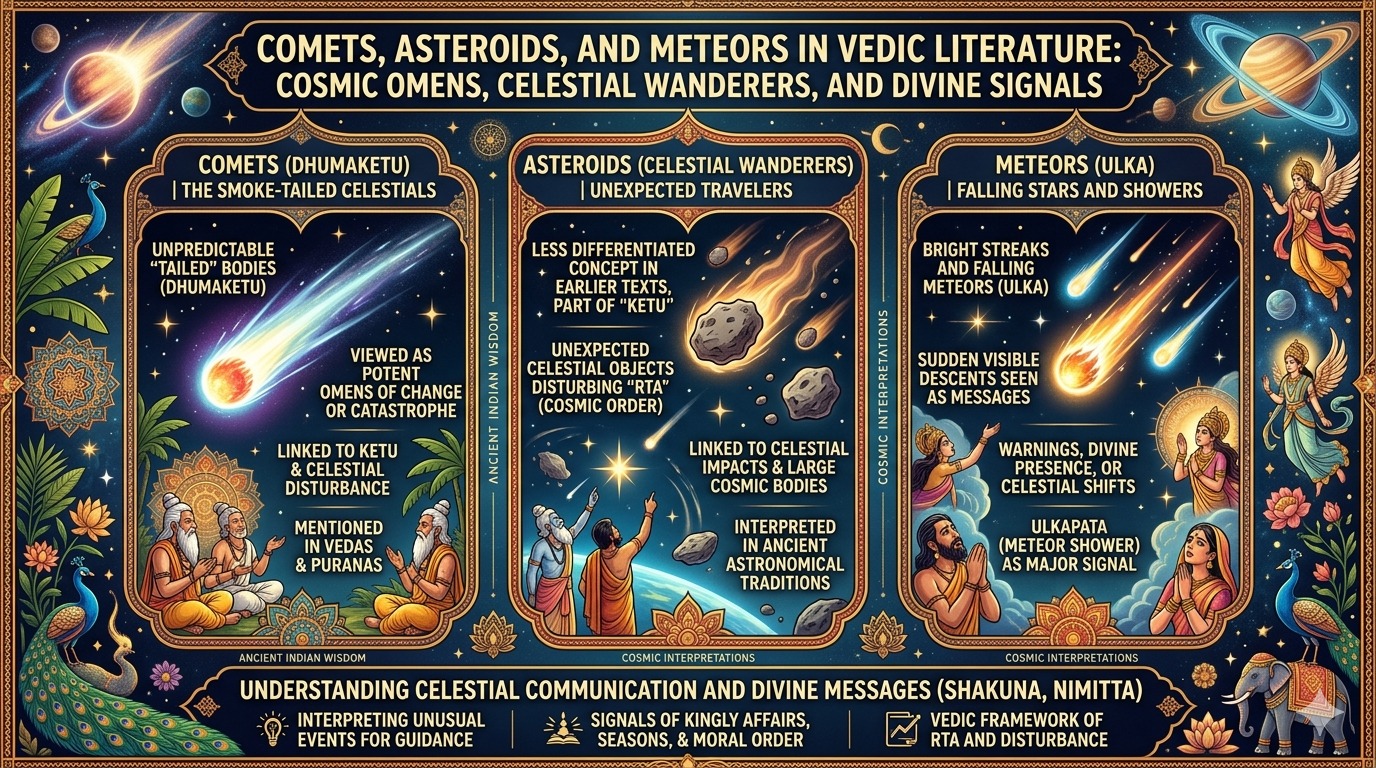
Cosmic Omens, Celestial Wanderers, and Divine Signals
The night sky has always inspired awe. Long before modern astronomy classified celestial objects into comets, asteroids, meteors, and meteorites, the sages of ancient India carefully observed the heavens and documented extraordinary phenomena in the Vedic and Puranic texts. These descriptions were not merely astronomical records; they were woven into a broader worldview where the cosmos, karma, devas, and human civilization remained deeply interconnected.
In Vedic cosmology, unusual celestial appearances often carried symbolic, karmic, or prophetic significance. Fiery streaks crossing the sky, blazing tailed stars, and falling luminous bodies were considered indicators of cosmic imbalance, political upheaval, natural disasters, or transitions in world history.
This article explores how Vedic literature interprets comets, meteors, asteroids, and related celestial phenomena through texts such as the Mahabharata, Srimad Bhagavatam, Brihat Samhita, Rig Veda, and Jyotisha scriptures.
Understanding Celestial Objects in Modern Astronomy
Before entering the Vedic perspective, it is useful to briefly distinguish these objects scientifically.
Comets
Comets are icy celestial bodies that orbit the sun. When they approach the sun, heat vaporizes their ice and dust, creating a glowing tail visible from Earth.
Asteroids
Asteroids are rocky bodies orbiting the sun, mostly concentrated in the asteroid belt between Mars and Jupiter.
Meteors
Meteors are small fragments of rock or metal entering Earth’s atmosphere and burning brightly due to friction. These are commonly called “shooting stars.”
Meteorites
When part of a meteor survives and reaches Earth’s surface, it is called a meteorite.
Celestial Phenomena in Vedic Cosmology
The Vedic worldview never separated astronomy from spirituality. The universe was understood as conscious, ordered, and governed by higher intelligence.
The Sanskrit word often associated with ominous celestial phenomena is Dhumaketu.
Dhumaketu — The Smoky Banner
The term Dhumaketu appears in several Vedic texts.
- Dhuma = smoke
- Ketu = banner, sign, flag, luminous marker
Thus, Dhumaketu literally means “smoke-banner” or “smoky celestial sign,” remarkably similar to the appearance of a comet with a glowing tail.
The Rig Veda refers to celestial signs resembling fiery banners in the sky, while later astronomical and astrological texts provide more elaborate descriptions.
One of the most detailed ancient Indian treatments appears in the Brihat Samhita of Varahamihira, which dedicates entire chapters to comets and celestial omens.
Comets in Vedic Literature
Comets as Cosmic Warnings
In many Puranic and Itihasa texts, comets are portrayed as harbingers of significant change.
Before the great war of Kurukshetra in the Mahabharata, terrifying celestial omens were observed:
- blazing objects in the sky
- eclipses
- meteoric disturbances
- unusual planetary alignments
- blood-red celestial appearances
These were interpreted as warnings of massive destruction and the decline of dharma.
The Mahabharata describes ominous heavenly signs appearing repeatedly before the war:
“Comets and meteors blazed fiercely in the heavens.”
The sages understood these not as random events, but as indicators of collective karmic upheaval.
Dhumaketu and Kali-yuga
Some traditions symbolically associate comets with disturbances characteristic of Kali-yuga — chaos, war, confusion, moral degradation, and instability.
The appearance of unusual celestial phenomena was believed to correspond with:
- collapse of kingdoms
- famine
- epidemics
- social unrest
- natural disasters
Ancient Jyotisha texts classified comets according to:
- color
- direction
- duration
- brightness
- location in the sky
Each category carried distinct interpretations.
Brihat Samhita and Ancient Indian Astronomy
The Brihat Samhita contains one of the most systematic ancient discussions of comets.
Varahamihira catalogued numerous cometary appearances and associated them with earthly effects.
He described:
- white comets
- red comets
- smoky comets
- multi-tailed comets
- stationary appearing comets
- fast-moving luminous bodies
Some were considered auspicious, while others foretold political turmoil or climatic disturbances.
This demonstrates that ancient Indian scholars maintained sophisticated observational astronomy alongside spiritual interpretation.
Meteors and Falling Stars in Vedic Thought
Ulka — Fiery Celestial Projectiles
The Sanskrit term Ulka often refers to meteors, fireballs, or blazing celestial objects.
Texts describe them as:
- fiery streaks
- burning masses
- falling stars
- luminous projectiles
In many scriptures, meteor showers were considered signs of instability in the cosmic order.
The Ramayana and Mahabharata both describe frightening meteorological and astronomical disturbances before catastrophic events.
Meteors as Omens
Classical Jyotisha texts interpreted meteor falls based on:
- direction of descent
- sound produced
- color
- time of appearance
- location of impact
For example:
- meteors falling near royal cities were interpreted as danger to rulers
- fiery red meteors suggested warfare
- dark smoky meteors suggested disease or famine
Such interpretations reflected the Vedic assumption that the macrocosm and human civilization are interconnected.
Asteroids in the Vedic Framework
The modern term “asteroid” does not appear explicitly in ancient Sanskrit literature. However, Vedic cosmology describes numerous classes of wandering celestial bodies and minor planetary entities.
Ancient Indian astronomy recognized:
- grahas (planetary influencers)
- upagrahas (sub-planets or secondary influences)
- nakshatras
- wandering stars
- luminous moving objects
Some scholars interpret descriptions of erratic celestial wanderers as potentially corresponding to asteroid-like bodies.
Unlike modern astronomy, however, Vedic literature focused less on material composition and more on: - energetic influence
- karmic symbolism
- cosmological significance
Rahu, Ketu, and Celestial Disturbances
No discussion of Vedic astronomy is complete without mentioning Rahu and Ketu.
Although not physical planets in the modern sense, Rahu and Ketu represent eclipse nodes in Jyotisha.
Ketu especially became associated with:
- smoke
- comets
- sudden disruption
- mystical phenomena
- karmic purification
- detachment
The term Dhumaketu itself linguistically resonates with Ketu symbolism.
In Vedic astrology, Ketu governs:
- unexpected celestial disturbances
- transcendence
- spiritual awakening through destruction
- mysterious phenomena
Cosmic Events and Dharma
A central Vedic principle is that the universe is morally responsive.
When adharma increases:
- celestial irregularities appear
- natural systems destabilize
- social chaos spreads
Thus, comets and meteors were viewed not merely as physical objects, but as reflections of deeper cosmic conditions.
This worldview differs radically from modern materialism. Ancient sages perceived the cosmos as alive, interconnected, and conscious.
Srimad Bhagavatam and Cosmic Structure
The Srimad Bhagavatam presents an elaborate cosmology describing:
- planetary systems
- stellar regions
- higher and lower lokas
- cosmic cycles
- universal destruction
While the Bhagavatam does not provide a modern astrophysical classification of asteroids or meteors, it consistently portrays the heavens as dynamic and purposeful.
The universe is not viewed as accidental machinery, but as a divine manifestation governed by the Supreme Lord.
Vedic Cosmology vs Modern Astronomy
Modern astronomy studies:
- composition
- orbital mechanics
- gravitational interactions
- impact probability
Vedic cosmology studies:
- meaning
- karma
- consciousness
- cosmic order
- divine governance
The two approaches are not necessarily mutually exclusive. One explains physical mechanisms; the other explores metaphysical significance.
Ancient sages were not ignorant sky-watchers. Their observations of eclipses, planetary motions, and celestial anomalies reveal deep astronomical awareness integrated with philosophical insight.
Are Comets Still Considered Omens?
Even today, many traditional Jyotisha practitioners regard major cometary appearances as spiritually or socially significant.
Historically, large visible comets have coincided with:
- wars
- political collapse
- pandemics
- societal transformation
However, Vedic wisdom ultimately emphasizes spiritual preparedness over fear.
The message is not superstition, but introspection:
- human civilization is fragile
- material stability is temporary
- cosmic time surpasses human control
Spiritual Lessons from Celestial Events
Vedic literature encourages humanity to see cosmic phenomena as reminders of higher truths:
1. Material Civilization Is Temporary
Even planets, stars, and galaxies undergo creation and destruction.
2. The Universe Operates Under Higher Laws
Nothing exists independently of divine order.
3. Human Life Should Be Spiritually Oriented
Fearful celestial events remind people to cultivate dharma, devotion, humility, and self-realization.
4. Cosmic Events Reflect Collective Consciousness
Civilizations rise and fall according to collective karma and moral culture.
Conclusion
Comets, meteors, and celestial disturbances occupy a fascinating place in Vedic literature. Ancient sages viewed them not merely as astronomical curiosities, but as meaningful cosmic indicators connected to karma, dharma, and divine administration.
Texts like the Mahabharata, Srimad Bhagavatam, and Brihat Samhita preserve a worldview in which the heavens communicate profound truths about the condition of humanity and the unfolding of cosmic time.
Modern astronomy may explain how celestial objects move, but Vedic wisdom asks a deeper question:
What do these events reveal about consciousness, destiny, and our place within the universe?
For the Vedic sages, the sky was never silent.