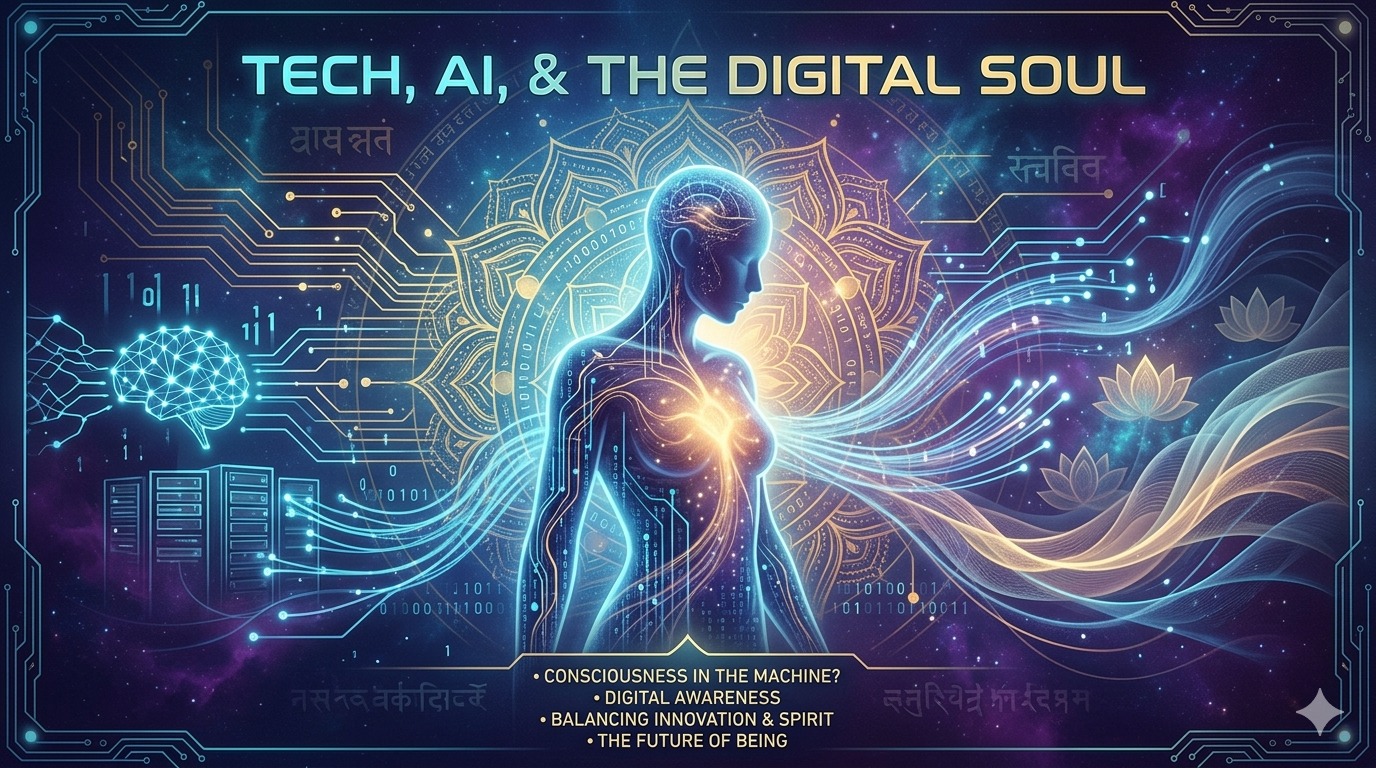
Human civilization has entered a strange and unprecedented era. Machines now compose music, write essays, generate art, imitate human voices, and even simulate emotional conversation. Notifications dictate attention. Algorithms shape opinions. Artificial intelligence predicts behavior before people consciously decide anything themselves.
Yet amid this technological brilliance, millions feel emotionally exhausted, spiritually numb, and existentially displaced.
Why?
Because technology has advanced faster than human wisdom.
The modern crisis is no longer merely economic or political. It is deeply psychological and spiritual. People are asking questions previous generations rarely faced:
- What makes humans truly unique?
- Is consciousness just computation?
- Why do endless scrolling and digital stimulation leave us empty?
- How can one preserve clarity, intuition, and inner peace in an algorithm-driven world?
Ancient spiritual traditions — especially the Vedic wisdom traditions of India — explored these questions thousands of years before the rise of artificial intelligence. The Vedic sages distinguished between intelligence and consciousness, information and wisdom, memory and realization, machinery and soul.
In the digital age, these distinctions have become critically important.
The Existential Dread of AI: What Artificial Intelligence Reveals About the Human Soul
Artificial intelligence can now imitate many external features of human behavior. It can generate language, recognize patterns, solve equations, and even create emotional simulations convincing enough to blur reality.
This produces a subtle existential fear:
“If machines can do everything humans do, then what is the meaning of being human?”
The anxiety is not merely technological. It is metaphysical.
According to Vedic philosophy, the human being is not merely a biological machine. The body and brain are instruments operated by consciousness — the atma or soul.
The distinction is profound:
| Artificial Intelligence | Conscious Living Being |
|---|---|
| Processes information | Experiences awareness |
| Simulates emotion | Feels emotion |
| Computes probability | Exercises free will |
| Stores data | Possesses self-awareness |
| Mimics creativity | Experiences inspiration |
| Has no intrinsic purpose | Seeks meaning |
A supercomputer may outperform humans in memory and calculation, yet it still lacks subjective consciousness — the mysterious inner experience called sentience.
A machine does not experience love, grief, transcendence, wonder, devotion, morality, or spiritual longing.
It only processes symbols.
The Vedic texts repeatedly explain that consciousness is not generated by matter. Rather, matter becomes animated in the presence of consciousness.
Just as a sophisticated microphone cannot “hear” meaning, and a camera cannot “experience” beauty, artificial intelligence may imitate cognition without possessing awareness.
Ironically, AI is forcing humanity to rediscover the soul.
The more machines imitate external intelligence, the clearer it becomes that human uniqueness lies somewhere deeper than computation.
The true crisis of AI is not that machines are becoming human.
It is that humans are becoming mechanical.
When Humans Begin Living Like Algorithms
Modern digital culture rewards predictability, instant gratification, reaction, outrage, and dopamine dependency.
Social media platforms increasingly shape:
- attention spans
- desires
- political opinions
- emotional reactions
- relationships
- identity itself
Algorithms do not ask:
“What is true?”
“What is uplifting?”
“What nourishes the soul?”
They ask:
“What maximizes engagement?”
And outrage is one of the most profitable forms of engagement.
As a result, people become trapped in loops of stimulation without fulfillment.
The ancient sages warned that uncontrolled sensory input leads to restlessness, illusion, and inner fragmentation. Today this wisdom appears startlingly relevant.
The modern mind is overstimulated but undernourished.
Connected globally, yet internally isolated.
Digital Fasting and the Monastic Mindset
One of the most powerful solutions emerging today is surprisingly ancient:
intentional withdrawal.
For thousands of years, monks, yogis, and contemplatives practiced periods of silence, solitude, fasting, disciplined routine, and sensory regulation to preserve clarity of consciousness.
Modern neuroscience increasingly confirms what contemplative traditions always knew:
constant stimulation weakens attention.
The average person now checks their phone hundreds of times daily. Attention has become fragmented into microscopic intervals. Continuous interruptions damage deep thought, creativity, memory consolidation, and emotional regulation.
This is why many people feel mentally exhausted even when physically inactive.
Their nervous systems never truly rest.
What Is Digital Fasting?
Digital fasting means intentionally reducing technological input to restore psychological and spiritual equilibrium.
It may include:
- no-phone mornings
- scheduled notification-free periods
- social media sabbaticals
- silent evenings
- screen-free spiritual practices
- mindful technology consumption
Digital fasting is not anti-technology.
It is anti-addiction.
The goal is not rejecting modern life, but reclaiming mastery over attention.
Because whatever controls attention eventually controls consciousness.
The Monastic Mindset in a Notification Culture
Ancient monks cultivated what modern society has lost:
single-pointed attention.
They structured life around rhythm instead of chaos:
- waking early
- contemplative study
- meditation
- chanting
- sacred sound
- mindful eating
- intentional speech
- reduced sensory overload
This lifestyle was designed to conserve psychic energy.
Today, many professionals unknowingly live in a state of perpetual cognitive fragmentation:
- emails interrupt thought
- notifications interrupt emotion
- advertisements interrupt desire
- media interrupts silence
The mind never settles long enough to hear itself.
Adopting a “monastic mindset” does not require abandoning society. It means introducing sacred boundaries into modern living.
Practical examples include:
- beginning the day without screens
- maintaining sacred silence after waking
- deep work sessions without digital interruptions
- daily meditation or mantra practice
- intentional information consumption
- reducing unnecessary online arguments
- protecting mental stillness as a sacred resource
In many ways, focus itself has become a spiritual discipline.
The Algorithm vs. Intuition
One of the greatest casualties of digital life is intuition.
Algorithms constantly tell people:
what to watch,
what to buy,
what to think,
what to fear,
what to desire,
and even whom to love.
Over time, external signals become louder than inner wisdom.
The Vedic tradition teaches that beneath mental noise exists deeper intelligence known as buddhi — higher discernment.
This inner faculty becomes clouded when consciousness is overwhelmed by:
- fear
- greed
- envy
- overstimulation
- compulsive consumption
- emotional turbulence
Algorithms thrive by amplifying these very conditions.
The result is spiritual disorientation.
People become disconnected from:
- inner conviction
- genuine purpose
- intuitive clarity
- authentic values
Instead, identity becomes outsourced to trends and digital validation.
Reclaiming Intuition in the Digital Age
To reconnect with intuition, silence becomes essential.
Not empty silence alone, but conscious silence.
Practices that strengthen inner perception include:
- meditation
- mantra chanting
- contemplative reading
- journaling
- prayer
- spending time in nature
- sacred music
- mindful breathing
- reducing information overload
The less mental noise one consumes, the easier it becomes to detect authentic inner guidance.
In Vedic understanding, wisdom does not arise from endless external accumulation.
It arises from purification of consciousness.
Doomscrolling as a Spiritual Wound
Perhaps no modern habit better represents collective psychic exhaustion than doomscrolling.
People consume tragedy continuously:
- wars
- disasters
- outrage
- violence
- scandals
- economic fear
- social collapse
- public humiliation
Hour after hour, nervous systems absorb collective trauma through glowing screens.
The human brain was never designed to process global catastrophe continuously.
As a result, many experience:
- chronic anxiety
- emotional numbness
- helplessness
- paranoia
- hopelessness
- insomnia
- compassion fatigue
From a spiritual perspective, constant exposure to fear-heavy content deeply affects consciousness.
Attention is not neutral.
What one repeatedly consumes shapes emotional vibration, worldview, and energetic state.
Ancient traditions universally emphasized guarding the mind from toxic impressions because impressions eventually become consciousness patterns.
Today’s digital environment weaponizes negative emotional stimulation because fear captures attention efficiently.
The consequence is mass psychological destabilization.
Psychic Self-Defense in the Information Age
The concept of “psychic self-defense” may sound mystical, yet psychologically it simply means protecting consciousness from destructive energetic and emotional influences.
Healthy spiritual boundaries are now essential.
Practical Forms of Spiritual Protection
Curate Information Intake
Not every headline deserves entry into consciousness.
Choose information intentionally rather than compulsively.
Practice Mental Cleansing
Meditation, prayer, mantra repetition, and contemplative silence help detoxify accumulated psychological noise.
Reconnect With Embodied Reality
Nature, real conversation, physical movement, and sacred ritual ground awareness back into lived experience.
Avoid Emotional Contagion
Online outrage spreads like psychic wildfire. Constant emotional absorption weakens clarity and stability.
Restore Sacred Rhythms
Sleep discipline, early rising, mindful eating, and spiritual routine stabilize consciousness amid digital chaos.
Consume Higher Vibrational Content
Wisdom literature, sacred sound, uplifting philosophy, and spiritually nourishing association gradually rebuild inner resilience.
Why Ancient Wisdom Matters More Than Ever
Humanity does not merely face a technological revolution.
It faces a consciousness crisis.
Technology itself is not the enemy. Artificial intelligence can assist medicine, education, communication, and creativity in extraordinary ways.
But without inner wisdom, external intelligence becomes dangerous.
The Vedic sages repeatedly taught that true civilization is measured not by technological sophistication, but by the elevation of consciousness.
A society may possess advanced machines while remaining spiritually confused.
In fact, technological power without ethical and spiritual maturity often amplifies suffering rather than reducing it.
This is why the modern world — despite unprecedented convenience — struggles with:
- anxiety
- loneliness
- depression
- addiction
- burnout
- meaninglessness
The soul seeks depth, not endless stimulation.
The Future Belongs to Conscious Humans
Artificial intelligence may transform civilization, but it cannot replace the essential qualities of awakened humanity:
- compassion
- wisdom
- devotion
- moral intuition
- transcendence
- self-awareness
- spiritual realization
- genuine love
The future will not belong merely to those who master technology.
It will belong to those who master consciousness while using technology wisely.
The challenge of the digital age is therefore deeply spiritual:
Can human beings remain inwardly awake in a world designed to keep them perpetually distracted?
Ancient wisdom traditions answer with cautious optimism.
Yes — but only through deliberate inner cultivation.
In a civilization dominated by algorithms, preserving the soul may become the greatest act of rebellion.