The modern world is in a massive crisis of masculinity.
If you look around today, young men are being pulled between two toxic extremes. On one side, you have the hyper-materialistic, “alpha-male” internet culture that measures a man’s worth strictly by his bank account, his physical dominance, and his ability to exploit others. On the other side, you have a completely unanchored, passive culture that strips men of their drive, responsibility, and higher purpose.
Both paths leave you empty. Both paths treat you like a consumer, a biological machine driven purely by kama (lust) and ahankara (false ego).
But there is a third option. A radical, time-tested framework that doesn’t ask you to suppress your drive, but instead demands that you direct it toward the ultimate reality.
If you want to know what it actually means to be a strong, deeply grounded man in 2026, you have to look at The Spiritual Blueprint left to us by the sages, Krishna in the Bhagavad-gita, and lived out by Srila Prabhupada.
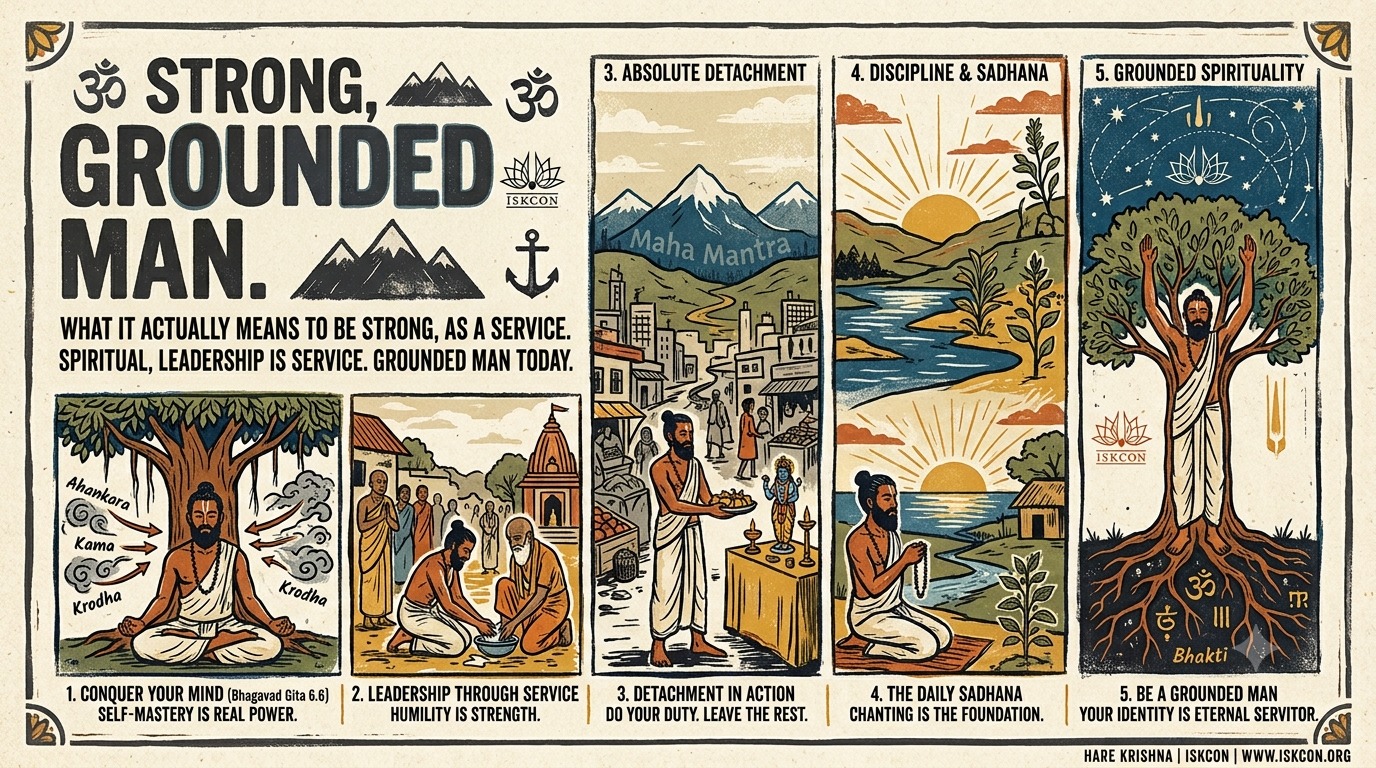
1. True Strength is Conquest of the Mind (Not the World)
The internet tells you that strength is about dominating your environment or conquering your rivals. The Bhagavad-gita calls bluff on that. True strength isn’t external; it is internal.
In Chapter 6, Verse 6, Krishna drops the ultimate truth about mental toughness:
“For him who has conquered the mind, the mind is the best of friends; but for one who has failed to do so, his mind will remain the greatest enemy.”
An “alpha” who can lift heavy weights or make millions but loses his mind over a single insulting comment, an urge to scroll social media, or a flash of lust isn’t strong. He is a slave. He is a puppet pulled by the strings of maya (illusion).
A grounded man is a master of his senses (gosvami). He doesn’t let his emotions, his passing impulses, or the chaotic culture dictate his actions. He controls his mind through the daily discipline of Sadhana—specifically, chanting the Maha-Mantra. That is the ultimate martial art for the consciousness.
2. Leadership Through Service: The King-Sage Ideal
Modern culture views leadership as a position of privilege—getting people to do what you want. The Vedic paradigm completely flips this on its head.
In the Srimad-Bhagavatam, the greatest leaders were Rajarsis—saintly kings. They were fierce protectors, highly capable, and fiercely disciplined, but their heart was entirely anchored in the service of Krishna and the citizens.
- Real power is the ability to protect and uplift those around you.
- Real grounding means you do not seek validation from the people you lead. Your validation comes from satisfying Guru and Krishna.
If you are a husband, a father, a brother, or a leader in your community, your job is not to dictate; it is to serve. You provide physical safety, emotional stability, and, most importantly, spiritual direction. If you aren’t waking up early, sharpening your consciousness, and practicing what you preach, you aren’t leading. You’re just taking up space.
3. Detachment is the Ultimate Armor
Why are men today so anxious, fragile, and easily triggered? Because they anchor their entire identity into things they can lose in a second: their job title, their appearance, their bank balance, or someone else’s opinion of them.
When Krishna tells Arjuna to fight in the Battle of Kurukshetra, He doesn’t tell him to do it out of raw anger or a desire for glory. He tells him to do it with absolute detachment:
“Do thou fight for the sake of fighting, without considering happiness or distress, loss or gain, victory or defeat—and by so doing you shall never incur sin.” (Bg. 2.38)
This is the spiritual blueprint for absolute invincibility. When you perform your duties strictly out of love for the Supreme—without being addicted to the result—you become completely unshakeable. If success comes, you offer it to Krishna. If failure comes, you accept it as His mercy and keep moving forward. You cannot break a man who wants nothing for himself but everything for God.
4. Upgrading Your Association (Sadhu-Sanga)
You cannot build a towering spiritual structure on a foundation of weak, worldly association. If your inner circle consists entirely of people chasing cheap thrills, talking about material nonsense, and wasting their potential, you will inevitably sink to their level.
A strong, grounded man intentionally curates his circle. He seeks out Sadhu-Sanga—the association of advanced, serious spiritual practitioners.
You need men around you who will call you out when you are slacking, hold you accountable to your vows, and inspire you to dig deeper into your spiritual practices. Iron sharpens iron. Find men who love Krishna, and run with them.
The Call to Action: Reclaim Your True Identity
Being a strong man today doesn’t mean buying into a artificial internet aesthetic. It means rejecting the cheap, superficial scripts the modern world tries to sell you and stepping into your true, eternal nature as a servant of Krishna (jivera ‘svarupa’ haya-krishnera ‘nitya-dasa’).
It means trading comfort for discipline. Trading lust for love. Trading a fragile ego for spiritual gravity.
Stop drifting. The world doesn’t need more passive observers, and it certainly doesn’t need more toxic ego-maniacs. It needs grounded, spiritually conscious men who can stand firm like mountains in the middle of Kali-yuga.
Start tomorrow. Wake up before the sun. Chant your rounds with intense focus. Read the Gita. Step up for your family and your temple. Live the blueprint.
1. On Mind Control and Inner Strength
This is the ultimate scriptural definition of internal mastery. Before a man can lead others, he must conquer his own lower nature.
Bhagavad-gita 6.6
bandhur ātmātmanas tasya yenātmaivātmanā jitaḥ
anātmanas tu śatrutve vartetātmaiva śatru-vat
Translation:
“For him who has conquered the mind, the mind is the best of friends; but for one who has failed to do so, his mind will remain the greatest enemy.”
2. On Shifting from Lust to Spiritual Gravity
Modern culture is hyper-sexualized and feeds on desire (kama). The Gita identifies this unchecked desire as the single greatest destroyer of a man’s intelligence, strength, and grounding.
Bhagavad-gita 3.37
kāma eṣa krodha eṣa rajo-guṇa-samudbhavaḥ
mahāśano mahā-pāpmā viddhy enam iha vairiṇam
Translation:
“It is lust only, Arjuna, which is born of contact with the material mode of passion and later transformed into wrath, and which is the all-devouring sinful enemy of this world.”
3. On Acting with Absolute Detachment and Duty
A grounded man doesn’t break when things go wrong because he doesn’t anchor his ego to the results of his work. He focuses entirely on executing his duty as an offering to the Divine.
Bhagavad-gita 2.47
karmaṇy evādhikāras te mā phaleṣu kadācana
mā karma-phala-hetur bhūr mā te saṅgo ’stv akarmaṇi
Translation:
“You have a right to perform your prescribed duty, but you are not entitled to the fruits of action. Never consider yourself the cause of the results of your activities, and never be attached to not doing your duty.”
4. On the True Nature of Leadership
A real leader doesn’t rule by tyrannical force; he leads by flawless personal example. What a strong man does, others will automatically emulate.
Bhagavad-gita 3.21
yad yad ācarati śreṣṭhas tat tad evetaro janaḥ
sa yat pramāṇaṁ kurute lokas tad anuvartate
Translation:
“Whatever action a great man performs, common men follow. And whatever standards he sets by exemplary acts, all the world pursues.”
5. On Speech, Discipline, and Emotional Mastery
To be “grounded” means you are not easily triggered by the chaotic impulses of the body, tongue, or mind. The Upadesamrta (Nectar of Instruction) by Srila Rupa Gosvami lays down the foundational rule for spiritual gravity.
Sri Upadesamrta, Verse 1
vāco vegaṁ manasaḥ krodha-vegaṁ
jihvā-vegam udaropastha-vegam
etān vegān yo viṣaheta dhīraḥ
sarvām apīmāṁ pṛthivīṁ sa śiṣyāt
Translation:
“A sober person who can tolerate the urge to speak, the mind’s demands, the actions of anger and the urges of the tongue, belly and genitals is qualified to make disciples all over the world [or conquer the entire world through his self-control].”