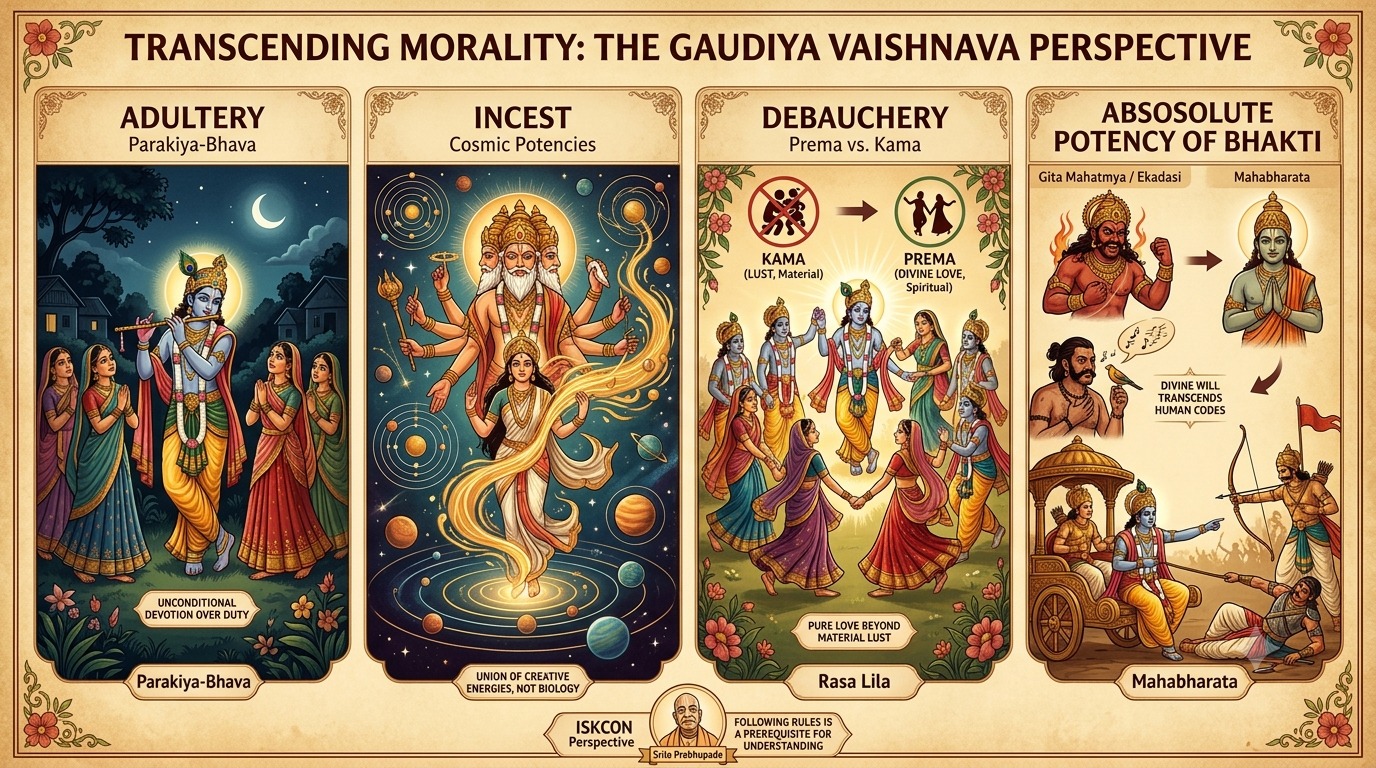
To the casual observer or the secular critic, certain narratives within Puranas read like a tabloid of ancient debauchery. The text features accounts of Supreme Divinity engaging in what society labels as adultery (Krishna and the married gopīs), incest (cosmic accounts like Brahma and Sarasvati, or Manu’s descendants), and unchecked sensual debauchery (the Rasa Lila).
To the untrained eye, these stories feature cold-blooded murder, cannibalism, betrayal of the worst kind, and absolute debauchery. Yet, Gaudiya Vaishnavism utilizes these extreme scenarios to prove a radical theological point: the absolute potency of devotion (bhakti) completely obliterates and transcends material karma and mundane morality.**
Looking at these texts without understanding their theological framework is like judging a brain surgeon for “stabbing” a patient. In *Gaudiya Vaishnavism—the monotheistic, devotion-centric tradition revitalized by Chaitanya Mahaprabhu in 16th-century India—these highly controversial narratives are not historical slips in morality. They are precise, deliberate, and *trans-moral paradoxes designed to challenge human conception.
1. The “Adultery” Paradox: Parakiya-Bhava vs. Svakiya-Bhava
The most heavily critiqued narrative is Krishna’s relationship with the gopīs (milkmaids) of Vrindavan, who were legally married to other men. Critics call it a glaring divine endorsement of adultery.
The Gaudiya response flips this entirely through the lens of Rasa (spiritual mellows). The tradition categorizes love into two core sentiments:
- Svakiya-bhava: Wedded, lawful, socially sanctioned love (found in Dwaraka with Krishna’s queens). It is bound by rules, duties, and awe.
- Parakiya-bhava: Paramour, illicit, law-breaking love (found in Vraja/Vrindavan).
[Social Duty / Laws] ──(Breaks Down)──> [Parakiya Bhava] ──> [Absolute Unconditional Love]
Why does God choose the “Illicit”?
In human society, a paramour relationship is born of lust. In the spiritual dynamic, Gaudiya theologians like Rupa Goswami and Jiva Goswami explain that parakiya-bhava is utilized because it represents the highest possible emotional intensity.
When love is legal and socially supported, it is easy. When love is completely illegal, socially ruinous, and highly dangerous, the lover risks everything—reputation, family, safety, and salvation—just for a momentary glimpse of the beloved.
The Trans-moral Shift: The gopīs abandoning their husbands in the middle of the night to meet Krishna is the ultimate cosmic metaphor for Sarva-dharman parityajya (“Abandon all varieties of worldly religion and duty”). It is not a green light for human cheating; it is an illustration that the soul’s obligation to the Divine supersedes all temporary earthly social contracts.
2. The “Incest” Question: Cosmic Blueprints vs. Human DNA
Another point of contention in Puranic literature includes accounts that mimic incest—such as the creator Brahma pursuing his daughter Sarasvati, or early patriarchal lineages (like Manu’s twin descendants, Yajna and Dakshina) marrying.
Gaudiya philosophy untangles this using Ontology (Tattva)** over worldly biological ethics:
Macrocosmic Energies, Not Flesh
When Brahma “creates” Sarasvati, she is not born of a womb or a biological egg; she is the manifestation of cosmic sound and wisdom emanating from his mind. Similarly, the marriage of early cosmic beings represents the union of potencies necessary to populate and balance a nascent universe.
The Pure Energy Paradigm
Gaudiya acharyas point out that structural taboos like incest exist in the human realm for two vital reasons: genetic safety (DNA health) and the preservation of safe family structures.
- Cosmic entities are vibhu (all-powerful, non-corporeal archetypes) or direct expansions of Vishnu’s internal energy (Svarupa-shakti).
- They do not possess mammalian DNA. Applying biological incest restrictions to metaphysical entities is a category error.
3. The “Debauchery” Accusation: Kama (Lust) vs. Prema (Love)
The Rasa Lila—where Krishna multiplies into millions of forms to dance and embrace the gopīs—is frequently misconstrued as an ancient divine orgy.
Gaudiya Vaishnavism draws a razor-sharp, absolute line between the psychological mechanics of the material world and the reality of the spiritual world:
| Attribute | Kama (Material Lust) | Prema (Transcendental Love) |
|---|---|---|
| Core Motive | Gratification of one’s own senses. | Exclusively gratifying the senses of the Divine. |
| Composition | Driven by the material modes (Gunas). | Formed of pure spiritual bliss (Hladini-shakti). |
| Result | Entanglement and karmic binding. | Complete spiritual liberation. |
The Historical Reality Check
The text itself (Srimad Bhagavatam) addresses this directly. When King Parikit asks the sage Shukadeva Goswami how Krishna could dance with other men’s wives, Shukadeva provides a multi-layered reality check:
- The Age Factor: Krishna was visually and historically a child of roughly seven or eight years old during these pastimes. The acts were entirely devoid of physical, adult carnal mechanics.
- The Omnipresence Factor: Krishna is the Supersoul (Paramatma) residing within the hearts of the gopīs and their husbands simultaneously. He cannot “steal” another man’s wife because every soul inherently belongs to Him.
4. The Gita Mahatmya: Devastating Sins Dissolved by Rhyme
The Gita Mahatmya (usually from the Padma Purana) deliberately uses worst-case moral nightmares to show that even the most heinous criminal acts are nothing compared to the transformational power of the Bhagavad Gita.
The Story of Dusasana (Not the Mahabharata character)
In the glories of the 3rd Chapter of the Gita, there is the account of a man named Dusasana. He was the definition of debauchery:
- He spent his life visiting brothels, gambling, and drinking heavily.
- He violently plundered his neighbors and stole from temples.
- He died a painful death and was cast into the lowest hells, eventually reincarnating as a dumb, burdened bull owned by a cruel master.
The Trans-moral Turn: The bull eventually collapsed from exhaustion. Passersby tried to offer the animal the pious merits of their lives to save it, but they had none. Finally, a prostitute—who had her own mountain of social sins—offered the bull the merit of a single verse of the 3rd Chapter of the Gita, which she had overheard a bird chirping. The bull was instantly liberated from its animal body and achieved a divine form.
The Gaudiya Insight: Gaudiya acharyas use this to show that Sukriti (spiritual merit) is entirely independent of social morality. The prostitute and the sinner Dusasana were spiritually elevated not by “being good citizens,” but by accidental contact with a sound vibration connected to the Supreme.
5. Ekadasi Lore: Cannibalism, Curses, and the Ultimate Loophole
The stories behind the bi-monthly Ekadasi fasts are filled with dark, grotesque themes. They frequently feature characters driven to the absolute brink of human depravity.
The Story of King Saudasa (Kalmashapada)
Featured in the lore of Mitrada Ekadasi, King Saudasa was cursed by the sage Vasistha to become a demoniac, flesh-eating monster (Rakshasa) due to a prideful offense.
- Driven by insatiable, cursed hunger, the King wandered the forests and ate human beings.
- In one horrific episode, he captured and devoured a young Brahmin right in front of his pleading wife. The distraught wife cursed him that he would die the moment he tried to intimately touch his own queen.
[King Saudasa Cursed] ──> [Becomes Human-Eating Rakshasa] ──> [Observes Ekadasi Fast] ──> [Sin Canceled / Royal Form Restored]
The Trans-moral Turn: After years of living in literal horror and debauchery, the king encountered a compassionate sage who instructed him to strictly observe the upcoming Ekadasi fast. Despite a lifetime of horrific, literal cannibalism, the singular act of fasting on this spiritually potent day burnt his mountain of sins to ash. He was restored to his human form and reunited with his kingdom.
The Gaudiya Insight: In the Bhakti-rasamrita-sindhu, Rupa Goswami explains that Hari-bhakti (devotion to Vishnu/Krishna) possesses Agha-hari potency—the power to destroy even Prarabdha-karma (sins that have already manifested as a physical body or state of mind). Cannibalism is a biological and moral dead end, but Ekadasi is an absolute spiritual cheat code that bypasses the karmic court of Yamaraja.
6. The Mahabharata: The “Dirty War” and Divine Deception
The Mahabharata is the ultimate playground for cut-throat moral analysis. While secularists view it as an ancient political thriller where “good guys” act just as dirty as “bad guys,” Gaudiya Vaishnavism views it through the lens of Krishna-ichha—the supreme will of God that dictates its own morality.
To ensure a Pandava victory, Krishna actively orchestrates and encourages acts that violate the ancient, sacred Kshatriya (warrior) code of honor:
- The Assassination of Drona: Krishna commands Yudhisthira—the literal personification of Truth—to tell a half-lie (“Ashwatthama is dead,” referring to an elephant) to break the spirit of Drona, allowing Dhrishtadyumna to decapitate an unarmed, meditating old man.
- The Slaying of Karna: Krishna orders Arjuna to shoot Karna while he is unarmed, helpless, and trying to lift his chariot wheel out of the mud—a flagrant violation of battlefield ethics.
- The Slaying of Bhishma: Krishna places Shikhandi (whom Bhishma would not fight due to gender vows) as a human shield in front of Arjuna, weaponizing Bhishma’s chivalry against him.
[Mundane Morality (Dharma)] │ (Violated for the Supreme Will) ▼ [Absolute Spiritual Reality (Absolutism)]
The Gaudiya Breakdown: Why Does God Cheat?
Critics argue this proves Krishna is a Machiavellian manipulator. Gaudiya acharyas reject this, defining these incidents via the concept of Relative Dharma vs. Absolute Dharma.
- God Is Not Bound by the Rules He Creates: If a king writes a law stating “citizens cannot enter the royal palace gardens at night,” the king himself is still free to walk through his garden whenever he pleases. The rules of Kshatriya chivalry are creations for the governance of mortal humans.
- The Purifying Nature of the Divine Will: Because Krishna is the absolute good, any action aligned with Him automatically becomes pure, regardless of how it looks to human ethicists. Bhishma, Drona, and Karna were all liberated because they died directly looking at Krishna on the battlefield.
The Deep Cut: In his commentary on the Bhagavad Gita (2.47), Vishvanatha Chakravarti Thakura notes that trying to judge Krishna’s actions using human ethics is like trying to measure the sky with a ruler. When Krishna orders a “sinful” act, that act ceases to be a sin; it becomes Bhakti (devotional service) because the highest duty of the soul is absolute alignment with the Center.
The Verdict
To execute an effective analysis of these narratives, one must understand that these Puranic stories are not as historical moral guidelines for humans (arya-patham), but as transcendental subversions of mundane morality.
The tradition warns against imitating these acts (anusthana). A human attempting to copy the Rasa Lila under the guise of spirituality is compared to an ordinary man trying to swallow deadly poison just because Lord Shiva drank ocean-poison to save the universe. What appears to be debauchery or adultery on the surface is actually a spiritual shock-tactic designed to prove that Absolute Divine Love answers to no human law.
The ISKCON Perspective: A Note on Realization vs. Imitation
Within the International Society for Krishna Consciousness (ISKCON)—the modern, global face of the Gaudiya tradition founded by A.C. Bhaktivedanta Swami Prabhupada— these esoteric narratives are tightly guarded against cheap material misinterpretation (sahajiya-vada).
Prabhupada consistently stressed a strict “hands-off” policy regarding imitation:
“One should not think, ‘Because Krishna acted like a paramour, I can also have affairs with other men’s wives.’ Krishna lifted Govardhan Hill with His pinky finger; if you can do that, then you can try to imitate His Rasa Lila. Until then, you must follow the rules.”
For ISKCON devotees, these stories are strictly sravanam (to be heard from a self-realized guru) to understand God’s ultimate freedom and sweetness, while one’s daily life is rigidly anchored in the four regulative principles: no meat-eating, no gambling, no intoxication, and no illicit sex. Morality is not the ultimate goal, but it is the mandatory prerequisite to understanding the trans-moral.