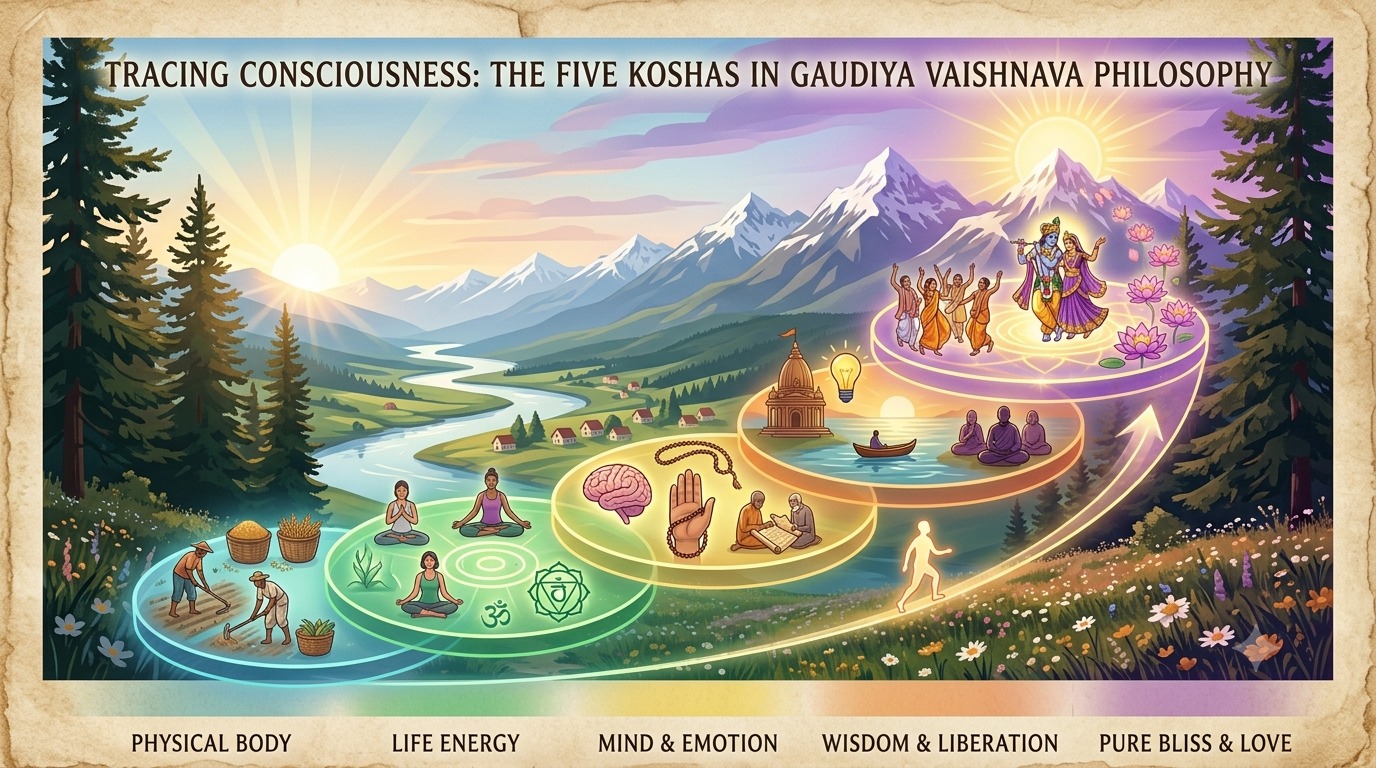
Tracing Consciousness: The Five Koshas in Gaudiya Vaishnava Philosophy
Most spiritual seekers are familiar with the *Pancha Koshas—the five layered sheaths that encapsulate the human soul. Originating in the *Taittiriya Upanishad, this psychological and metaphysical mapping is widely utilized across Yoga and Advaita Vedanta to navigate self-realization.
However, Gaudiya Vaishnava philosophy takes a distinct, razor-sharp approach to this hierarchy. While classic non-dual systems view these sheaths as illusions to be discarded to reach an impersonal void or formless state, Gaudiya acharyas (teachers) map the koshas as progressive evolutionary stages of consciousness leading to a personal, eternal relationship with the Supreme Personality of Godhead, Sri Krishna.
The Gaudiya Mapping of the Five Koshas
In Gaudiya theology, notably expanded by Srila Bhaktivinoda Thakura and commented upon in the Vedanta-sutra commentaries like Baladeva Vidyabhusana’s Govinda Bhashya, the sheaths are structured as follows:
| Kosha (Sheath) | Core Element | The Material Trap | The Gaudiya Spiritualization |
|---|---|---|---|
| 1. Annamaya | Food & Physical Matter | Identification with the physical flesh, eating, and bodily survival. | Utilizing the body as a temple; honoring Prasadam (sanctified food). |
| 2. Pranamaya | Vital Airs & Life Force | Pride in sensory power, vitality, and physical health. | Dedicating one’s life breath (prana) and active labor to the service of Krishna. |
| 3. Manomaya | Mental & Emotional | Mental speculation, passing desires, and philosophical gymnastics. | Subordinating the mind to scriptural truth; engaging the mind in Sravanam (hearing). |
| 4. Vijnanamaya | Intellect & Discrimination | Intellectual ego, false humility, or absorption in a formless Brahman. | Realization of the individual atomic soul (jiva) as an eternal servant of God. |
| 5. Anandamaya | Pure Spiritual Bliss | Seeking static liberation (mukti) or voidist peace. | Prema-bhakti: Active, dynamic, loving ecstasies in relationship with the Divine. |
Shastric Foundations: What the Scriptures Say
The foundational error of the conditioned soul is getting stuck in any of the lower four layers, falsely believing them to be the final destination. The Taittiriya Upanishad (2.1-5) methodically strips these layers away, but the final verdict on the ultimate layer—Anandamaya—is fiercely debated.
While non-dualists argue that Anandamaya is still a subtle material casing that must be dissolved, Gaudiya acharyas reference the Vedanta-sutra (1.1.12) to correct this:
आनन्दमयोऽभ्यासात्
ānandamayo ’bhyāsāt
“By nature, the Supreme Lord is full of ecstatic bliss.”
Baladeva Vidyabhusana clarifies that the Supreme Lord Himself is the very embodiment of the Anandamaya platform. Therefore, when the soul fully purifies its consciousness, it does not dissolve; it enters into this divine atmosphere of pure bliss.
In the Srimad-Bhagavatam (10.87.17), the personified Vedas pray:
“The wise master the life-breath and senses to worship You. Those who merely control the physical layers without active devotion simply tire themselves out, like crushing empty husks of grain.”
The Problem: The Perils of Casing-Identification
When a seeker fails to understand the Gaudiya perspective on the koshas, two existential crises emerge:
- The Materialist Dead-End (Annamaya / Pranamaya / Manomaya): The individual lives purely for comfort, sensory fitness, or emotional validation. This traps the soul in the cycle of samsara (repeated birth and death), mistaking the car (the body) for the driver (the soul).
- The Impersonal Pitfall (Vijnanamaya / Incomplete Anandamaya): The advanced yogi realizes they are not the body or mind and merges into a state of peaceful neutrality. Gaudiya philosophy marks this as incomplete. If you step out of the material casings but do not engage your true spiritual form in active service, you experience a “dry” liberation that eventually leads to a spiritual fall-down due to a lack of nutritional spiritual relationship.
The Remedy: Engaging the Soul via Bhakti-Yoga
The Gaudiya remedy does not require you to artificially destroy or reject your physical, mental, or intellectual layers. Instead, the strategy is Yukta-Vairagya—the principle of using everything in the service of the Divine.
- Purify the Annamaya & Pranamaya layers: Physical & Vital.
Transform your relationship with matter. Instead of consuming food for selfish pleasure, eat only pure, sanctified plant-based food offered to God (Krishna-Prasadam). Use your physical strength and daily career to support spiritual communities. - Engage the Manomaya layer: Emotional & Mental.
Anchor the restless mind by replacing toxic mental chatter with the vibration of transcendental sound. The ultimate weapon here is the congregational chanting of the Holy Names (Sankirtan). - Enlighten the Vijnanamaya layer: Intellectual.
Systematically study sacred texts like the Bhagavad-gita under the guidance of a bona fide spiritual master (guru). This sharpens the intellect to discern the difference between matter (prakriti) and spirit (purusha). - Awaken the Anandamaya core: The Ecstatic Soul.
Transition from passive realization to active loving service (Bhakti). This awakens the soul’s innate, dormant spiritual identity (svarupa), allowing it to experience infinite, ever-expanding waves of divine love (Prema).
The Ultimate Benefit: Active Perfection
By understanding the koshas through the lens of Gaudiya philosophy, a practitioner achieves more than just a stress-free life or an escape from suffering. The final reward is the awakening of Sat-Chid-Ananda: an eternity of fully conscious, active joy. You transcend the casings not by discarding your identity, but by discovering your true, unadulterated form as an eternal servant of the divine couple, Sri Sri Radha-Krishna.
In his seminal works—particularly *Tattva-viveka and Jaiva Dharma—Srila Bhaktivinoda Thakura provides a brilliant socio-spiritual analysis of how human civilizations evolve. Rather than evaluating history purely through technological milestones or economic eras, he traces the upward trajectory of human societies by mapping them directly to the progressive awakening of the *Pancha Koshas (the five sheaths of consciousness).
To Bhaktivinoda Thakura, the progression of human civilization is a mirror reflection of the internal awakening of the soul as it bursts through its material casings.
1. The Annamaya Stage: The Uncivilized & Savage Society
At the dawn of human congregation, society is firmly anchored in the Annamaya Kosha (the physical body and food sheath).
- Socio-Cultural Expression: This is the phase of early hunter-gatherers and lawless, survival-driven clans. Bhaktivinoda Thakura notes that at this stage, humans are barely indistinguishable from animals. The primary preoccupation is securing food (anna), procreation, and physical survival.
- The Shift: Civilization truly “begins” when humans learn agriculture and economic structure to sustainably feed the physical body. Yet, if a society remains focused entirely on gross industrial capitalism, material comfort, and consumerism, Bhaktivinoda Thakura characterizes it as a highly sophisticated but spiritually primitive Annamaya society.
2. The Pranamaya Stage: The Organized, Rule-Bound State
As physical survival is secured, human consciousness expands into the Pranamaya Kosha (the vital life force, health, and sensory vigor).
- Socio-Cultural Expression: To protect the life breath (prana) and optimize sensory security, human communities begin establishing laws, martial structures, systems of defense, and medicine.
- The Shift: In this phase, civilization organizes basic societal moral codes. However, it is largely driven by fear of annihilation and the desire to maximize physical vitality. If a nation’s highest ideal is purely national security, athletics, healthcare, and physical longevity, it is an advanced Pranamaya civilization.
3. The Manomaya Stage: The Era of Philosophy and Secular Ethics
As survival and protection become automated, energy moves upward into the Manomaya Kosha (the mental and emotional sheath).
- Socio-Cultural Expression: This stage gives birth to high culture: deep literature, secular philosophy, psychological sciences, art, and the democratic balance of human rights.
- The Shift: Here, human beings begin to control the animalistic impulses of the lower layers using ethics (dharma). However, Bhaktivinoda Thakura explains that a purely Manomaya civilization remains trapped in mental speculation. It may produce brilliant academic philosophers, humanitarian ethics, or philanthropic organizations, but it lacks empirical knowledge of the soul itself.
4. The Vijnanamaya Stage: The Religious and Self-Realized Society
When a civilization begins to transcend the mind, it unlocks the Vijnanamaya Kosha (the intellectual and spiritual discrimination sheath).
- Socio-Cultural Expression: At this stage, society moves past secular ethics into actual, systematic religion and metaphysics. The intellect (buddhi) identifies that the living entity is not the physical body (annamaya) or the restless mind (manomaya), but an eternal spirit soul (jiva).
- The Shift: In a Vijnanamaya civilization, the focus shifts toward asceticism, yoga, and standard religious duties. People understand their spiritual identity and seek liberation (moksha). However, Bhaktivinoda Thakura warns that if a society stops here, it often leans toward impersonalism (Advaita Vedanta) or a desire to merge into a formless void to escape material suffering.
5. The Anandamaya Stage: The Spiritual Utopia (The Bhakti Society)
The ultimate pinnacle of human civilization occurs when it collective pierces through to the innermost layer: the Anandamaya Kosha (the sheath of pure, unadulterated divine bliss).
- Socio-Cultural Expression: This is a society organized entirely around unalloyed devotional service (Prema-bhakti) to the Supreme Personality of Godhead, Sri Krishna.
- The Ultimate Form: Bhaktivinoda Thakura writes that on the Anandamaya platform, civilization is no longer defined by rigid, fearful religious rules, but by spontaneous, ecstatically affectionate relationships. All actions—art, food, labor, science—are performed as an offering of love. This represents the absolute perfection of human society, transforming the mundane world into a reflection of the spiritual sky (Vaikuntha).
The Thakura’s Core Conclusion:
Material historians evaluate a civilization’s advancement by how efficiently it manipulates the Annamaya (roads, buildings, factories) and Pranamaya (military, medicine) layers. Srila Bhaktivinoda Thakura flips this paradigm on its head, asserting that a truly advanced civilization is measured solely by how effectively it helps the individual citizen step out of material casing altogether and experience the pure bliss (Ananda) of the soul.