Here are Scriptural Proofs that Vaishnavas Are Superior to Smarta Brahmanas
What Makes a True Brahmana? Why Vedic Scriptures Prioritize Bhakti Over Seminal Birth
In modern spiritual discourse, the debate between birthright (Janma) and qualification (Guna-Karma) remains highly volatile. For centuries, orthodox smarta traditions have claimed that being born into a brahmana family grants an unassailable spiritual monopoly.
However, the highest Vedic conclusions (Siddhanta) painted by the Puranas, Upanishads, and the Bhagavad-gita reveal a radical truth: A pure devotee of the Lord (Vaishnava), regardless of birth, is highly superior to a person who is merely a brahmana by birth.
1. The Myth of the “Seminal Brahmana” (Janmana Jayate Sudrah)
The scriptures explicitly declare that no one is born a brahmana. Birth only grants a biological body; character and initiation grant spiritual status.
The Evidence from the Skanda Purana: to
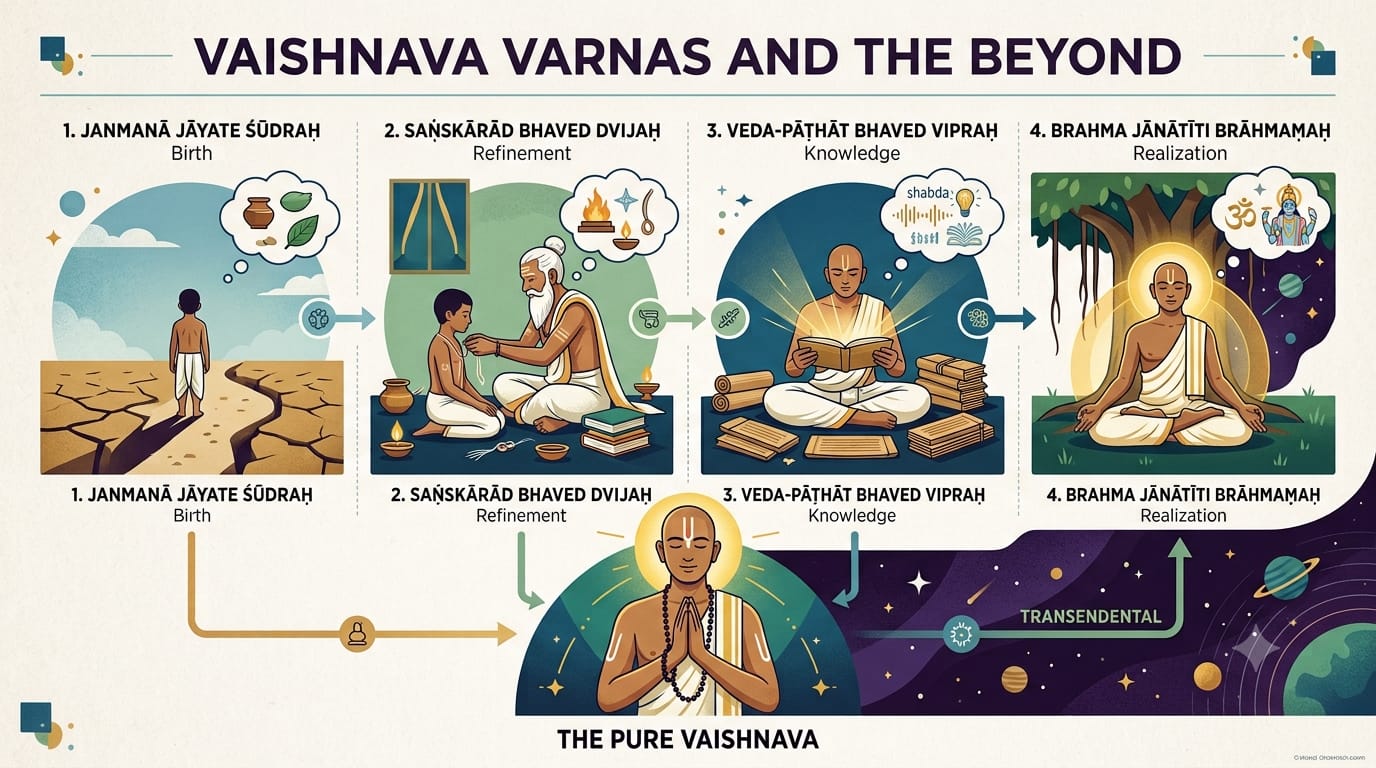
janmanā jāyate śūdraḥ saṁskārād bhaved dvijaḥ
veda-pāṭhāt bhaved vipro brahma jānātīti brāhmaṇaḥ
- Translation: “By birth, everyone is a shudra (unrefined). By undergoing purificatory processes (samskaras), one becomes twice-born (dvija). By studying the Vedas, one becomes a vipra (scholar). But only one who actually knows the Supreme Brahman is a true brahmana.”
If a brahmana by birth does not realize the Supreme Lord, they fundamentally remain stuck at the baseline. A Vaishnava, by definition, has realized and surrendered to the Supreme Brahman.
2. A Scholar of 4 Vedas vs. An Outcaste Devotee
A common argument is that a birth-right brahmana knows all the complex Vedic rituals. But what does the Supreme Lord value more—ritualistic grammar or love?
The Evidence from the Hari-bhakti-vilasa (10.127) & Itihasa-samuccaya:
na me ’bhaktaś catur-vedī mad-bhaktaḥ śva-pacaḥ priyaḥ
tasmai deyaṁ tato grāhyaṁ sa ca pūjyo yathā hy aham
                   ┌─────────────────────────┐
                   │   THE HIERARCHY OF SOUL │
                   └────────────┬────────────┘
                                │
              ┌─────────────────┴─────────────────┐
              ▼                                   ▼
   [ The Non-Devotee Scholar ]         [ The Outcaste Devotee ]
     • Master of 4 Vedas                 • Born in low family
     • High birth lineage                • Filled with love for Vishnu
     • Rejected by Krishna               • "As worshipable as God"
“A scholar of the four Vedas who is devoid of devotional service is not dear to Me. But a devotee who comes from a family of dog-eaters (outcastes) is very dear to Me. Whatever he offers should be accepted, and to him charity should be given, for he is as worshipable as I am.
- Lord Krishna explicitly states that a low-born Vaishnava is equal to Him in honor, while a non-devotee brahmana is rejected.
3. Verdict from the Srimad-Bhagavatam (7.9.10)
Prahlada Maharaja, one of the twelve great authorities (Mahajanas) of Vedic truth, delivered the definitive blow to birth-based elitism.
The Evidence:
viprād dvi-ṣaḍ-guṇa-yutād aravinda-nābha-
pādāravinda-vimukhāt śvapacaṁ variṣṭham
manye tad-arpita-mano-vacanehitārtha-
prāṇaṁ punāti sa kulaṁ na tu bhūrimānaḥA brahmana may possess all twelve brahminical qualifications (such as wealth, high lineage, beauty, austerity, and scholarship), but if he is averse to the lotus feet of the Lotus-Nabhah Lord, he is inferior to a dog-eater who has surrendered his mind, words, activities, wealth, and life to the Lord. The outcaste devotee purifies his entire lineage, whereas the proud brahmana cannot even purify himself.”
Ritual purity is useless without spiritual alignment. Vaishnava possesses a purifying potency that a proud, hereditary brahmana completely lacks.
4. The Padma Purana Warning: Looking at Vaishnav
The Padma Purana takes the argument to its absolute extreme, establishing that a brahmana who is not a devotee shouldn’t even be associated with.
The Evidence (Uttara Khanda 224.53):
śva-pākam iva nekṣeta loke vipram avaiṣṇavam
vaiṣṇavo varṇo-bāhyo ’pi punāti bhuvana-trayam“In this world, one should not even look at the face of a *brahmana who is not a devotee of Vishnu; looking at him is like looking at a dog-eater (candala). On the other hand, a Vaishnava, even if born outside the varna system, purifies all the three worlds.”
The history of Vaishnavism is filled with revolutionary instances where birthright was completely set aside in favor of spiritual advancement.
According to Vedic theology, a Vaishnava operates on the Vaikuntha (transcendental) platform, which sits far above the material designations of the varna (caste) system.
Here are the most prominent historical and scriptural examples of non-Brahmana or low-born Vaishnavas who became the spiritual guides, masters, or objects of worship for born Brahmanas.
1. Haridasa Thakura & The Advaita Acharya Defiance
Born into a Muslim family in 15th-century Bengal, Haridasa Thakura was considered an absolute outcaste by the orthodox Hindu society of his time. Yet, Chaitanya Mahaprabhu designated him as the Namacharya (the master of chanting the Holy Name).
The Brahmana Submission:
Advaita Acharya, a top-tier, highly respected brahmana scholar of Shantipur, performed the yearly Sraddha (ancestral offerings) ceremony. Scriptural injunctions dictate that the highest-ranking brahmana must be fed first to validate the ritual. Advaita Acharya bypassed the entire assembly of elite aristocratic Brahmanas and offered the plate directly to Haridasa Thakura.
When the local Brahmanas protested that feeding a low-born man ruined the ritual, Advaita Acharya quoted the Puranas, stating:
“Feeding you, Haridasa, is equal to feeding millions of Brahmanas.”
Eventually, born Brahmanas like Yadunandana Acharya took spiritual guidance and initiation within the fold where Haridasa Thakura was an ultimate authority.
2. Thiruppaan Alvar & Sage Saranga Deva
In the Sri Vaishnava tradition of South India, the Alvars are twelve ancient saints whose ecstatic poetry forms the core of the Divya Prabandham. Thiruppaan Alvar was born into the Paana community—a group of low-caste wandering musicians considered untouchable.
The Brahmana Submission:
Thiruppaan spent his days singing outside the Ranganathaswamy Temple in Srirangam, as he wasn’t allowed inside. One morning, the temple’s chief high priest, a rigid born-brahmana named Saranga Deva, arrived to fetch water for the deity. Finding Thiruppaan in the way, Saranga Deva threw a stone at him to make him move, injuring the saint’s forehead.
Later, when Saranga Deva entered the sanctum sanctorum, he was horrified to find the deity of Lord Ranganatha bleeding from the exact same spot on the forehead. The Lord appeared in the priest’s dream and commanded him to carry Thiruppaan into the temple on his own shoulders.
The proud brahmana priest repented, went out, bowed down before the low-caste saint, and carried Thiruppaan Alvar on his shoulders into the holiest sanctuary of the temple, accepting him as a supreme spiritual guide.
3. Shukadeva Goswami & The Assembly of Sages
Shukadeva Goswami, the narrator of the Srimad-Bhagavatam, was a liberated soul from birth. While he was technically born to Vyasadeva (a Brahmana/Sage), he lived completely outside society as an avadhuta—he wore no clothes, followed no social rituals, didn’t wear the brahminical thread, and appeared like a madman to ordinary people.
The Brahmana Submission:
When Emperor Parikshit was preparing to die and sat on the banks of the Ganges, an assembly of the greatest minds in the universe gathered: Vyasadeva, Narada, Vashistha, Vishvamitra, and Parashara—all top-tier Brahmanas and Brahmarshis by birth, age, and culture.
Yet, when the young, unkempt Shukadeva Goswami walked into the assembly, *every single elder Brahmana stood up to show respect. They unanimously elected the non-ritualistic, socially unclassified Vaishnava to sit on the *Vyasa-asana (the highest seat of the teacher) and speak the ultimate truth to them all.
4. Ramananda Raya & Sri Chaitanya Mahaprabhu
Ramananda Raya was born into a non-Brahmana family (the Kayastha or administrative class) and served as the Governor of Madras under King Prataparudra.
The Brahmana Submission:
Sri Chaitanya Mahaprabhu, who was born into a highly aristocratic brahmana family in Navadvip, approached Ramananda Raya on the banks of the Godavari River specifically to learn the highest confidential aspects of bhakti (devotion).
When Ramananda Raya hesitated to instruct a born brahmana and sannyasi, Chaitanya Mahaprabhu uttered one of the most famous verses in Vaishnava philosophy regarding spiritual mastership:
kibā vipra, kibā nyāsī, śūdra kene naya
yei kṛṣṇa-tattva-vettā, sei ‘guru’ haya
(Chaitanya-charitamrta, Madhya 8.128)
- Meaning: “Whether one is a brahmana, a sannyasi (renunciant), or a shudra—it does not matter. Anyone who knows the science of Krishna (Krishna-tattva) is eligible to become a spiritual master.”
5. Narottama Dasa Thakura & Ramachandra Kaviraja
In the generations following Chaitanya Mahaprabhu, Narottama Dasa Thakura emerged as a towering spiritual powerhouse. He was born into a royal Kayastha (non-Brahmana) family in East Bengal.
The Brahmana Submission:
Despite his non-Brahmana birth, Narottama Dasa Thakura initiated dozens of high-born, traditional Smarta Brahmanas into the Vaishnava fold. His most prominent disciple was Ramachandra Kaviraja, an exceptionally brilliant physician and scholar born into a high-caste family.
The orthodox Smarta Brahmanas of the region were furious that a non-Brahmana was giving spiritual initiation (diksha) and the sacred thread to Brahmanas. They challenged Narottama Dasa to a debate. However, Narottama’s disciples easily defeated the caste-proud Brahmanas using strict scriptural evidence, proving that a pure devotee is automatically purified beyond the status of any ritualistic priest.
          ┌──────────────────────────────────────────────┐
          │ SCRIPTURAL VERDICT ON GURU QUALIFICATION     │
          └──────────────────────┬───────────────────────┘
                                 │
     ┌───────────────────────────┴───────────────────────────┐
     ▼                                                       ▼
[ Padma Purana: The Ultimate Rule ]            [ Padma Purana: The Warning ]
"A Vaishnava who is expert in all              "A born Brahmana who is NOT a
spiritual science can become a guru            Vaishnava CANNOT become a guru;
for all classes, including Brahmanas."         initiating through him leads to ruin."
The Definitive Verse from the Padma Purana:
mahā-kula-prasūto ’pi sarva-yajñeṣu dīkṣitaḥ
sahasra-śākhādhyāyī ca na guruḥ syād avaiṣṇavaḥ
- Meaning: “Even if a person is born in a highly aristocratic aristocratic family, is initiated into all Vedic sacrificial rituals, and has studied thousands of branches of the Vedas—if he is not a Vaishnava (devotee), he can never become a spiritual master.”
Conclusion: Character Over Caste
The message of the Vedic core is clear: Caste is a matter of character, not chemistry. A brahmana by birth who lacks devotion to the Supreme Lord is simply an empty vessel. A Vaishnava, filled with love for God, possesses the highest realization of Brahman and is naturally situated far above the material designations of the caste system.