
The Commodification of Cosmic Consciousness
Modern Spirituality is the Ultimate Consumer Trap
Enlightenment used to require renunciation. Today, it requires a credit card, a 10-step morning routine, and a subscription to a mindfulness app optimized for corporate retention.
Welcome to the era of spiritual consumerism—a multi-trillion-dollar industry that took ancient practices meant to dismantle the ego and repackaged them as premium lifestyle accessories for it.
1. The Monetization of Liberation
The fundamental trick of spiritual consumerism is convincing you that your soul is an underperforming asset that requires external upgrades.
If traditional consumerism sells you things to fix your body or status, spiritual consumerism sells you things to fix your vibration. It converts existential anxiety into product categories:
- McMindfulness: Strip meditation of its ethical framework, rebrand it as “stress resilience,” and sell it to Fortune 500 companies so burnt-out employees can squeeze out another 60 hours of productivity.
- Aesthetic Asceticism: The aestheticization of simplicity—where a minimal, neutral-toned linen robe costs $400 and an “artisanal” singing bowl retails for the price of a used car.
- Egoic Transmutation: You aren’t buying a rock; you are buying an amethyst frequency generator that aligns your chakras while matching your living room decor.
2. The “Good Vibes Only” Industrial Complex
By enforcing toxic positivity, the modern wellness machine neutralizes genuine critique. “Low vibrations” are treated like a contagious disease, effectively silencing righteous anger, political awareness, or systemic critique.
The Trap: When suffering is framed entirely as an internal mindset issue (“you manifest your own reality”), structural poverty, workplace exploitation, and corporate burnout are magically erased. You aren’t underpaid; you just have an “abundance scarcity block.”
Traditional Path: Discomfort ──> Inner Inquiry ──> Ego Dissolution ──> Freedom
Consumerist Path: Discomfort ──> Buy Product ──> Temporary Relief ──> Repeat
3. The Anatomy of Commercialized Awakening
| Traditional Spiritual Practice | Spiritual Consumerism Equivalent | The Real Function |
|---|---|---|
| Ahimsa & Non-Attachment | $120/month luxury studio membership | Status signalling & aesthetic belonging |
| Shadow Work & Self-Inquiry | $3,500 “Soul Realignment” Bali Retreat | Instagram content & performative catharsis |
| Inner Discipline (Sadhana) | “Biohacking” wellness stack & supplements | Optimization fetishism |
| Community (Sangha) | Paid Discord tiers & influencer circles | Monetized access to pseudo-gurus |
4. The Guru Playbook: Funneling Transcendence
Modern digital spiritual entrepreneurs use standard direct-to-consumer (DTC) marketing tactics applied to the human soul:
- The Problem Agitation: Convince you that your exhaustion, grief, or boredom is a sign of “unaligned energy” or an “unhealed inner child.”
- The Parasocial Authority: Present the founder as someone who was once “broken like you,” but unlocked secret ancient wisdom through trial, error, and an expensive trip to Tulum.
- The Tiered Salvation: Offer a free podcast, a $49 gateway PDF course, a $500 weekend workshop, and finally a $10,000 “inner circle” mastermind for true high-vibrational seekers.
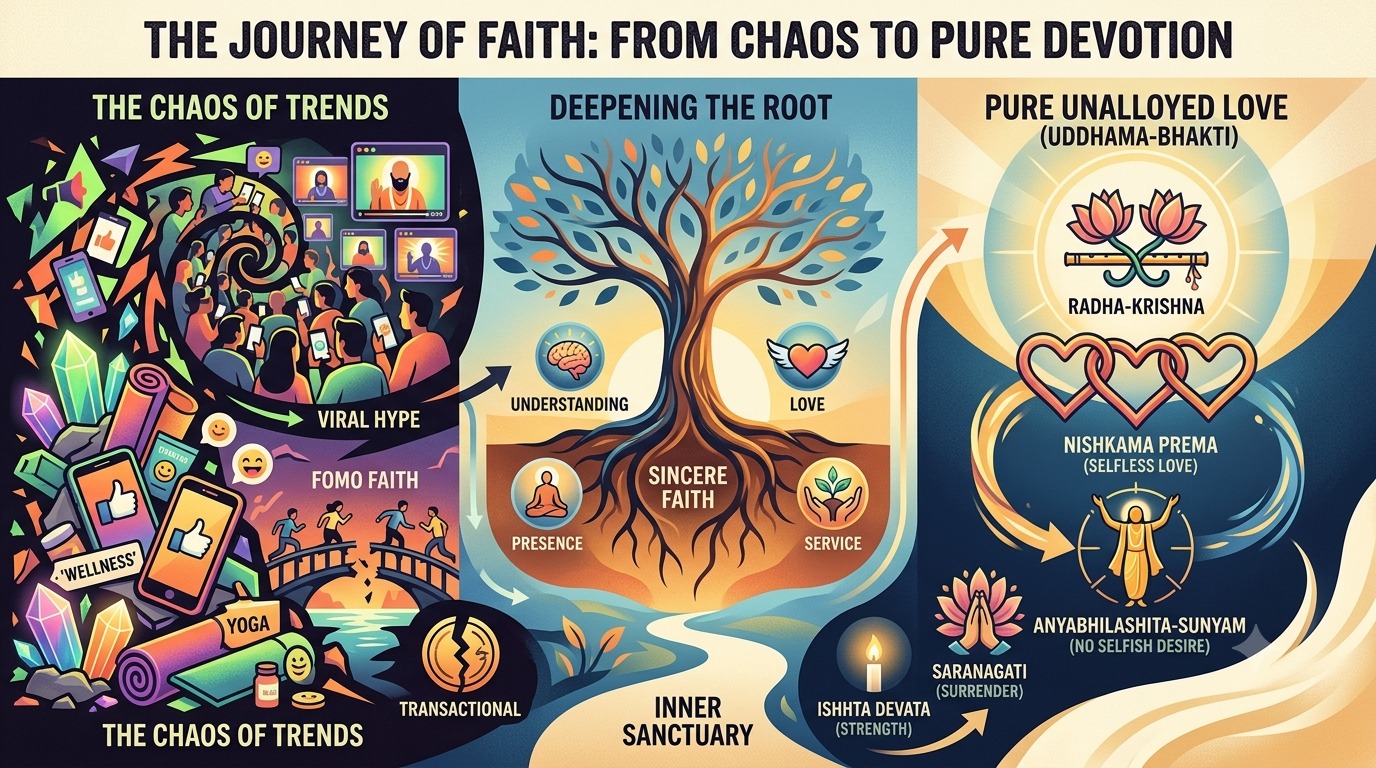
The Viral Faith Trap: Why Fast-Food Devotion Won’t Save Your Soul
In today’s India, spiritual devotion (Bhakti) is increasingly measured by algorithms.
One week, a reels clip goes viral, and thousands rush to a specific temple, queueing for ten hours for a two-second Darshan. The next month, a new saint or baba trends on YouTube, and the crowds pivot instantly—chasing the newest hotspot for instant miracles, quick remedies, and spiritual shortcuts.
This isn’t devotion; it’s spiritual FOMO (Fear of Missing Out)
When faith becomes driven by trends, Bhakti is stripped of its depth and transformed into a fast-food transaction. But true Indian spiritual tradition has always taught the exact opposite: devotion is not a seasonal trend—it is a lifelong, sincere relationship.
1. The Trap of “Chamatkar” (Miracle Chasing)
Why do people jump from one deity or shrine to another? Because modern viral culture promises quick returns:
- “Visit this temple to clear your loans in 7 days.”
- “Chant this mantra 108 times to pass your exam.”
- “Post this reel or face bad luck.”
When you approach the Divine only for a bargain or a miracle, you treat God like an atmospheric vending machine: insert a token of prayer, demand a reward.
The Reality: When the miracle doesn’t happen on schedule, the faith crumbles, and the search for the “next viral spot” begins. This is not connection—it is commercial negotiation disguised as faith.
2. The Four Pillars of True Bhakti
The great saints of India—from Shabari and Hanuman to Meera, Tukaram, and Kuriur Amma—never chased viral miracles. Their devotion was grounded in four deeply personal aspects:
To Understand Him ──> To Love Him ──> To Be With Him ──> To Serve Him
(Gyan) (Prema) (Sanga) (Seva)
I. Understanding Him (Jnana)
Real devotion begins with understanding who you are praying to. It comes from reading scripture, reflecting on teachings, and seeing the Divine not just as a power to fear or exploit, but as the supreme consciousness within and around you.
II. Loving Him (Prema)
Pure love (Nishkama Bhakti) asks for nothing in return. Shabari didn’t offer taste-tested berries to Lord Rama to get a promotion or a lottery win; she offered them out of selfless, overflowing affection.
III. Being With Him (Sanga)
True connection doesn’t require a $500 special VIP entry ticket or an Instagram story at a trending shrine. God is accessible in the silence of your own home, in quiet contemplation, and in sincere daily remembrance.
IV. Serving Him (Seva)
Devotion manifests in action. To serve God is to serve His creation—treating people with kindness, helping those in need, living an honest life and preaching message of Bhagavad Gita, Srimad Bhagavatam to others. A thousands-strong pilgrimage means little if one returns home to treat family or workers with disrespect.
3. Viral Hype vs. Deep Connection
| Viral / Trend-Driven Faith | Deep & Sincere Bhakti |
|---|---|
| Triggered by: Reels, algorithms, and hype | Triggered by: Inner calling and steady discipline |
| Core Goal: Instant solutions, luck, and social validation | Core Goal: Peace, inner purity, and closeness to God |
| Demeanor: Restless, transactional, always searching | Demeanor: Calm, patient, surrendered (Sharana) |
| Location: Whichever temple/shrine is trending | Location: Everywhere—starting within one’s own heart |
The Path Forward: Quiet the Noise, Deepen the Root
A tree with shallow roots falls in the first storm, no matter how many leaves it has. Jumping from one trend to another keeps your spiritual roots shallow.
If you truly want to experience the power of faith:
- Pick any Ishta Devata of Bhagavad Gita, Bhagavatam Path and stay committed.
- Stop treating prayer as a shopping list. Sit quietly and simply express love, gratitude, and surrender.
- Focus on character, not just rituals. True devotion softens the heart and reduces the ego.
God does not live in an algorithm, nor is He waiting at the end of a viral trend. He is found in the quiet, sincere depth of an unwavering heart.
The Verdict: Reclaiming the Unsellable
The ultimate irony of spiritual consumerism is that true awakening is utterly useless to the market. It cannot be monetized because it desires nothing.
When you stop treating your inner life like a renovation project that needs infinite supplies, the entire industry loses its grip. Silence costs nothing, breathing is free, and no crystal on earth can give you what you already possess when you stop buying into the delusion.
The Gaudiya Vaishnava Perspective: Pure Unalloyed Love (Suddha-Bhakti) Over Transactional Faith
The Gaudiya Vaishnava tradition—rooted in the teachings of Chaitanya Mahaprabhu, the 16th-century saint and avatar of Radha-Krishna—offers a profound, uncompromising response to both commercialized spirituality and trend-driven, transactional religion.
From the Gaudiya perspective, jumping between viral shrines for quick miracles isn’t just shallow; it belongs to the lowest tier of spiritual realization. True faith is not about getting something from the Lord (Kama), but about offering everything to Him out of unselfish, unconditional love (Prema).
1. The Trap of Kama (Selfish Desire) vs. Prema (Pure Love)
The central pillar of Gaudiya philosophy, as outlined by Srila Rupa Gosvami in the Bhakti-rasamrta-sindhu, makes a strict distinction between genuine devotion and material bargaining:
“Unalloyed devotion (Uttama Bhakti) is the rendering of favorable service to Krishna, free from all desire for material gain, subtle speculation, or fruitive activity.”**
When people chase trending temples for wealth, exam results, or quick fixes, they are engaging in Kama (desire for self-gratification), not Prema (desire to satisfy Krishna).
In Gaudiya philosophy, using God as a tool to fulfill material desires treats the Supreme Lord like a servant, reversing the eternal constitutional position of the soul (Jiva), which is to be the eternal servant of Krishna (Jivera ‘svarupa’ haya-krsnera ‘nitya-dasa’).
2. The Four Stages of Faith (Sraddha)
Why do people jump from one viral phenomenon to another? The Gaudiya texts explain this through the evolution of faith:
Kanishtha-Adhikari (Neophyte) ──> Madhyama-Adhikari (Intermediate) ──> Uttama-Adhikari (Advanced)
[External, Trend-Driven] [Discriminating & Deep] [Unshakable Prema]
- Kanishtha-Adhikari (The Neophyte): Worships the deity in the temple with standard rituals, but lacks deep scriptural understanding and cannot see God in all living beings. This level of faith is fragile—easily swayed by viral videos, hype, and promises of instant miracles.
- Madhyama-Adhikari (The Intermediate): Develops sincere love for the Lord, makes friends with devotees, shows mercy to the innocent, and avoids the envious. Faith here becomes rooted in philosophy and real spiritual relationships.
- Uttama-Adhikari (The Advanced): Sees Krishna everywhere and in everyone. For such a soul, spiritual connection doesn’t depend on a specific geographic shrine or social trend—their heart is an unbroken temple of Bhakti.
3. The Mood of Saranagati (Complete Surrender)
In Gaudiya Vaishnavism, spiritual maturity is marked by six limbs of surrender (Saranagati), famously summarized by Bhaktivinoda Thakura. Notice how these directly oppose the modern urge to control or demand outcomes from God:
- Accepting what is favorable for Bhakti: Cultivating holy name chanting, sacred study, and good company.
- Rejecting what is unfavorable: Turning away from materialistic hype, spiritual commercialism, and ostentatious displays.
- Accepting the Lord as one’s sole protector: Knowing that true shelter comes from Krishna, not from a specific “lucky” talisman or trending ritual.
- Accepting the Lord as one’s maintainer: Trusting His arrangement rather than bargaining for wealth.
- Self-surrender (Atma-niksepa):** Dedicating one’s thoughts, words, and actions to His joy.
- Humility (Karpanya):** Realizing that without His grace, one has no pride or spiritual leverage.
4. The Supreme Goal: Anyabhilashita-Sunyam
The crest jewel of Gaudiya theology is the spirit of Chaitanya Mahaprabhu’s Siksastakam (Verse 4):
“O Almighty Lord, I have no desire to accumulate wealth, nor do I desire beautiful women, nor do I want any number of followers. I only want Your causeless devotional service, birth after birth.”
| Transactional Religion (Viral Hype) | Gaudiya Suddha-Bhakti |
|---|---|
| Motivation: Anyabhilasa (material motives, wealth, relief) | Motivation: Anyabhilashita-sunyam (devoid of all motives) |
| Attitude: “Lord, give me what I want.” | Attitude: “Lord, how can I serve Your happiness?” |
| Stability: Shifting—moves to whichever deity “works” next | Stability: Unwavering—holds fast to Krishna/Radha regardless of circumstances |
| Expression: Showy pilgrimages, social posts, crowds | Expression: Inner transformation, humble Japa (chanting), Seva |
The Verdict: Moving From Bargaining to Seva
From the Gaudiya perspective, true devotion doesn’t require jumping on the latest trend or traveling across the country to stand in a chaotic queue for a two-second selfie-darshan.
The supreme practice for this age (Yuga-Dharma) is simple, quiet, and infinitely deep: Sankirtana and Japa—chanting the holy names with humility, free from material motives, and cultivating a loving service attitude (Sravanam, Kirtanam, Visnu-Smaranam).
When you stop treating God like a dispenser of material favors and start approaching Him with genuine love, the need for viral shortcuts vanishes—because you’ve already found the ultimate destination within.