Rethinking : Hinduism, Dignity, Karma, Caste, Purity & Devotion: Dalit Philosophy meets Gaudiya Thought
Origins and Meaning of the Term “Dalit”
Vedic vs. Non-Vedic Origins
The word “Dalit” is not a Vedic term. You will not find it in ancient Sanskrit texts such as the Rigveda, Upanishads, or classical Dharmashastras.
In traditional Sanskrit, the root word dal (दल) means “to split,” “to crack,” or “to crush.” However, as a social category, “Dalit” is a modern political and social designation.
Sanskrit root “Dal” (to crush / broken)
↓
19th-Century Marathi translations (used by Jotirao Phule)
↓
1970s Dalit Panther Movement (politicized & popularized)
Modern Meaning and Political Identity
- Literal Meaning: “Crushed,” “broken,” “ground down,” or “oppressed.”
- As a Political Identity: The term was popularized in the late 19th century by social reformer Jotirao Phule and later used in administrative contexts. However, it was radically transformed in the 1970s by the Dalit Panthers movement and deeply influenced by Dr. B.R. Ambedkar’s philosophy.
- Self-Assertion: Rather than accepting administrative labels like “Scheduled Castes”, marginalized communities embraced “Dalit” as a badge of pride, solidarity, and active political assertion—framing their identity around a shared history of struggle rather than a ritual status assigned by birth.
- Harijan (literally translating to “People of Lord Vishnu”) is a Gujarati and Hindi term famously popularized in the 1930s by Mahatma Gandhi to refer to Dalit, faced intense criticism, most notably from Dr. B.R. Ambedkar.
The Rise of Dalit Critique Against Vedic and Orthodox Principles
The formalization of Dalit philosophy—most prominently articulated by Dr. B.R. Ambedkar in foundational works like Annihilation of Caste—led to a systemic ideological challenge against orthodox Vedic and Brahminical frameworks.
While the terms Scheduled Castes (SC) and Dalit are often used interchangeably in everyday speech to refer to the same communities, they belong to entirely different domains—one is a precise *legal-administrative classification, while the other is an *emancipatory political identity.
1. Constitutional & Legal Definition: “Scheduled Castes” (SC)
Origin and Status
- Legal Basis: “Scheduled Castes” is an official, legal term defined under Article 341 of the Constitution of India.
- Historical Precedent: It originated in the Government of India Act of 1935 during British rule and was formally adopted into the Indian Constitution in 1950.
- How It Works: Under Article 341, the President of India issues a public notification listing specific social groups within each state or union territory. These groups are compiled into a “Schedule”—hence the name “Scheduled Castes.”
Key Characteristics
- Administrative Purpose: The designation exists strictly to identify communities that historically faced extreme social exclusion, untouchability, and disadvantage, so the state can extend affirmative action (reservation in education, employment, and political seats) and social welfare protections.
- Statutory Rights: Inclusion in the Schedule grants specific legal safeguards, such as protection under the Scheduled Castes and Scheduled Tribes (Prevention of Atrocities) Act, 1989.
- Religious Criterion (The 1950 Order): Under the Constitution (Scheduled Castes) Order, 1950, only individuals professing Hinduism, Sikhism (added in 1956), or Buddhism (added in 1990) can legally be classified as Scheduled Castes. Dalit converts to Christianity or Islam are excluded from the legal SC status (though they may fall under the Other Backward Classes / OBC category in some states).
- Self-Chosen Identity: Unlike bureaucratic labels imposed by the state (“Scheduled Castes” or historical administrative terms like “Depressed Classes”), “Dalit” was chosen by the people themselves as an act of self-assertion and dignity.
- Transcends Religious Boundaries: Unlike the legal SC category (which excludes Christians and Muslims), “Dalit” is a broad political umbrella encompassing all historically oppressed groups suffering from caste discrimination, regardless of their current religious affiliation (e.g., Dalit Christians, Dalit Muslims).
The Official Advisory Against Using “Dalit” in Government Documents
Because “Dalit” is an ideological term rather than a statutory definition, the legal system explicitly distinguishes between the two:
* Ministry Guidelines: The Ministry of Social Justice and Empowerment, along with various High Courts (such as the Madhya Pradesh High Court and Bombay High Court), issued advisories directing government authorities and media houses to use the official constitutional term “Scheduled Castes” (or Anusuchit Jati) in official communication, documents, and certificates rather than “Dalit.”
Misuse of “Scheduled Castes” (SC) quota
While affirmative action was designed as a constitutional tool to correct centuries of structural exclusion and provide social mobility, critics, policymakers, and legal scholars highlight several ways these benefits are bypassed, exploited, or inefficiently distributed today.
1. Fake Caste Certificates (Fraudulent Identity Claims)
One of the most direct forms of misuse involves individuals obtaining fraudulent SC certificates to claim reserved seats in higher education, government employment, and political offices.
2. Religious Conversion and Dual Identity (“Crypto-Converts”)
Under the Constitution (Scheduled Castes) Order, 1950, legal SC status is restricted to individuals practicing Hinduism, Sikhism, or Buddhism. Some individuals convert religiously while maintaining their Hindu names and official paperwork solely to retain SC reservation benefits in education and employment.
3. The “Creamy Layer” Cornering Benefits
Unlike the Other Backward Classes (OBC) category, which has a legal income threshold (“creamy layer”) that excludes wealthy individuals from reservation benefits, the Scheduled Caste quota historically has had no creamy layer restriction.
- Concentration of Benefits: Families that have benefited from reservations over two or three generations—securing high-paying civil service jobs, political positions, or professional careers—continue to utilize SC quotas for their children.
- Deprivation of the Most Vulnerable: Critics argue this creates an elite sub-group within the SC category that repeatedly captures available seats, leaving rural, economically destitute, and illiterate SC individuals unable to compete or access state assistance.
4. Misuse of the SC/ST Prevention of Atrocities Act
The Scheduled Castes and Scheduled Tribes (Prevention of Atrocities) Act, 1989 was enacted to protect marginalized communities from systemic violence, harassment, and humiliation. However, concerns regarding its weaponization have been raised in courts.
- False Complaints: Courts have noted instances where the Act’s stringent provisions (such as immediate arrest without preliminary inquiry, or denial of anticipatory bail) were misused to settle personal enmities, land disputes, workplace grievances, or political rivalries against non-SC individuals.
5. Political Co-optation and Tokenism
Governments frequently expand reservation percentages or make grand promises regarding quotas without investing adequately in primary education, basic healthcare, or rural land reforms—the foundational elements required to help disadvantaged communities compete effectively.
- Institutional Neglect: Reserved seats in universities and government departments sometimes remain vacant for years due to administrative apathy, rendering the theoretical benefit useless on the ground.
Common Misinterpretations
Viewing it as a Caste Name: “Dalit” is not a single caste, sub-caste (jati), or ethnic group. It is an umbrella political and social identity encompassing hundreds of distinct communities across India.
Why SC/ST Communities Were Not Part of the Traditional Varnashrama System
The communities categorized today as Scheduled Castes (SC) and Scheduled Tribes (ST) were historically classified as Avarna (outside the fourfold Varna framework) due to a combination of historical, economic, and cultural factors:
- Geographical & Social Isolation (STs/Adivasis): Indigenous and tribal communities lived in forests, hills, and remote regions outside the core urban and agrarian centers where the Varnashrama economy functioned. They maintained their own distinct languages, customary laws, and clan-based governance.
- Occupational Segregation (SCs/Dalits): As settled agrarian society expanded, communities engaged in manual labor, sanitation, leatherwork, and handling waste were relegated to the margins. Rather than receiving an organic “limb” in the fourfold model (priests, rulers, merchants, laborers), they were placed outside it to create a captive, subjugated labor class.
- Cultural & Ritual Differences: These communities followed their own indigenous traditions—such as nature and ancestor worship, local dietary habits, and customary rites—without adopting Vedic rites of passage (Samskaras like Upanayana) or recognizing Brahminical ritual authority.
- Codification of “Purity & Pollution”: Vedic legal texts (Smritis) codified strict rules regarding physical and ritual cleanliness. Communities whose livelihoods or customs did not align with these codes were classified as Avarna or Antyaja (“last-born”), establishing the structural foundation for social exclusion.
1. Distinct Dietary Habits
Orthodox Brahminical society placed severe emphasis on ritual purity (saucha) through strict dietary rules. Groups that lived outside these rules were marked as socially and ritually polluting:
- Consumption of Scavenged or Unsanctioned Meat: While Vedic rituals historically involved specific animal sacrifices, orthodox post-Vedic society increasingly moved toward vegetarianism or strict rules about which meats could be consumed. Groups that ate beef, pork, wild game, or the meat of naturally dead/scavenged animals were deemed profoundly impure.
- Fermented Drinks and Forest Produce: Many forest tribes brewed traditional, wild-fermented beverages (such as mahua, rice beer, or palm toddy) for daily use and rituals, which orthodox texts viewed as degrading.
- Non-Observance of Ritual Fasting and Cooking Codes: Orthodox traditions mandated elaborate rules regarding who could cook food, how fire was lit, and who could sit together to eat (pankti-bhed). Indigenous communities ignored these taboos entirely.
2. Independent Spiritual Practices
Rather than adopting the Vedic pantheon (Indra, Agni, Varuna) or the later Puranic temple rituals (Pooja) led by Brahmin priests, indigenous and marginalized communities maintained their own spiritual systems:
- Animate/Animistic Nature Worship: They worshipped local forest deities, sacred groves, rivers, rocks, and animals—viewing nature itself as living spirits rather than relying on abstract cosmic deities.
- Gramadevatas (Village Deities) and Ancestor Worship: Worship was centered on local guardian spirits, mother goddesses (Gramadevatas), and ancestral spirits who protected specific clans or territories.
- Shamanic Practices and Direct Mediumship: Instead of relying on learned priests to chant Sanskrit mantras, their spiritual leaders were often local shamans, healers, or mediums who entered trances to communicate directly with spirits.
- Meat and Alcohol Offerings: Their spiritual offerings (bali) to local deities often included blood sacrifices, wild animal offerings, and local liquor—practices that orthodox Brahminical legal codes treated with extreme disdain.
3. Refusal (or Absence) of Vedic Rituals (Samskaras)
Belonging to the traditional Varna framework required undergoing specific rites of passage (Samskaras) that tied a person to the orthodox social order. Indigenous and non-conforming groups lived completely outside this ritual grid:
- No Upanayana (Sacred Thread Ceremony): They did not undergo the Upanayana ceremony, which was the prerequisite for receiving formal Vedic education and entering the upper varnas.
- Customary Marriages vs. Vedic Rites: They followed their own customary marriage practices—such as bride-price, mutual consent, or remarriage of widows—which directly contradicted orthodox texts like the Manusmriti that strictly regulated endogamy, dowry, and lineage purity.
- Burial Practices Instead of Cremation: While Vedic orthodoxy mandated cremation as a final sacrifice (Antyesti), many indigenous and tribal communities buried their dead according to their ancient clan traditions.
- Rejection of Brahminical Authority: Because these communities had their own elder councils, traditional headmen, and spiritual shamans, they had no social or economic reason to invite Brahmin priests to perform rituals or mediate their lives.
The Historical Outcome
Because these communities maintained their own food ways, worshipped their own gods, and governed themselves without adopting Vedic rites, orthodox legalists categorized them as existing outside the Varnashrama order.
Over centuries, as the agrarian state expanded into their forests and lands, this cultural and ritual distance was weaponized into social stigma—transforming what was originally cultural difference into systematic caste discrimination and untouchability.
From Social Revolt to Spiritual Realization
The critique raised by Dalit philosophy is not merely a social protest, but a profound demand for fundamental human dignity, equality, and freedom from systemic oppression. While political movements seek justice through state policies, legal frameworks, and social confrontation, the Gaudiya Vaishnava tradition offers a transcendental resolution—inviting every individual to step beyond the temporary, painful labels of the material world (upadhis) altogether.
In the Gaudiya perspective, true equality cannot be fully realized solely through material agitation or socio-political debate, as these operate within the realm of temporary dualities. By reorienting one’s energy toward Sankirtana (devotional chant and divine remembrance), the individual transcends the cycle of societal resentment and material identity, awakening to their eternal nature as a beloved fragment of the Divine (jivera ‘svarupa’ haya-krsnera ‘nitya-dasa’).
Rather than remaining locked in endless material conflict, the tradition invites all souls—regardless of birth, history, or background—to claim their highest spiritual heritage, embrace universal brotherhood, and experience authentic, unshakeable joy (ananda).
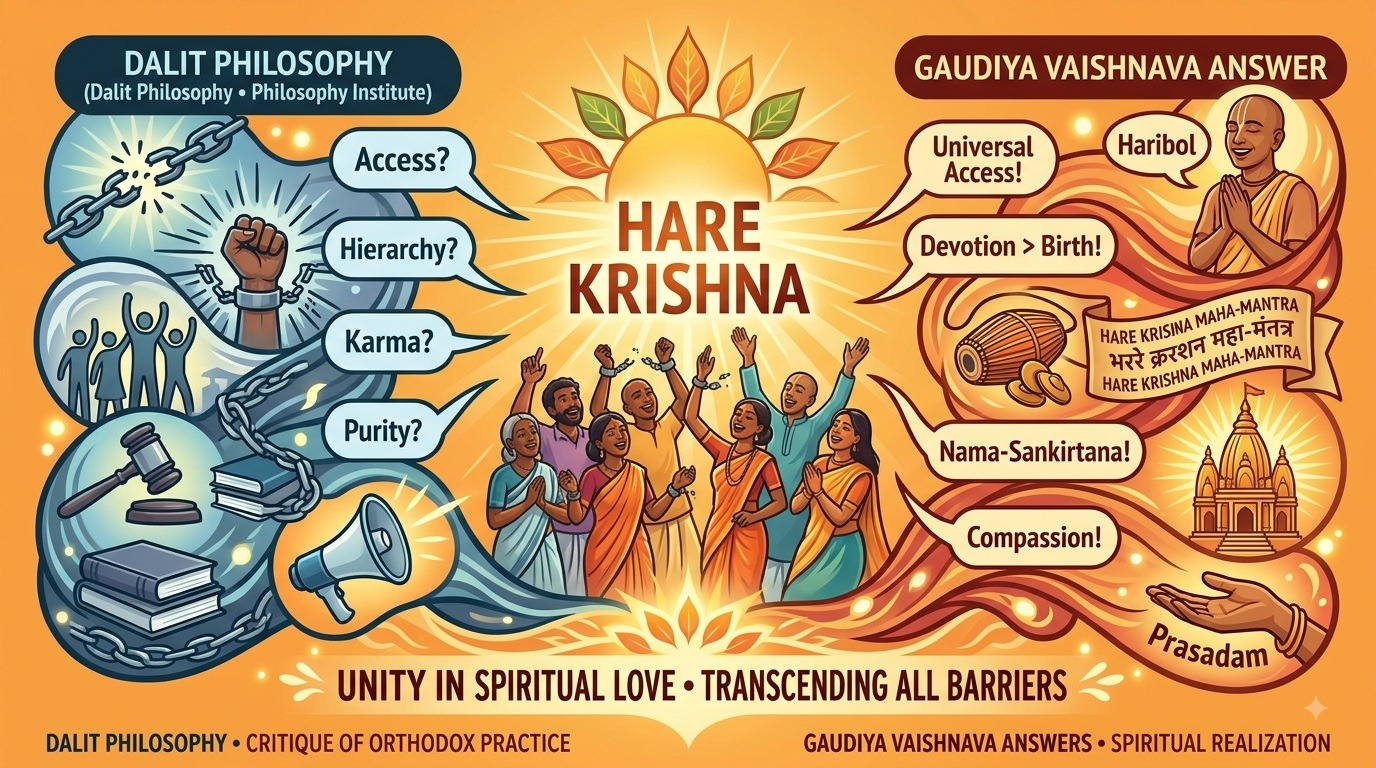
SC/ST Critiques vs. Gaudiya Vaishnava Answers
Below are core philosophical questions framed from the perspective of Dalit philosophy (as analyzed in comparative platforms like the Philosophy Institute) alongside how the Gaudiya Vaishnava (the devotional tradition revived by Chaitanya Mahaprabhu in the 16th century) tradition addresses them.
1. On Temple Entry, Priesthood, and Ritual Exclusion
“Why should access to the divine require elite Brahmin priests, Sanskrit rituals, and rigid concepts of ritual purity/impurity that historically barred marginalized communities from temples and sacred texts?”
- Universal Access via the Holy Name: Gaudiya Vaishnavism asserts that in Kali Yuga (the current age), elaborate temple rituals and hereditary priesthood are secondary to Sankirtana—the public, congregational chanting of the Holy Names of Krishna (Hare Krishna Maha-mantra).
- Transcending Purity Norms: Chaitanya Mahaprabhu broke social taboos by singing and dancing in public with people of all social strata. He quoted the Padma Purana: a person born in a so-called lower family who chants the name of God is considered superior to an orthodox Brahmin devoid of devotion.
- No Intermediary Needed: Devotion (bhakti) is a direct heart-to-heart connection between the soul (jiva) and God, requiring no ritualistic priest as a gatekeeper.
2. On Hereditary Caste (Janma-Varna) vs. Spiritual Equality
“Orthodox Hindu social structure fixes a person’s status, dignity, and rights by birth. How can a religion claim spiritual equality when its social practices preserve hereditary hierarchy?”
- Qualifications Over Birth (Guna-Karma):* Gaudiya theology explicitly rejects *janma-vāt (caste determined by birth). Citing Bhagavad-gita (4.13), the tradition holds that varna (occupational inclination) is defined strictly by individual quality (guna) and activity (karma), not family lineage.
- Daivi-Varnasrama & Brahminical Initiation: 20th-century Gaudiya reformist Bhaktisiddhanta Sarasvati Thakura formally instituted Daivi-Varnasrama. He awarded the sacred thread (upanayanam) and Brahminical initiation to practitioners based on character and devotional sincerity, regardless of whether they were born as Dalits, foreigners, or lower-caste individuals.
- *The Principle of *Kiba Vipra, Kiba Sudra:* Chaitanya Mahaprabhu declared in the *Chaitanya Charitamrita (Madhya 8.128):
“Whether one is a Brahmin, a sannyasi, or born in a low family, if he knows the science of Krishna, he is a spiritual master.”
3. On Immanence vs. Remote Transcendence
“Dominant Brahminical theology projects a distant, transcendent Absolute (Brahman) or a majestic, unapproachable king-like deity. Dalit spirituality focuses on an intimate, immediate, earth-bound deity who shares in human life.”
- Madhurya (Intimacy) Over Aisvarya (Awe): While Gaudiya philosophy acknowledges Krishna as the ultimate source of reality (Swayam Bhagavan), it prioritizes His intimate, personal form over His majestic, awe-inspiring aspects (Aisvarya).
- A God Who Plays and Eats: In Vrindavan, Krishna does not act like a distant ruler. He walks barefoot, plays with cowherd boys (sakhyam), steals butter, and submits to the affectionate love of His mother (vatsalya).
- Accessibility: The deity is made immediate through personal affection rather than complex Vedic geometry or fear-inducing orthodoxy.
4. On Karma as a Justification for Oppression
“The doctrine of Karma is often weaponized by upper castes to blame oppressed peoples for their current suffering while justifying systemic exploitation as ‘past sins.'”
- Past Karma is Destroyed by Bhakti: Gaudiya texts emphasize that the moment one takes up pure devotional service, all past karmic reactions—whether bad or good, manifested (prarabdha) or unmanifested (aprarabdha)—are burned away.
- Oppression is an Offense (Vaishnava-Aparadha):* Gaudiya theology does not excuse mistreatment or prejudice. Mistreating or discriminating against any living entity—especially a devotee—on the basis of their body, birth, or social status is classified as a severe spiritual offense (*Vaishnava-Aparadha or Jiva-Aparadha), which destroys one’s own spiritual progress.
- Active Compassion (Jiva-Doya):* A fundamental pillar of Gaudiya practice is *jiva-doya (compassion to all living beings). Realizing that every soul is a part-and-parcel of the Divine (mamaivamsho jiva-loke) obligates a practitioner to treat all people with respect.
5. On the Concept of Purity and Pollution (Saucha and Asaucha)
*”Traditional Hindu practices enforce rigid codes of ritual purity where physical touching, sharing food, or even the shadow of certain communities is considered ‘polluting.’
- Spiritual vs. Material Purity: Gaudiya theology redefines purity entirely. Material cleanliness (bahya-saucha) is subordinate to internal, spiritual purity (antara-saucha). The Chaitanya Charitamrita states that no material substance or physical birth can truly purify a human being—only contact with devotion (bhakti) and the Holy Name can.
- Prasad Breaks Purity Taboos: In Gaudiya practice, honored food (prasadam) is transcendental. Chaitanya Mahaprabhu explicitly rejected the orthodox rule that upper castes cannot eat food cooked or touched by lower castes. He frequently accepted food from Haridasa Thakura (who was born into a Muslim family) and sat with devotees of all backgrounds to take prasadam together, demonstrating that sacred food transcends caste pollution.
- The Body as a Temporary Garment: The physical body, whether classified socially as “clean” or “unclean,” is regarded merely as a material shirt (upadhi). The core identity is the pure spiritual soul (jiva), which is inherently untainted by material designations.
6. On the Authority of Sacred Texts (Vedas and Dharmashastras)
“Texts like the Manusmriti and certain Vedic commentaries have historically been used to justify social segregation and deny education to lower castes. Must one accept these texts to practice Hindu spirituality?”
- Supremacy of the Srimad-Bhagavatam: Gaudiya Vaishnavism places the Srimad-Bhagavatam (Bhagavata Purana) above social codes like the Dharmashastras. The Bhagavatam explicitly declares in its opening chapters that it rejects all forms of religion motivated by material status, caste privileges, or social gain (dharmaḥ projjhita-kaitavo ‘tra).
- Direct Access to Scriptures: Unlike traditional orthodox schools that restricted Vedic study to born Brahmins, the Gaudiya tradition insists that spiritual wisdom belongs to everyone. Great Gaudiya teachers translated, commented upon, and distributed sacred literature freely to all strata of society.
- Scriptural Validation of the Outcaste: The Srimad-Bhagavatam (3.33.7) contains a famous verse often cited by Gaudiya scholars: even a person born in a family of dog-eaters (svapacha) becomes worshipable if they engage in devotion, while a Brahmin lacking devotion is spiritually bankrupt.
7. On Liberation: Earthly Dignity vs. Heavenly Salvation
“Many mainstream Hindu doctrines promise liberation (moksha) or a better rebirth in the next life, which can act as a distraction from demanding justice, dignity, and equality in the present world.”
- Jivanmukti (Liberation Here and Now): Gaudiya philosophy does not view liberation as a distant, post-mortem reward. A practitioner who engages in unselfish devotional service experiences jivanmukti—liberation while still living in this body.
- Immediate Social Dignity: When a person enters the fold of devotion, their social standing within the devotional community changes instantly. They are addressed as Prabhu (master/lord) or Devotee, signaling that their spiritual dignity is active in the present, not deferred to a future life.
- Rejection of Passive Acceptance: While Gaudiya thought recognizes that material karma exists, it rejects using karma to mistreat others. Exploiting or dehumanizing someone under the pretext of their “karma” is viewed as a grave moral and spiritual failing that incurs severe negative consequences for the perpetrator.
8. On the Role of Renunciation (Sannyasa) and Social Engagement
“Renunciation in orthodox traditions often meant abandoning social responsibilities, or worse, preserving elite ascetic institutions that excluded lower castes from becoming spiritual leaders.”
- Yukta-Vairagya (Engaged Renunciation): Formulated by Rupa Gosvami, yukta-vairagya means using everything in the material world—technology, social structures, resources—in the service of the Divine rather than fleeing to the forest.
- Democratizing Spiritual Leadership: Bhaktisiddhanta Sarasvati Thakura broke centuries of tradition by granting the renounced order of life (sannyasa) to individuals based purely on character and devotion, rather than orthodox Brahminical lineage. This systematically opened the highest ranks of spiritual leadership to everyone.
- Grassroots Social Reform via Chanting: Chaitanya Mahaprabhu’s movement functioned as a public, social revival. The Sankirtana movement took worship out of restricted, elite temple sanctums into the streets, villages, and public squares, democratizing spiritual life across Bengal and Odisha.
9. On Gender, Body, and Social Identity (Upadhi)
“Social hierarchies do not exist in isolation—caste oppression is deeply intertwined with patriarchal control over bodies, marriage, and lineage. How does devotional theology dismantle these physical and social classifications?”
- *The Doctrine of *Upadhi (Material Designations):* Gaudiya theology explicitly teaches that race, caste, gender, economic status, and family lineage are superficial material labels (*upadhis) covering the soul. The fundamental identity of every living entity is jivera ‘svarupa’ haya-krsnera ‘nitya-dasa’—the eternal servant of Krishna.
- Radha-Bhava and Transcendence of Gender: In Gaudiya philosophy, the highest expression of love for God is exemplified by Srimati Radharani and the gopis (cowherd maidens of Vrindavan). The soul itself is inherently receptive (prakriti) in relation to the supreme active principle (Purusha). This reframes spiritual perfection around humility, love, and devotion rather than patriarchal control or ritual dominance.
- Equal Capacity for Devotion: Because the spirit soul has no material gender or caste, anyone—regardless of their social body—is fully capable of reaching the highest states of divine love (Prema).
10. On Language, Sanskrit Supremacy, and Vernacular Devotion
“Sanskrit has historically functioned as an elite language of exclusion, keeping spiritual knowledge locked away from working classes and marginalized communities who spoke local languages.”
- Elevating Vernacular Literature: While Gaudiya scholars wrote extensive Sanskrit treatises, Chaitanya Mahaprabhu and his followers championed the use of local languages—Bengali, Oriya, and Braj Bhasha—to compose songs, biographies, and poetry. Works like the Chaitanya Charitamrita and Chaitanya Bhagavata brought profound metaphysics directly to the common people.
- The Holy Name Transcends Grammar: Gaudiya theology holds that the Holy Name (Nama) is identical to God Himself and requires no knowledge of Sanskrit grammar, correct pronunciation, or Vedic accents to be effective. The Srimad-Bhagavatam notes that even an illiterate person chanting sincerely receives the full benefit of devotion.
- Mass Mass-Communication: By prioritizing song, dance, and storytelling over dry scholastic debate, the movement transformed spiritual practice into an accessible, communal culture rather than an elite academic pursuit.
11. On Agency, Subaltern Voice, and Self-Determination
“Reform movements often treat marginalized communities as passive recipients of charity or patronizing upliftment rather than autonomous agents of their own destiny.”
- Empowerment as Teachers and Gurus: Gaudiya Vaishnavism does not merely grant lower-caste individuals permission to worship; it empowers them to become teachers, guides, and spiritual masters (gurus). Figures like Haridasa Thakura were designated by Chaitanya Mahaprabhu as the Nama-Acharya (the foundational authority on chanting), positioned spiritually above elite court scholars.
- Direct Religious Authority: By validating personal inner experience, devotion (bhakti), and character over lineage, the tradition gives practitioners total spiritual agency. A devotee does not rely on societal approval or priestly sanction to perform worship (seva) or teach others.
- Rejection of Social Patronage: True Vaishnava compassion (jiva-doya) is rooted in seeing the divine presence within everyone, not in condescending pity. Respect (mana) is offered to all living beings without expecting honor for oneself (amanina manadena).
12. On Institutional Power and Material Co-optation
“Even egalitarian movements frequently get co-opted over time by upper-caste elites who re-establish hereditary control over institutions, properties, and leadership.”
- Historical Tension and Reform: The Gaudiya tradition itself experienced this exact historical tension. After the time of Chaitanya Mahaprabhu, hereditary priestly groups (Caste Goswamis) tried to reclaim exclusive rights over temples and guru lineages.
- The 19th–20th Century Counter-Reform: In response, reformers like Bhaktivinoda Thakura and Bhaktisiddhanta Sarasvati Thakura aggressively fought back against hereditary monopolies. They established institutional structures based strictly on personal merit, spiritual training, and ethical character rather than family succession.
- Continuous Vigilance via Scripture: Gaudiya texts explicitly warn against institutional decay, defining a true representative of the tradition not by birthright or institutional title, but by active devotion, humility, and freedom from material greed (lobha) and pride (pratishtha).
13. On Sacrificial Rituals, Blood Sacrifice, and Temple Economics
Dalit Critique:
“Vedic and Brahminical traditions historically used expensive animal sacrifices (yajna), strict ritual economics, and elite priests to maintain a monopoly on divine favor. How does Gaudiya theology address the ethics of ritual sacrifice and economic barriers to spiritual life?”
The Gaudiya Answer
- Rejection of Animal Sacrifice (Ahimsa):* Gaudiya Vaishnavism strictly forbids animal sacrifice and the consumption of meat. Citing the *Srimad-Bhagavatam, Gaudiya acharyas explicitly condemn ritual violence disguised as Vedic duty (dharma), asserting that true devotion must be rooted in non-violence (ahimsa) and compassion toward all living entities.
- Zero Cost for Salvation: Chaitanya Mahaprabhu introduced Nama-Sankirtana as the only required sacrifice (yajna) in the age of Kali. It requires no elaborate wealth, no golden altars, and no hired priests—only a sincere voice and a loving heart.
- Democratization of Spiritual Wealth: In the Chaitanya Charitamrita, Chaitanya Mahaprabhu compares himself to a merchant stocking the market of the Holy Name (Nama-hatta), distributing divine love freely without charging any price other than faith (sraddha).
14. On the Meaning of Suffering and “The Problem of Evil”
“When a system inflicts structural violence and dehumanization on millions for centuries, calling it ‘god’s will’ or ‘their own bad karma’ makes God complicit in injustice. How does theology reconcile divine love with systematic earthly suffering?”
- Distinguishing God’s Will from Human Misuse of Free Will: Gaudiya theology maintains that God (Krishna) does not author human cruelty or caste oppression. Structural violence stems from avidya (spiritual ignorance) and the misuse of human free will (karma).
- The Sinner Incurs Greater Evil: While a victim of violence may undergo material hardship, Gaudiya texts emphasize that the perpetrator who inflicts injustice accumulates severe negative karma and spiritual degradation (adharma). Oppression is never sanctioned as “divine justice”; it is defined as a grave moral failure.
- The Divine Encounters Suffering Directly: In Gaudiya philosophy, God is not an aloof monarch watching suffering from afar. As Avatara, Krishna descends directly into the material world to protect the vulnerable (paritranaya sadhunam) and dismantle arrogant, oppressive power structures.
15. On Local Deities, Ancestor Worship, and “High” vs. “Subaltern” Faith
“Brahminical orthodoxy often dismisses subaltern religions—such as the veneration of local village guardians (Gramadevata), earth spirits, and ancestral protector gods—as ‘superstition’ or ‘demonic’ (tamasic).”
- Respect for the Divine Presence in All Forms: Gaudiya Vaishnavism recognizes that ordinary folk traditions reflect humanity’s innate longing for divine protection. While Gaudiya theology encourages worshipping Krishna as the supreme source (Avataree), it discourages disrespecting or insulting local or folk deities (deva-ninda).
- Harmonizing Local Faith: Historically, when Gaudiya saints moved through rural Bengal and Odisha, they did not forcibly erase local traditions. Instead, they recontextualized local guardians as servants or devotees of Krishna (e.g., viewing Shiva or local protector deities as Vaishnavas who guard sacred geography).
- Inclusivity of Worship Styles: The fundamental essence of worship in Gaudiya thought is Bhava (emotional intent) rather than mechanical compliance with rigid Vedic Sanskrit rules. If a person approaches God with genuine affection, that worship is accepted.
16. On Physicality, Labor, and the Sacredness of the Earthly Body
“Dominant Hindu traditions often characterize the physical world as mere illusion (Maya) and physical labor as low or degrading, while exalting intellectual/priestly contemplation. Dalit philosophy asserts the inherent dignity of physical labor, sweat, and material life.”
- Rejection of Monistic Illusionism (Mayavada):* Gaudiya philosophy strongly rejects Advaita Vedanta’s view that the material world is absolute falsehood (*brahma satyam jagan mithya). Under Chaitanya’s doctrine of Achintya-Bhedabheda (simultaneous oneness and difference), the material world is a real, temporary energy (prakriti) emanating from God, not a delusion to be despised.
- *Labor Transformed into *Seva (Devotional Service):* In Gaudiya practice, physical labor—sweeping the temple grounds, cooking, farming, weaving, or building—is elevated to the highest spiritual discipline (*Kaya-Seva). Physical work done out of love for the Divine carries greater spiritual merit than dry, intellectual speculation without devotion.
- The Body as a Sacred Instrument: The physical body is neither an object of untouchable pollution nor a mere illusion; it is a temple (dehalaya) designed to serve others and chant the name of God.
17. On Historical Memory, Erasure, and Reclaiming Agency
“Dominant religious histories often erase the contributions of marginalized communities or rewrite their histories to fit orthodox narratives. How does the tradition handle historical memory, representation, and subaltern voices within its own heritage?”
- Preserving Subaltern Biographies: Key Gaudiya historical texts—such as Vrindavana Dasa Thakura’s Chaitanya Bhagavata and Krishnadasa Kaviraja’s Chaitanya Charitamrita—explicitly document and celebrate disciples from non-Brahminical, marginalized, and non-Hindu backgrounds. The histories of figures like Haridasa Thakura, Rupa, and Sanatana Gosvami were preserved as foundational to the movement’s identity rather than marginalized.
- Critique of Contemporary Brahminical Pride: Early Gaudiya literature records direct confrontation with 16th-century orthodox scholars (Pandits) of Nabadwip. The texts document how these scholars mocked Chaitanya Mahaprabhu’s egalitarian movement for allowing lower castes and ordinary citizens to chant sacred mantras publicly.
- Continuous Re-examination: Gaudiya history highlights that genuine devotion requires actively dismantling spiritual elitism in every era, recognizing that history must be continually reclaimed from conservative co-optation.
18. On Education, Pedagogy, and Access to Knowledge
“Historically, sacred knowledge was restricted to privileged groups, using secret mantras, esoteric rituals, and guarded texts to maintain social control. How does devotional theology approach pedagogy and the distribution of knowledge?”
- Open-Source Knowledge: Chaitanya Mahaprabhu broke the strict tradition of esoteric, secret initiation by publicly broadcasting the highest spiritual mantra—the Hare Krishna Maha-mantra—to everyone in streets, fields, and village squares without distinction or prerequisite qualifications (adhikara).
- Democratized Learning: The tradition established that eligibility to learn and teach spiritual philosophy is determined by one’s desire and character, not by hereditary privilege.
- Vernacular Commentary: By translating, writing, and explaining complex Sanskrit Vedanta into popular regional languages, Gaudiya acharyas dismantled the academic monopoly on philosophy, making deep metaphysical concepts understandable to farmers, artisans, and laborers.
19. On Collective Resistance vs. Individual Salvation
“Spiritual frameworks often focus purely on individual salvation or personal moral purity, ignoring the need for collective action against structural injustice and institutional oppression.”
- The Power of Mass Public Gathering (Sankirtana):* *Sankirtana was not merely private meditation; it was a collective, public movement. By gathering thousands of people to sing and march through public spaces, Chaitanya Mahaprabhu organized one of the earliest recorded civil disobedience actions in Indian history against the tyrannical Governor (Chand Kazi) of Nabadwip, who had banned public chanting.
- Community-Centric Spirituality: Gaudiya practice centers on Sadhu-Sanga (association of seekers) and collective congregation rather than isolated asceticism. Spiritual growth is seen as inherently tied to how one interacts with and builds community with others.
- Structural Reform through Institutions: In the 20th century, Bhaktisiddhanta Sarasvati Thakura institutionalized these egalitarian principles, creating a global network where social background was rendered irrelevant to organizational role or spiritual standing.
20. On the Nature of Human Dignity and Ultimate Identity
“In a society that has historically assigned value to human beings based on birth, purity, or social utility, where does absolute, unshakeable human dignity actually come from?”
- Inherent Divine Worth: In Gaudiya philosophy, human dignity is not granted by social institutions, state recognition, or ritual purity. It is inherent because every soul (jiva) is an eternal fragment (amsha) of the Supreme consciousness, possessing intrinsic beauty, agency, and capacity for divine love.
- Universal Brotherhood/Sisterhood: Because every living entity shares the exact same spiritual nature, looking down on any person based on social identity is viewed not just as a social crime, but as a fundamental spiritual delusion (maya).
- The Ultimate Goal (Prema):* The highest goal of life is not mere rule-following or institutional status, but *Prema—unconditional, unselfish divine love. In the realm of Prema, social hierarchies are completely rendered meaningless.
21. On Service (Seva) vs. Forced Servitude and Caste Labor
“In the orthodox caste system, ‘service’ was weaponized as the mandatory, degrading duty of the Shudras and Dalits, who were forced to labor for upper castes without compensation, dignity, or rights. How does the theology of ‘servitude to God’ avoid replicating this trauma?”
- Reclaiming the Title of ‘Servant’ (Dasa):* In Gaudiya theology, the title *Dasa (servant) is not a marker of social degradation, but the highest spiritual honor. The greatest spiritual masters append Dasa to their names, recognizing that true liberation is found in voluntary, loving service to the Divine, not in dominating others.
- Service as a Divine Privilege, Not Human Exploitation: Gaudiya philosophy strictly distinguishes between material servitude (forced labor for human masters) and spiritual seva (an autonomous, joyful offering to God). Forcing another human being to serve you based on their birth is considered a symptom of material disease (the desire to play God or Ishvara).
- God as the Ultimate Servant: To demonstrate that service is not degrading, Gaudiya texts highlight instances where the Divine takes the role of a menial servant for His devotees—such as Krishna driving Arjuna’s chariot or washing the feet of the guests at the Rajasuya sacrifice.
22. On Intellectualism, “Merit,” and Spiritual Elitism
“Concepts like ‘merit’ and ‘knowledge’ are often defined through upper-caste epistemologies—such as fluency in Sanskrit debate or abstract philosophy—used to gatekeep marginalized people from being recognized as wise or qualified.”
- Rejection of Dry Intellectualism (Jnana-marga):* Gaudiya Vaishnavism firmly subordinates dry academic scholarship and intellectual speculation (*jnana) to simple, sincere devotion (bhakti).
- The Pride of the Scholar: Chaitanya Mahaprabhu repeatedly defeated proud scholars (digvijayi pandits) not merely to prove his own intellect, but to humble them and demonstrate that academic arrogance actually blocks spiritual realization.
- True Merit is Humility: In the Gaudiya framework, spiritual “merit” is not measured by how many scriptures one has memorized, but by one’s humility, tolerance, and lack of false prestige. The Sikshashtakam states that one should be “more tolerant than a tree and devoid of all sense of false prestige” to chant the Holy Name properly.
23. On Food Politics and Dietary Stigmatization
“Vegetarianism has historically been weaponized by dominant castes as a tool of ‘food fascism’—stigmatizing marginalized, meat-eating (especially beef-eating) communities as polluted, aggressive, or inferior.”
- Ahimsa Without Elitism: Gaudiya Vaishnavism is strictly lacto-vegetarian, but its theology of diet is rooted in ahimsa (non-violence to animals) and offering food to the Divine, not in asserting caste superiority.
- Diet Does Not Equal Salvation: Gaudiya acharyas explicitly mock the idea that being vegetarian alone makes one holy. Bhaktisiddhanta Sarasvati Thakura famously pointed out that monkeys and pigeons are vegetarians, but that doesn’t make them saints. If vegetarianism is accompanied by hatred or discrimination toward others, it is spiritually useless.
- Transformative Power of Prasadam: Rather than isolating communities through food taboos, the tradition uses prasadam (sanctified food) as an equalizer. Historically, Gaudiya saints shared prasadam with tribal communities, hunters, and marginalized groups, believing that the divine grace in the food transforms the heart naturally, without resorting to social ostracization or violence.
24. On Social Duty (Varna-dharma) vs. Absolute Love (Sanatana-dharma)
“Traditional Hinduism often insists on adhering to ‘Dharma’—which, in practice, usually means Varnashrama-dharma, or strictly performing the duties of one’s birth caste. This prioritizes maintaining social hierarchy over absolute justice and human freedom.”
- Subordinating Varna to Bhakti: Gaudiya theology classifies Varnashrama-dharma (social duties) as temporary, material, and ultimately secondary. The true, eternal function of the soul is Sanatana-dharma—unalloyed love and service to the Supreme.
- Abandoning Material Religion: The foundational text of the tradition, the Bhagavad-gita, climaxes with Krishna’s instruction (18.66): sarva-dharman parityajya—”abandon all varieties of religion/duty and just surrender unto Me.” Gaudiya acharyas interpret this as a mandate to transcend all socially constructed duties and caste obligations in favor of pure devotion.
- The Madman for God: A highly advanced Gaudiya practitioner (a Paramahamsa) often acts in ways that completely disregard conventional social rules, etiquette, and caste duties, rendering the rigid structures of orthodox society totally irrelevant to the spiritual path.
25. On Spatial Segregation and the Right to Public Spaces
“Historically, untouchability wasn’t just a social concept—it was spatial. Marginalized communities were banned from using public roads near temples, drawing water from village wells, or living in central village locations. How does theology confront spatial segregation?”
- Reclaiming Public Spaces via Nagara Sankirtana: The defining practice of Chaitanya Mahaprabhu’s movement was Nagara Sankirtana—taking divine praise out of closed, upper-caste domestic altars and inner temple sanctums into public streets, roads, and market squares. By filling public spaces with people of all backgrounds singing together, the movement practically dismantled spatial segregation.
- Transforming Sacred Geography: When Chaitanya Mahaprabhu visited Jagannath Puri, he chose to stay at the house of Kasi Misra, but spent significant time with Haridasa Thakura at Siddha Bakula. Haridasa, because of his Muslim birth, voluntarily refrained from entering the main Jagannath temple to avoid confrontation with orthodox priests. Rather than ignoring him, Chaitanya Mahaprabhu visited him daily, declaring that Haridasa’s body was purer than the temple itself and bringing him the deity’s prasadam directly.
- God Beyond Physical Temples: Gaudiya theology explicitly insists that God cannot be confined within brick-and-mortar structures controlled by a particular social class. The omnipresent Supreme Lord resides wherever His names are sung with devotion.
26. On the Concept of Maya (Illusion) vs. Material Injustice
“When religious frameworks label the material world as ‘Maya’ (illusion), it can be used to minimize real-world oppression. Dismissing hunger, poverty, or discrimination as ‘just an illusion’ invalidates the lived suffering of oppressed peoples.”
- Illusion Does Not Mean Insubstantial: Unlike monistic philosophies (Advaita) that view the material world as non-existent or a total hallucination, Gaudiya metaphysics (Achintya-Bhedabheda) asserts that the material world is real, though temporary. The suffering experienced within it is real and felt directly by the soul attached to the body.
- Cruelty in the Name of Philosophy is Condemned: Gaudiya acharyas teach that using philosophical concepts like Maya to ignore another person’s suffering is a sign of cold-hearted spiritual pride (ahankara). True spiritual realization increases one’s sensitivity to the pain of others, not indifference.
- Fulfilling Basic Needs is Integral to Devotion: The tradition emphasizes yukta-vairagya—using material resources appropriately. Feeding the hungry, providing shelter, and relieving distress are viewed as natural extensions of devotional service (seva), because every living body is a vehicle harboring a spirit soul.
27. On Individual Karma vs. Structural Injustice
“Traditional interpretations of karma treat social inequality purely as an individual issue—you are born poor or marginalized because of your past lives. This prevents people from recognizing that poverty and caste are engineered by human-made political and economic systems.”
- Human Systems are Driven by Ignorance (Tamas):* Gaudiya theology acknowledges that while individual karma operates on a subtle level, social structures created by human greed, pride, and exploitation are products of *Tamo-guna (the mode of ignorance). The tradition explicitly condemns social systems designed to exploit or suppress human beings as demonic (asuric).
- Breaking the Cycle: The core message of Gaudiya Vaishnavism is not to passively accept social systems, but to radically transform human consciousness. By introducing bhakti, individuals and communities are freed from the bondage of past karma altogether, empowering them to rise above structural limitations.
- The Responsibility of the Strong: Those in positions of power or privilege who build or maintain oppressive structures incur massive collective and individual karma. Gaudiya texts sternly warn that exploiting the vulnerable guarantees severe spiritual downfall, regardless of one’s birth or wealth.
28. On Aesthetic Standards and “Classical” vs. “Folk” Traditions
“Mainstream Hinduism often exalts elite Sanskritized art, classical music, and temple architecture as ‘pure’ and ‘divine,’ while marginalizing subaltern music, folk instruments, and rustic expressions of faith as ‘uncultured.'”
- The Holiness of Folk Instruments: In Gaudiya Sankirtana, the primary instruments are the Mridanga (a clay drum historically crafted and played by rural artisans and working-class communities) and Kartalas (simple hand cymbals). The tradition elevated these accessible, popular instruments to sacred status, declaring the sound of the clay drum to be non-different from the divine vibration of Krishna’s flute.
- Emotion (Bhava) Over Musical Technicality:* Chaitanya Mahaprabhu taught that God is not captivated by complex ragas or technical expertise, but by *Bhava—genuine, ecstatic love. The devotional songs composed by rural Bengali poets and saints (Kirtaniyas) became the spiritual heart of the tradition, bypassing classical elitism.
- Sanctifying Local Expression: Rather than forcing practitioners into rigid, upper-caste aesthetic norms, Gaudiya culture embraced regional languages, local melodies, and spontaneous dance, proving that divine beauty manifests wherever sincere love is expressed.
29. On Patriarchal Control, Marriage, and Lineage
“Caste purity relies heavily on enforcing strict endogamy (marrying only within one’s birth caste) and controlling women’s bodies to maintain lineage purity. How does devotional theology view endogamy and patriarchal lineage?”
- Spiritual Lineage Over Biological Lineage: Gaudiya Vaishnavism shifts the entire definition of family from biological lineage (gotra or kula) to spiritual community (sampradaya). Belonging to the family of Krishna (Achyuta-gotra) completely supersedes any worldly caste or genealogical heritage.
- Transcendence of Endogamy: In pure devotional practice, social boundaries regarding marriage lose their sacred authority. Because all souls are equal servants of Krishna, restricting social or marital alliances based on birth-caste purity is recognized as a material illusion (upadhi).
- Women as Independent Spiritual Authorities: Gaudiya history highlights women who functioned as powerful spiritual leaders, gurus, and theologians without needing male intermediaries. Figures like Jahnava Devi (wife of Nityananda Prabhu) assumed leadership of the entire Gaudiya community after her husband’s passing, initiating both men and women regardless of their caste background.
30. On Mental Health, Trauma, and the Stigma of Oppression
“Centuries of systemic exclusion, humiliation, and generational trauma inflict deep psychological wounds on marginalized communities. Does the theology offer psychological liberation, or does it tell people to ‘endure suffering patiently’?”
- Validation of Inner Pain: Gaudiya theology does not ask individuals to suppress their feelings or passively accept degradation. Instead, it offers a transformative space through Kirtan—a cathartic, collective emotional release involving singing, crying, and dancing that directly addresses existential and psychological distress.
- Restoration of Core Worth: The psychological trauma of caste oppression often installs a deep sense of internalized inferiority. The foundational realization of Aham Brahmasmi (recontextualized in Gaudiya thought as Jivera Svarupa Haya Krishnera Nitya-Dasa) instills an unshakeable sense of self-worth—reminding the individual that they are an eternal, blissful, and pure child of God, completely untouched by societal stigma.
- Therapeutic Community (Sadhu-Sanga):* Healing occurs within a community of practitioners where respect (*mana) is actively given to those whom society devalues. The injunction to offer respect to all without demanding it for oneself creates a safe, affirming environment for psychological recovery.
31. On Reclaiming Historical Icons and Subaltern Heroes
“Dominant traditions often co-opt subaltern saints and heroes by ‘Sanskritizing’ them—erasing their radical social critiques and turning them into passive figures who complied with orthodox norms.”
- Preserving Radical Narratives: Gaudiya literature has preserved the uncompromising social defiance of its key figures rather than smoothing it over. Texts explicitly record how Haridasa Thakura was severely beaten in twenty-two market squares by local rulers for refusing to abandon his devotion, framing his endurance as supreme heroic strength (tejas).
- Defying Orthodox Re-absorption: In the 19th and 20th centuries, when conservative elements tried to convert Chaitanya Mahaprabhu’s movement back into a conventional Brahminical framework, Gaudiya reformers aggressively fought back. They republished original texts to demonstrate that the founder’s core mission was explicitly anti-hereditary and revolutionary.
- The Saint as a Symbol of Resistance: In the Gaudiya perspective, a saint (sadhu) is not an compliant ascetic who validates oppressive social orders, but a truth-teller who actively exposes the falsehood of material power structures, material pride, and social hypocrisy.
32. On Universalism vs. Cultural Imperialism
“When dominant traditions promote ‘universalism,’ it often means forcing marginalized groups to adopt upper-caste regional customs, languages, and lifestyle norms while erasing their own distinct cultural identities.”
- Unity in Diversity (Achintya-Bhedabheda):** The underlying philosophical framework of Gaudiya Vaishnavism—inconceivable simultaneous oneness and difference—allows for profound cultural diversity within a shared spiritual unity.
- Adapting to Local Contexts (Desha-Kala-Patra):* A key principle in Gaudiya practice is adapting external details to time, place, and circumstance (*desha-kala-patra). The essence of devotion remains constant (loving remembrance of God), while cultural expressions, food customs, and languages naturally adapt to local communities.
- Global Expansion Without Caste Homogenization: When Gaudiya Vaishnavism expanded worldwide in the 20th century, it proved that the core philosophy could thrive across completely different cultures, languages, and continents without requiring people to adopt rigid Indian upper-caste social customs.
33. On Property, Material Wealth, and Land Ownership
“Social oppression is inextricably tied to economic dispossession—specifically the denial of land rights and property ownership to lower castes. How does devotional philosophy view property, ownership, and economic justice?”
- *The Doctrine of *Isha-Vasyam (Universal Ownership):* Gaudiya theology, drawing from the *Ishopanishad, teaches that all land, wealth, and natural resources belong exclusively to God (Ishavasyam idam sarvam). Human claims of absolute ownership—whether by individuals, dominant castes, or states—are viewed as an illusion rooted in greed.
- Condemnation of Hoarding: Amassing excess property or exploiting resources while denying basic necessities to others is classified as theft (steena). Gaudiya ethics demand that material wealth be used responsibly for the well-being of the whole community (sarva-bhuta-hite).
- Democratizing the Sacred Earth: The tradition holds that land and natural spaces (such as rivers, forests, and sacred sites) cannot be exclusively commodified or owned by elite groups; they are public, sacred trusts open to all living beings for spiritual upliftment.
34. On Legalism (Shastras) vs. Living Conscience (Anubhava)
“Orthodox religion relies on rigid legalistic texts (Smritis) that codify discrimination and hierarchy. How does devotional theology resolve conflicts between discriminatory traditional rules and living moral conscience?”
- Heart Realization Over Letter of the Law: Gaudiya Vaishnavism elevates Anubhava (direct spiritual realization and divine love) and Sadhu-Sanga (the living example of compassionate saints) above dry legalistic codes.
- *The Principle of *Kaala-Patra-Desha:* Traditional social codes are understood to be temporary rules designed for specific historical contexts, not absolute eternal laws. When an old legal rule conflicts with compassion or the core principles of devotion, it is discarded or updated by realized teachers (*acharyas).
- Love Transcends Rules: In the Chaitanya Charitamrita, Chaitanya Mahaprabhu routinely set aside orthodox social conventions (lokachara) and ritual prohibitions when they stood in the way of expressing genuine love for God and humanity.
35. On Environmental Justice, Ecology, and Marginalized Lives
“Marginalized communities bear the disproportionate burden of environmental degradation, resource depletion, and ecological harm. How does devotional metaphysics view humanity’s relationship with nature and environmental justice?”
- Kinsmanship with All Life: Gaudiya metaphysics views all living entities—humans, animals, trees, and plants—as equal spirit souls (jivas) housed in different physical bodies. The Srimad-Bhagavatam describes how Krishna played barefoot in the forests of Vrindavan, treating animals, trees, and rivers with deep reverence.
- Rejection of Exploitative Anthropocentrism: The tradition firmly opposes treating nature as a dead resource to be conquered and exploited for profit or luxury. Exploiting the earth (Bhumi) causes severe karmic imbalance and social harm, particularly affecting vulnerable communities who rely directly on the land.
- Simple Living, High Thinking: The Gaudiya ideal promotes eco-friendly, decentralized, and agricultural modes of life centered on minimal consumption and self-sufficiency, offering a direct structural alternative to resource-extractive economic models.
36. On the Concept of the “Ideal Society” (Varnasrama vs. Radical Equality)
“Even reformed religious frameworks often retain the dream of a ‘reformed Varnasrama’ (a four-tier social division). Isn’t any system based on functional division vulnerable to sliding back into hereditary caste privilege?”
- Varnasrama as Secondary and Optional: Gaudiya thinkers clearly distinguish between Daivi-Varnasrama (a purely material framework for social organization based strictly on natural aptitude) and Bhakti (the absolute, transcendental path). Varnasrama is seen as a temporary external shell, whereas true spiritual equality exists in Vaishnava-ta (the realm of pure devotion).
- *The Higher Standard of *Vaishnava-Sabhya:* Within the devotional community, *Varnasrama designations completely dissolve. A devotee is recognized neither as a Brahmin nor a Shudra, but as a Vaishnava—a spiritual equal.
- Vigilance Against Re-Feudalization: Gaudiya literature explicitly cautions against confusing external social organization with spiritual standing, warning that any attempt to turn functional roles into hereditary privileges destroys the very spirit of pure devotion.