The Hidden Karma of Krishna’s Enemies, What Their Past Lives Teach Us. Slay your inner demons
Beyond the Blade: The Spiritual Symbolism of Those Slain by Lord Krishna
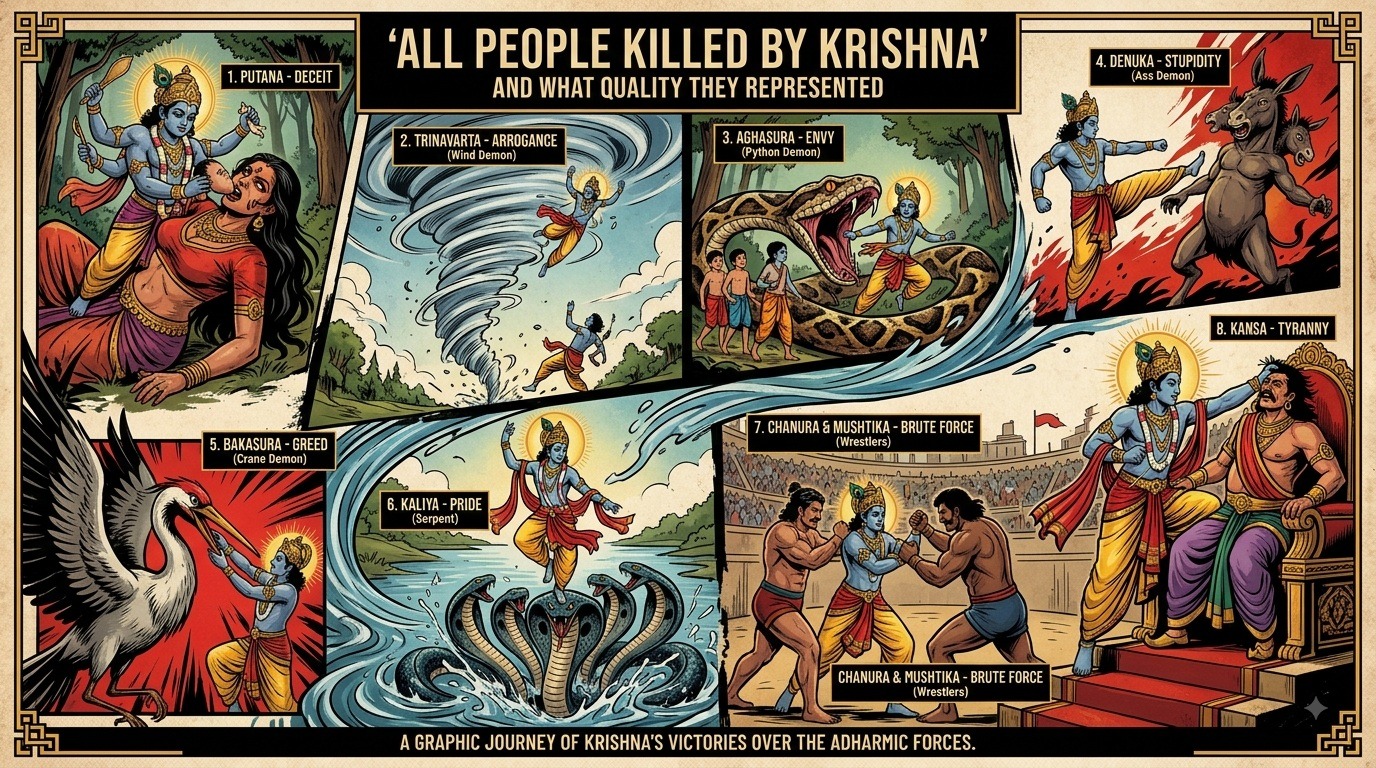
In sacred Srimad Bhagavatam—the combat between Lord Krishna and the demonic entities (asuras) is far more than physical warfare. According to traditional commentaries like Srila Bhaktivinoda Thakura’s Sri Caitanya Siksamrita, each figure vanquished by Krishna embodies a specific egoic trait or spiritual obstacle (anartha). Furthermore, their backstories (purva-janma) illuminate how karmic consequences manifest across lifetimes.
Here is a overview of the major figures slain by Krishna, their past lives, and the inner impurities they symbolize.
1. Pūtanā (The Breast-Feeding Demoness)
- Quality / Impurity Represented: Deceit, hypocrisy, and false gurus (pseudo-spirituality).
- Past Life (Purva-Janma):* In her previous life, she was *Ratnavali, the daughter of King Bali. Upon seeing the Vamana avatar, she felt maternal love and wished to nurse Him; however, when Vamana took everything from her father, her love morphed into vengeful hatred, leading to her rebirth as a poison-bearing demoness.
- Spiritual Lesson: False guidance or deceptive affection cannot withstand ultimate truth.
2. Śakaṭāsura (The Cart Demon)
- Quality / Impurity Represented: Lethargy, bad habits, and the physical weight of accumulated karma.
- Past Life (Purva-Janma):* Formerly *Utkacha, a son of the demon Hiranyaksha. After stepping on the hermitage of Sage Lomasa out of arrogance, he was cursed to exist as a bodyless force until liberated by the touch of the Lord’s feet.
- Spiritual Lesson: Overcoming spiritual inertia and breaking toxic routine habits.
3. Tṛṇāvarta (The Whirlwind Demon)
- Quality / Impurity Represented: Arrogance, false pride born of intellectualism, and bogus philosophical speculation.
- Past Life (Purva-Janma):* He was a king named *Tarakaksha who became drunk with power and neglected his duties, leading to his reborn state as a destructive storm.
- Spiritual Lesson: Intellectual ego blinds a seeker to higher spiritual reality.
4. Bakāsura (The Stork Demon)
- Quality / Impurity Represented: Duplicity, cunning behavior, and false religious pretenses.
- Past Life (Purva-Janma):* A gandharva or demon named *Utpala who used deceptive means to achieve status.
- Spiritual Lesson: Superficial piety and deceptive intentions ultimately destroy themselves.
5. Aghāsura (The Giant Serpent Demon)
- Quality / Impurity Represented: Cruelty, envy, and violence toward others.
- Past Life (Purva-Janma):* Formerly **Agha, the younger brother of Putana and Bakasura, as well as a former prince named *Sankha who mocked the physically deformed sage Ashtavakra and was cursed to become a crooked snake.
- Spiritual Lesson: Envy and malice swallow the mind like a trap.
6. Dhenukāsura (The Donkey Demon)
- Quality / Impurity Represented: Gross materialism and stubborn ignorance (ignorance of spiritual truth).
- Past Life (Purva-Janma):* Formerly *Sahasrika, a demon cursed by the sage Durvasa for disturbing his meditations.
- Spiritual Lesson: Purely animalistic intelligence blocks higher spiritual growth.
7. Kaṁsa (The Tyrant King of Mathura)
- Quality / Impurity Represented: Absolute ego, fear-driven tyranny, and personal atheism.
- Past Life (Purva-Janma):* Kamsa was the rebirth of *Kalanemi, a powerful demon slain by Lord Vishnu during the churning of the ocean (Samudra Manthan).
- Spiritual Lesson: The ego’s fear of its own mortality drives tyranny, which collapses when confronted by divine consciousness.
8. Śiśupāla (King of Cedi)
- Quality / Impurity Represented: Deep-seated envy, blasphemy, and chronic hatred toward divinity.
- Past Life (Purva-Janma):* He was **Jaya, one of the gatekeepers of Vaikuntha cursed by the Four Kumaras to be born three times on Earth as Vishnu’s adversary (previously *Hiranyakashipu and Ravana).
- Spiritual Lesson: Persistent negativity towards divine truth seals one’s spiritual destruction—and ultimate liberation.
9. Keśī (The Horse Demon)
- Quality / Impurity Represented: Vanity, false pride in one’s achievements, and intellectual arrogance.
- Past Life (Purva-Janma):* A proud celestial musician (*Gandharva) named *Keshin* who, intoxicated by his own beauty and talent, disrespectfully interrupted the meditation of Sage Bharadvaja.
- Spiritual Lesson: Pride in worldly talents creates a runaway, unmanageable mind (symbolized by an untamed horse) that must be subdued to attain peace.
10. Vyomāsura (The Bat/Sky Demon)
- Quality / Impurity Represented: Deceitfulness, theft, and stealing the achievements or devotion belonging to others.
- Past Life (Purva-Janma):* Formerly *Bhimaratha, a greedy prince who stole from sages and spiritual seekers to build his personal wealth.
- Spiritual Lesson: Attempting to hide or steal spiritual merit through devious means leads to ultimate ruin.
11. Pauṇḍraka Vāsudeva (The Fake Krishna)
- Quality / Impurity Represented: Impostor syndrome, spiritual plagiarism, and megalomania.
- Past Life (Purva-Janma):* *King Paundraka of Karusha, who was so consumed by jealousy of Krishna’s fame that he fabricated two artificial extra arms, carried fake weapons (a artificial discus and mace), and declared himself the real God.
- Spiritual Lesson: Imitating spirituality without genuine inner purity is a dangerous path born of fragile ego.
12. Śālva (The Master of Illusion)
- Quality / Impurity Represented: Illusion (Maya), reliance on technological arrogance, and emotional manipulation.
- Past Life (Purva-Janma):* A staunch ally of Shishupala and Jarasandha who performed extreme penance to Shiva to acquire an invincible flying city (*Saubha) made of iron and magic.
- Spiritual Lesson: No matter how complex or technologically advanced an illusion is, it shatters when confronted with absolute truth.
13. Narakāsura (Bhaumāsura)
- Quality / Impurity Represented: Unchecked desire, hoarding, and disrespect toward the sacred feminine.
- Past Life (Purva-Janma):** Son of Varaha (the Boar incarnation) and Bhumi (Earth Goddess). Though divine by lineage, he fell into demoniac association (specifically through his alliance with Banasura) and began abducting thousands of princesses and hoarding world treasures.
- Spiritual Lesson: Noble lineage cannot save someone if they succumb to destructive desires and tyranny; Krishna overthrew him alongside Satyabhama to restore dignity to the captive women.
14. Dantavakra & Vidūratha
- Quality / Impurity Represented: Deep-seated spiritual hostility and blind rage.
- Past Life (Purva-Janma):* Dantavakra was the final earthly birth of *Vijaya (the second gatekeeper of Vaikuntha cursed along with Jaya). He was previously Kumbhakarna in the Ramayana and Hiranyaksha in the Srimad Bhagavatam.
- Spiritual Lesson: Marks the complete fulfillment of the three-lifetime curse, ending the cycle of divine antagonism and returning the soul back to the spiritual realm.
15. Jarāsandha (King of Magadha)
- Quality / Impurity Represented: Entrenched ritualism without devotion, world-dominating ambition, and institutional tyranny.
- Past Life (Purva-Janma):* In a prior cosmic epoch, he was *Viprachitti, a powerful leader of the Danavas who warred against the devas to establish material hegemony over the universe.
- Spiritual Lesson: Material power and complex sacrifices, when divorced from devotion, become a fortress of arrogance that can only be overcome through strategic wisdom (as Krishna guided Bhima in duel).
16. Dvivida (The Gorilla Demon)
- Quality / Impurity Represented: Offense against sacred figures (Sadhu-Ninda), degradation of past pious merit, and violent mockery.
- Past Life (Purva-Janma):* Dvivida was actually a pious *Vanara hero who served Lord Rama faithfully in the Ramayana. However, through bad association with Narakasura in a later era, his mind became corrupted by arrogance and spite.
- Spiritual Lesson: Past spiritual achievements do not make one immune to downfall if one indulges in blasphemy and bad company; he was ultimately slain by Lord Balarama.
17. Bāṇāsura (The Thousand-Armed King)
- Quality / Impurity Represented: Overwhelming pride in physical strength, martial arrogance, and craving for conflict.
- Past Life (Purva-Janma):* The eldest son of *Mahabali (King Bali). Though devoted to Lord Shiva, his desire for battle grew so monstrous that he longed for an opponent who could match his thousand arms.
- Spiritual Lesson: Krishna severed his thousand arms—leaving only four—symbolizing the destruction of excessive physical pride while sparing his life due to his father’s devotion.
18. Mushtika & Chānūra (Kamsa’s Royal Wrestlers)
- Quality / Impurity Represented: Brute force, systemic oppression, and using bodily strength to crush the innocent.
- Past Life (Purva-Janma):** Demonic spirits born into the wrestling clan under Kamsa, representing pure physical materialism devoid of moral grounding.
- Spiritual Lesson: Physical intimidation collapses when confronted by divine grace and righteousness (Krishna destroyed Chanura, while Balarama eliminated Mushtika).
19. Kuvalayāpīḍa (The Royal Elephant)
- Quality / Impurity Represented: Gigantic pride, uncontrollable anger, and blind brute strength utilized by corrupt rulers.
- Past Life (Purva-Janma):* In prior legends, the spirit animating this royal elephant was born of *Kumuda, an arrogant celestial serpent who used its stature to trample underlings.
- Spiritual Lesson: The giant obstacles placed at the entrance of spiritual progress are uprooted easily by divine intervention.
20. Śṛṅgāra/Kālayavana (The Invincible Barbarian King)
- Quality / Impurity Represented: Blind hostility, unstoppable external pressure, and karmic inevitability.
- Past Life (Purva-Janma):** Son of the sage Garga (born through penance to seek revenge on the Yadu dynasty after being insulted). He was granted invincibility against the Yadavas by Shiva.
- Spiritual Lesson: Krishna strategically led Kalayavana into a cave where King Mucukunda’s stored spiritual power incinerated him—showing that divine intelligence bypasses brute invincibility.
21. Rukmī (Brother of Rukmiṇī)
- Quality / Impurity Represented: Petty jealousy, family pride, and refusal to accept defeat.
- Past Life (Purva-Janma):** A proud warrior from a line of royal rulers who allowed worldly status to override divine alliances.
- Spiritual Lesson: False prestige and arrogance born of earthly lineage lead to public humiliation and self-destruction. Though Krishna spared his life during Rukmini’s abduction, Rukmi was later killed by Lord Balarama during a game of dice due to his persistent deceit and taunting.
22. Śambara (The Demon of Illusion)
- Quality / Impurity Represented: Deceptive illusion, fear of one’s replacement, and spiritual kidnapping.
- Past Life (Purva-Janma):* An ancient *asura king skilled in dark arts (maya) who had previously fought the Devas in cosmic wars.
- Spiritual Lesson: Shambara abducted Krishna’s infant son, Pradyumna (the incarnation of Kamadeva), out of fear that Pradyumna would kill him. Pradyumna grew up, learned all of Shambara’s illusions, and destroyed him—symbolizing that true divine love and desire cannot be suppressed by trickery.
23. Satrajit (Owner of the Syamantaka Jewel)
- Quality / Impurity Represented: Material possessiveness, paranoia, and false accusation.
- Past Life (Purva-Janma):** A noble-born solar devotee whose intense attachment to wealth eclipsed his judgment.
- Spiritual Lesson: Attachment to material wealth (the Syamantaka jewel) creates paranoia, slander, and social chaos. Satrajit falsely accused Krishna of stealing the gem; though Krishna cleared His name, Satrajit was later killed in his sleep by Shatadhanva due to the curse of greed surrounding the jewel.
24. Śatadhanva
- Quality / Impurity Represented: Malice driven by greed and bad association.
- Past Life (Purva-Janma):** A opportunistic warrior who allowed himself to be manipulated by Akrura and Kritavarma’s political scheming.
- Spiritual Lesson: Acting as a puppet for others’ greed leads to a swift downfall. Krishna pursued Shatadhanva on foot and beheaded him with His Sudarshana Chakra after Shatadhanva murdered Satrajit to steal the jewel.
25. Vatsāsura (The Calf Demon)
- Quality / Impurity Represented: Childish duplicity, mischievous deceit, and hidden motives under an innocent disguise.
- Past Life (Purva-Janma):* Formerly *Pramila, a son of Murasura who disguised himself as a young Brahmin to deceive the sage Vasishtha, resulting in a curse to take the form of a calf.
- Spiritual Lesson: Deceit that presents itself under the guise of innocence or youthful harmlessness must be recognized and neutralized early in spiritual life.
26. Dvivida & Mainda (The Fallen Vanaras)
- Quality / Impurity Represented: Sadhu-Sanga-Tyaga (abandonment of holy association), lapse from virtue, and betrayal of past pious roots.
- Past Life (Purva-Janma):* Heroic Vanara brothers who fought alongside Lord Rama in the *Treta Yuga. Over centuries, bad association with Narakasura corrupted their minds, turning them against the sages.
- Spiritual Lesson: Illustrates how past devotion can be eclipsed by current bad company, showing that ongoing spiritual vigilance is always necessary.
27. Murāsura (The Five-Headed Demon)
- Quality / Impurity Represented: Entrenched mental defenses, stubborn resistance to divine truth, and spiritual obstinacy.
- Past Life (Purva-Janma):** An ancient general of Narakasura who created an impenetrable defense network of fire, water, and magic around Narakasura’s kingdom of Pragjyotishpura.
- Spiritual Lesson: The mental “fortresses” of rationalization and doubt built over time are severed by Krishna’s Sudarshana Chakra (the disc of divine truth).
28. Pañcajana (The Conch Demon)
- Quality / Impurity Represented: Material greed, hoarding of spiritual wisdom, and obstruction of knowledge.
- Past Life (Purva-Janma):** A demon dwelling in the depths of the ocean who kidnapped the son of Krishna’s guru, Sandipani Muni.
- Spiritual Lesson: Krishna killed Panchajana and turned his ocean shell into the sacred conch Panchajanya, symbolizing the transformation of material obstruction into a divine instrument of truth.
29. Narakāsura’s Seven Generals (Hayagriva, Pitha, Swarbhanu, etc.)
- Quality / Impurity Represented: Institutional corruption, military aggression, and systemic enforcement of evil.
- Past Life (Purva-Janma):* Reincarnated remnants of ancient Danava warriors from the *Samudra Manthan era.
- Spiritual Lesson: Systems built to support corruption and tyranny inevitably collapse once their primary pillar is defeated.
30. The Rajaka (Kamsa’s Royal Washerman)
- Quality / Impurity Represented: Arrogance born of institutional power, disrespect toward the Divine, and lack of spiritual devotion (Bhakti).
- Past Life (Purva-Janma):* According to traditional texts like the *Garga Samhita, he was the washerman in Ayodhya during Treta Yuga who spoke slanderously about Sita Devi’s purity upon her return from Lanka. Because of his blasphemy, Lord Rama allowed his karmic rebirth, but chose not to execute punishment in that life.
- Spiritual Lesson: Krishna struck off his head with the palm/side of His hand, purifying his past offenses and granting him liberation (Moksha). It illustrates how worldly status and pride can blind a person from recognizing the Divine right in front of them.
31. Kāliya (The Multi-Hooded Serpent)
- Quality / Impurity Represented: Toxic pride, malice, egotism, and envy (matsarya).
- Past : According to the Srimad Bhagavatam and regional Puranic traditions, Kaliya lived on Ramanaka Island. His intense pride in his deadly venom led him to defy Garuda (Lord Vishnu’s divine mount). Fleeing Garuda’s wrath, Kaliya hid in the Yamuna River near Vrindavan, where Garuda was cursed by Sage Saubhari never to enter.
- Spiritual Lesson: Kaliya was not actually slain by Krishna, but rather humbled and liberated. Kaliya’s lethal venom poisoned the Yamuna River, symbolizing how unchecked ego and toxicity poison one’s spiritual environment. Krishna danced upon Kaliya’s many hoods (Kaliya Nardana), crushing each head of pride until the serpent surrendered in devotion. Krishna spared his life due to the prayers of Kaliya’s wives (Naga-patnis) and banished him back to Ramanaka Island, leaving His footprints on Kaliya’s heads to protect him from Garuda forever.
Complete Overview of All Figures Covered
| Figure | Form | Key Quality / Anartha | Slayer |
|---|---|---|---|
| Pūtanā | Nurse | False Teachers & Deceit | Krishna |
| Śakaṭāsura | Cart | Lethargy & Bad Habits | Krishna |
| Tṛṇāvarta | Whirlwind | Intellectual Pride & Arrogance | Krishna |
| Bakāsura | Stork | Hypocrisy & Duplicity | Krishna |
| Aghāsura | Serpent | Envy & Cruelty | Krishna |
| Vatsāsura | Calf | Hidden Deceit in Innocent Form | Krishna |
| Dhenukāsura | Donkey | Gross Materialism & Ignorance | Balarama |
| Kāliya | Serpent | Toxicity & Ego (Subdued) | Krishna |
| Pralambāsura | Cowherd | Impostor Syndrome & Treachery | Balarama |
| Keśī | Horse | Vanity & Unruly Mind | Krishna |
| Vyomāsura | Bat / Sky | Spiritual Theft | Krishna |
| Kuvalayāpīḍa | Elephant | Blind Brute Strength | Krishna |
| Chānūra & Mushtika | Wrestlers | Systemic Violence & Bullying | Krishna & Balarama |
| Kaṁsa | King | Fear, Tyranny & Atheism | Krishna |
| Kālayavana | Yavana King | External Hostility & Unyielding Karma | Mucukunda / Krishna |
| Jarāsandha | King | Institutional Ego & Power Ambition | Bhima / Krishna |
| Śiśupāla | King | Chronic Envy & Divine Hatred | Krishna |
| Dantavakra | King | Residual Blind Rage | Krishna |
| Pauṇḍraka | False Avatar | Megalomania & Plagiarism | Krishna |
| Śālva | Sorcerer | Technological Illusion (Maya) | Krishna |
| Narakāsura | King | Hoarding, Lust & Domination | Krishna & Satyabhama |
| Murāsura | Demon | Obstinacy & Mental Fortresses | Krishna |
| Pañcajana | Ocean Demon | Hoarding Knowledge | Krishna |
| Bāṇāsura | 1000-Armed | Martial Pride (Humbled) | Krishna |
| Dvivida | Gorilla | Blasphemy & Fallen Merit | Balarama |
| Rukmī | Prince | Family Pride & Jealousy | Balarama |
| Śambara | Sorcerer | Fear of Replacement & Trickery | Pradyumna |
| Śatadhanva | King | Violent Greed | Krishna |