The Social Reformer, His Split from Tradition, and the Vedic Way Forward
Introduction
Basavanna (also Basava or Basaveshwara) is remembered in Indian history as a remarkable 12th-century social reformer and devotional poet in what is now Karnataka. He challenged the rigid caste system, the domination of Brahminical ritual authority, and ritual formalism in favor of direct devotional experience and social equality. While his intent resonates with core bhakti values — particularly the accessibility of the divine to all — his historical break with the traditional Vedic order ultimately produced a distinct sect whose long-term doctrinal authenticity has been debated by scholars and spiritual authorities.
This article explores who Basavanna was, what drove his reforms, why he effectively separated from the classical Vedic system, and how a truly sustainable devotional movement, in the spirit of bhakti-yoga, must remain anchored in paramparā (the disciplic succession) and śāstra (scriptural authority).
Who Was Basavanna? Origin, Early Life, and Environment
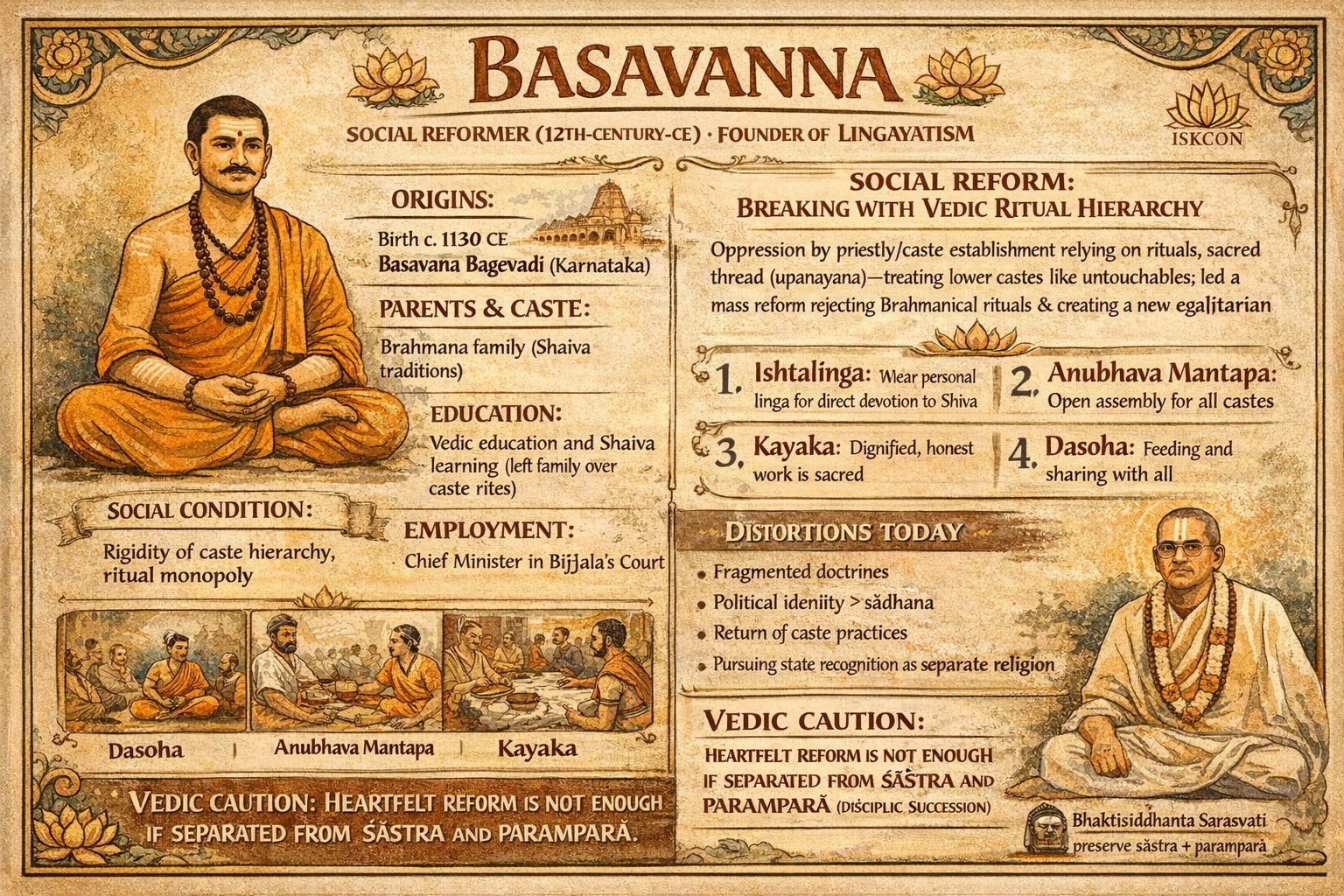
Basavanna was born in 1131 CE in Basavana Bagewadi in northern Karnataka, India, into a Brahmin family with Shaiva affiliations. He grew up in a period when hierarchical caste practices and priestly authority dominated social and religious life. Educated in the traditional ways, he studied Vedic and religious texts early, yet became deeply troubled by the ways ritual and caste division excluded ordinary people from spiritual life. Later, he served as a minister or high official in the court of Kalachuri king Bijjala II, giving him the influence to promote wide-ranging social and spiritual reform. ([Wikipedia][1])
The society of his time was deeply stratified: caste privilege determined access to education, ritual roles, and temple resources, while common people were largely shut out from religious authority. The growing Bhakti movement across India emphasized direct devotion to God without heavy ritual mediation — a theme Basavanna adopted and expanded in his region. ([DDE Pondicherry University][2])
Why Basavanna Challenged Ritual Authority and Caste
Basavanna’s writings — especially his vachanas (short, powerful devotional poems) — express strong opposition to caste hierarchy, empty ritualism, gender discrimination, and priestly monopoly. His movement insisted that:
- True spiritual life is devotional, not based on birth or purely external ritual.
- Equality before God is essential — all men and women can pursue devotion, regardless of caste.
- Ritual focus on external ceremonies and caste ranks distracts from sincere communion with God.
He rejected traditional caste hierarchies, including the sacred thread (upanayana) and other caste-based rituals, preferring the every-person’s direct relationship with the divine, symbolized by the Ishtalinga — a small Shiva icon worn on the body as a constant reminder of direct devotion. ([Wikipedia][3])
A well-known incident from the Basava Purana has Basavanna refusing his own upanayana thread ceremony, arguing with his father that — once inner purity and devotion are achieved — external caste markers should not determine spiritual worth. This confrontation symbolizes his break with ritual prescriptions that he saw as barriers rather than enablers of bhakti. ([Mahavidya][4])
What Was the Movement Called, and What Were Its Core Teachings?
Basavanna’s milieu gave rise to the social-religious movement known variously as Veerashaivism or Lingayatism. Its core teachings included:
- Equality of all people regardless of caste or gender.
- Direct devotional relationship with Shiva, often through wearing the Ishtalinga.
- Rejection of hereditary priestly dominance and caste-based religious exclusion.
- Kayaka (work as worship) — a dignity-of-labor ethic where honest work is itself a devotional value.
- Dasoha (social sharing/feeding) — serving others as an expression of spiritual service.
- Transparent platforms of dialogue, like the Anubhava Maṇṭapa, where people from all walks of life discussed spiritual and ethical issues. ([Testbook][5])
These teachings resonated with many but effectively produced a distinct identity apart from mainstream Vedic ritual life. Over centuries, this identity became institutionalized, socially significant, and in modern times politically mobilized, with some in the community even advocating recognition of Lingayat as a separate religion in census and policy. ([The New Indian Express][6])
Scriptural Critique: Why Rejecting Vedic Authority Is Problematic
From an ISKCON/Gaudiya Vaiṣṇava viewpoint, spiritual reform is most effective and enduring when grounded in the paramparā disciplic succession and Vedic teaching — not created outside those frameworks. Two key scriptural principles illustrate this:
1. Paramparā Is Essential
The Bhagavad-gītā (4.2) establishes that spiritual knowledge must come through the disciplic succession (paramparā):
“This supreme science was thus received through the chain of disciplic succession…” — BG 4.2 (received from commentator Śrīla Prabhupāda).
This underlines that authentic spiritual realisation grows within a lineage of teachers who preserve, interpret, and protect the teachings — rather than through a wholly custom-built system.
2. Leaders’ Conduct Shapes Society
Another verse, Bhagavad-gītā 3.21, explains:
“Whatever action a great man performs, common men follow his example.” — BG 3.21
Srila Prabhupāda often cited this to stress that spiritual leaders must preserve scriptural standards lest followers imitate deviations that do not lead to realization.
Modern Gaudiya ācāryas like Śrīla A.C. Bhaktivedanta Swami Prabhupāda and Śrīla Bhaktisiddhānta Sarasvatī emphasised that movements lacking Vedic and paramparic grounding are prone to deviation and corruption — sometimes producing sahajiyā (unregulated or misinterpreted devotional practices) rather than pure bhakti. This is a caution against reform movements detaching themselves from classical systems altogether.
Was Basavanna “Wrong” to Break with Vedic Ritual?
A balanced assessment recognises:
- His motive — to reduce caste discrimination and open devotional life — aligns with the universal spirit of bhakti: removing barriers to God and uplifting humanity.
- His method — fully rejecting central Vedic structures, rituals, and scripture authority — diverges from how classical bhakti traditions conserve and transmit transformative practice.
Reforms that distance themselves from the disciplic system and scriptural basis can produce social change but may lack the protective framework that ensures long-term spiritual integrity. That is why modern authorities in the Gaudiya tradition recommend reconnecting such reformation with paramparā and vedic discipline, preserving both social justice and devotional potency.
A Vedic Path Forward: Integrating Reform with Tradition
Any contemporary movement seeking social justice and devotional accessibility — whether inspired by Basavanna or other reformers — will be more spiritually robust if it:
- Reestablishes disciplic links (paramparā) to authoritative sources.
- Reincorporates scriptural study (Bhagavad-gītā, Śrīmad-Bhāgavatam).
- Sustains ethical and devotional disciplines (regulated practice, guru guidance).
- Retains social reforms (equality, dignity of work, service) as expressions of genuine bhakti — karma transmuted into seva.
This path does not reject Basavanna’s social concerns; it preserves them within a living spiritual lineage that continues to renew itself without severing from the source.
Conclusion
Basavanna’s movement was born from legitimate social and spiritual discontent in a stratified era, and his teachings on equality and devotion have enduring value. But creating a wholly separate system outside paramparic Vedic authority — even for noble motives — risks doctrinal drift over time. The Vedic tradition’s insistence on disciplic succession and scriptural grounding remains the most reliable way to preserve both spiritual depth and social reform in balance.
A truly transformative movement integrates heart-felt devotion, ethical life, and clear scriptural connection — a model found in the Gaudiya Vaiṣṇava tradition and exemplified by teachers like Srila Prabhupāda. That is the right path forward for communities inspired by reformers like Basavanna, ensuring social justice and spiritual realization.
More info: https://iskconraichur.com/lingayats-veerashaivas/