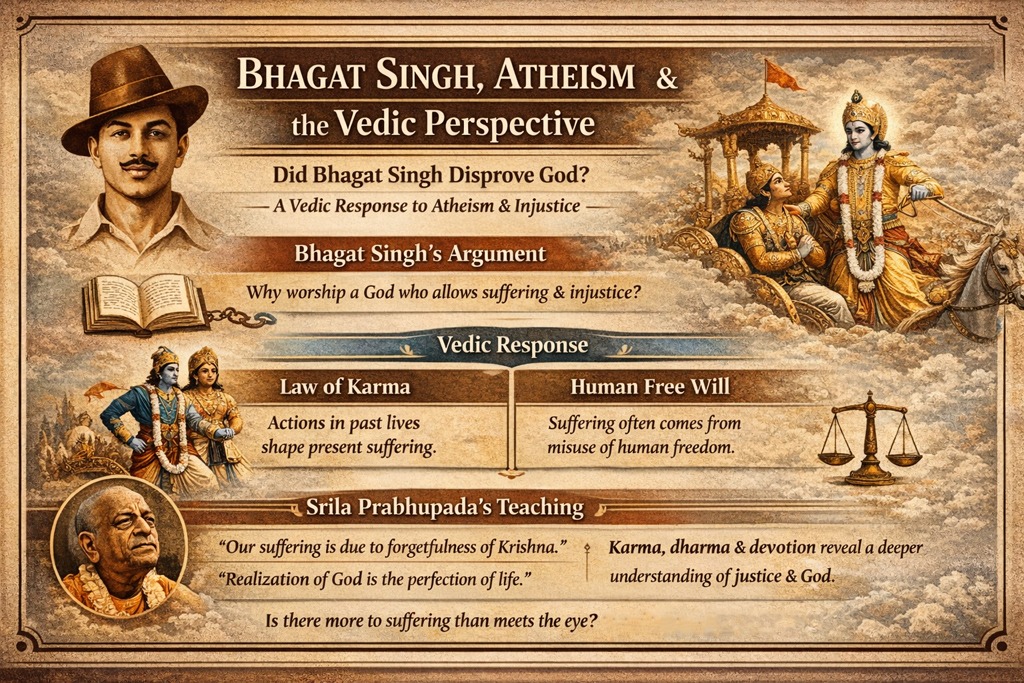
One of the most frequently discussed topics in modern spiritual discourse is the question of whether God truly exists. Among the notable historical figures who openly rejected belief in God was Bhagat Singh. While imprisoned by the British government, he wrote the famous essay “Why I Am an Atheist”, where he explained his reasons for rejecting belief in God. His arguments were not based on ignorance or superficial thinking; rather, they emerged from deep reflection on injustice, oppression, and suffering in the world. Bhagat Singh questioned how a compassionate and omnipotent God could allow widespread misery. He even remarked that if God truly existed and still allowed such injustice, he would refuse to worship Him. This powerful moral argument continues to influence many young thinkers today. However, when we examine this question through the philosophical wisdom of the Bhagavad-gita and Srimad Bhagavatam, we discover a much deeper explanation of suffering and justice.
The Vedic Explanation: The Law of Karma
The Vedic scriptures explain that the universe operates under precise moral laws known as karma. Just as physical laws govern nature, moral laws govern the consequences of human actions. According to the Bhagavad-gita (4.17), “The intricacies of action are very hard to understand.” This means that events occurring in our present life are often the result of actions performed in the past, even in previous lifetimes. Therefore, what appears to be injustice may actually be part of a larger moral framework that unfolds over many lifetimes. The Vedic tradition teaches that divine justice is not absent; rather, it operates with perfect precision across time. Because we perceive only a small fragment of reality, we may misinterpret temporary circumstances as ultimate injustice.
Human Free Will and Responsibility
Another important point emphasized in the Vedic scriptures is human free will. In Bhagavad-gita (5.15), Lord Krishna explains that the Supreme Lord does not create anyone’s sinful or virtuous actions; living beings act according to their own nature and choices. Much of the suffering in the world arises from human decisions driven by greed, anger, and ignorance. Wars, exploitation, and injustice are not created by God but by human misuse of freedom. Blaming God for the consequences of human actions is therefore philosophically problematic. The Vedic view is that God provides the laws of the universe and guidance through scriptures, but individuals are responsible for their own behavior.
The Moral Argument and Its Deeper Implication
Interestingly, Bhagat Singh’s criticism of God actually reveals a strong belief in justice. When someone calls the world “unfair,” they are implicitly comparing it with a real standard of fairness. This philosophical observation has been discussed by many thinkers, including C. S. Lewis. If morality were merely a human invention in a purely material universe, concepts such as justice and injustice would be nothing more than personal opinions. Yet human beings everywhere instinctively feel that cruelty, exploitation, and oppression are objectively wrong. The Vedic tradition explains this universal moral awareness through the concept of dharma, the cosmic order established by the Supreme.
Worship as Spiritual Alignment
Another misunderstanding about God arises from the idea that worship means flattering a powerful being. In Vedic philosophy, worship is not about pleasing God through empty rituals; it is about transforming one’s own consciousness and reconnecting with the divine source of existence. Through devotional practices such as chanting, meditation, and service, individuals gradually awaken their spiritual identity. The founder-acharya of International Society for Krishna Consciousness, A. C. Bhaktivedanta Swami Prabhupada, explained this principle clearly: “God is not a product of our imagination. God is a fact, and realization of God is the perfection of human life.” In another teaching he stated, “Our suffering is due to forgetfulness of Krishna. When we revive our relationship with Him, life becomes peaceful and meaningful.”
Spiritual Inspiration Among Freedom Fighters
It is also important to remember that many freedom fighters who admired Bhagat Singh did not abandon spirituality. Leaders such as Subhas Chandra Bose, Sri Aurobindo, and Bal Gangadhar Tilak drew deep inspiration from the Bhagavad-gita while working for India’s independence. Tilak’s famous commentary Gita Rahasya interprets the Gita as a call to selfless action and duty. For these leaders, spirituality was not an escape from social responsibility but a powerful source of courage and moral clarity.
The Timeless Answer of the Bhagavad-gita
The Bhagavad-gita provides a comprehensive understanding of life, suffering, and divine justice. Rather than asking people to believe blindly, it invites sincere seekers to explore spiritual knowledge through disciplined practice. Lord Krishna declares in Bhagavad-gita (18.66), “Abandon all varieties of religion and simply surrender unto Me. I shall deliver you from all sinful reactions. Do not fear.” This assurance reveals the compassionate nature of the Supreme. When individuals reconnect with God through devotion, they begin to understand the deeper harmony behind the apparent chaos of the world.
Conclusion
Bhagat Singh’s atheism was rooted in a sincere concern for justice and human dignity. His questions about suffering are important and deserve thoughtful answers. However, the Vedic scriptures offer a philosophical framework that addresses these concerns without rejecting the existence of God. By understanding the laws of karma, the role of free will, and the eternal nature of the soul, one can see that suffering does not disprove God but rather highlights the complexity of the moral universe. The wisdom of the Bhagavad-gita encourages humanity to move beyond speculation and experience spiritual truth through devotion and self-realization. In that journey, the deepest questions about justice, suffering, and the existence of God gradually find their answers.
Key Vedic Quotations on Karma, Suffering, and God
1. Law of Karma
From the Bhagavad-gita (4.17)
“The intricacies of action are very hard to understand. Therefore one should know properly what action is, what forbidden action is, and what inaction is.”
This verse explains that the results of actions are complex and not always visible immediately. What appears as injustice may actually be part of a larger karmic framework.
2. God Is Not Responsible for Human Suffering
From the Bhagavad-gita (5.15)
“The Supreme Lord does not accept anyone’s sinful or pious activities. Embodied beings are bewildered because of the ignorance which covers their real knowledge.”
This verse clarifies that God does not create suffering arbitrarily; rather, living beings experience the results of their own actions.
3. The Temporary Nature of Material Happiness and Distress
From the Bhagavad-gita (2.14)
“O son of Kunti, the nonpermanent appearance of happiness and distress, and their disappearance in due course, are like the appearance and disappearance of winter and summer seasons.”
This verse teaches that suffering and happiness in the material world are temporary conditions.
4. God Maintains the Universal Order
From the Bhagavad-gita (9.10)
“This material nature, which is one of My energies, is working under My direction, producing all moving and nonmoving beings.”
Here Lord Krishna explains that the universe operates under divine supervision, not random chaos.
5. The Ultimate Shelter in God
From the Bhagavad-gita (18.66)
“Abandon all varieties of religion and simply surrender unto Me. I shall deliver you from all sinful reactions. Do not fear.”
This verse offers the ultimate spiritual solution to the cycle of suffering.
6. Quote from Srila Prabhupada
A. C. Bhaktivedanta Swami Prabhupada explained:
“Our suffering is due to forgetfulness of Krishna. When we revive our relationship with Krishna through devotional service, our life becomes peaceful and meaningful.”
He also wrote:
“God is not a product of imagination. God is a fact, and realization of God is the perfection of human life.”
7. The Supreme Controller
From the Svetasvatara Upanishad (6.11)
Eko devaḥ sarva-bhūteṣu gūḍhaḥ
Sarva-vyāpī sarva-bhūtāntar-ātmā
“The one Supreme Lord is hidden in the hearts of all living beings. He is all-pervading and the inner controller of all.”
This verse explains that God is not absent but present within every living being as the Supersoul.
8. The Source of Everything
From the Taittiriya Upanishad (3.1)
Yato vā imāni bhūtāni jāyante
Yena jātāni jīvanti
Yat prayanty abhisaṁviśanti
“From whom all beings are born, by whom they live, and into whom they enter at death—that is the Supreme Brahman.”
This describes the Supreme as the ultimate origin, sustainer, and destination of all existence.
9. The Supreme is the Ultimate Reality
From the Chandogya Upanishad (6.2.1)
Sad eva saumya idam agra āsīt
Ekam eva advitīyam
“In the beginning, dear boy, this universe existed as pure existence alone, one without a second.”
10. Truth Is One
From the Rig Veda (1.164.46)
Ekam sat viprā bahudhā vadanti
“Truth is one; the wise describe it in many ways.”
This verse highlights that the Supreme Reality is one, though understood differently by different sages.
11. Karma Governs Suffering and Happiness
From the Garuda Purana
Avashyam eva bhoktavyaṁ kṛtaṁ karma śubhāśubham
“Every living being must inevitably experience the results of actions, whether good or bad.”
This verse explains why suffering occurs without blaming God.
Short Conclusion Quote
From the Katha Upanishad (2.2.13)
Nityo nityānāṁ cetanaś cetanānām
Eko bahūnāṁ yo vidadhāti kāmān
“Among all eternal conscious beings, there is one Supreme eternal being who fulfills the needs of all others.”
These verses collectively establish the Vedic view that:
- God is the ultimate source of existence
- The universe operates under moral law (karma)
- The Supreme resides within every living being