Origins, History, Jesus’ Birth, Distortions — A Bhakti Perspective
Christmas is today both a sacred Christian commemoration of Jesus’ nativity and a global cultural festival. Its historical origin is complex — a layering of early Christian choices, older mid-winter rites, and modern commercial developments. This article explains the facts and offers a devotional response.
1. What is Christmas
Christmas is the annual Christian festival that marks the celebration of the birth of Jesus of Nazareth (the Nativity). Formally observed on 25 December in most Western churches, the date and many surrounding customs were shaped by centuries of religious, social and cultural development.
2. When was Jesus born? (Scholarly uncertainty)
The New Testament does not give a precise date for Jesus’ birth. Most biblical scholars place the event between about 6 BCE and 4 BCE, primarily because the Gospel accounts mention Herod the Great, who likely died in 4 BCE. The choice of 25 December as the official liturgical date was made centuries later and is not a reliable indicator of the historical day. There is no biblical reference to 25 December. Early Christians never celebrated Jesus’ birthday at all. Serious scholars agree Jesus was most likely born between March and September, based on climate notes (e.g., shepherds out at night)..
3. Why 25 December? — Pagan calendars, solstice festivals, and Christian adaptation
By the fourth century CE, Christian leaders formalized a winter date for the Nativity. Scholars have long observed that the decision to celebrate Jesus’ birth on 25 December occurred in a cultural environment already rich with mid-winter festivals (Saturnalia and the Roman Dies Natalis Solis Invicti), seasonal “rebirth of light” rites, and New-Year customs. The Christian calendar absorbed and reinterpreted many symbolic practices—lights, feasting and gift-giving—that predated Christianity. In short: 25 December is a liturgical choice shaped by prior mid-winter traditions, not documented Gospel fact.
Early Christian leaders wanted to:
- convert large Pagan populations
- replace their festivals with Christian ones
- offer meaningful symbolism: “Christ is the real Light of the World”
So they fixed the birth of Jesus on the same date. This helped people transition more easily. Thus: The date is adopted, not revealed. Not wrong, but strategic. Not spiritual in origin, but practical.
4. How Christmas evolved — sacred, social, then commercial
Christmas developed in phases:
- Early Christian liturgical adoption (3rd–4th centuries) that fixed a date and introduced ecclesial rites.
- Medieval and folk accretions: nativity pageants, carols, seasonal foods and charitable customs.
- Modern reinvention (19th–20th centuries): the Victorian revival of family carols, the popular image of Santa Claus, and later industrial advertising turned Christmas into a major commercial event. The result today is a complex mixture of sincere religious observance and secular, consumer-oriented celebration.
None of these are in the Bible. None are connected directly to Jesus.
5. Distorted layers — what is authentic, what is borrowed, and what is modern drift
Today’s Christmas contains multiple layers:
- Core religious layer: Christian worship, nativity readings, Eucharistic/mass rites for believers.
- Syncretic/cultural layer: evergreen trees, lights, gift-giving, holly and mistletoe—some elements trace to pre-Christian winter rites.
- Commercial layer: heavy marketing, consumer pressure, and often secularized public rituals (decorations, concerts, sales).
- Secular civic layer: public festivities and holiday culture that may be religiously neutral in plural societies.
Over centuries, as Christianity spread across Europe and America:
- The deep message of Jesus got overshadowed.
- Christmas became a family-and-food holiday.
- Later it became a commercial event.
- Now it’s a shopping season with spiritual flavoring.
Problematic:
It often forgets the actual teachings of Jesus: • renunciation • nonviolence • humility • surrender to God • compassion for all beings (including animals)
Instead, modern Christmas sometimes becomes: • overeating • meat-heavy meals • expensive shows of wealth • a material race for gifts • a stress-filled social ritual
This is where the “distortion” is obvious. Jesus would not recognize most of today’s Christmas.
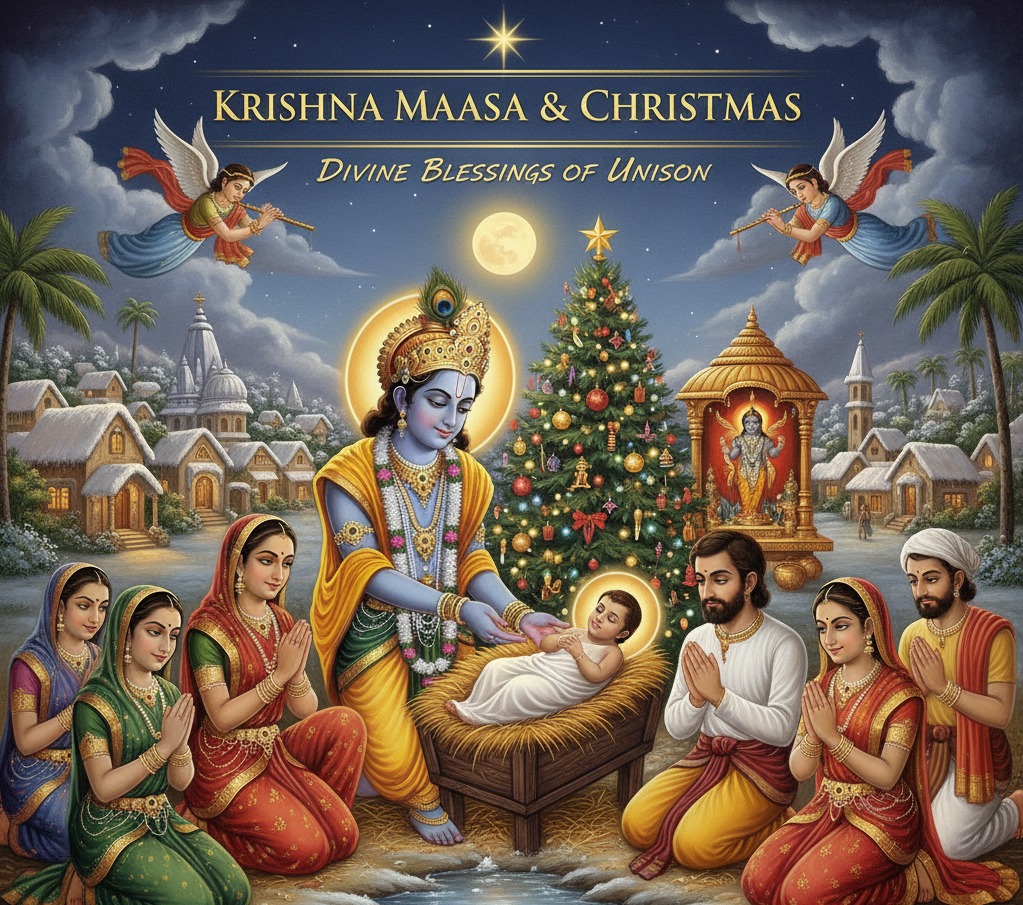
6. “Krishna-māsa” or “Christmas = Krishna-mas”? — Debunking the etymology
You may hear the claim that “Christmas” actually means “Krishna-māsa” or that December is intrinsically a “Krishna month.” These claims are linguistically and historically unfounded:
- “Christmas” derives from “Christ’s Mass” (Old English Cristes mæsse), a Christian liturgical label. The abbreviation “Xmas” uses the Greek letter Chi (Χ) as a Christian symbol for Christ, not as a cipher for “Krishna.”
- Any attempt to read Christian terms as Sanskrit-based etymologies (Krishna, Krusna, etc.) is speculative and not supported by historical linguistics.
In the Vedic calendar (depending on lunar/solar reckoning), December often overlaps with Margashirsha.
And Krishna Himself says:
“Among months, I am Margashirsha.”
(Bhagavad Gita 10.35)
Boom.
This is the strongest, most authentic Vedic link.
So if someone says “This is Krishna’s month,” THIS is the correct scriptural basis. But note: it’s Margashirsha maasa, not “Krishna maasa.”
7. Parallels between Christmas and bhakti themes (what a Vaishnava can appreciate)
Despite differences, there are genuine parallels a devotional person can honor:
- Divine-incarnation motif: both traditions speak of a Divine appearance to help humanity—Christians in Jesus, Vaishnavas in various Acaryas like Srila Prabhupada.
- Light at mid-winter: festivals celebrating light, hope and renewal resonate spiritually with the bhakti mood of remembering God in darkness.
- Compassion and charity: Christmas’s social emphasis on giving and caring for the needy aligns with bhakti ethics of dāna and compassionate service.
These points can become bridges for respectful interfaith contact and preaching (in a spirit of service and humility), while preserving doctrinal clarity.
8. Prabhupāda’s teaching on Christ & Christian festivals
Śrīla A.C. Bhaktivedanta Swami Prabhupāda treated Jesus Christ as a great saint and a teacher of God-consciousness. He encouraged devotees to recognize genuine spiritual teaching wherever it appears, while keeping Kṛṣṇa as the Supreme Goal. As one summary of his remarks puts it: “Lord Christ… came to give you God-consciousness.”
Prabhupāda advised that festivals of other faiths are opportunities for distribution of prasādam, kirtan, spiritual friendship, interfaith dialogue, reflection on Jesus’ sacrifice and surrender and preaching, but never to dilute one’s own devotional practice.
Srila Prabhupada spoke beautifully about Jesus:
- He called him “our guru.”
- He honored his sacrifice.
- He said people should follow his commandments, not merely celebrate his birthday.
- He emphasized that Jesus taught bhakti.
In Vaishnava language: Christmas is a chance for sattva, not rajas.
10. Final devotional perspective — Krishna, time and compassion
From a Bhagavad-gītā perspective, festivals of light and compassion are opportunities for remembrance of the Supreme. Krishna says that whatever path a sincere heart follows to approach God will not fail it (see Gītā teaching about acceptance of sincere devotion).
May this Christmas season inspire everyone toward deeper devotion, compassion, and spiritual understanding.
Hare Krishna.
May the light of divine love illuminate your home.