The Cosmic Administration of Devatās: Roles, Powers, and Influence
1. Shiva – Supreme Transformer
Role: Lord of destruction and regeneration, ascetic yogi, cosmic dancer (Nataraja), meditator and purifier.
Shiva is part of the traditional Trimurti (along with Brahma and Vishnu), representing transformation, dissolution, and transcendence. He is also revered as a supreme ascetic and meditation master. In some traditions (e.g., Śaivism), Shiva is regarded as the highest reality, embodying the power to destroy ignorance and create spiritual transformation.
functions:
- Destroys illusion, ego, and obstacles to spiritual life
- Exemplifies detachment and inner discipline
- Represents the power of meditation and higher consciousness
2. Parvati – Divine Feminine and Cosmic Balance
Role: Goddess of fertility, devotion, marital harmony, and nature; divine mother of Ganesha and Kartikeya.
Parvati balances Shiva’s ascetic aspect with nurturing and creative energy, symbolizing nature (prakriti) and devotion (bhakti).
functions:
- Nurtures life, family, home, and devotion
- Represents power (śakti) that supports and complements Shiva
- Some traditions say she oversees the Navagrahas (nine planets) and mitigates their influence on life.
3. Ganesha – Remover of Obstacles
Role: First-worshipped deity before undertaking auspicious tasks; guardian of beginnings, intellect, and success.
Ganesha is one of the most beloved deities in Hindu culture, revered as Vighnaharta (remover of obstacles) and patron of wisdom and auspiciousness. His mythology includes themes of creation and transformation, and his worship precedes most ceremonies.
functions:
- Removes psychological and material obstacles
- Blesses intellectual pursuit and new ventures
- Represents the union of power and wisdom
4. Kartikeya (Subrahmanya/Murugan/Skanda) – Commander of the Divine Army
Role: God of war and victory; leader (Senapati) of the celestial forces.
Born to defeat powerful demons, Kartikeya embodies valor, courage, and discipline, functioning as protector of dharma and cosmic order.
functions:
- Courage and protection
- Control over negative forces and passions
- Spiritual warrior archetype
5. Navagrahas – Celestial Influencers
In astrology (jyotiṣa), the Navagrahas are nine planetary deities whose positions are believed to influence individual destiny, personality, health, and life outcomes. They are not “cosmic rulers” in a Purāṇic administrative sense, but they play a significant astrological role.
List of Navagrahas
- Surya (Sun) – Vitality, leadership, soul force
- Chandra (Moon) – Mind, emotions, nurturing
- Mangala (Mars) – Courage, energy, conflict
- Budha (Mercury) – Intelligence, communication
- Brihaspati (Jupiter) – Wisdom, prosperity
- Shukra (Venus) – Love, beauty, pleasure
- Shani (Saturn) – Discipline, karma, hurdles
- Rahu – Ambition, illusion
- Ketu – Spirituality, detachment
Together, these nine are worshipped to harmonize influences on human life. People consult them through temple puja, yantras, and astrology charts (kundali).
6. Other Aspects of Shiva’s Family
Daughters and other divine figures:
Some traditions describe Shiva and Parvati’s divine daughters, often associated with rivers, nurturing energy, and spiritual virtues—symbolizing life, purity, and spiritual aspiration.
Ardhanarishvara:
A composite form of Shiva and Parvati representing union of masculine and feminine energies, symbolizing balance, non-duality, and cosmic harmony.
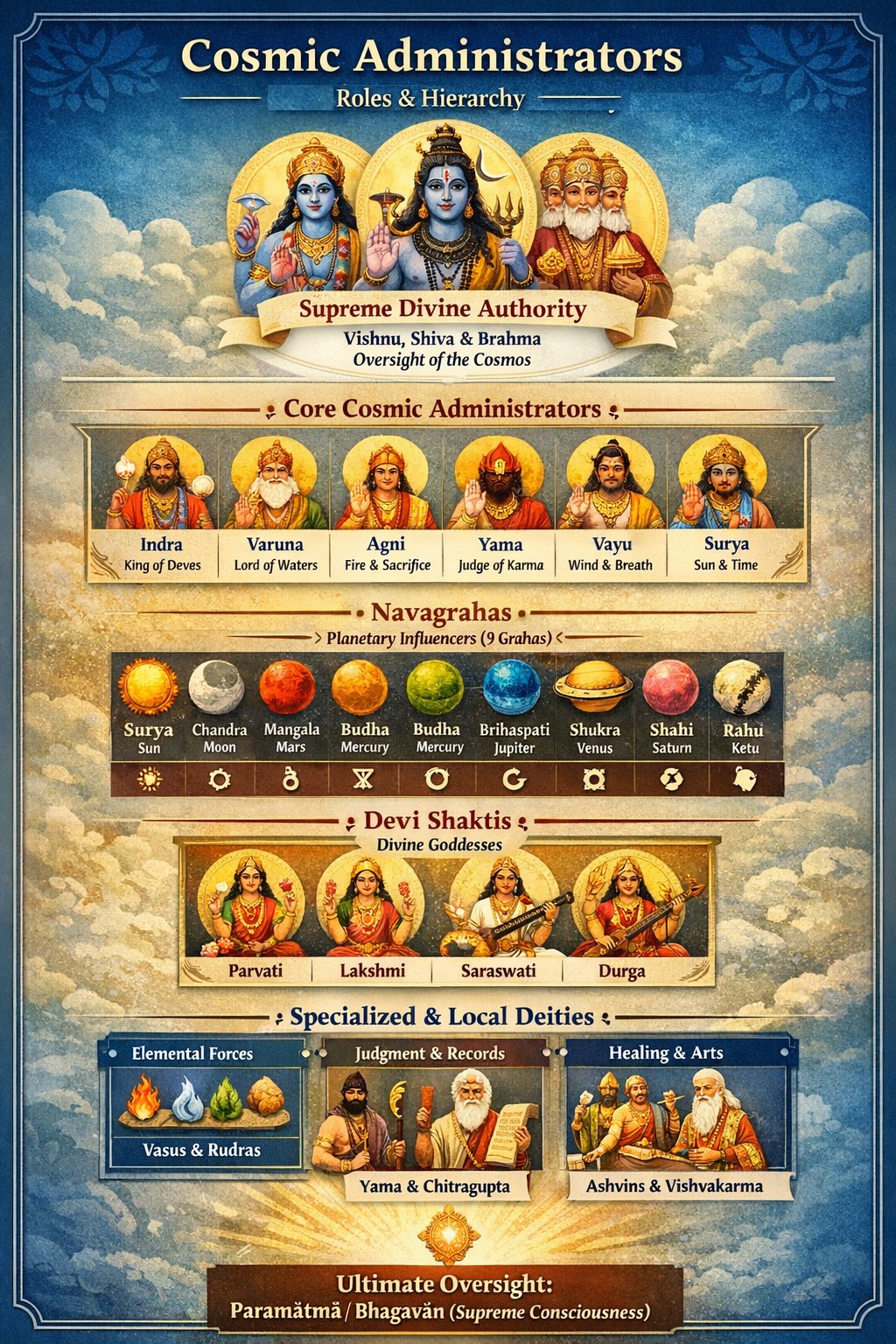
Below is a deep-search, SEO-friendly blog-style resource listing cosmic administrators, devatās, and divine beings in Hindu tradition with categorization and a one-line role description for each. This is not an exhaustive census of every minor being (that would run into the thousands), but it is a broad, searchable compendium of major categories and hundreds of named entities and offices found in Vedic, Purāṇic, and astrological sources. Where possible, roles are briefly described in administrative, symbolic, or functional terms.
While ancient sources sometimes mention vast numbers of beings (e.g., 33 koti “categories” of gods), important sources agree on core groups of administrators with specific roles.
1. Supreme Authorities
Vishnu
Preserver of cosmic balance and the source of sustaining power; incarnates to restore dharma when it declines.
Shiva
Lord of transformation and dissolution; oversees inner discipline, yoga, and the ending of ignorance.
Brahma
Creator of beings and systems; delegates functions and initiates cosmic processes.
2. Vedic Administrators (33 Koti / Types)
According to Vedic lists, 33 principal deities are grouped into categories such as Adityas, Rudras, Vasus, and others.
Adityas (12) — Forces of social and cosmic order
- Indra – King of gods and heavenly administration
- Varuṇa – Law, water, and moral order
- Mitra – Friendship and contracts
- Pushan – Protector of journeys and herds
Rudras (11) — Forces of life power and storm
Often personified aspects of Shiva’s energy; connected with wind, movement, and transformation.
Vasus (8) — Elemental administrators
Represent physical elements like Earth (Prithvi), Wind (Vāyu), Fire (Agni), Moon (Soma), etc.
Ashvini Kumāras (2)
Divine physicians guiding healing and dawn-forces.
3. Classic Devatā Roles in the Cosmic System
Agni — Witness & Purifier
Cosmic fire, carrier of offerings, and witness of all rites; conveys human intentions into the divine realm.
Vāyu — Vital Force Administrator
Controller of air, breath, and movement.
Surya — Solar Governor
Sun deity overseeing light, time, health, and rhythm of life.
Chandra — Lunar Administrator
Moon deity representing mind, emotions, and monthly cycles.
Yama — Judge of Karma
Administrator of death and karmic adjudication; guides souls post-life.
Chitragupta — Record Keeper
Registrar of deeds and karmic account for Yama’s judgment.
Kubera — Treasurer of Wealth
Guardian of riches and lord of Yakshas (semi-divine wealth spirits).
4. Major Devī / Shakti Administrators
Parvati
Cosmic balance and strength; divine mother and partner of Shiva.
Durga / Bhavānī
Warrior goddess defending righteousness and defeating demonic forces.
Lakshmi
Goddess of prosperity, fortune, and auspiciousness.
Saraswati
Goddess of knowledge, arts, and eloquence.
Ganga / River Devis
Personified river energies associated with purification and life.
5. Navagraha — Cosmic Planetary Administrators
In traditional astrology (Jyotiṣa), the nine celestial bodies represent karmic influences:
- Surya (Sun) – Self, energy
- Chandra (Moon) – Mind and emotions
- Mangala (Mars) – Strength
- Budha (Mercury) – Intelligence
- Brihaspati (Jupiter) – Wisdom, dharma
- Shukra (Venus) – Pleasure
- Shani (Saturn) – Discipline and karma
- Rāhu and Ketu – Shadow nodes influencing life patterns
Each governs subtle life cycles and human experience.
6. Specialized and Functional Beings
Beyond major administrators, Hindu lore names many special function devatās associated with life, nature, and society. The total number of named deities cataloged in mythological databases exceeds 300+ distinct beings, including celestial helpers and localized guardians.
Examples:
- Vishvakarma – Divine architect and craftsman of gods’ weapons and palaces.
- Pushan – Psychopomp and protector of travelers.
- Bhairava – Fierce guardian form associated with protection and transcendence.
- Chhaya – Personification of shadow and intermediary influences.
- Grāma devatās – Local village guardians named regionally.
1. Fundamental Principle
The human body is a microcosm of the universe (piṇḍāṇḍa = brahmāṇḍa)
Whatever operates in the cosmos also operates in the body:
- Sun → vision & metabolism
- Moon → mind & fluids
- Wind → breath & movement
Thus devatās govern functions, not flesh.
2. Devatās Governing Major Sense Organs
(From Bṛhadāraṇyaka & Chāndogya Upaniṣads)
| Organ / Function | Presiding Devatā | Role |
|---|---|---|
| Eyes (vision) | Sūrya (Sun) | Light, perception |
| Ears (hearing) | Dik-devatās | Sound, direction |
| Nose (smell) | Aśvinī Kumāras | Sensory healing |
| Tongue (taste/speech) | Varuṇa / Agni | Taste, articulation |
| Skin (touch) | Vāyu | Sensation, movement |
👉 If these devatās withdraw support, the organ remains but stops functioning.
3. Devatās Governing Vital Forces (Prāṇas)
There are 5 major prāṇas, each administered by divine intelligence:
| Prāṇa | Devatā | Function |
|---|---|---|
| Prāṇa | Vāyu | Breathing |
| Apāna | Yama | Excretion, elimination |
| Samāna | Agni | Digestion |
| Udāna | Indra | Speech, upward energy |
| Vyāna | Soma | Circulation |
4. Devatās Governing Internal Organs
| Organ | Presiding Devatā | Explanation |
|---|---|---|
| Heart | Īśvara / Paramātmā | Seat of consciousness |
| Mind | Chandra (Moon) | Emotions, fluctuation |
| Intelligence | Bṛhaspati | Discernment |
| Ego | Rudra | Sense of “I” |
| Speech | Agni / Sarasvatī | Expression |
Bhagavad Gītā 15.13:
“Entering the earth, I sustain all beings; becoming the moon, I nourish all plants.”
5. Upa-Devatās (Sub-Administrators)
Beyond main devatās, hundreds of upa-devatās govern:
- Blood circulation
- Hormonal balance
- Sleep
- Memory
- Reflexes
- Immunity
They operate like departmental officers, not independent gods.
6. Who Is the Ultimate Controller?
Very important clarification:
Devatās are administrators—not independent controllers
Bhagavad Gītā 9.10:
“Under My supervision, material nature works.”
Bhāgavata Purāṇa:
“The demigods function like limbs of the Supreme.”
So:
- Devatās → Function
- Sri Krishna → Permission
- Jīva → Experience
7. Why This Knowledge Exists
This teaching was not meant for superstition, but for:
- Humility – “I am not the doer”
- Gratitude – Life is supported, not owned
- Detachment – Body is a rented system
- Bhakti – All powers trace back to Bhagavān
8. Modern Analogy (Very Important)
- Hardware = Body
- Software = Prāṇa
- Network = Devatās
- Server owner = Paramātmā
- User = Jīva
When the server withdraws permission, the system shuts down—death.
9. Final Balanced Understanding
✔ Yes, every organ has a presiding devatā
✘ No, they are not mythological puppets
✔ They represent cosmic intelligence governing function
✔ Ultimate control always rests with Śrī Kṛṣṇa / Paramātmā
—
FAQs on Cosmic Administrators (Devatās) in Vedic Philosophy
1. What are cosmic administrators?
Cosmic administrators, known as devatās, are intelligences appointed to govern natural laws, cosmic functions, and material operations such as rain, fire, time, death, wind, and planetary movement. They are not creators of the universe but managers within a larger divine system.
2. Are devatās gods or symbolic representations?
In Vedic philosophy, devatās are both functional beings and symbolic principles. They represent real cosmic forces while also teaching philosophical truths about order, responsibility, and interdependence in the universe.
3. Who appoints or controls these cosmic administrators?
All devatās function under the Supreme Reality (Bhagavān Sri Krishna). Scriptures repeatedly clarify that devatās have delegated authority, similar to ministers under a sovereign.
4. Is Indra the most powerful devatā?
Indra is the king of devatās, responsible for governance of the heavenly realms and rainfall, but he is not the most powerful. Beings like Brahmā, Śiva, and Nārāyaṇa operate on higher cosmic levels.
5. Why do scriptures describe conflicts among devatās?
Conflicts illustrate that devatās are not infallible. These narratives teach humility, accountability, and the dangers of ego—even at cosmic levels.
6. How many devatās are there—33 or 33 crore?
The original Vedic term is *“33 koti devatāḥ”, where *koti means type/category. It refers to 33 principal classes, though their manifestations are countless.
7. Are Navagrahas cosmic administrators or planets?
Navagrahas are cosmic influencers, governing karma and time cycles. They are not administrators of physical organs but regulators of experiential outcomes in material life.
8. What is Varuṇa’s administrative role?
Varuṇa governs cosmic law (ṛta), water bodies, and moral accountability. His role extends beyond oceans to ethical order.
9. Why did Varuṇa’s servants arrest Nanda Mahārāja?
The incident symbolises jurisdictional overreach and cosmic protocol, later corrected to demonstrate Kṛṣṇa’s supremacy over all administrative systems.
10. Why don’t devatās intervene in everyday human actions now?
Most devatās function automatically through natural laws, not direct intervention. Intervention occurs only during extraordinary cosmic events.
11. How is Yamarāja’s administration different from Varuṇa’s?
- Yamarāja: Moral justice and post-death accountability
- Varuṇa: Ethical order and cosmic law during life
One judges actions; the other governs balance.
12. What is Agni’s administrative responsibility?
Agni governs transformation—fire, digestion, sacrifice, and communication between humans and cosmic realms.
13. Do devatās control human organs literally?
They control functions, not anatomy. For example, the Sun governs vision, not eyeballs. This is functional governance, not physical occupation.
14. What are upa-devatās?
Upa-devatās are sub-administrators, managing specialised functions such as memory, sleep, circulation, and hormonal balance.
15. Is this system mythology or early science?
It is symbolic cosmology, not modern science, yet it reflects a sophisticated understanding of systemic interdependence—comparable to governance models.
16. Why doesn’t modern science acknowledge devatās?
Science studies mechanism, while Vedic cosmology studies agency and meaning. The two operate at different explanatory layers.
17. Can one bypass devatās through spirituality?
Yes. Scriptures state that direct devotion to the Supreme transcends dependence on intermediary administrators.
18. Are devatās eternal?
No. Devatās are posts, not permanent identities. Souls occupy these roles temporarily, based on karma.
19. Why worship devatās if they are not supreme?
Devatā worship is traditionally for material harmony, while spiritual liberation is sought through higher realization.
20. What is the modern relevance of cosmic administrators?
They teach:
- Accountability
- Systems thinking
- Humility before natural laws
- Respect for ecological and moral balance
21. Is Hindu cosmology polytheistic?
It is better described as hierarchical monism—one supreme reality with many delegated intelligences.
22. Can a skeptic appreciate this framework?
Yes. When read philosophically, devatās represent governance, order, and systemic intelligence, not superstition.
23. What happens when cosmic administration fails?
Scriptures say imbalance (adharma) increases, prompting divine intervention or reset.
24. Final takeaway: who truly runs the cosmos?
All administration ultimately rests with the Supreme Consciousness Sri Krishna, while devatās function as executive instruments.