As the festival of Holi approaches, the atmosphere gradually fills with anticipation—colors, celebration, and festivity. Yet, just before this joyous occasion comes a lesser-known but deeply meaningful period called Holashtak, the eight days leading up to Holi.
For many, Holashtak is simply labeled “inauspicious.” But when seen through the wisdom of Srimad Bhagavatam, it reveals something far more profound: a period of testing, purification, and spiritual opportunity.
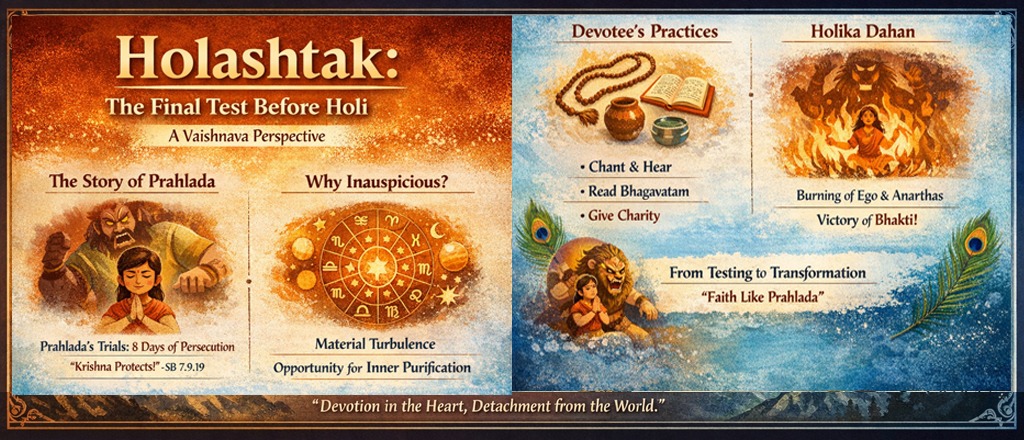
The Spiritual Background: Prahlada’s Unshaken Faith
The essence of Holashtak lies in the life of Prahlada, the great devotee whose unwavering devotion stands as one of the most powerful examples in Vedic literature.
Born in the household of the powerful but atheistic Hiranyakashipu, Prahlada faced relentless persecution simply for remembering Lord Vishnu. These final days before Holi are traditionally associated with the peak of those trials—moments where material protection failed, but spiritual conviction only deepened.
In this context, Holashtak is not merely a span of time; it is a state of spiritual testing.
What Appears Inauspicious… and What Actually Is
Traditionally, people avoid major life decisions during Holashtak—marriages, housewarmings, or new ventures. On the surface, this appears to be due to unfavorable cosmic influences.
But the deeper teaching is subtler. Holashtak represents a phase where external stability is shaken so that internal dependence on the Divine can awaken.
This mood is beautifully captured in the teachings of Prahlada in Srimad Bhagavatam (7.5.5):
tat sādhu manye ’sura-varya dehināṁ
sadā samudvigna-dhiyām asad-grahāt
hitvātma-pātaṁ gṛham andha-kūpaṁ
vanaṁ gato yad dharim āśrayeta
“O best of the demons, I consider that the best thing for persons who are always full of anxiety is to give up materialistic life and take shelter of Hari.”
“For those who are always anxious due to material life, the best course is to take shelter of the Lord.”
What is called “inauspicious” for material expansion becomes highly auspicious for spiritual introspection.
Bhakti Under Pressure: The Heart of Holashtak
During his suffering, Prahlada did not negotiate with circumstances. He did not pray for comfort or relief. Instead, he remained absorbed in devotion, describing the nine processes of bhakti (SB 7.5.23–24), beginning with hearing and chanting about the Lord.
This is the real meditation for Holashtak: not avoidance, but alignment.
Another powerful expression of this consciousness appears in Srimad Bhagavatam (7.9.12), where Prahlada declares:
tasmād ahaṁ vigata-viklava īśvarasya
sarvātmanā mahi gṛṇāmi yathā manīṣam
“I am not afraid of material existence, for I am absorbed in glorifying the Lord.”
In other words, fear does not disappear when situations improve—it disappears when consciousness becomes absorbed in Krishna.
The Collapse of Material Security
One of the most striking realizations from Prahlada’s prayers comes in Srimad Bhagavatam (7.9.19), where he explains that no material arrangement—parents, medicine, or intelligence—can ultimately protect a person without divine sanction.
bālasya neha śaraṇaṁ pitarau nṛsiṁha
nārtasya cāgadam udanvati majjato nauḥ
Holashtak gently forces us to confront this truth. The structures we rely on begin to feel uncertain, not as punishment, but as revelation.
It is a reminder that real shelter is not situational—it is spiritual.
From Turbulence to Transformation
As Holashtak progresses, it culminates in the burning of Holika, symbolized in Holika Dahan. This is not merely a historical or mythological event; it is an inner process.
The fire represents the destruction of ego, pride, and resistance to the Divine. What survives that fire is what is real—devotion, sincerity, and surrender.
Shortly thereafter, the Lord appears as Lord Narasimha to protect Prahlada, demonstrating a timeless principle: when devotion remains steady, divine intervention is inevitable.
A Vaishnava Way to Observe Holashtak
Rather than seeing Holashtak as a restriction, the Vaishnava tradition embraces it as a refinement period. The external world may slow down, but the inner life deepens. Chanting becomes more attentive, hearing more relishable, and association more meaningful.
This is a time to quietly evaluate one’s own consciousness. What needs to be burned? What needs to be strengthened? Where is dependence placed—on temporary arrangements or on Krishna?
Conclusion: The Real Meaning of Holashtak
Holashtak is not about avoiding action; it is about understanding priority. It teaches that before celebration comes purification, and before divine protection comes unwavering faith.
Through the example of Prahlada in the Srimad Bhagavatam, we learn that the most intense moments of difficulty are often the final steps before grace.
So rather than fearing Holashtak, one can approach it with a different vision:
not as an inauspicious gap in time, but as a sacred opportunity—