Introduction: What Does “Purifying the Heart” Actually Mean?
In bhakti terminology, the “heart” (citta) does not mean the physical organ. It refers to the mind–intelligence–ego complex that stores:
- habits
- emotional reactions
- identity patterns
- deep-seated desires
“Purification” means removing distortions in perception, not suppressing emotions.
Śrīmad Bhāgavatam states:
ceto-darpaṇa-mārjanam
“Chanting cleanses the mirror of the heart.”
|| Hare Krishna, Hare Krishna, Krishna Krishna, Hare Hare || Hare Rama, Hare Rama, Rama Rama, Hare Hare ||
But how does this work practically and technically?
1. Chanting as Auditory Neural Reprogramming
Modern understanding
The human brain is plastic—it rewires based on repeated sensory input.
Chanting works through:
- Repetition
- Rhythmic sound
- Meaningful language
When you chant regularly, the brain’s default neural loops (anxiety, craving, rumination) are gradually replaced by stable, coherent patterns.
Technical explanation
- Sound enters through the auditory cortex
- Repetition strengthens specific neural circuits
- Competing destructive thought loops weaken
This is why intrusive thoughts reduce with consistent chanting.
2. Regulation of the Nervous System (Parasympathetic Activation)
Chanting naturally:
- slows breathing
- creates rhythmic exhalation
- calms the vagus nerve
This activates the parasympathetic nervous system (rest-and-digest mode).
Result
- reduced stress hormones
- lowered impulsivity
- increased emotional regulation
A calmer nervous system makes impure reactions less likely to arise.
Purification here means less reactive living.
3. Chanting Interrupts Habit Loops (Cue → Craving → Action)
Modern behavioral psychology explains addiction and bad habits as loops.
Chanting:
- interrupts the craving stage
- replaces compulsive stimuli with sacred sound
- retrains dopamine pathways
Instead of pleasure-seeking stimulation, the mind begins to associate peace and fulfillment with chanting.
This is desire purification, not repression.
4. Identity Rewiring: From “I am the Body” to “I am the Observer”
Repeated chanting gradually shifts identity from:
- “I am my urges”
- “I am my thoughts”
- “I am my emotions”
to: - “I am the observer of the mind”
- “I am servant of Krishna”
This detachment reduces:
- lust
- anger
- envy
- insecurity
In modern terms, chanting increases meta-awareness.
5. Emotional Detox: Processing Suppressed Emotions Safely
During chanting, unresolved emotions surface:
- grief
- guilt
- anger
- fear
This is not impurity increasing—it is stored emotional content releasing.
Because chanting provides:
- safety
- structure
- meaning
the mind can process these emotions without collapse.
This is similar to trauma-informed therapeutic processing, but without verbal analysis.
6. Language + Meaning = Deep Cognitive Alignment
Unlike random sounds or affirmations, the Hare Krishna mantra has:
- linguistic structure
- theological meaning
- relational intent
Meaningful repetition aligns: - cognition (what I believe)
- emotion (what I feel)
- action (how I live)
This alignment reduces inner conflict—the root of mental impurity.
7. Reduction of Ego-Centered Thought Patterns
Impurity in bhakti is primarily ego dominance.
Chanting repeatedly affirms:
- dependence
- humility
- gratitude
Neurologically, ego-centric narrative activity decreases, which is associated with: - reduced anxiety
- less comparison
- less resentment
This is why long-term chanters show greater emotional stability.
8. Attention Training (Superior to Passive Meditation)
Most modern meditation techniques are:
- passive
- objectless
- attention-draining
Chanting is: - active
- auditory
- intentional
It trains sustained attention, which: - reduces impulsivity
- strengthens self-control
- improves decision-making
Attention purity = mental purity.
9. Why Purification Is Gradual, Not Instant
Modern systems require repetition + time to rewire.
Chanting works like:
- exercise for the mind
- physiotherapy for emotions
- detox for identity
Expect: - early resistance
- emotional turbulence
- boredom phases
These are signs of old patterns dissolving, not failure.
10. Why Chanting Works Even When You “Don’t Feel It”
Chanting acts below conscious emotion, at the level of:
- neural conditioning
- subconscious memory
- identity formation
Just as exercise strengthens muscles even if you dislike it, chanting purifies the heart even without emotional highs.
Consistency matters more than mood.
11. Spiritual Dimension (Beyond Psychology)
From the Vaishnava perspective:
- Sound is not symbolic
- Krishna’s name is non-different from Krishna Himself
Thus chanting introduces divine consciousness into the mental field.
Technically: - lower modes lose dominance
- higher qualities (clarity, compassion, detachment) naturally manifest
This is purification by replacement, not suppression.
Conclusion: What “Purified Heart” Looks Like in Real Life
A purified heart does not mean:
- emotionless
- passive
- unrealistic
It means: - reduced compulsions
- clearer values
- calmer reactions
- deeper purpose
- increasing joy without dependency
This transformation is observable, gradual, and reproducible.
Practical Implementation (For Beginners)
- Start with 10–15 minutes daily
- Chant aloud, not silently
- Fix a time (morning is ideal)
- Do not analyze during chanting
- Observe life changes over months, not days
Final Thought
Chanting is not belief-based.
It is a technology of consciousness, refined over millennia and now increasingly validated by modern psychology and neuroscience.
Purification is simply the return of clarity.
Q & A: Chanting, Devotees, and Moral Failures
Q1. If chanting is so powerful, why do some devotees—even seniors—fall into illicit activities?
Answer:
Chanting is powerful, but it does not remove free will. It purifies the heart gradually by increasing awareness and conscience. When a devotee falls, it is not because chanting failed, but because inner warnings were ignored, suppressed desires were unmanaged, or accountability systems were absent.
Chanting reveals impurities so they can be addressed—not magically erased overnight.
Q2. Does this mean chanting does not work for everyone?
Answer:
Chanting works for everyone, but not mechanically. Just as medicine works best when taken correctly and supported by healthy habits, chanting works best when accompanied by sincerity, humility, guidance, and introspection.
Time alone does not purify; quality of practice and honesty with oneself do.
Q3. Should newcomers lose faith when they see senior devotees fall?
Answer:
No. Faith should be placed in:
- Śrī Kṛṣṇa
- The Holy Name
- The process of bhakti
—not in the personal perfection of any practitioner.
Bhāgavatam is realistic: even advanced sādhakas face internal battles. A devotee’s fall highlights human vulnerability, not the failure of bhakti.
Q4. Are such devotees hypocrites?
Answer:
Not necessarily. Many devotees sincerely struggle with deep-rooted conditioning, trauma, or suppressed emotions. Failure often indicates unaddressed internal conflicts, not deliberate deception.
Condemnation prevents healing; compassion combined with accountability enables reform.
Q5. Why do falls often happen after many years of practice?
Answer:
Because:
- Gross habits reduce first
- Subtle tendencies surface later
- Long-suppressed desires may re-emerge under stress
This stage requires greater vigilance, not complacency. Psychologically and spiritually, delayed challenges are well-documented phenomena.
Q6. Does chanting automatically remove lust, anger, or greed?
Answer:
Chanting weakens these tendencies, but they must still be consciously addressed. Chanting provides clarity and strength; it does not replace responsibility, boundaries, or healthy coping mechanisms.
Bhakti is a transformational process, not a bypass.
Q7. Should we stop chanting if we are struggling internally?
Answer:
Absolutely not. Chanting is most needed during struggle. However, one should also:
- Seek guidance
- Open up honestly
- Avoid isolation
- Accept help
Chanting and seeking help are complementary, not contradictory.
Q8. Can psychological counseling or therapy be used along with chanting?
Answer:
Yes. Proper psychological support helps address trauma, emotional regulation, and behavioral patterns. Chanting purifies the heart; therapy helps organize the mind.
Śrīla Prabhupāda emphasized practical intelligence along with devotion.
Q9. Why don’t such devotees speak up earlier?
Answer:
Common reasons include:
- Fear of losing respect
- Shame
- Cultural stigma
- Lack of safe spaces
Creating non-judgmental support environments is essential for prevention.
Q10. Does a devotee’s fall cancel all their spiritual progress?
Answer:
No. Spiritual progress is never lost. A fall may delay progress, but sincere repentance, correction, and humility can deepen realization.
Kṛṣṇa values honesty over pretense.
Q11. How should the community respond when such incidents occur?
Answer:
With:
- Sobriety, not gossip
- Compassion, not cover-up
- Accountability, not witch-hunts
- Protection of victims as top priority
True Vaiṣṇava culture balances mercy and responsibility.
Q12. What is the correct takeaway for youth and new devotees?
Answer:
- Chant sincerely
- Stay humble
- Build healthy support systems
- Do not idolize individuals
- Do not abandon bhakti due to human failure
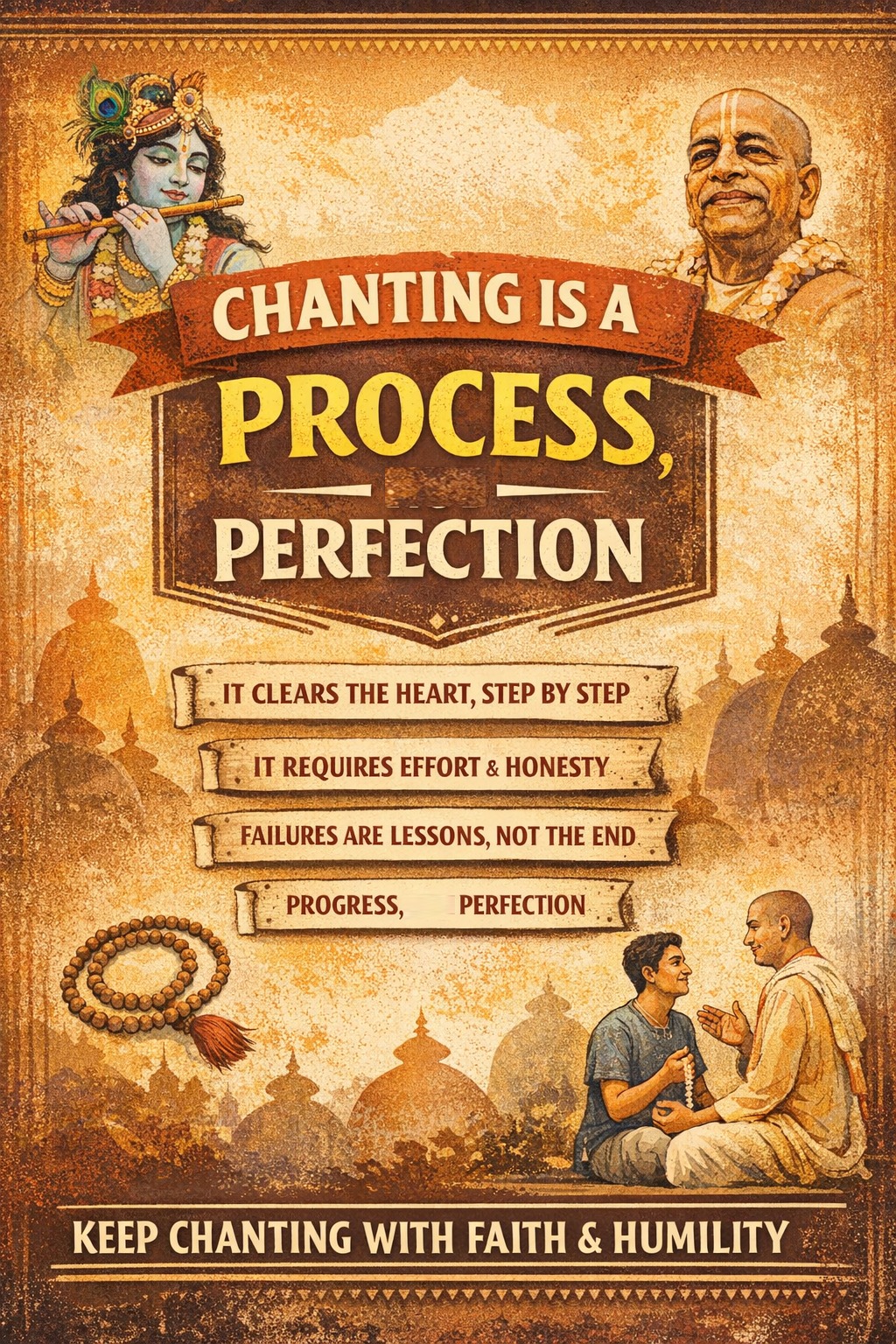
Bhakti is a lifelong path of continuous alignment, not instant perfection.
Q13. Is chanting still the best solution for purification?
Answer:
Yes. There is no higher purifier than the Holy Name.
But it must be accompanied by:
- Honest introspection
- Guru and sadhu guidance
- Accountability
- Emotional maturity
Chanting is the engine; integrity is the steering wheel.
Final Assurance
“The Holy Name does not fail us. It reveals us.”
Failures reveal areas needing healing—not reasons to abandon bhakti.