Birth, Teachings, Authentic Verses & Vaiṣṇava Understanding
Introduction: The Real Dattātreya of the Bhāgavatam
Dattātreya is an ancient, divine personality mentioned in Śrīmad-Bhāgavatam as an empowered incarnation of the Supreme Lord. While later traditions portray him with three heads, *Vaiṣṇavas accept only the Bhāgavatam description, where he appears as an *avadhūta sage with one head, teaching pure self-realization.
Śrīmad-Bhāgavatam is accepted by Vaiṣṇavas as Amala Purāṇa (spotless scripture), and thus it is the final authority for understanding Dattātreya.
Birth of Dattātreya – Date, Tithi & Place
Parents
Dattātreya appeared as the son of:
- Atri
- Anasuya
His birth is recorded in Śrīmad-Bhāgavatam 1.3.11:
tataḥ ṣaṣṭham atrer apatyam dattātreyam akalmaṣam
nirgrantho ’vatatāra
caran bhikṣāṁ mahā-muniḥ
“The sixth incarnation was the pure son of Atri Muni known as Dattātreya. As an avadhūta brahmacārī, he wandered as a great saint.”
— SB 1.3.11
Birth Tithi (Traditional Observance)
While the Bhāgavatam does not explicitly name the lunar tithi, all major Vaiṣṇava and Vedic calendars observe:
📅 Dattātreya Jayantī
Tithi: Mārgāśīrṣa Pūrṇimā (Full Moon of Mārgaśīrṣa)
(Usually falls in November–December)
Dattātreya’s Teachings in Śrīmad-Bhāgavatam
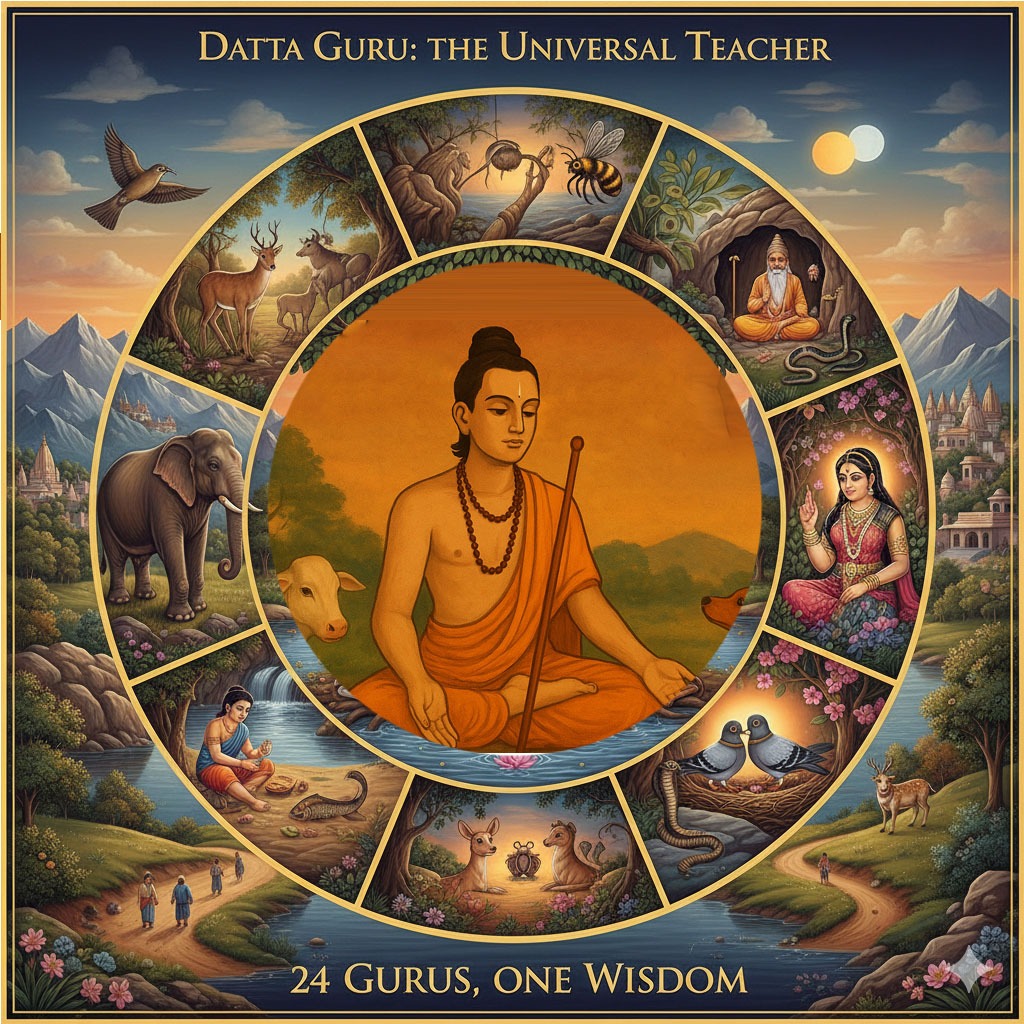
The 24 Gurus of an Avadhūta
The most authentic teachings of Dattātreya are found in:
📖 Śrīmad-Bhāgavatam Canto 11, Chapters 7–9
He teaches King Yadu by explaining how he learned wisdom from 24 natural gurus.
Here are authentic key verses:
1. On Learning from Nature
santi me guravo rājan
bahavo buddhy-upāśritāḥ
yato buddhim upādāya
mukto ’ṭāmīha tān śṛṇu
— SB 11.7.32
“with my intelligence I have taken shelter of many spiritual masters. Having gained transcendental understanding from them, I now wander about the earth in a liberated condition.”
2. On Detachment from Material Happiness & Distress
śrī-brāhmaṇa uvāca
parigraho hi duḥkhāya
yad yat priyatamaṁ nṛṇām
anantaṁ sukham āpnoti
tad vidvān yas tv akiñcanaḥ
— SB 11.9.1
Meaning:
“Everyone considers certain things within the material world to be most dear to him, and because of attachment to such things one eventually becomes miserable..”
3. On Control of the Mind
yasmin mano labdha-padaṁ yad etac
chanaiḥ śanair muñcati karma-reṇūn
— SB 11.9.12
“The mind can be controlled when it is fixed on the Supreme Personality of Godhead. Having achieved a stable situation, the mind becomes free from polluted desires to execute material activities.”
4. The Bee Example
aṇubhyaś ca mahadbhyaś ca
śāstrebhyaḥ kuśalo naraḥ
sarvataḥ sāram ādadyāt
puṣpebhya iva ṣaṭpadaḥ**
— SB 11.8.10
Meaning:
“Just as the honeybee takes nectar from all flowers, big and small, an intelligent human being should take the essence from all religious scriptures.”
Did Dattātreya Teach Nirākāra (Formless Philosophy)?
From a Bhāgavatam point of view —No.
Nowhere in Śrīmad-Bhāgavatam does Dattātreya preach:
❌ “God has no form”
❌ “Ultimate reality is impersonal only”
Instead, his teachings focus on:
✅ detachment from matter
✅ freedom from ego
✅ calmness of consciousness
Later Advaita, Nāth and tantric sects reinterpreted him as a promoter of nirākāra, but Vaiṣṇavas reject those layers as non-Bhāgavatam additions.
Since the Bhāgavatam declares him an incarnation of the Lord, it is illogical that he would deny the Lord’s own spiritual form.
Why Dattātreya Is Depicted With Three Heads
The Bhāgavatam never describes Dattātreya with three heads.
This form appeared later to symbolize:
- Brahmā
- Viṣṇu
- Śiva
This is a Smārta symbolic painting tradition, not scriptural Bhāgavatam truth.
Vaiṣṇava Conclusion
✅ Accept: One-headed Dattātreya of Bhāgavatam
❌ Reject: Three-headed symbolic form as authoritative truth
How Vaiṣṇavas Properly Respect Dattātreya
Gaudiya Vaiṣṇavas:
- Respect him as a śaktyāveśa-avatāra
- Study only his Bhāgavatam teachings
- Do not perform separate worship
- Do not mix tantric rituals with Vaiṣṇava bhakti
Conclusion
Dattātreya is a divine teacher of *pure detachment and self-realization, whose true form and teachings are found only in *Śrīmad-Bhāgavatam — not in later symbolic or impersonal reinterpretations.
Only by following the Bhāgavata-paramparā can one properly understand his real glory.