A Vaiṣṇava Guide to Time, Transformation, and the Ultimate Goal
INTRODUCTION: The New Year as a Universal Human Reset
Every culture across the world celebrates the New Year with hope, renewal, and enthusiasm. Whether it is *January 1st, **Ugadi, **Gudi Padwa, **Vaisakhi, or *Chinese New Year, the essence is the same:
“A fresh beginning and a renewed desire for improvement.”
From the Vedic and Vaiṣṇava viewpoint, time is not merely a calendar reset — it is a manifestation of Kṛṣṇa Himself.
kālo ’smi
“I am Time.”
— Bhagavad-gītā 11.32
The New Year — in any tradition — is a divine reminder to *realign our life with Kṛṣṇa, deepen our sādhana, and move closer to life’s real goal: *pure devotion (bhakti).
SECTION 1: WHY INDIA HAS MULTIPLE NEW YEARS AND MULTIPLE SAMVATSARAS
India is unique because it follows multiple regional calendars, all rooted in Vedic astronomy. People commonly refer to many year systems:
- Vikram Samvat
- Shaka Samvat
- Kali Yuga years
- Tamil New Year cycle (60-year samvatsara)
- Malayalam / Kollam Era
- Bengali Sambat
- Gujarati New Year (after Diwali)
- Lunisolar Panchāṅga-based New Years
This creates questions like:
“Why do Indians have so many different New Years and samvatsaras?”
The answer is simple:
India uses multiple calendars because:
- Some regions follow the moon (Chandramāna)
- Others follow the sun (Sauramāna)
- Some begin the month from Amavasya (new moon)
- Others from Purnima (full moon)
- Some start New Year according to solar transit into Aries (Mesha)
- Others begin with Chaitra Shukla Pratipada (the day of creation)
Yet all Indian calendars are connected through the *Vedic 60-year Samvatsara cycle, the *Bṛhaspati (Jupiter) time cycle, including names like:
Prabhava, Vibhava, Śukla, Pramoda, Prajāpati, Ānanda, Rakṣasa, Nala, Pingala, Śārvari, Plava, Subhakṛt, etc.
So Indians mention different samvatsaras because each year in the cycle has a unique name, used across most Vedic regions.
SECTION 2: IMPORTANT INDIAN NEW YEARS AND THEIR SIGNIFICANCE
2.1 Ugadi (Andhra, Telangana, Karnataka)
- Lunar New Year (Chaitra Shukla Pratipada).
- Commemorates the beginning of Brahmā’s creation.
- Ugadi Pachadi symbolizes the six tastes of life — spiritual acceptance of all experiences.
2.2 Gudi Padwa (Maharashtra)
- Same day as Ugadi.
- Gudi (victory flag) symbolizes purity, triumph of dharma, and auspiciousness.
2.3 Vaisakhi / Baisakhi (Punjab / North India)
- Solar New Year.
- Represents gratitude for harvest and divine providence.
2.4 Tamil Puthandu
- Solar New Year (Chittirai month).
- Associated with temple visits, auspicious beginnings, and āgama traditions.
2.5 Vishu (Kerala)
- Solar New Year.
- Vishukkani reinforces the belief in beginning the year with auspicious vision.
2.6 Poila Boishakh (Bengal)
- New Year with cultural roots going back to Gaudiya Vaiṣṇava regions.
2.7 Cheti Chand (Sindhi New Year)
- Celebrates Jhulelal’s appearance.
2.8 Gujarati New Year (Day After Diwali)
- Spiritual renewal with deep devotional mood.
Across all regions, the message is clear:
Time is sacred. A new year is a chance for spiritual rebirth.
SECTION 3: GLOBAL / FOREIGN NEW YEARS
3.1 Gregorian New Year (January 1st)
Most celebrated worldwide.
Not spiritually rooted, but offers psychological motivation.
**3.2 Chinese Lunar New Year ( Jan – Feb ) **
- Largest festival in East Asia.
- Based on lunisolar cycle phases.
3.3 Islamic New Year (Hijri)- (June)
- Purely lunar.
- Commemorative significance.
3.4 Jewish New Year (Rosh Hashanah) – (September)
- Day of reflection, repentance, and renewal.
3.5 Western Culture
- Fireworks, countdowns, resolutions — but often externally oriented.
SECTION 4: DO NEW YEARS HAVE SPIRITUAL BENEFIT?
Yes — but not because of the date.
Their spiritual value depends on how we respond.
Vedic scripture teaches:
Time (Kāla) = Energy of Kṛṣṇa
- Time is irreversible.
- Time pushes us toward death.
- Time reminds us to turn toward the eternal.
Śrīmad-Bhāgavatam 2.3.17
“With each sunrise and sunset, a day is taken from our life unless we use it for glorifying Hari.”
Thus, every New Year — Indian or global — is a checkpoint:
“Am I going closer to Kṛṣṇa or drifting away?”
SECTION 5: VAIṢṆAVA PERSPECTIVE — THE REAL NEW YEAR BEGINS WHEN ONE TURNS TOWARD Kṛṣṇa
Vaiṣṇavas do not depend on a date. We depend on intention and surrender.
Any day becomes a New Year when we:
- Resume chanting properly
- Strengthen sādhana
- Purify consciousness
- Renew our commitment to Guru and Kṛṣṇa
As Śrīla Prabhupāda emphasized:
“A devotee sees every day as a new opportunity to serve Kṛṣṇa.”
This is the true spiritual New Year.
SECTION 6: WHY HUMANS FEEL RENEWAL AT NEW YEAR
Psychology and spirituality agree:
- Humans love “fresh starts”
- Calendar resets motivate change
- Symbolic dates inspire vows
Spiritually this is linked to:
- Sankalpa (sacred determination)
- Sad-vrata (devotional vows)
- Citta-śuddhi (purification of consciousness)
Thus, the New Year is a divinely designed psychological-spiritual reset.
SECTION 7: HOW SHOULD DEVOTEES CELEBRATE THE NEW YEAR?
7.1 Offer Gratitude
- Thank Kṛṣṇa for protecting you throughout the year.
- Thank Guru and Vaiṣṇavas for guidance.
- Offer the results of your year’s service.
7.2 Reflect Honestly
Ask yourself:
- Did I improve my chanting?
- Did I reduce offenses?
- Did I read Bhāgavatam daily?
- Did I help devotees or hurt them?
7.3 Begin with Purification
- Attend maṅgala-ārati
- Offer special prayers
- Chant extra rounds
- Read a significant chapter of Bhagavad-gītā
- Take a vow for spiritual improvement
7.4 Offer Yourself to Kṛṣṇa Again
Say:
“My Lord, everything I do this year is for Your pleasure. Please guide me.”
SECTION 8: NEW YEAR RESOLUTIONS (VAIṢṆAVA-STYLE)
8.1 Strengthen Sādhana
- Chant 16 attentive rounds
- Reduce phone/social media distraction
- Read Bhāgavatam daily
- Attend temple programs weekly
8.2 Strengthen Character
- Reduce anger, envy, and gossip
- Develop forgiveness
- Practice humility and respect
8.3 Strengthen Service
- Choose a fixed service to temple or community
- Support outreach/preaching
- Adopt a regular donation plan
- Help in deity seva or prasāda distribution
8.4 Strengthen Relationships
- Avoid Vaishnava aparādha
- Improve family communication
- Be an example of sattva
8.5 Strengthen Health
- Regulated habits
- Proper rest
- Satvik food
- Mindful lifestyle
8.6 Strengthen the Highest Goal
Life’s only real resolution:
To awaken love of God (kṛṣṇa-prema). Everything else supports this.
SECTION 9: A NEW YEAR PRAYER FOR DEVOTEES
“O Lord Kṛṣṇa, thank You for guiding me through another year. Please allow me to chant Your holy names with deeper purity, serve with greater sincerity, avoid offenses, and dedicate my time, energy, and life to Your mission. Let this New Year bring me closer to Your lotus feet.”
SECTION 10: THE FINAL REALIZATION — TIME IS SHORT, KṚṢṆA IS ETERNAL
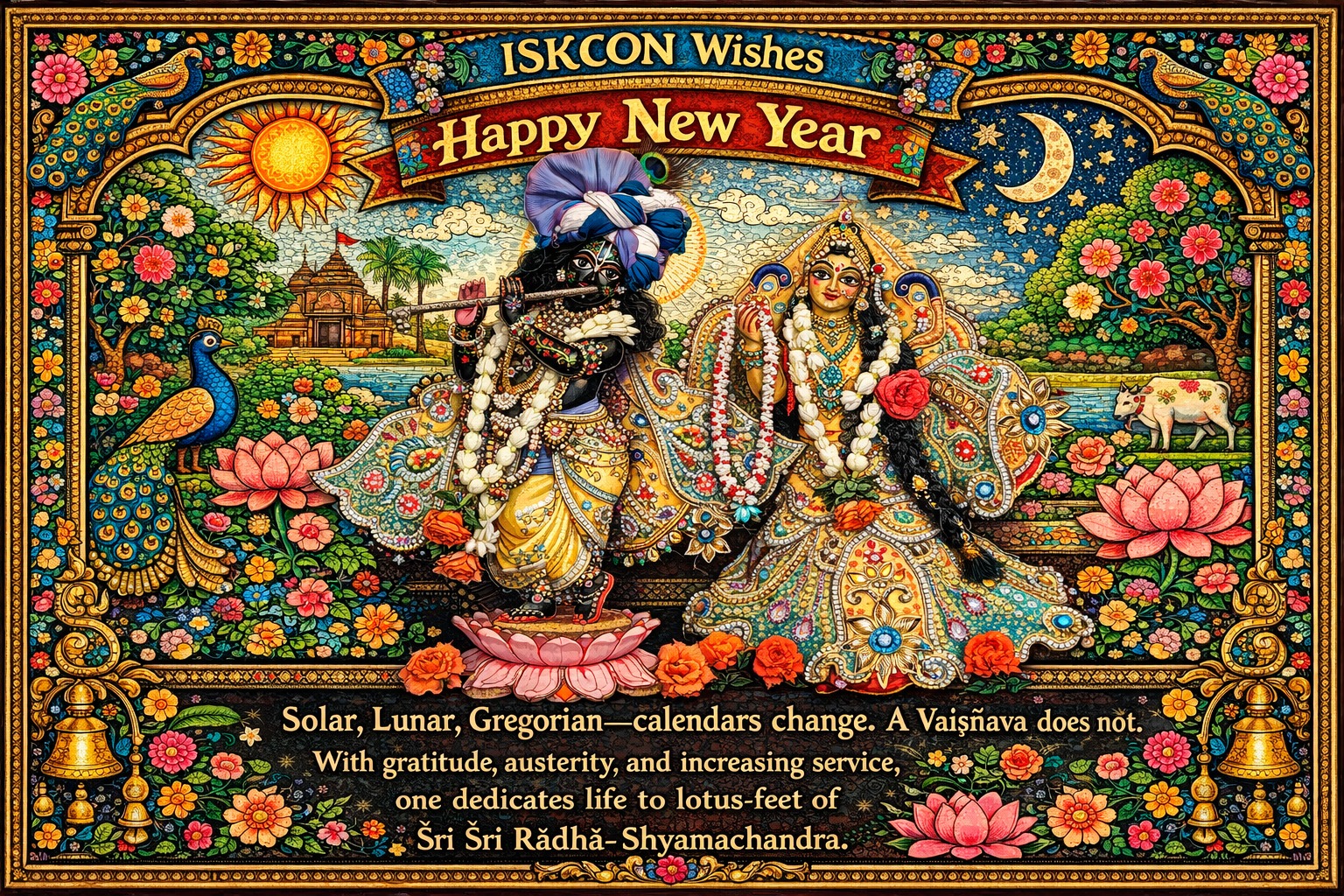
The calendars may differ: Indian, Western, Lunar, Solar, Samvatsara, Shaka, Vikram, Tamil, Bengali. But the truth is the same: Our life is reducing. Our chance to return to Kṛṣṇa is now.
A true Vaiṣṇava New Year means:
- Purify your heart
- Deepen your chanting
- Strengthen your service
- Offer your time to Kṛṣṇa
- Live with gratitude
- Move steadily toward the eternal goal
When Kṛṣṇa becomes the center, every year becomes auspicious, every month becomes sacred, every day becomes a festival.
🚩 Seva Opportunities
Contribute towards:
✨ Temple Construction
✨ Maha Abhishek, Annadanam, Flowers & Decorations, Goshala Seva
💰 Donation Details:
Account Name: ISKCON
Bank: Canara Bank
A/c No.: 0519101043190
IFSC: CNRB0000519
🌐 # Online Donations, online receipt: give.iskconraichur.com