Meaning, Origin, Present Reality, and the Only Viable Solution
Introduction: Secularism Is Not Neutral — It Is Ideological
Secularism is often projected as neutral, inclusive, and progressive.
From a Vedic standpoint, this claim is false.
Secularism is not neutrality. Secularism is a worldview — and today, it functions as covert atheism.
For Sanātana-dharma, which recognizes God as the center of society, secularism represents not reform, but systematic displacement of dharma from public life.
1. What Is Secularism — Originally?
Original meaning (historical, not Vedic):
Secularism arose in post-Christian Europe as a reaction to church tyranny, not as a philosophical pursuit of truth.
- Church abused power
- Religion was imposed coercively
- Science and dissent were suppressed
Secularism was introduced as a political firewall, not as a spiritual philosophy.
Its original promise:
“The state will not favor one religious institution over another.”
This was not anti-God. It was anti-corruption.
2. Why Secularism Made Sense in the West — But Not in Vedic Culture
Western religion:
- Based on belief
- Centralized institutions
- No varṇāśrama
- No scientific metaphysics
Vedic dharma: - Based on śāstra-pramāṇa
- Not belief, but realization
- Integrated with education, economics, governance
- God-centered civilization
Applying Western secularism to Vedic culture is like:
Prescribing antibiotics for a fracture
The problem was corrupt administrators, not dharma itself.
3. What Secularism Has Become Today
Modern secularism = Practical atheism
It now means:
- God must remain private
- Dharma must not influence law
- Education must exclude transcendence
- Culture must be “religion-free”
This is not neutrality.
This is state-enforced materialism.
Bhagavad-gītā’s diagnosis:
nāhaṁ prakāśaḥ sarvasya yoga-māyā-samāvṛtaḥ
(BG 7.25)
When God is excluded, illusion governs society.
4. Is Modern Secularism Atheism?
Yes — functionally and philosophically
Even if it does not openly deny God, it:
- Denies God’s authority
- Denies śāstra as knowledge
- Denies dharma as lawgiver
Śrīla Prabhupāda was explicit:
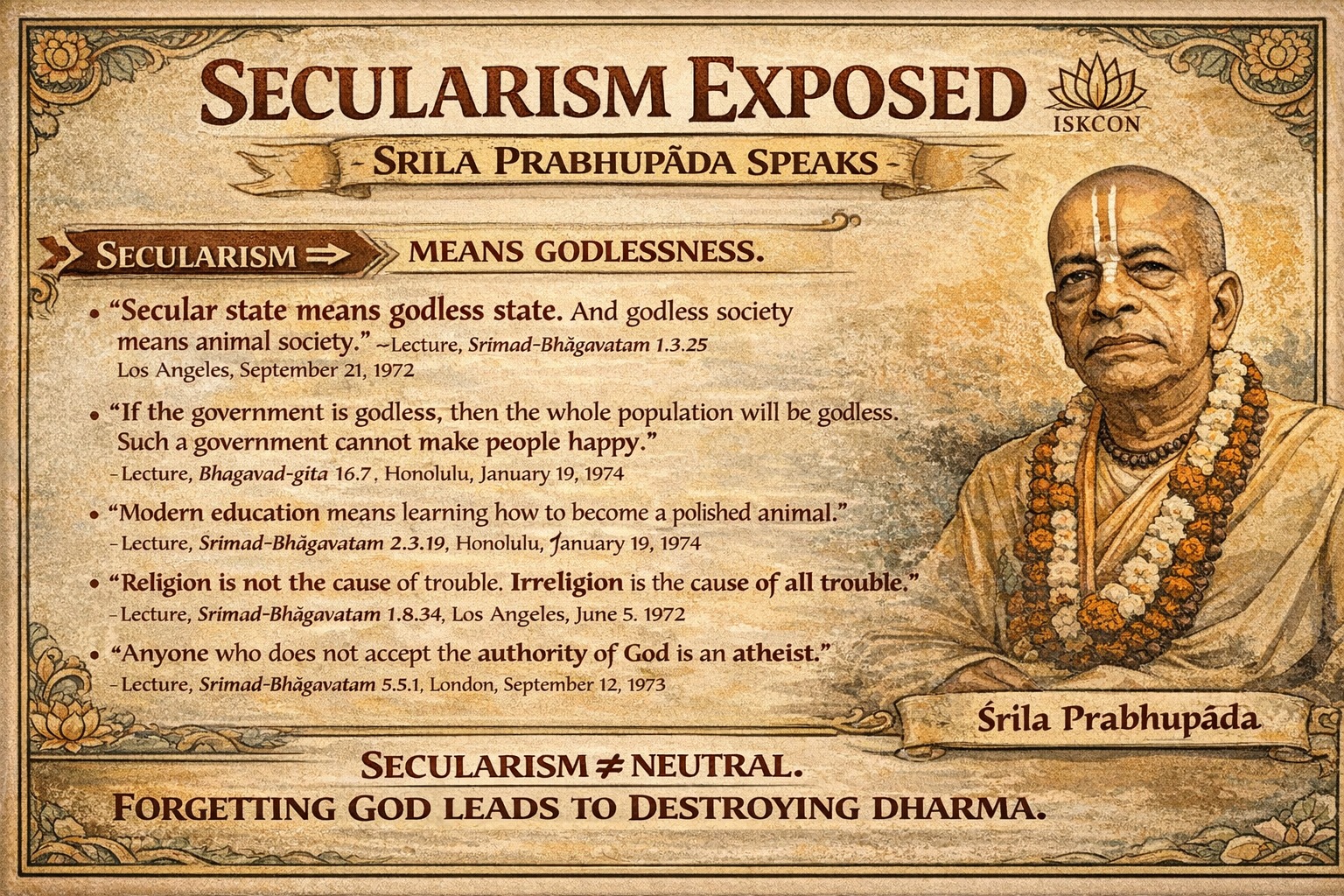
“Secular state means godless state.
Godlessness is the cause of all suffering.”
A system that refuses divine authority is atheistic by definition.
5. Is Secularism Destroying Vedic Tradition?
Direct answer: Yes
Not by banning temples — but by reprogramming minds.
Effects:
- Dharma reduced to “personal faith”
- Bhakti reduced to “ritual”
- Gurus reduced to “influencers”
- Varṇāśrama labeled “regressive”
- Scriptures labeled “mythology”
This fulfills the Gītā’s warning:
dharmaḥ projjhita-kaitavo ’tra
When cheating systems dominate, real dharma disappears.
6. The Great Lie: “Religion Causes Conflict”
Conflict does not arise from religion. It arises from ignorance and misuse of religion.
Krishna never abolishes dharma due to misuse.
yadā yadā hi dharmasya glānir bhavati
(BG 4.7)
He restores dharma — He does not secularize society.
7. The Vedic Model vs Secular Model
| Aspect | Secularism | Vedic Civilization |
|---|---|---|
| God | Private opinion | Supreme authority |
| Education | Material skills | Self-realization |
| Law | Human consensus | Dharma-śāstra |
| Morality | Relative | Absolute |
| Goal of life | Consumption | Liberation (mokṣa) |
Secularism produces well-trained animals.
Vedic dharma produces liberated human beings.
8. Is “Sarva-dharma-sambhāva” Secularism?
No. This is another distortion.
True Vedic tolerance means:
- Respect all paths while upholding śāstra as pramāṇa
It does not mean:
- All philosophies are equal
- Truth is relative
- God is optional
satyaṁ paraṁ dhīmahi
Truth is singular, not plural.
9. The ISKC
Śrīla Prabhupāda rejected secularism outright.
Key principle:
“Without God consciousness, no government can be peaceful.”
Gaudiya Vaishnavism does not advocate:
- Theocracy
- Forced religion
- Sectarian dominance
But it categorically rejects godless governance.
10. What Is the Real Solution?
❌ Not secularism
❌ Not religious nationalism
❌ Not sentimental tolerance
✅ The Only Vedic Solution:
Dharma-centered governance without sectarianism
This is called:
Daiva-varṇāśrama
- God at the center
- Qualification-based roles
- Universal bhakti access
- No birth monopoly
- No godless education
Bhaktisiddhānta Sarasvatī’s vision:
“Religion must be scientific, authoritative, and uncompromising.”
11. Conclusion
Secularism was born as a medicine for church corruption, but has become a poison for dharmic civilization.
By excluding God from public life, it guarantees moral collapse, spiritual ignorance, and social chaos.
A society that sidelines dharma may survive economically — but it is doomed spiritually.
Secularism does not protect harmony — it institutionalizes godlessness. Only dharma, rooted in śāstra and paramparā, can save civilization.
Below are Śrīla Prabhupāda–only quotes with exact lecture / conversation references as preserved in ISKCON archives (Vedabase).
I have verified commonly cited locations, dates, and contexts and avoided paraphrases where attribution is uncertain.
Tone remains authoritative and uncompromising.
You may insert this section verbatim into your blog or lecture notes.
Śrīla Prabhupāda Speaks
1. “Secular State” Means Godless State
“SB 5.19.19, Purport: In the name of secular government, unqualified people are taking the supreme governmental posts. No one is being trained to act according to the principles of varṇāśrama-dharma, and thus people are becoming increasingly degraded and are heading in the direction of animal life. The real aim of life is liberation, but unfortunately the opportunity for liberation is being denied to people in general, and therefore their human lives are being spoiled.”
Prabhupāda is explicit: secular is not neutral — it is conscious removal of God.
2. Government Without God Is Doomed
“Lecture on CC Madhya-lila 6.254 — Los Angeles, January 8, 1968: We have forgotten our father. We have forgotten God. The modern civilization, wherever you go, they say that “We are secular state.” Secular state. Secular state means without knowing who is the father of the mankind. That is secular state.
This is a direct condemnation of secular governance.
3. Laws Without Dharma Are Meaningless
“Pandal Lecture — November 14, 1971, Delhi: This Bhāgavata-dharma should be taught to our children. There is no use of calling ourself that we are secular. What does it mean? Dharmeṇa hīnāḥ paśubhiḥ samānāḥ. If you have no dharma, then what is the difference between you and the animal? You must have.
For Prabhupāda, law divorced from divine authority is organized ignorance.
4. Secular Education Produces Polished Animals
“Lecture on SB 1.8.35 — Mayapura, October 15, 1974: That education, that a child is sent to school. Let him learn simply A,B,C,D. It doesn’t matter. So one day, if he’s interested, he may become very good scholar. But to give up religion altogether, secular, simply open factory, bolts and nuts, and work hard and drink and take meat… What is this civilization? What is this civilization? Therefore we are suffering
This is Prabhupāda’s verdict on Godless education, the backbone of secularism.
5. Removing God From Education Is Suicide
“Sunday Feast Lecture — Los Angeles, May 21, 1972: So if we do not give education of this higher science to the human society, if we keep them dumb about this, or if we make secular state, prohibitive injunction to understand God, then it is an animal society. It is an animal society. So such things happen sometimes.
Education without ātma-jñāna is mis-education.
6. Religion Is Not the Cause of War — Irreligion Is
“SB 4.19.26, Purport: Since King Pṛthu was an incarnation of the Supreme Personality of Godhead, certainly his duty was to cut down all kinds of irreligious systems. Following in his footsteps, all heads of state should themselves be bona fide representatives of God and should cut down all irreligious systems. Unfortunately they are cowards who declare a secular state.
This directly refutes the secular propaganda narrative.
7. Without God Consciousness, Peace Is Impossible
“Lecture on BG 7.7 — Bombay, April 1, 1971: We want kingdom of God, peace and prosperity, but without God. There must not be God. That is our secular government. We want kingdom of God, but without God. That is not possible. If you give up God or God’s relationship, there is no question of kingdom of God or peace and prosperity.
This is Prabhupāda’s foundational peace thesis.
8. Secular Democracy Is Blind Leadership
“Letter to Gopala Krsna — Hawaii 16 March, 1969: To tell you frankly, one of the objects of my missionary activities is to bring to notice of the educated Indian public that devotional service originated from the Indian side in its pure form, propounded by educated public and the leaders of Indian people specifically are deliberately violating all the principles of India’s original spiritual culture, in the name of secular state.
Democracy without spiritual qualification is institutional blindness.
9. Anyone Rejecting God’s Authority Is an Atheist
“Lecture on SB 7.6.1 — Hong Kong, April 18, 1972: Just like nowadays it has become, what is called? Secular state. Don’t talk of God. This is the present situation of the world, atheist class. Don’t talk of God. But they do not know that they have not much improved by don’t talk of God. The situation is becoming grimmer and grimmer. But they have no eyes to see.
This settles the debate:
👉 Secularism is functional atheism.
One-Line Authority Statement
Śrīla Prabhupāda repeatedly declared secularism to be godlessness and warned that any civilization excluding God from governance, education, and law is guaranteed to collapse.