Understanding Āstika, Nāstika, and the Six Systems of Vedic Philosophy
Beyond Logic: The Journey to Absolute Truth
By the Mercy of Śrīla Prabhupāda
In the vast ocean of human inquiry, the soul eternally seeks answers to three fundamental questions: Who am I? What is this universe? And what is the ultimate goal?
The Vedic tradition offers a systematic ladder of knowledge to answer these questions. However, for the sincere seeker, it is crucial to distinguish between mental speculation and the Absolute Truth as revealed by the Supreme Personality of Godhead, Śrī Kṛṣṇa.
As Śrīla Prabhupāda often taught, philosophy without religion is mental speculation, and religion without philosophy is sentiment. To understand the position of Bhakti-yoga (devotional service), we must first understand the landscape of Indian philosophy—the Āstika and Nāstika schools—and how they eventually point toward the lotus feet of the Lord.
The Great Divide: Āstika vs. Nāstika
In modern terminology, “atheist” usually refers to someone who does not believe in God. However, in Sanskrit Vedic terminology, the distinction is based on the acceptance of the Vedas as the supreme authority (śabda-pramāṇa).
- Nāstika (Heterodox): These schools reject the authority of the Vedas. They rely solely on direct perception and logic.
- Examples: Buddhism, Jainism, and Cārvāka (materialism).
- Note: While Buddhism advocates non-violence (ahimsa), it is classified as Nāstika because Lord Buddha (an avatāra of Kṛṣṇa) deliberately rejected the Vedas to stop the misuse of animal sacrifice, as explained in the Daśāvatāra Stotra by Jayadeva Gosvāmī.
- Āstika (Orthodox): These schools accept the Vedas as the infallible authority. However, accepting the Vedas does not always mean they accept the Supreme Person. Many use the Vedas to promote impersonalism or ritualistic karma.
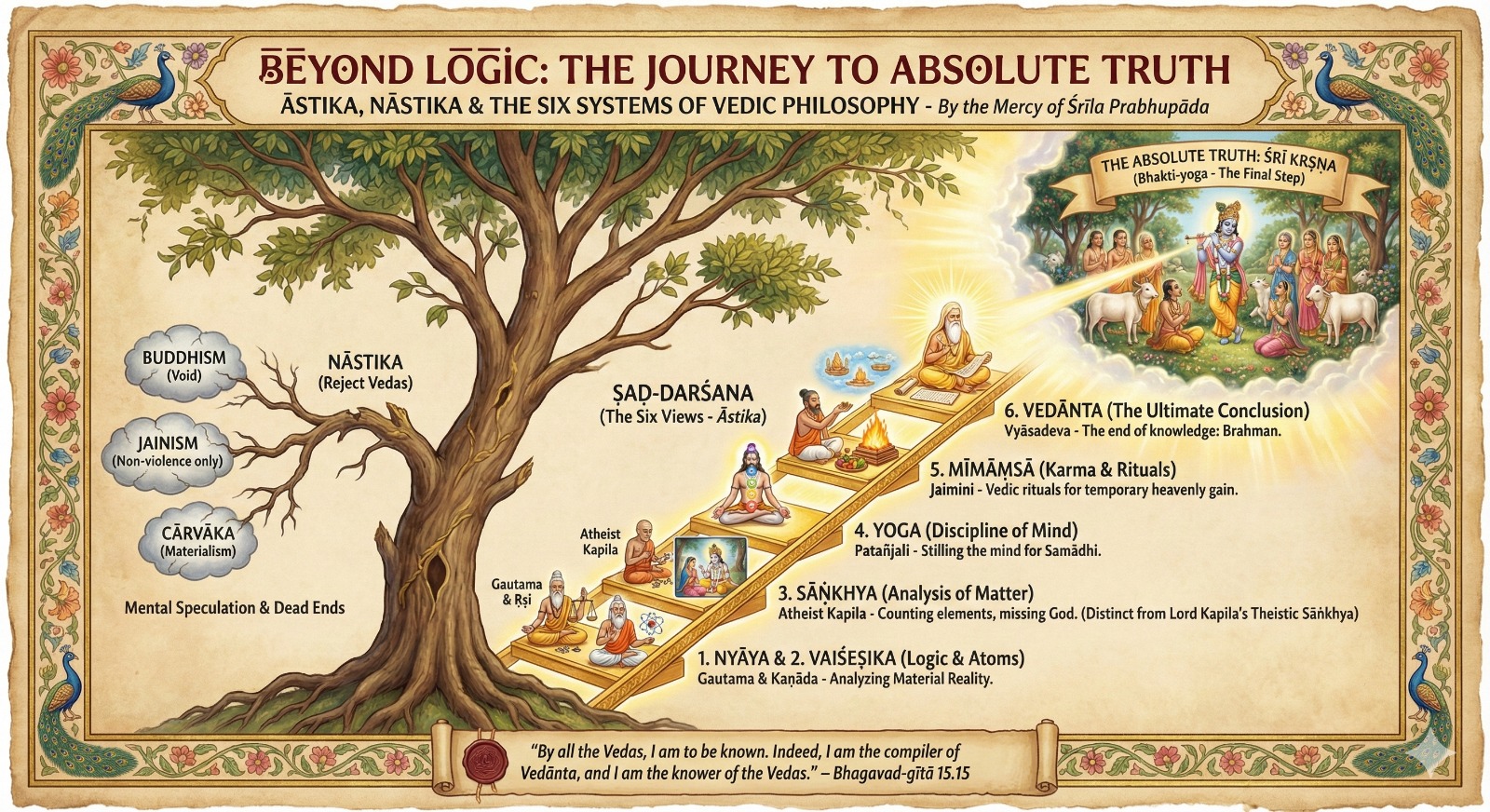
The Āstika tradition consists of six major philosophical systems known as the Ṣaḍ-darśana (Six Views).
The Ṣaḍ-darśana: Six Systems of Philosophy
The Vedic sages (ṛṣis) formulated these six systems to analyze reality from different angles. Śrīla Prabhupāda explains that these philosophers—from Kaṇāda to Patañjali—presented partial truths, acting as steps on a ladder. However, without the final conclusion of Vedānta, they remain incomplete.
Here is a breakdown of the six systems:
1. Nyāya (Logic & Epistemology)
- Propounder: Gautama Ṛṣi
- Core Concept: The science of reasoning and logic. It focuses on how we acquire valid knowledge (pramāṇa) through inference and evidence.
- The Goal: To remove suffering by attaining clear, logical understanding of the material world.
- Example: Using the logic of “smoke and fire” to prove the existence of an unseen cause (God) as the creator of the world.
2. Vaiśeṣika (Atomic Theory)
- Propounder: Kaṇāda Ṛṣi
- Core Concept: Analysis of material elements. It proposes that the universe is made of eternal atoms (paramāṇu).
- The Goal: To distinguish between the soul and matter by understanding the atomic building blocks of nature.
- Example: Breaking down a pot to see it is just earth atoms; similarly, analyzing the body to see it is different from the soul.
3. Sāṅkhya (Analysis of Matter)
- Propounder: Atheistic Kapila
- Core Concept: Dualism. Counting the elements of material nature (prakṛti) and the spirit (puruṣa).
- Important Distinction: There are two Kapilas. The Ṣaḍ-darśana refers to the *atheistic Kapila, who analyzed matter but ignored the Supreme Lord. The *original Lord Kapila (son of Devahūti) is an incarnation of Kṛṣṇa who taught Theistic Sāṅkhya—connecting analytical knowledge with Bhakti—in the Śrīmad-Bhāgavatam (Canto 3).
- The Goal: Liberation through discriminating between matter and spirit.
4. Yoga (Discipline of the Mind)
- Propounder: Patañjali
- Core Concept: Controlling the fluctuations of the mind (citta-vṛtti-nirodha) through the eight-fold path (aṣṭāṅga-yoga).
- The Goal: Samādhi (complete absorption).
- Prabhupāda’s Insight: In Kali-yuga, mechanical yoga is difficult. The mind is best controlled by the mantra (mind-deliverer): Hare Kṛṣṇa, Hare Kṛṣṇa, Kṛṣṇa Kṛṣṇa, Hare Hare…
5. Mīmāṁsā (Karma and Rituals)
- Propounder: Jaimini
- Core Concept: The path of Karma-kāṇḍa. It holds that if one performs Vedic rituals perfectly, one will automatically get material happiness or heavenly promotion. It marginalizes God, treating Him merely as an “order-supplier.”
- The Goal: Elevation to heavenly planets (Svarga-loka) for sense enjoyment.
- The Flaw: As Kṛṣṇa says in the Gītā, this result is temporary (kṣīṇe puṇye martya-lokaṁ viśanti).
6. Vedānta (The Ultimate Conclusion)
- Propounder: Śrīla Vyāsadeva (The literary incarnation of God)
- Core Concept: Vedānta means “the end of knowledge.” It summarizes the conclusion of all Vedas: the Absolute Truth is Brahman.
- The Goal: Realization of the Supreme.
- The Glitch: Impersonalists (Māyāvādīs) misinterpret Vedānta to mean merging into light. However, the true commentary on Vedānta-sūtra is the Śrīmad-Bhāgavatam, which establishes that the Absolute Truth is the Supreme Personality of Godhead, Śrī Kṛṣṇa.
The Vaiṣṇava Verdict: Acintya-Bhedābheda-Tattva
Why are the first five systems insufficient? Because they rely on the ascending process (āroha-panthā)—trying to reach the Infinite using finite senses and logic.
Śrīla Prabhupāda explains that these philosophers were great thinkers, but because they did not surrender to Kṛṣṇa, their knowledge was imperfect. As stated in Bhagavad-gītā (15.15):
vedaiś ca sarvair aham eva vedyo
“By all the Vedas, I am to be known. Indeed, I am the compiler of Vedānta, and I am the knower of the Vedas.”
The path of *Gauḍīya Vaiṣṇavism, established by Śrī Caitanya Mahāprabhu, harmonizes these philosophies through *Acintya-bhedābheda-tattva: Inconceivable Oneness and Difference.
Origins & classical propounders
Darśana Traditional propounder / principal text Short citation
Sāṅkhya Kapila; core ideas in Sāṅkhya tradition and later Sāṅkhya-kārikā. scholarly studies discuss Kapila as legendary founder and early texts.
Yoga Patañjali; Yoga-Sūtra (classical codification of yogic practice). standard editions and academic treatments of Patañjali.
Nyāya Gautama (Gotama); Nyāya-Sūtra — logic and pramāṇa theory. primary Nyāya texts preserved (Gotama).
Vaiśeṣika Kaṇāda (Kaśyapa); Vaiśeṣika-Sūtra — categories (padārtha). Kaṇāda’s sūtras form Vaiśeṣika core.
Pūrva-Mīmāṃsā Jaimini; Mīmāṃsā-Sūtra — ritual exegesis and dharma theory. Jaimini’s Mimamsa sūtra is the foundational text.
Vedānta (Uttara-Mīmāṃsā) Bādarāyaṇa (Badarayana/Vyāsa); Brahma-Sūtra — summarises Upaniṣadic teaching; later commented by śāstris (Śaṅkara, Rāmānuja, Madhva, etc.). Brahma-Sūtra tradition attributed to Badarayana/Vyāsa.
Note: classical Indian attribution mixes history and tradition; these are the canonical ascriptions used by commentators and by ISKCON teachers.
Teaching examples & analogies
Sāṅkhya vs Yoga: Two students study a locked room (bondage). Sāṅkhya maps the lock (prakṛti) and key (viveka); Yoga trains the hands to use the key (practice).
How the schools relate — ladder, complementarity, and ISKCON perspective
Classical commentators often treat the six systems as complementary: Sāṅkhya and Vaiśeṣika give metaphysics, Nyāya gives method, Yoga gives practice, Mīmāṃsā attends ritual order, Vedānta synthesizes final meaning. ISKCON emphasizes Vedānta (as explained by Śrīmad-Bhāgavatam and Bhagavad-gītā) as the culminating teaching that points to Krishna as the Supreme Person.
Prabhupāda’s guidance
“Of the six orthodox philosophies… only the Vedānta of Bādarāyaṇa… explains the Absolute Truth.” (paraphrased from many lectures). He urges devotees to study the six systems to appreciate Vedānta’s completeness while relying on guru — śāstra — sadhu for interpretation
Nyāya detective: Show how testimony + perception + inference can convict a thief — just as Nyāya defines valid means to know Brahman or error.
Mīmāṃsā librarian: A ritual handbook that insists on exact wording — like a legal code that preserves society’s backbone; remove it and social-religious structure frays.
Conclusion: The Final Step
Logic and analysis can bring us to the doorstep of the temple, but only Bhakti (devotion) allows us to enter. The six systems are like the different limbs of the body, but Kṛṣṇa Consciousness is the life air. Without the life air, the body has no value.
We invite you to bypass the difficult path of dry speculation and take the elevator of Bhakti-yoga.
Practical temple/life applications
Study ladder: Teach Sāṅkhya basics to older students (analysis), lead beginners into Yoga practice (simple āsana & breath), present Nyāya questions for youth debates (critical thinking), use Mīmāṃsā ideas to explain ritual importance at festivals, and ground all in Vedānta/Bhagavad-gītā & Bhāgavatam for devotion.
Preach with balance: Use logical tools (Nyāya) to answer questions, but always point to bhakti as the final goal. Prabhupāda cautions against getting lost in speculative systems alone
“Therefore, O Arjuna, in all circumstances, be a yogi.” — Bhagavad-gītā 6.46