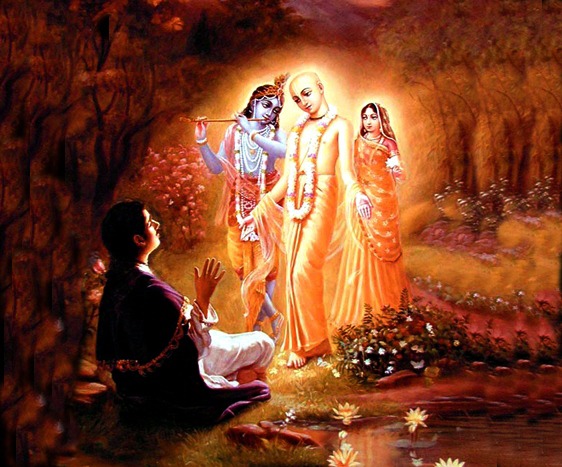
Among the most compelling theological developments in post-Purāṇic Vaiṣṇava thought is the advent and mission of Sri Caitanya Mahaprabhu (1486–1534 CE), revered within the Gauḍīya sampradāya as Kṛṣṇa Himself in the mood (bhāva) and golden effulgence (dyuti) of Śrī Rādhā. His life represents a rare confluence of historical personality, scriptural anticipation, ecstatic praxis, and rigorous metaphysical articulation. To understand Caitanya is to engage simultaneously with hagiography, Vedānta, aesthetics (rasa-śāstra), and devotional sociology.
Sacred Lineage: Parents and Early Milieu
Śrī Caitanya appeared in Navadvīpa (present-day West Bengal) during a lunar eclipse in 1486 CE. His father, Jagannatha Mishra, was a learned brāhmaṇa of the Śāndilya gotra, and His mother, Sachi Devi, was celebrated for her deep piety and maternal devotion. The child was named Viśvambhara (“one who sustains the universe”), though affectionately called Nimāi due to His birth beneath a neem tree. Born as Viśvambhara Miśra and affectionately called “Nimāi,” He exhibited prodigious scholarship in His early years. Yet, a transformative pilgrimage to Gayā catalyzed His shift from intellectual brilliance to ecstatic devotion. From that point, His life became a public revelation of divine love—marked by tears, trembling, and unceasing chanting of:
Hare Kṛṣṇa Hare Kṛṣṇa Kṛṣṇa Kṛṣṇa Hare Hare
Hare Rāma Hare Rāma Rāma Rāma Hare Hare
The Gauḍīya tradition interprets His parentage theologically rather than merely genealogically: Jagannātha Miśra and Śacī Devī are understood as the earthly manifestations of Nanda and Yaśodā in a new līlā-context.
Navadvīpa at that time was a formidable center of Nyāya scholarship. Young Nimāi excelled as a prodigious logician, yet this erudition was eventually eclipsed by a transformative devotional awakening following initiation by Ishvara Puri in Gayā. From that moment, scholastic pride dissolved into ecstatic bhakti.
Śāstric Foundations: Scriptural Proofs of Divinity
1. Bhāgavata Purāṇa (11.5.32)
kṛṣṇa-varṇaṁ tviṣākṛṣṇaṁ saṅgopāṅgāstra-pārṣadam yajñaiḥ saṅkīrtana-prāyair yajanti hi su-medhasaḥ
- kṛṣṇa-varṇam — one who constantly utters the name “Kṛṣṇa.”
- tviṣā akṛṣṇam — of non-dark (i.e., golden) complexion.
- Worshiped through saṅkīrtana-yajña.
2. Mahābhārata and Purāṇic References
Passages attributed to the Viṣṇu-sahasra-nāma and various Purāṇas speak of a golden-complexioned sannyāsī who inaugurates nāma-saṅkīrtana in Kali-yuga.
3. Internal Theological Necessity
In the Caitanya-caritāmṛta, Kṛṣṇadāsa Kavirāja presents a metaphysical rationale: Kṛṣṇa desired to taste Rādhā’s love. Thus, He incarnates as Caitanya to experience:
- The glory of Rādhā’s love.
- His own sweetness as She relishes it.
- The bliss She feels in loving Him.
This triadic motivation situates Caitanya’s appearance as the consummation of Kṛṣṇa-līlā rather than a separate avatāra.
The Saṅkīrtana Revolution: Devotion as Public Theology
Caitanya’s most visible contribution was the saṅkīrtana movement—collective chanting of the divine names. Assisted by Nityananda Prabhu and Advaita Acharya, He transformed private mysticism into communal ecstasy.
Socioreligious Impact
- Democratization of Bhakti: Access to transcendence was no longer mediated by caste or scholastic attainment.
- Performative Theology: Kīrtana functioned as embodied Vedānta; metaphysics was sung rather than merely debated.
- Resistance and Reform: The civil disobedience against the Kazi in Navadvīpa exemplified nonviolent devotional assertion.
Theologically, saṅkīrtana is understood as the prescribed sacrifice (yajña) for Kali-yuga. Ontologically, the holy name (nāma) is non-different from Kṛṣṇa (nāmī), rendering sound vibration itself sacramental.
Acintya-bhedābheda-tattva: The Metaphysical Synthesis
One of Caitanya Mahāprabhu’s enduring intellectual legacies is the doctrine of acintya-bhedābheda—inconceivable simultaneous oneness and difference.
Philosophical Context
Vedānta prior to Caitanya had crystallized into major interpretive schools:
- Śaṅkara’s non-dualism (advaita)
- Rāmānuja’s qualified non-dualism (viśiṣṭādvaita)
- Madhva’s dualism (dvaita)
Caitanya’s synthesis preserves relational duality while affirming ontological unity.
Core Tenets
- The jīva is a real, eternal part of Bhagavān.
- The world is a real transformation of divine energies.
- Unity and distinction coexist beyond mundane logic (acintya).
This framework provides the metaphysical grounding for rasa: love presupposes difference, yet intimacy presupposes unity.
The system was later systematically articulated by the Six Gosvāmīs of Vṛndāvana, particularly Jiva Goswami.
The Final Years and Disappearance Pastime
In His later years in Purī, Caitanya Mahāprabhu entered increasingly intense states of divine ecstasy, particularly in separation (vipralambha) from Kṛṣṇa. Residing near the temple of Jagannath, His nights were marked by profound mystical absorption.
- – He entered into the Tota Gopīnātha deity during kīrtana at temple.
In Gauḍīya hermeneutics, such ambiguity reinforces His transcendence; the Lord’s aprakaṭa-līlā (unmanifest pastimes) continue beyond empirical perception.
He is the hermeneutical key to understanding Kṛṣṇa’s deepest interiority. In Him, theology becomes song, metaphysics becomes dance, and divine love becomes universally accessible.
The golden moon that rose in Navadvīpa continues to illumine devotional thought and practice—its radiance undiminished by time.
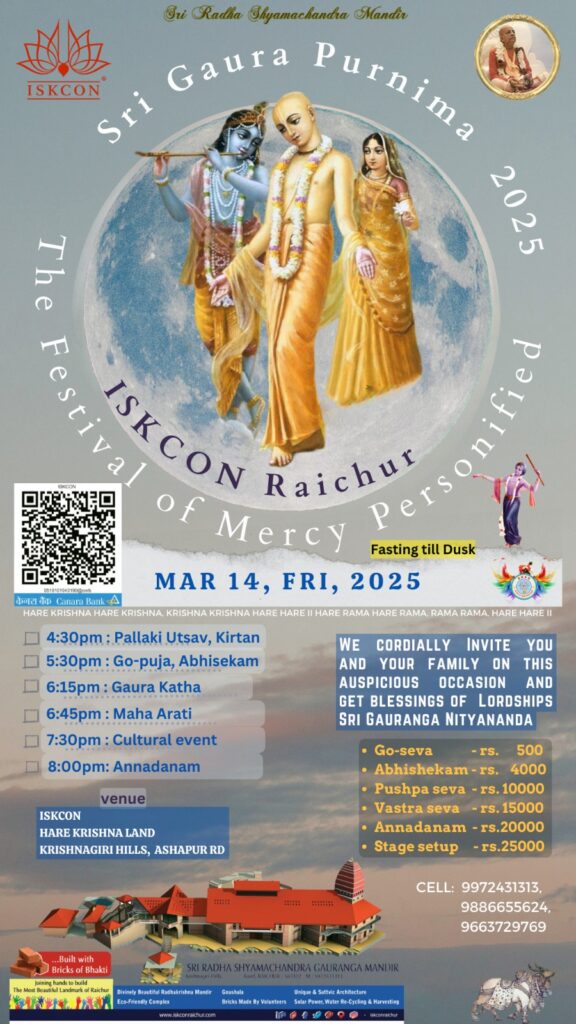
Gaur Pūrṇimā: Ritual, Aesthetics, and Devotional Praxis
The celebration of Gaur Pūrṇimā is both liturgical and affective. Devotees typically observe a day-long fast, culminating in a midnight ārati that coincides with the Lord’s appearance time. Temples are adorned with golden hues, symbolizing Mahāprabhu’s effulgent form (gaura-varṇa).
Key Elements of the Celebration:
- Abhiṣeka (Ceremonial Bathing): Deities of Caitanya Mahāprabhu are bathed with sanctified substances—milk, yogurt, honey, ghee—accompanied by Vedic hymns and kīrtana.
- Saṅkīrtana: Extended sessions of congregational chanting, often with traditional instruments like mṛdaṅga and karatālas.
- Scriptural Recitation: Passages from texts such as Caitanya-caritāmṛta and Caitanya-bhāgavata are read, narrating His life and teachings.
- Prasāda Distribution: After the fast is broken, elaborate vegetarian offerings are shared, emphasizing communal harmony and grace.
Śrī Caitanya Mahāprabhu’s life is not merely a subject of reverence but an invitation—to participate in divine love through the simplest yet most profound means: the chanting of the holy names. Gaur Pūrṇimā thus stands as a luminous threshold, where history meets eternity, and theology becomes song.
In an age marked by fragmentation and distraction, His message resounds with clarity:
“Chant, and be transformed.”
Offer donation for Temple construction, Maha Abhishek, Annadanam, Flowers, Goshala
Deposit donations @
ISKCON
Canara bank account
0519101043190
IFSC CNRB0000519
Online
https://give.iskconraichur.com/