Introduction: The Pinnacle of Divine Love
Among all narrations in the Śrīmad Bhāgavatam, the Rāsa Līlā stands as the most profound revelation of divine love (prema-tattva). Described in the 10th Canto (Chapters 29–33), it portrays the intimate dance between Śrī Kṛṣṇa and the Vraja gopīs, led by Śrīmatī Rādhārāṇī.
Yet, this sacred pastime is often misunderstood through a material lens. A scholarly and faithful approach—guided by ācāryas—is essential to grasp its transcendental nature.
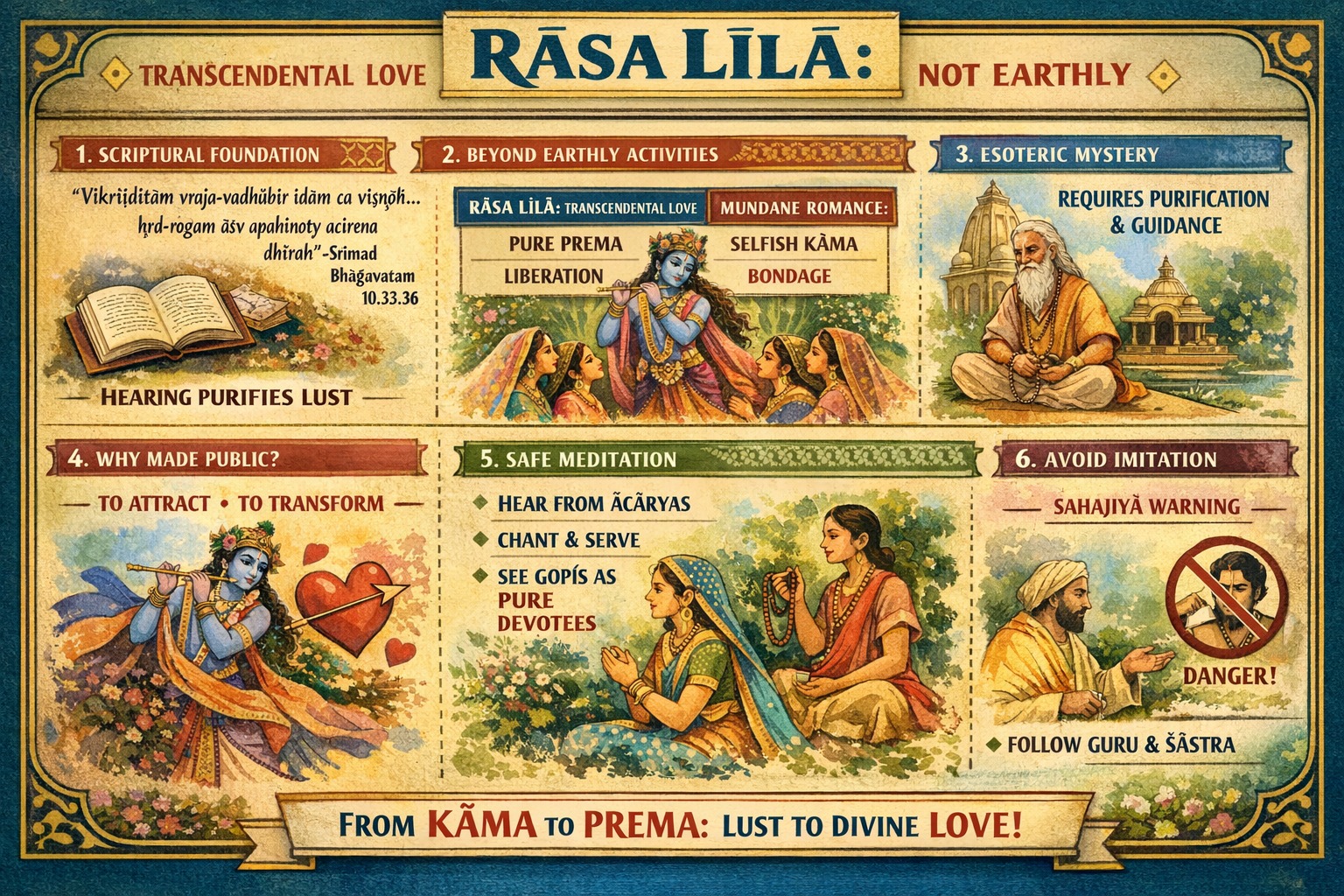
1. Scriptural Foundation of Rāsa Līlā
The Śrīmad Bhāgavatam (10.33.36) clearly establishes the purifying potency of hearing Rāsa Līlā:
“vikrīḍitaṁ vraja-vadhūbhir idaṁ ca viṣṇoḥ śraddhānvito ’nuśṛṇuyād atha varṇayed yaḥ bhaktiṁ parāṁ bhagavati pratilabhya kāmaṁ hṛd-rogam āśv apahinoty acireṇa dhīraḥ”
One who faithfully hears or describes the Lord’s pastimes with the gopīs attains supreme devotion and quickly becomes freed from lust, the disease of the heart.
This verse is pivotal—it defines Rāsa Līlā not as a stimulus for sensuality, but as a cure for it.
Supporting Revelations
- Gīta Govinda – poetic expansion of Rādhā-Kṛṣṇa love
- Brahma-saṁhitā – description of Goloka & divine form
- Caitanya-caritāmṛta – theological explanation of rāsa-tattva
- Garga Saṁhitā – detailed Vṛndāvana pastimes
Foundational Teachers
- Śukadeva Gosvāmī, Śrī Caitanya Mahāprabhu
Systematizers
- Rūpa Gosvāmī – Bhakti-rasāmṛta-sindhu, Jīva Gosvāmī – Sandarbhas
Modern Expositors
A. C. Bhaktivedanta Swami Prabhupāda, Bhaktivinoda Ṭhākura, Bhaktisiddhānta Sarasvatī Ṭhākura
2. How Rāsa Līlā Differs from Earthly Activities
Ontological Difference (Tattva-bheda)
| Aspect | Rāsa Līlā | Mundane Romance |
|---|---|---|
| Ontology | Transcendental (aprakṛta) | Material (prakṛta) |
| Motivation | Pure love (prema) | Self-centered desire (kāma) |
| Center | Kṛṣṇa (Absolute Reality) | Individual ego |
| Result | Liberation and divine love | Bondage and karma |
The Achintya Bheda Abheda principle explains that although the form appears similar, the essence is entirely different.
Śāstric Clarification
In Bhagavad-gītā (4.9), Kṛṣṇa declares:
“janma karma ca me divyam…”
His activities are divine, not material.
Thus, applying mundane morality to divine līlā is a categorical error (adhyāropa).
3. The Esoteric Nature: Why It Requires Proper Understanding
Rāsa Līlā belongs to the highest spiritual domain—mādhurya-rasa. According to Rūpa Gosvāmī in Bhakti-rasāmṛta-sindhu, this rasa is accessible only after purification through regulated devotion (vaidhi-bhakti).
Sequential Revelation in Bhāgavatam
The structure of the Śrīmad Bhāgavatam itself is pedagogical:
- Cantos 1–9: Philosophical foundation
- Canto 10: Kṛṣṇa’s pastimes (Rāsa Līlā appears only after preparation)
This indicates that premature exposure without purification leads to misunderstanding.
Superhuman Features
✨ Infinite Expansion
- Kṛṣṇa manifests countless forms simultaneously
- Each gopī experiences exclusive personal association
✨ Time Suspension - One night of rāsa = duration of Brahmā’s night (cosmic scale)
✨ Spiritual Environment - Takes place in Goloka Vṛndāvana (beyond material universe)
✨ Self-Luminous Reality - No sun, moon required—everything is conscious and divine
Completely Non-earthly
| Feature | Rāsa Līlā | Material World |
|---|---|---|
| Energy | Internal (Yoga-māyā) | External (Mahā-māyā) |
| Bodies | Sat-cit-ānanda | Temporary material |
| Emotion | Prema (pure love) | Kāma (selfish desire) |
👉 As stated in Vedic aesthetics, highest rasa (śṛṅgāra) becomes pure only when centered on Bhagavān
4. Why Was Such an Esoteric Līlā Made Public?
Compassionate Intent of the Lord
Śukadeva Gosvāmī, a self-realized soul beyond material desire, narrates this līlā to Mahārāja Parīkṣit, who was facing imminent death.
Purpose:
- To attract conditioned souls through the highest beauty
- To transform lust into love
As A. C. Bhaktivedanta Swami Prabhupāda explains:
“The gopīs’ love is the highest perfection, and hearing it purifies the heart of lust.”
Theological Principle: Sublimation, Not Suppression
Rather than denying attraction, Vedic wisdom redirects it toward Kṛṣṇa, the ultimate object of love.
5. How to Properly Understand and Meditate on Rāsa Līlā
Authorized Method (Paramparā Approach)
- Śravaṇam (Hearing) from realized devotees
- Gradual purification through:
- Chanting (nāma-japa)
- Regulated sādhana
- Avoid independent interpretation
Meditative Framework
- Meditate on Kṛṣṇa as the Supreme Enjoyer (puruṣa)
- Understand gopīs as pure devotees, not material women
- Focus on selfless service mood (seva-bhāva)
6. Protection Against Imitation (Sahajiyā Tendencies)
The Danger
Imitating Rāsa Līlā leads to:
- Moral degradation
- Spiritual downfall
- Offense (aparādha)
Śāstric Warning
In Bhagavad-gītā (3.6):
One who externally restrains but internally dwells on sense objects is a pretender.
Practical Safeguards
- Follow regulated principles (sādhana-bhakti)
- Study under bona fide guru
- Avoid erotic interpretation or dramatization
- Engage in service, not imitation
7. The Transformative Goal: From Kāma to Prema
The essence of Rāsa Līlā is transformation:
- Kāma (lust) → taking for oneself
- Prema (love) → giving everything to Kṛṣṇa
The gopīs exemplify the highest renunciation:
They abandoned everything—not for personal gain, but for Kṛṣṇa’s pleasure.
Conclusion: A Sacred Mystery to Be Revered, Not Imitated
Rāsa Līlā is not a narrative to be judged—it is a revelation to be received.
- It is transcendental, not symbolic sensuality
- It is therapeutic, not provocative
- It is ultimate theology, not mythology
Approached with humility, guided by guru and śāstra, it becomes the most powerful purifier of the human heart.
Etymology of “Rāsa Līlā”
1. The Word “Rāsa” (रास / रस)
Primary Root: √ras (रस्)
The Sanskrit verbal root √ras means:
“to taste”, “to relish”, “to experience essence or flavor”
A. Rasa as “Essence” and “Taste”
In the Rg Veda, rasa initially denotes:
- juice, sap, extract, or essence
Later, in the Taittirīya Upaniṣad (2.7), the term reaches its highest philosophical definition:
“raso vai saḥ”
“The Absolute Truth is rasa (the ultimate relish/bliss).”
Here, rasa becomes synonymous with Brahman as experiential bliss—not merely existence, but relishable divine reality.
B. Rasa in Aesthetics (Nāṭya-śāstra Tradition)
In the Nāṭya Śāstra of Bharata Muni, rasa refers to:
- aesthetic emotion experienced by the spectator
Examples include: - śṛṅgāra (romantic), vīra (heroic), karuṇa (compassion)
But in devotional theology, especially in Rūpa Gosvāmī’s works, this concept is elevated:
Rasa becomes the living exchange between the soul and the Divine.
C. Rāsa (रास) as a Specific Form
The word “rāsa” (with long ā) is a derivative form used in:
- circular dance formations
- festive group dances (especially in Vraja tradition)
Thus, rāsa specifically indicates:
👉 a circular, rhythmic, relational dance of divine participation
2. The Word “Līlā” (लीला)
The word līlā is derived from the Sanskrit verbal root:
- √lī (ली) or √līl (to play, to sport, to move freely)
Core Meaning
play, sport, effortless activity, divine pastime
A. Theological Significance
In texts like the Brahma Saṁhitā, līlā is used to describe:
The spontaneous, आनंदमय (blissful) activities of the Supreme Being
Unlike human action, which is driven by:
- need, karma, incompleteness
Divine līlā is: - पूर्ण (complete), स्वाभाविक (natural), अनायास (effortless)
It is action without necessity—only for आनंद (bliss).
3. The Compound: “Rāsa Līlā” (रास लीला)
Grammatical Structure
“Rāsa Līlā” is a tatpuruṣa compound, meaning:
the līlā (divine play) consisting of rāsa (the dance of rasa)
Integrated Meaning
When combined, the term signifies:
“The divine play in which the Supreme relishes and reciprocates the highest spiritual rasa through a circular dance with His devotees.”
Or more deeply:
“The supreme ecstatic exchange of divine love, expressed through an infinite, conscious, aesthetic, and relational dance.”
4. Theological Expansion in Bhakti Tradition
In the Śrīmad Bhāgavatam, especially Canto 10:
- Rāsa = mādhurya-prema (sweet, intimate divine love)
- Līlā = Kṛṣṇa’s transcendental, playful manifestation of that love
Thus, Rāsa Līlā becomes: - The highest revelation of “raso vai saḥ” — God as the ultimate relishable reality
5. Key Philosophical Insight
- Rasa answers: What is experienced? → Divine love
- Līlā answers: How is it expressed? → Through divine play
Together: