Pinnacle of Rasa
Silent Yet Supreme Service in the Theology of Divine Love
In the esoteric theology of Gaudiya Vaishnavism, no concept is more refined, intimate, and spiritually elevated than mañjarī-bhāva—the devotional mood of the confidential maidservants of Śrīmatī Rādhārāṇī. It is not merely a sentiment; it is a highly technical, ontological position within the architecture of divine love (rasa-tattva), described in precision by the Gosvāmīs and realized by the rāgānugā saints.
This blog explores the theological depth, aesthetic structure, and experiential supremacy of mañjarī-bhāva—revealing why it is considered the pinnacle of all devotional attainment.
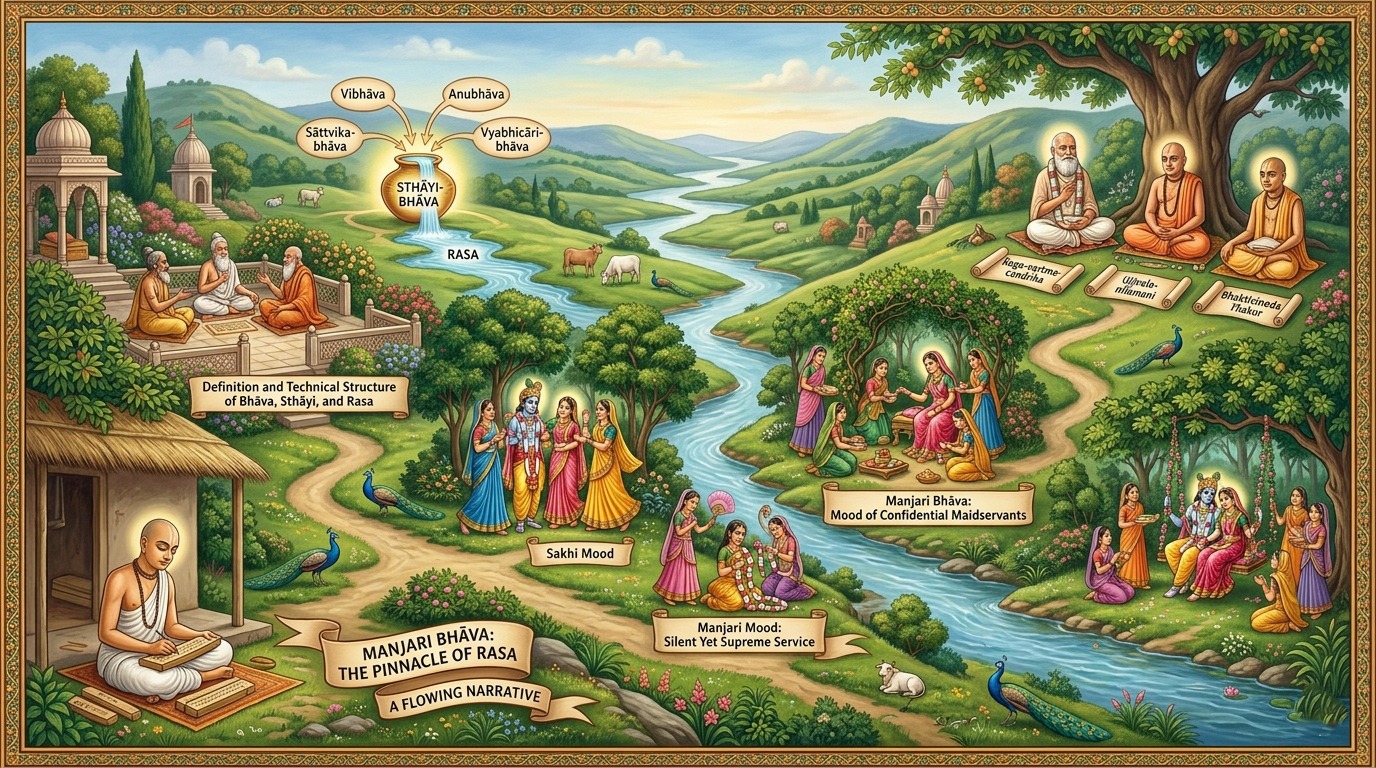
1. Understanding the Technical Structure of Rasa
The science of devotional aesthetics (rasa-śāstra) reaches its apex in the works of Rupa Goswami, especially in Ujjvala-nilamani. To understand mañjarī-bhāva, one must first grasp the fundamental structure of rasa.
Core Components
- Sthāyī-bhāva (Permanent Emotion):
The foundational emotional disposition toward Kṛṣṇa (e.g., madhura-rati in conjugal love). - Vibhāva (Stimuli):
The causes that awaken emotion—Kṛṣṇa as the object (viṣaya) and the devotee as the shelter (āśraya). - Anubhāva (Expressions):
External manifestations such as smiling, dancing, or glancing. - Vyabhicārī-bhāvas (Transitory Emotions):
Supporting emotional waves like anxiety, joy, or longing. - Sāttvika-bhāvas (Involuntary Ecstasies):
Transformations such as tears, trembling, and horripilation.
👉 When these combine harmoniously, they culminate in rasa—a fully relishable transcendental aesthetic experience.
Among all rasas, mādhurya-rasa (conjugal love) is supreme, and within it, mañjarī-bhāva is its most refined expression.
2. Sakhi vs Mañjarī: A Subtle but Absolute Distinction
Within the conjugal domain of Vṛndāvana, there are gradations of intimacy and service identity.
Sakhi-bhāva (Confidential Friends)
The sakhīs, like Lalitā and Viśākhā, are direct participants in Kṛṣṇa’s pastimes. They:
- Sometimes engage in loving exchanges with Kṛṣṇa themselves
- Possess a degree of independent emotional agency
- Facilitate the union of Rādhā and Kṛṣṇa
Mañjarī-bhāva (Confidential Maidservants)
The mañjarīs, however, embody something more radical:
- They have no independent desire to enjoy Kṛṣṇa
- Their identity is fully dissolved in service to Śrīmatī Rādhārāṇī
- They experience greater intimacy than even the sakhīs—being present in the most confidential moments
This paradox is central:
👉 By renouncing personal participation, the mañjarīs gain deeper access.
As described in Ujjvala-nilamani, the mañjarīs can enter spaces where even senior sakhīs cannot—such as assisting in the most intimate meetings (nikunja-sevā).
3. The Essence of Mañjarī-Bhāva
Mañjarī-bhāva is characterized by tādātmya with Rādhā—complete identification with Her emotions.
Key Features
- Bhāvollāsa-rati:
A unique emotional condition where the devotee relishes Kṛṣṇa exclusively through Rādhā’s pleasure. - Absolute Selflessness:
No trace of personal enjoyment (svārtha-śūnyatā). - Unobstructed Service Access:
The mañjarīs can serve at times and places inaccessible even to sakhīs. - Emotional Reflection:
When Rādhā feels joy or separation, the mañjarī experiences it even more intensely.
This is why the tradition calls it “the highest reach of rāgānugā-bhakti.”
4. Scriptural Foundations and Quotations
From Raga-vartma-candrika by Vishvanatha Chakravarti Thakur
He emphasizes that advanced practitioners follow the mood of the Vraja associates:
“One should internally serve in the mood of the desired associate of Vraja.”
This instruction becomes most fully realized in mañjarī-bhāva, where the practitioner follows the maidservants of Rādhā.
From Ujjvala-nilamani
Rūpa Gosvāmī identifies the mañjarīs as uniquely qualified:
“They relish the sweetness of Kṛṣṇa through the happiness of Rādhā.”
This establishes mañjarī-bhāva as not merely a category—but a superlative experiential state.
From Bhaktivinoda Thakur
In his writings, especially Jaiva Dharma and kīrtanas, he reveals the aspirational mood:
“I am the maidservant of the maidservant of Śrī Rādhā.”
This layered humility (dāsī-anudāsī-bhāva) is the gateway into mañjarī identity.
5. Silent Yet Supreme Service
The defining paradox of mañjarī-bhāva is this:
👉 It is the most hidden form of devotion, yet the most exalted.
The mañjarīs do not seek:
- Recognition
- Direct union with Kṛṣṇa
- Emotional independence
Instead, they exist solely for:
- Decorating Rādhā
- Arranging divine meetings
- Consoling Her in separation
- Assisting in the most intimate līlās
- Their service is silent, but its theological status is supreme.
6. Why Mañjarī-Bhāva is the Pinnacle
From a doctrinal perspective, mañjarī-bhāva is the highest because:
- Maximum Selflessness – zero personal desire
- Maximum Intimacy – access to the deepest līlās
- Maximum Emotional Depth – experiencing Rādhā’s love directly
- Maximum Theological Alignment – complete harmony with the hlādinī-śakti
- In Gaudiya ontology, Śrīmatī Rādhārāṇī is the embodiment of Kṛṣṇa’s pleasure potency. Thus, serving Her directly is ontologically superior to serving Kṛṣṇa independently.
7. Practical Implications for Sādhakas
While mañjarī-bhāva represents the highest ideal, it is approached gradually through:
- Nāma-bhajana (pure chanting)
- Śāstra study
- Guru-pāda-āśraya
- Internal meditation (smaraṇa) in rāgānugā practice
- As emphasized by Vishvanatha Chakravarti Thakur, one should not artificially imitate but naturally awaken this identity through purification.
Conclusion: The Theology of Divine Intimacy
Mañjarī-bhāva is not merely a poetic idea—it is the culmination of the entire Gaudiya theological project. It represents the highest synthesis of:
- Aesthetic theory (rasa)
- Ontology (śakti-tattva)
- Devotional psychology (bhāva)
In its essence, it proclaims a radical truth:
👉 The highest love is not to be loved—but to facilitate love. - And in that silent facilitation, the mañjarīs attain the deepest union of all—not with Kṛṣṇa directly, but with the very heart of His pleasure: Śrīmatī Rādhārāṇī.
Here is a precise tattva-comparison chart situating mañjarī-bhāva within the full Gaudiya rasa ontology. This is structured for teaching, preaching, and advanced study.
Tattva Comparison Chart: Mañjarī-Bhāva vs Other Rasas
| Category | Śānta-rasa | Dāsya-rasa | Sakhya-rasa | Vātsalya-rasa | Mādhurya (Sakhi-bhāva) | Mādhurya (Mañjarī-bhāva) |
|---|---|---|---|---|---|---|
| Primary Emotion (Sthāyī-bhāva) | Neutral reverence | Servitorship | Friendship | Parental affection | Conjugal love | Conjugal love (via Rādhā) |
| Degree of Intimacy with Kṛṣṇa | Very distant | Respectful closeness | Intimate equality | Protective superiority | Direct romantic intimacy | Indirect yet deepest intimacy |
| Sense of Identity | “Kṛṣṇa is God” | “I am servant” | “Kṛṣṇa is my friend” | “Kṛṣṇa is my child” | “Kṛṣṇa is my beloved” | “I am Rādhā’s maidservant” |
| Presence of Aiśvarya (Majesty) | High | Moderate | Minimal | Minimal | None | None |
| Access to Confidential Līlā | None | Limited | Moderate | Moderate | High | Highest (Nikuñja-sevā) |
| Independence in Relationship | None | Low | Moderate | High | Moderate | Zero (Absolute dependence on Rādhā) |
| Personal Enjoyment with Kṛṣṇa | None | None | Yes (playful) | Yes (affection) | Yes (romantic) | None (only via Rādhā’s joy) |
| Emotional Center | Kṛṣṇa’s greatness | Kṛṣṇa’s आदेश (command) | Friendship exchanges | Care and protection | Romantic union | Rādhā’s pleasure exclusively |
| Experience of Separation (Vipralambha) | Philosophical | Service anxiety | Friendly longing | Parental चिंता | Romantic विरह | Rādhā-centered विरह (more intense) |
| Eligibility for Rāgānugā | Rare | Possible | Strong | Strong | Very strong | Highest aspiration in Gaudiya line |
| Representative Associates | Four Kumāras | Raktaka, Patraka | Subala, Śrīdāma | Yaśodā, Nanda | Lalitā, Viśākhā | Rūpa-mañjarī, Rati-mañjarī |
| Scriptural Basis | Srimad Bhagavatam | Bhagavad-gita | Srimad Bhagavatam | Srimad Bhagavatam | Ujjvala-nilamani | Ujjvala-nilamani, Raga-vartma-candrika |
| Theological Position | Foundation | Service layer | Intimate expansion | Nourishing aspect | Highest direct rasa | Supreme refinement of highest rasa |
Focused Comparison: Sakhi vs Mañjarī (Core Distinction)
| Aspect | Sakhi-bhāva | Mañjarī-bhāva |
|---|---|---|
| Relation to Kṛṣṇa | Direct प्रिय-नायिका (beloved) | No direct romantic relation |
| Relation to Rādhā | मित्र (confidante) | दासी (exclusive maidservant) |
| Personal Desire | Subtle personal enjoyment present | Absolutely nil (svārtha-śūnyatā) |
| Participation in Līlā | Direct participant | Facilitator and servant |
| Access to Nikuñja | Restricted in certain moments | Unrestricted access |
| Emotional Experience | Own प्रेम for Kṛṣṇa | Rādhā’s प्रेम reflected (bhāvollāsa-rati) |
| Theological Status | Extremely exalted | Most exalted in Gaudiya siddhānta |
Key Siddhānta Insights
1. Hierarchical but Non-Competitive
All rasas are perfect and eternal, yet from the Gaudiya theological lens (as presented by Rupa Goswami), intimacy progressively deepens toward mādhurya, culminating in mañjarī-bhāva.
2. Ontological Superiority of Rādhā-Centered Service
Since Śrīmatī Rādhārāṇī is the embodiment of hlādinī-śakti, serving Her pleasure is considered superior even to direct service to Kṛṣṇa.
3. The Paradox of Highest Attainment
- Sakhi: Direct enjoyment → high intimacy
- Mañjarī: No enjoyment → highest intimacy
This inversion defines Gaudiya theology.
4. Practical Orientation for Sādhakas
According to Raga-vartma-candrika:
- One follows internally (manasi-sevā) the mood of Vraja associates
- Mañjarī-bhāva is approached through greed (lobha), not mechanical practice
Conclusion
👉 Śānta → Dāsya → Sakhya → Vātsalya → Mādhurya → Mañjarī
is not just a scale of emotion—but a progressive unveiling of divine intimacy, where: