
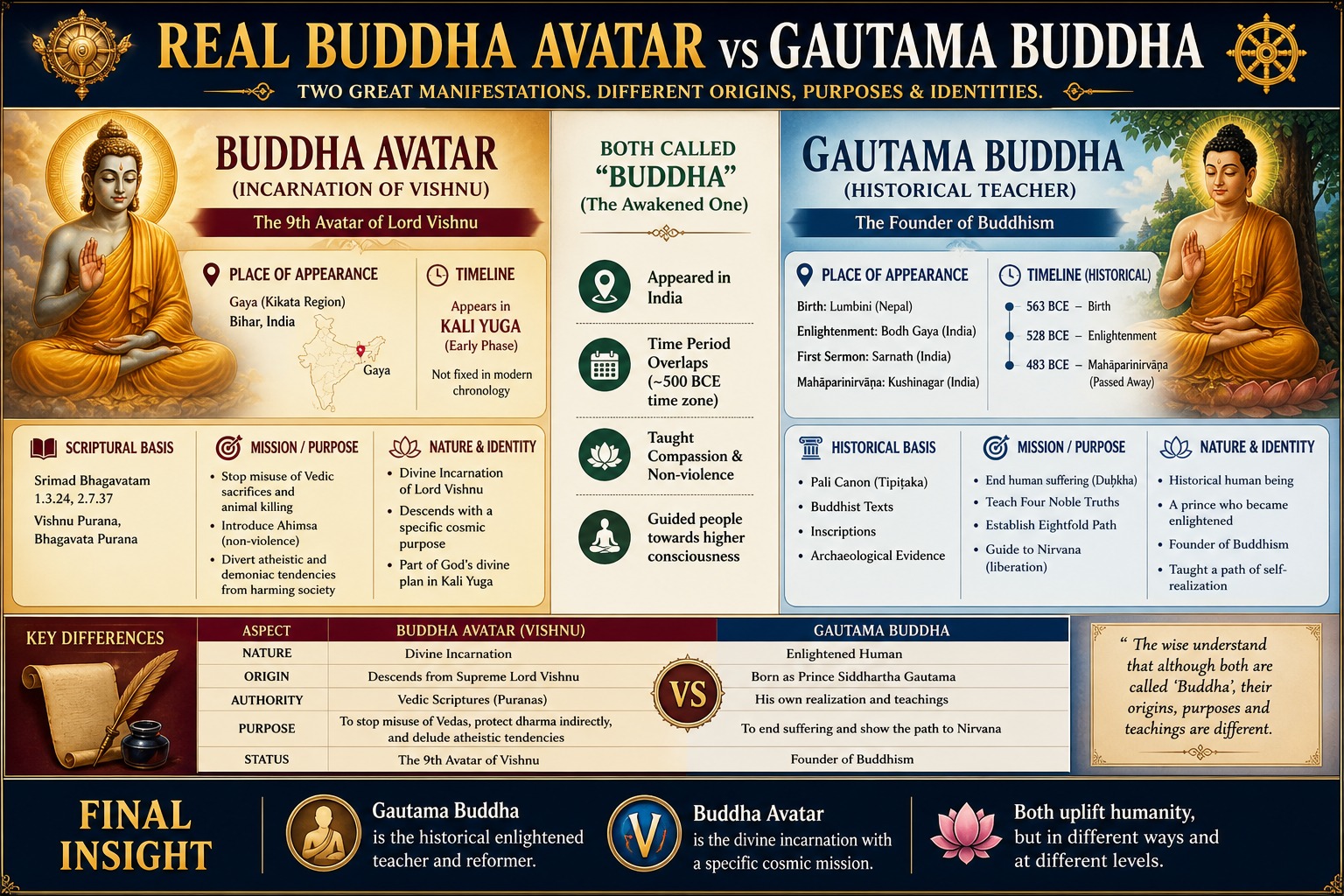
Avatar Buddha vs Gautama Buddha
A Deep Exploration of Two “Buddhas” in Hinduism and Buddhism
The word “Buddha” is not a name—it is a title, meaning “the awakened one” or “one who has realized truth.” This single word has created one of the most misunderstood intersections between Hinduism and Buddhism. Are the Buddha Avatar of Vishnu and Gautama Buddha the same? Or are they fundamentally different?
1. Gautama Buddha: The Historical Enlightened Teacher
Gautama Buddha
Historical Identity
Gautama Buddha, born as Siddhartha Gautama, lived around the 6th–5th century BCE in the Indian subcontinent.
He was:
- A Kshatriya prince
- A spiritual seeker
- The founder of Buddhism
After intense meditation, he attained enlightenment and became known as Buddha—“the awakened one.”
Core Teachings
His philosophy centers on:
- The Four Noble Truths
- The Eightfold Path
- Liberation from suffering (dukkha)
- Attainment of Nirvana
Notably:
- He rejected Vedic authority
- He avoided speculation about God
- He emphasized self-realization over ritual
👉 From a philosophical standpoint, Buddhism is considered nāstika (non-Vedic) in classical Hindu categorization.
2. Buddha Avatar of Vishnu: The Puranic Perspective
Vishnu
Within Hinduism—especially Vaishnava traditions—Buddha is described as an avatar (incarnation) of Vishnu.
Scriptural Basis
Texts like:
- Bhagavata Purana
- Vishnu Purana
describe Buddha as an incarnation who appears in Kali Yuga.
A key verse states:
The Lord appears as Buddha to delude those hostile to the Vedas
Purpose of This Avatar
Unlike other avatars like:
- Rama
- Krishna
the Buddha avatar has a unique mission:
- Stop misuse of Vedic rituals
Especially animal sacrifice - Redirect atheistic or demonic tendencies
To weaken destructive forces (asuras) - Reform society indirectly
By introducing non-violence and compassion
Some traditions even describe this avatar as a strategic divine intervention, not a straightforward teaching mission.
3. The Core Difference: Same or Different?
| Aspect | Buddha Avatar (Vishnu) | Gautama Buddha |
|---|---|---|
| Nature | Divine incarnation | Enlightened human |
| Purpose | Delude atheists / stop misuse of Vedas | Teach liberation from suffering |
| Authority | Rooted in Vedic cosmology | Rejects Vedic authority |
| Ontology | Theistic | Non-theistic/agnostic |
| Role | Cosmic intervention | Spiritual reformer |
👉 This distinction arises because:
- Puranas present Buddha with a specific divine mission
- Gautama Buddha presents a philosophical path independent of Vedic theology
4. Why the Confusion Exists
The blending of these two figures is not accidental—it is historical and cultural.
- Shared Name
“Buddha” = title, not identity - Cultural Integration
Hinduism absorbed Buddhist influence and vice versa - Religious Politics
During ancient India:
• Buddhism was rising
• Hindu texts incorporated Buddha to maintain continuity - Philosophical Overlap
Both emphasize:
• Non-violence (Ahimsa)
• Detachment
• Compassion
5. A Deeper Theological Insight (Gaudiya Perspective)
In traditions like Gaudiya Vaishnavism, a refined interpretation emerges:
- Krishna (Vishnu) may appear as Buddha-like teacher
- Purpose: gradual elevation of consciousness
- Strategy: meet people where they are spiritually
This aligns with the idea that:
👉 God sometimes teaches partial truths to guide people step-by-step.
⚖️ Timeline Comparison (Critical Insight)
| Aspect | Gautama Buddha | Buddha Avatar |
|---|---|---|
| Time | ~563–483 BCE | Early Kali Yuga (non-fixed) |
| Place | Lumbini, Bodh Gaya | Gaya (Kikata region) |
| Nature | Historical human | Divine incarnation |
| Evidence | Archaeology + texts | Puranic scriptures |
| Role | Spiritual teacher | Cosmic intervention |
Conclusion: Unity Without Confusion
Instead of forcing identity, a more sophisticated understanding is:
- Gautama Buddha = Historical Enlightened Master
- Buddha Avatar = Theological Expression of Divine Strategy
They intersect in name and influence, but differ in origin, purpose, and philosophy.
Theistic Kapila vs Atheistic Kapila
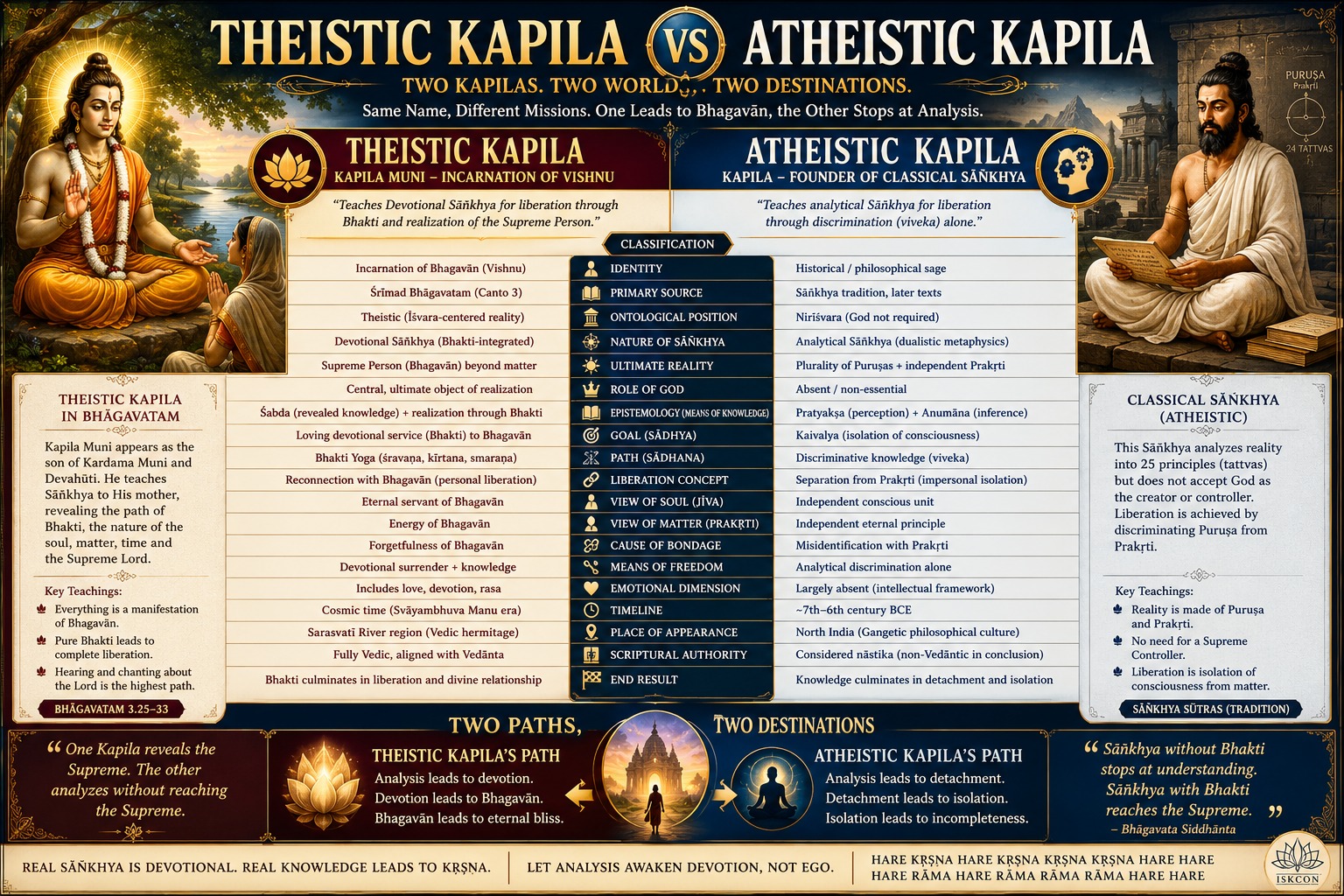
The Lost Divide That Rewrote Sāṅkhya Philosophy
In the layered history of Vedic thought, certain names echo across time with such force that they begin to blur into one. “Kapila” is one such name. For many modern readers, Kapila is remembered simply as the founder of Sāṅkhya—a system often described as analytical, dualistic, and even atheistic. But this common understanding conceals a deeper and far more consequential truth.
There are not one, but two Kapilas.
One is divine. The other is philosophical. One descends. The other speculates. And confusing the two does not merely create academic error—it reshapes the very goal of spiritual life.
The Divine Kapila: A Voice from the Beginning of Creation
The first Kapila appears not within the narrow corridor of recorded human history, but at the dawn of cosmic civilization itself. This is Kapila Muni, described in the Srimad Bhagavatam as an incarnation of the Supreme Lord.
He is born to Kardama Muni and Devahuti, in a sacred hermitage situated along the now-mystical Sarasvati River. This setting is not incidental—it places His appearance within the era of Svāyambhuva Manu, a time far preceding conventional historical timeline. In other words, this Kapila does not belong to a datable century like 600 BCE; He belongs to cosmic time, measured in yugas and manvantaras.
From the very outset, His purpose is precise. He does not come to speculate or construct a theory. He comes to liberate. Sitting before His mother Devahuti, Kapila unfolds a system of Sāṅkhya that is radically different from what later generations would come to know.
He analyzes matter and spirit, yes—but only to bring the soul to its natural conclusion: devotion to the Supreme Person. In His teachings, the enumeration of elements (tattvas) is not an intellectual exercise; it is a surgical dismantling of illusion, clearing the path for bhakti.
In this original Sāṅkhya, knowledge does not culminate in detachment alone—it culminates in loving engagement with Bhagavān. Kapila does not merely separate puruṣa from prakṛti; He reconnects the purified soul with its eternal object of love.
The Other Kapila: A Philosopher in Historical Time
Centuries—or perhaps millennia—later, another Kapila enters the intellectual landscape of India. This Kapila, known in philosophical traditions, is associated with the development of classical Sāṅkhya as a structured system. Unlike the divine Kapila, his presence is situated within the realm of history, generally placed around the 7th to 6th century BCE, in the cultural expanse of northern India.
This second Kapila is not described as an incarnation of God. He is remembered as a thinker, a system-builder, and a pioneer of analytical metaphysics. His Sāṅkhya retains the framework of puruṣa and prakṛti, but something essential is missing.
God is no longer central.
In this system, liberation is achieved through discrimination—through the clear intellectual understanding that consciousness is distinct from matter. It is elegant, precise, and philosophically influential. But it is also silent about devotion. The personal Absolute, so vividly present in the teachings of the earlier Kapila, recedes into absence.
This is why later traditions would describe this system as nirīśvara Sāṅkhya—Sāṅkhya without Īśvara.
Where the Confusion Begins
The convergence of these two figures under a single name is not accidental. Both speak of Sāṅkhya. Both analyze reality. Both leave a lasting imprint on Indian thought. Over time, the historical Kapila’s framework became more accessible to scholars and philosophers, while the theological depth of the earlier Kapila remained preserved in texts like the Bhagavatam.
Gradually, the balance shifted.
What was originally a devotional science of reality, began to be interpreted as a purely intellectual system. In academic circles, the name “Kapila” became almost synonymous with atheistic Sāṅkhya, while the divine Kapila was either overlooked or reinterpreted.
But the Srimad Bhagavatam stands as a corrective lens. It does not present Kapila as a speculative philosopher. It presents Him as Bhagavān Himself, teaching that the ultimate perfection of knowledge is not detachment, but devotion.
Two Timelines, Two Worlds
The distinction becomes even sharper when we consider time and place.
The divine Kapila appears in a sacred Vedic landscape along the Sarasvati River, in a primordial age tied to the early cycles of creation. His timeline cannot be compressed into BCE dates because it belongs to a cosmology far older than recorded history.
The later Kapila, by contrast, belongs to the intellectual ferment of ancient India, roughly around the 7th–6th century BCE, moving within the cultural and philosophical networks of the Gangetic plains.
Even geographically, there is a shift—from Vedic hermitage culture to urbanizing philosophical discourse.
The Real Consequence: Two Destinations
At first glance, the difference between these two Kapilas may seem technical. But in reality, it determines the destination of the practitioner.
In the teachings of the divine Kapila, analysis leads to surrender. Knowledge culminates in bhakti. Liberation is not merely freedom from matter—it is reconnection with the Supreme Person.
In the system attributed to the later Kapila, analysis leads to separation. Liberation is defined as isolation of consciousness, with no explicit relationship to a personal Absolute.
Thus, the divergence is not just philosophical—it is existential.
Restoring the Original Vision
For the Gaudiya Vaishnava tradition, and especially within ISKCON, this distinction is not optional. It is essential. To accept Kapila merely as an atheistic philosopher is to disconnect Sāṅkhya from its original purpose. To understand Kapila as presented in the Bhagavatam is to see Sāṅkhya as a powerful ally of bhakti, not its replacement.
The real Kapila does not lead us away from Krishna.
He leads us directly to Him.
Final Insight
Two Kapilas stand in history and scripture—one illuminated by divine purpose, the other by human intellect. Both analyze reality, but only one reveals its ultimate meaning.
The question is not which Kapila existed.
The question is: Which Kapila are we following?
Because one stops at understanding the world.
The other takes us beyond it—to the Supreme Person who stands behind it all.
🪷 Theistic Kapila vs Atheistic Kapila — Classification Table
| Category | Kapila Muni (Theistic) | Kapila (Atheistic / Classical) |
|---|---|---|
| Identity | Incarnation of Bhagavān (Vishnu) | Historical / philosophical sage |
| Primary Source | Srimad Bhagavatam (Canto 3) | Sāṅkhya tradition, later texts |
| Ontological Position | Theistic (Īśvara-centered reality) | Nirīśvara (God not required) |
| Nature of Sāṅkhya | Devotional Sāṅkhya (Bhakti-integrated) | Analytical Sāṅkhya (dualistic metaphysics) |
| Ultimate Reality | Supreme Person (Bhagavān) beyond matter | Plurality of Puruṣas + independent Prakṛti |
| Role of God | Central, ultimate object of realization | Absent / non-essential |
| Epistemology (Means of Knowledge) | Śabda (revealed knowledge) + realization through Bhakti | Pratyakṣa (perception) + Anumāna (inference) |
| Goal (Sādhya) | Loving devotional service (Bhakti) to Bhagavān | Kaivalya (isolation of consciousness) |
| Path (Sādhana) | Bhakti Yoga (śravaṇa, kīrtana, smaraṇa) | Discriminative knowledge (viveka) |
| Liberation Concept | Reconnection with Bhagavān (personal liberation) | Separation from Prakṛti (impersonal isolation) |
| View of Soul (Jīva) | Eternal servant of Bhagavān | Independent conscious unit |
| View of Matter (Prakṛti) | Energy of Bhagavān | Independent eternal principle |
| Cause of Bondage | Forgetfulness of Bhagavān | Misidentification with Prakṛti |
| Means of Freedom | Devotional surrender + knowledge | Analytical discrimination alone |
| Emotional Dimension | Includes love, devotion, rasa | Largely absent (intellectual framework) |
| Timeline | Cosmic time (Svāyambhuva Manu era) | ~7th–6th century BCE |
| Place of Appearance | Sarasvati River hermitage | North India (Gangetic philosophical culture) |
| Scriptural Authority | Fully Vedic, aligned with Vedānta | Considered nāstika (non-Vedāntic in conclusion) |
| End Result | Bhakti culminates in liberation and divine relationship | Knowledge culminates in detachment and isolation |