Sadāśiva, Śiva–Pārvatī, Rudras, and Kṛṣṇa
If one studies Vedic literature superficially, it can appear that sometimes Shiva is declared supreme, sometimes Krishna is the source of everything, and sometimes both are shown interacting as equals—or even in apparent conflict.
Add to this:
- Śiva appearing as an infinite pillar of light
- Rama worshipping Śiva
- Kṛṣṇa worshipping Śiva for a son
- Śiva fighting Kṛṣṇa
- Śiva as Advaita Acharya in Caitanya-līlā
…and naturally the mind asks:
👉 “Who is actually Supreme?”
This article resolves that confusion systematically, using guru–sādhu–śāstra harmony, in the mood taught by Śrīla Prabhupāda.
The Root Principle: One Truth, Multiple Presentations
Vedic knowledge operates on three simultaneous layers:
- Siddhānta (final philosophical conclusion)
- Upāsanā (method of worship)
- Stuti / Artha-vāda (contextual glorification)
Confusion begins when these are mixed without discrimination.
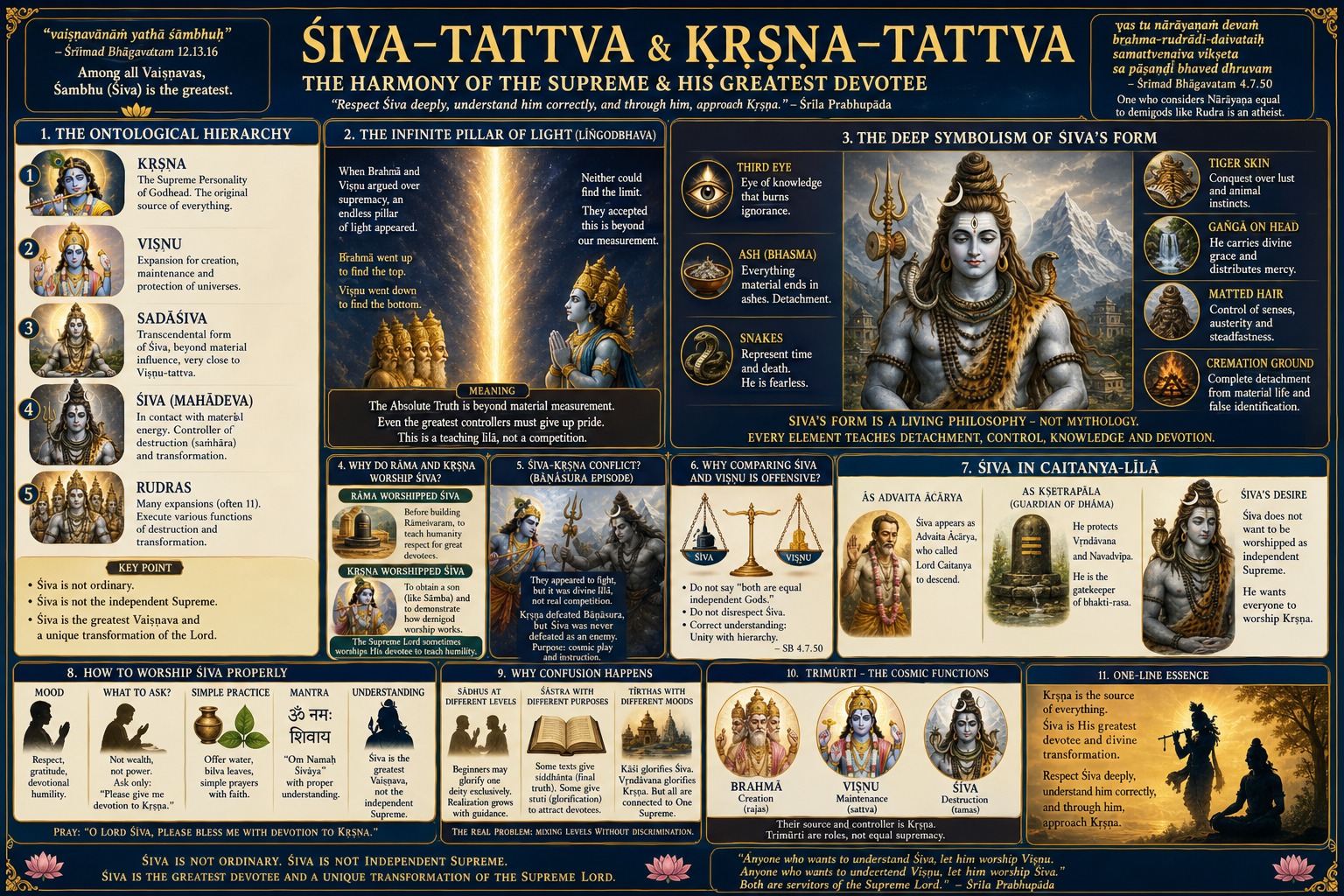
The Ontological Key: What is Śiva-tattva?
Śiva is not an ordinary being, nor identical in category to Viṣṇu.
Śāstra gives a precise analogy (Brahma-saṁhitā):
Milk becomes yogurt by transformation.
- Milk = Viṣṇu/Kṛṣṇa
- Yogurt = Śiva
👉 Same source, different function
The Hierarchical Flow
Kṛṣṇa (Supreme Source)
↓
Viṣṇu (Expansion for cosmic management)
↓
Sadāśiva (Transcendental Śiva principle)
↓
Śiva (in contact with material nature)
↓
Rudras (functional expansions)
Sadāśiva, Śiva, and Rudras — Proper Classification
1. Sadāśiva — The Transcendental Origin
- Exists beyond material world
- Never touched by māyā
- Close to Viṣṇu-tattva
👉 This is pure Śiva principle
2. Śiva (Mahādeva) — Controller of Material Transformation
- Associated with Parvati (Śakti)
- Controls destruction (saṁhāra)
- Governs tamo-guṇa
👉 He is in contact with māyā, but not controlled by it
3. Rudras — Expansions
- Many forms (often 11)
- Execute destruction and transformation
- Connected to prāṇa and cosmic functions
Difference Between Sadāśiva, Śiva–Pārvatī, and Rudras
A Śāstric, Philosophical, and Ontological Analysis
The names Sadāśiva, Śiva (with Pārvatī), and Rudras are often used interchangeably in popular discourse, yet within Vedic, Purāṇic, and Siddhāntic theology, they represent distinct ontological layers (tattvas) of the same divine reality.
To understand the distinction properly, one must analyze them across three axes:
- Ontological level (tattva)
- Cosmic function (śakti and līlā)
- Scriptural evolution (Veda → Purāṇa → Vedānta)
1. Rudra: The Vedic Foundation (Cosmic Force of Transformation)
Vedic Identity
The earliest appearance of Śiva is as Rudra in the Vedas.
- Ṛg Veda (2.33): Rudra is called “the mightiest of the mighty”
- He is both:
- Terrifying (ghora)
- Healing (bhīṣak)
Nature of Rudra
- Storm deity, associated with wind, destruction, and medicine
- Represents raw, untamed cosmic energy
Rudras (Plural)
Śāstra speaks of 11 Rudras:
- Bṛhadāraṇyaka Upaniṣad (3.9.4):
“The ten prāṇas and the Ātman are the eleven Rudras.”
Philosophically:
- Rudras = manifestations of life-force (prāṇa)
- They operate in:
- Cosmic atmosphere
- Human subtle body
Functional Role
- Agents of:
- Destruction
- Transformation
- Dissolution of ignorance
👉 Thus, Rudra = Functional, dynamic, fearsome aspect of divinity
2. Śiva–Pārvatī: Personal God and Divine Duality (Śakti–Śaktimān)
As theology evolves into Purāṇic literature, Rudra becomes Śiva, and his inseparable energy manifests as Pārvatī (Śakti).
Śiva (Personal Deity)
- Identified with Rudra in later texts
- Becomes:
- Yogī
- Householder
- Destroyer (saṁhāra-kartā)
Pārvatī (Śakti)
- Consort of Śiva
- Embodiment of divine energy (śakti)
Philosophical Principle
Śiva without Śakti is śava (inactive)
- Śiva = Consciousness
- Pārvatī = Energy
Together:
- They represent:
- Creation (through Śakti)
- Balance of renunciation & household life
Iconic Expressions
- Ardhanārīśvara → Unity of masculine & feminine
- Liṅga–yoni → Source of creation
👉 Thus, Śiva–Pārvatī = Relational, personal, and cosmic dual principle
3. Sadāśiva: The Transcendental Ontological Reality
Sadāśiva belongs to a higher metaphysical category, especially emphasized in:
- Śaiva Siddhānta
- Tantra
- Vedāntic interpretations
Definition
Sadāśiva = eternal, unchanging, transcendental Śiva
- Mentioned in Śrī Rudram as supreme aspect ([Wikipedia][1])
- Often equated with:
- Parama-Śiva
- Pure Consciousness beyond guṇas
Fivefold Function (Pañcakṛtya)
Sadāśiva governs:
- Sṛṣṭi (creation)
- Sthiti (maintenance)
- Saṁhāra (destruction)
- Tirobhāva (concealment)
- Anugraha (grace)
Unlike Rudra or Śiva:
- He is not limited to a single function
- He is the source of all functions
Ontological Position
- Beyond Time, Space, Form
- Root of: Śiva-tattva, All Rudras
👉 Thus, Sadāśiva = Transcendental, causal, supreme reality
4. Comparative Ontological Table
| Aspect | Sadāśiva | Śiva–Pārvatī | Rudras |
|---|---|---|---|
| Level | Transcendental (Para-tattva) | Personal Divine (Īśvara) | Functional manifestations |
| Nature | Formless / subtle | Personal, with form | Multiple forms |
| Function | Source of all five cosmic acts | Governs creation & dissolution through Śakti | Execute destruction & transformation |
| Scriptural Layer | Tantra, Siddhānta, Upaniṣadic interpretation | Purāṇas, Itihāsa | Vedas |
| Relationship | Source | Expansion | Manifestations |
| Energy | Inherent | Dual (Śiva–Śakti) | Distributed |
5. Integrated Understanding
A unified view emerges across traditions:
Hierarchical Flow
Sadāśiva (Supreme Consciousness)
↓
Śiva (Personal God) + Pārvatī (Śakti)
↓
Rudra and Rudras (Cosmic functional forces)
6. Key Śāstric Insight
From a theological standpoint:
- Rudra = Energy in motion (kriyā-śakti expression)
- Śiva–Pārvatī = Consciousness + Energy in relationship
- Sadāśiva = Pure consciousness beyond duality
7. Philosophical Analogy
A classical analogy helps:
- Sadāśiva = Sun (source of light)
- Śiva–Pārvatī = Sun + rays (active expression)
- Rudras = Individual rays illuminating different areas
8. Gaudiya Perspective (Important for deeper theology)
In Acintya-bhedābheda:
- Sadāśiva occupies a unique category (Śiva-tattva)
- He is:
- Neither jīva
- Nor fully Viṣṇu-tattva
- Functions as transformational interface between spiritual and material realms
Conclusion
The apparent confusion arises because all three—Sadāśiva, Śiva–Pārvatī, and Rudras—are not separate entities, but graded manifestations of one divine principle.
- Sadāśiva → Absolute reality
- Śiva–Pārvatī → Relational divine (Śakti–Śaktimān)
- Rudras → Functional cosmic powers
👉 The deeper one goes into śāstra, the more one sees:
Difference is not contradiction — it is progressive revelation of the same tattva
Śrīmad Bhāgavatam Verses on Śiva-tattva
Here are clear, exact Śrīmad Bhāgavatam verses (with Sanskrit + translation essence) that establish the position, origin, and uniqueness of Śiva-tattva, presented in a Prabhupāda-style teaching flow.
1. Śiva is the Greatest Vaiṣṇava
Śrīmad Bhāgavatam 12.13.16
vaiṣṇavānāṁ yathā śambhuḥ
Meaning
Among all Vaiṣṇavas, Shiva (Śambhu) is the greatest.
👉 Prabhupāda’s emphasis:
- Śiva is not independent God competing with Viṣṇu
- He is topmost devotee
2. Śiva is a Transformation (Not Equal, Not Separate)
Śrīmad Bhāgavatam 4.7.50
yas tu nārāyaṇaṁ devaṁ brahma-rudrādi-daivataiḥ
samatvenaiva vīkṣeta sa pāṣaṇḍī bhaved dhruvam
Meaning
One who considers Narayana equal to demigods like Brahmā or Rudra is an atheist.
👉 Key point:
- Equality = philosophical mistake
- But disrespect = also wrong
3. Śiva Comes from Viṣṇu (Tattva Clarity)
Śrīmad Bhāgavatam 3.12.7–10
From the anger of Brahma, Rudra was born.
But deeper understanding (from purports):
- Rudra is empowered manifestation
- Ultimately connected to Viṣṇu expansion
👉 This shows:
- Rudra appears within creation
- Not the original source
4. Rudra Expands into Many Forms
Śrīmad Bhāgavatam 3.12.12
Brahmā instructed Rudra to create, and he produced many forms like himself.
👉 Meaning:
- Rudras = expansions
- Functional roles in destruction and transformation
5. Śiva Controls Material Mode (Tamo-guṇa)
Śrīmad Bhāgavatam 4.24.29 (Prayers of the Pracetas)
namaḥ śivāya śāntāya…
Meaning (Essence)
- Śiva is peaceful, powerful
- Controller of material influence
👉 Important:
- Connected with tamo-guṇa, but not controlled by it
6. Śiva is Compassionate and Gives Both Material and Spiritual Results
Śrīmad Bhāgavatam 8.7.31 (Samudra Manthan Episode)
When poison came:
Śiva drank the halāhala poison to protect the universe.
👉 Meaning:
- Supreme compassion
- Protector of creation
7. Śiva Acts Under Supreme Will
Śrīmad Bhāgavatam 10.88.3
śrī-śuka uvāca
Lord Śiva quickly gives benedictions, whereas Viṣṇu gives after careful consideration.
👉 Prabhupāda’s point:
- Śiva = very merciful, easily pleased
- But still acting within system of Supreme
8. Śiva’s Unique Position (Not Jīva, Not Viṣṇu)
Śrīmad Bhāgavatam 10.88.5
Lord Śiva is the greatest of all demigods.
👉 Combined understanding:
- Not ordinary jīva
- Not equal to Viṣṇu
- Unique category = Śiva-tattva
9. Connection to Material Energy
Śrīmad Bhāgavatam 3.26.21
From false ego in ignorance, Lord Śiva appears.
👉 Meaning:
- Śiva is connected to material transformation
- Interface between spirit and matter
10. Devotional Position of Śiva
Śrīmad Bhāgavatam 4.24.28
Śiva instructs pure devotion to the Supreme Lord.
👉 Final clarity:
- Śiva himself teaches bhakti to Viṣṇu/Kṛṣṇa
Final Synthesis (Prabhupāda-style)
From all these verses:
Clear Conclusions
- Śiva is greatest Vaiṣṇava
- Śiva is not equal to Viṣṇu/Kṛṣṇa
- Śiva is not ordinary jīva
- Śiva is a transformation of the Supreme for material work
One-line Understanding
👉
Kṛṣṇa is Supreme → Viṣṇu expands → Śiva transforms → Rudras execute
Why Do Scriptures Glorify Śiva as Supreme?
Texts like the Shiva Purana declare Śiva as the ultimate reality.
This is not contradiction—it is purposeful glorification.
Why?
- To attract Śiva-bhaktas
- To gradually elevate them
- To build faith
👉 This is called artha-vāda
Final Authority
The Srimad Bhagavatam gives the final conclusion:
- Kṛṣṇa is the source of all
- Śiva is the greatest Vaiṣṇava
The Famous Infinite Light Pillar (Liṅgodbhava)
When Brahma and Vishnu argued over supremacy:
👉 An endless pillar of light appeared
- No beginning
- No end
Neither could measure it.
What Does It Mean?
Not that Śiva “defeated” Viṣṇu.
It means:
- The Absolute Truth is beyond measurement
- Pride—even of great controllers—must be broken
👉 It is a teaching līlā, not a competitive event
Does Śiva Have Viśvarūpa?
Yes—Śiva can manifest cosmic forms.
But:
- Kṛṣṇa’s viśvarūpa = source of all universes
- Śiva’s cosmic form = empowered manifestation
👉 Difference:
- Source vs representation
Why Do Rāma and Kṛṣṇa Worship Śiva?
Rāma Worships Śiva
- To teach respect for great devotees
- Not out of dependence
Kṛṣṇa Worships Śiva
- To demonstrate how demigod worship works
- To honor Śiva
👉 The Supreme Lord sometimes worships His devotee to teach humility
1. Does Śiva Show a Universal (Viśvarūpa-like) Form?
Yes—texts like Shiva Purana and Linga Purana describe Śiva appearing as:
- Infinite light (jyotir-liṅga)
- Cosmic, all-pervading form
- Containing all directions, elements, beings
- Virāṭ / cosmic manifestation
- Or ananta-jyoti (endless effulgence)
2. But Is It the Same as Kṛṣṇa’s Viśvarūpa?
No.
Kṛṣṇa’s Viśvarūpa (Bhagavad-gītā Chapter 11)
- Direct, complete manifestation of all universes
- Includes:
- Time (kāla)
- All devatās
- Creation, maintenance, destruction simultaneously
👉 It proves:
Kṛṣṇa is the source of everything
Śiva’s Cosmic Form
Śiva can display:
- Vast cosmic energy
- Universal-scale manifestation
- Form representing dissolution and transformation
But:
👉 It is not the original source of all viśvarūpa
👉 It is empowered / representational manifestation
3. Example Narrative (Understanding the Difference)
Think like this:
- King (Kṛṣṇa) shows entire kingdom → original authority
- Minister (Śiva) can show large domain → delegated authority
👉 Both appear vast
👉 But source is different
Śiva–Kṛṣṇa “Conflict” (Bāṇāsura Episode)
They appear to fight.
But:
- No real competition
- No ego clash
👉 It is divine līlā for cosmic purposes
Why Comparing Śiva and Viṣṇu Leads to Offense
Śāstra warns:
- Do not say: “Both are equal independent Gods”
- Do not disrespect Śiva
👉 Correct understanding:
Unity with hierarchy
The Deep Symbolism of Śiva’s Form
Śiva’s appearance is not mythology—it is philosophy in visual form.
Ash (Bhasma)
- Everything becomes ashes
👉 Detachment
Third Eye
- Burns ignorance
👉 Divine knowledge
Snakes
- Time and death
👉 Fearlessness
Tiger Skin
- Conquest of lust
👉 Sense control
Gaṅgā on Head
- Divine grace flowing through devotee
Śiva in Caitanya-līlā
Śiva plays a crucial role in Gauḍīya theology.
As Advaita Ācārya
- Calls Chaitanya Mahaprabhu to descend
As Guardian of Dhāma
- Protects Vṛndāvana and Navadvīpa
- Grants access to sincere devotees
👉 Śiva is gatekeeper of bhakti
How to Worship Śiva Properly
Śrīla Prabhupāda’s balanced instruction:
Correct Mood
Respect, Gratitude, Devotional humility
What to Ask
Not: Wealth, Power
But:
👉 “Please give me devotion to Kṛṣṇa”
Simple Practice
- Offer water
- Bilva leaves
- Chant respectfully
Why Confusion Happens
Three sources:
1. Sādhus at Different Levels
2. Śāstra with Different Purposes
3. Tīrthas with Different Moods
The Real Problem
👉 Mixing levels without discrimination
Synthesis
Everything becomes crystal clear when seen properly:
- Śiva is not ordinary
- Śiva is not independent Supreme
- Śiva is the greatest devotee and a unique tattva
Ultimate Conclusion
👉 Kṛṣṇa is the source of everything
Śiva is His greatest devotee and divine transformation