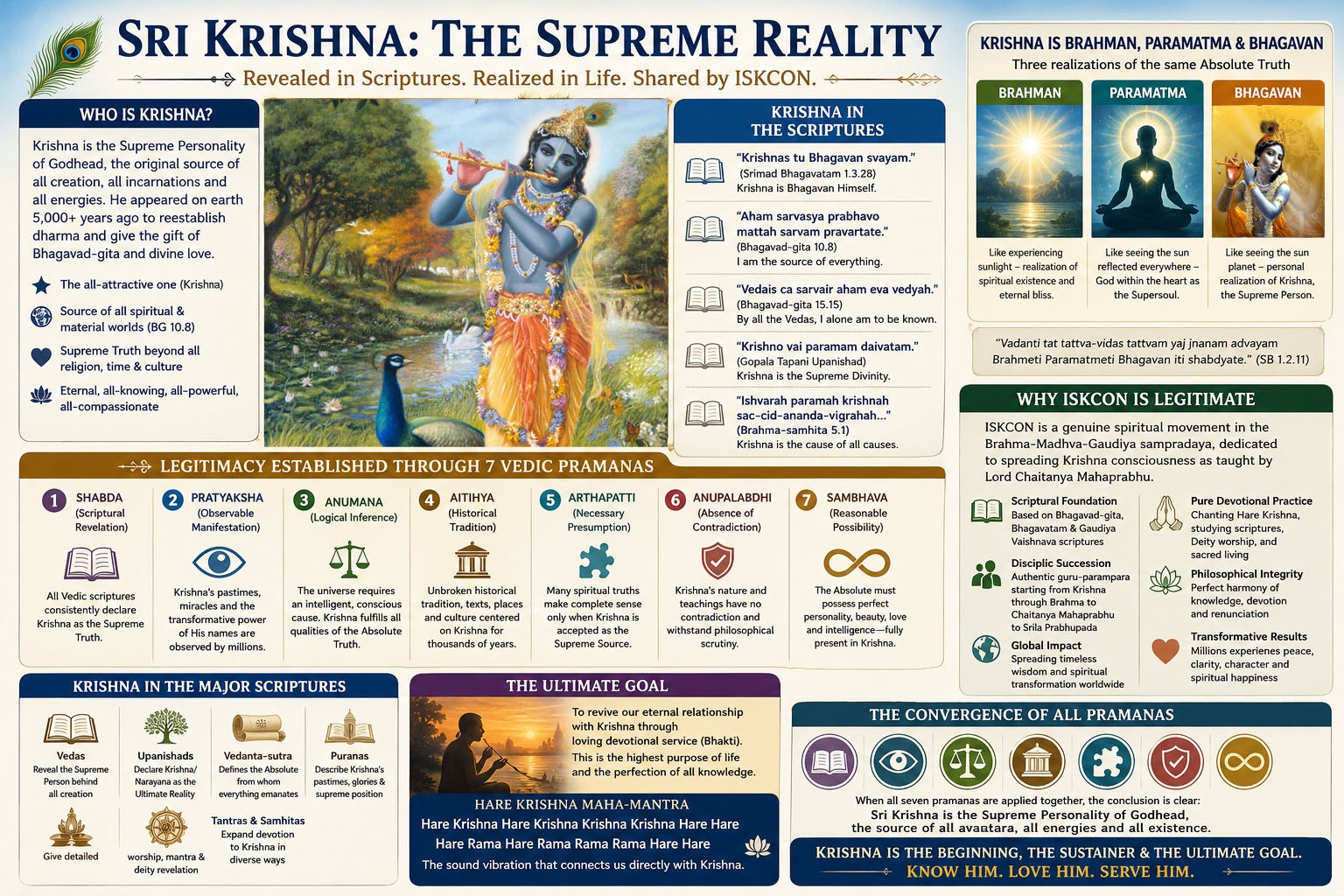
Who is Krishna? This timeless question has been asked by philosophers, saints, yogis, scholars, and spiritual seekers for thousands of years. According to the ancient Vedic scriptures, Sri Krishna is not merely a historical figure, mythological hero, or symbolic deity. He is the Supreme Personality of Godhead, the original source of all creation, all incarnations, and all spiritual realities. The sacred texts of India—including the Bhagavad-gita, Srimad Bhagavatam, Upanishads, Puranas, and Vedanta literature—consistently identify Krishna as the highest manifestation of the Absolute Truth.
Krishna appeared on earth more than 5,000 years ago in Vrindavan and Mathura to perform divine pastimes and reestablish spiritual principles. His life is filled with extraordinary beauty, wisdom, compassion, heroism, and transcendental love. From lifting Govardhan Hill and speaking the Bhagavad-gita to enchanting devotees with His flute in Vrindavan, Krishna’s activities reveal both supreme divinity and intimate sweetness. Unlike ordinary beings, Krishna’s appearance, actions, and form are eternal and completely spiritual.
Why Krishna Is Bhagavan: The Supreme Truth Revealed in Vedas, Upanishads, Puranas and Vedanta
Among all theological conclusions of the Vedic tradition, one declaration shines with extraordinary force and consistency: Sri Krishna is Bhagavan Himself. Not merely an avatara, not simply a historical saint, not only an ethical teacher, but the original Supreme Personality of Godhead from whom all incarnations emanate.
The Meaning of “Bhagavan”
The Sanskrit word Bhagavan refers to the possessor of all opulences in full:
- unlimited beauty, strength, fame, knowledge, wealth, renunciation
This definition is given in the Vishnu Purana:
“One who possesses all opulences completely is known as Bhagavan.”
The Direct Declaration of Srimad Bhagavatam
The most famous and decisive statement appears in the Srimad Bhagavatam (1.3.28):
ete camsa-kalah pumsah
krishnas tu bhagavan svayam
“All the listed incarnations are either plenary portions or portions of plenary portions of the Purusha-avatara, but Krishna alone is Bhagavan Himself.”
The Bhagavatam first lists many incarnations—Matsya, Kurma, Varaha, Narasimha, Rama, Vamana and others—and then distinguishes Krishna from all of them.
Not “Krishna is one of the Bhagavans.”
Not “Krishna represents Bhagavan.”
But:
“Krishna is Bhagavan Svayam” — the Original Supreme Lord.
Krishna in the Bhagavad-gita
In the Bhagavad-gita, Krishna openly reveals His supreme position.
Source of Everything
aham sarvasya prabhavo
mattah sarvam pravartate
(Bhagavad-gita 10.8)
“I am the source of all spiritual and material worlds. Everything emanates from Me.”
Supreme Reality Above All
mattah parataram nanyat
kincid asti dhananjaya
(Bhagavad-gita 7.7)
“There is no truth superior to Me.”
The Object of All Vedic Knowledge
vedais ca sarvair aham eva vedyo
(Bhagavad-gita 15.15)
“By all the Vedas, I alone am to be known.”
Krishna in the Upanishads
Many mistakenly assume the Upanishads teach only impersonal Brahman. Yet several Upanishads explicitly glorify Krishna or Govinda.
Gopala Tapani Upanishad
krishno vai paramam daivatam
“Krishna is the Supreme Divinity.”
govindam sac-cid-ananda-vigraham
“Govinda possesses an eternal, conscious and blissful form.”
Maha Upanishad
eko vai narayana asit
“In the beginning only Narayana existed.”
Gaudiya acharyas explain through Purana evidence that Krishna is the original source even of Narayana expansions.
This harmonizes with Bhagavatam theology where Krishna expands into Narayana forms for Vaikuntha pastimes.
Svetasvatara Upanishad
“He is the supreme controller of all controllers.”
Vaishnava commentators identify this Supreme Person ultimately as Krishna, the original source of Vishnu-tattva.
Krishna in the Brahma-samhita
ishvarah paramah krishnah
sac-cid-ananda-vigrahah
anadir adir govindah
sarva-karana-karanam
“Krishna, known as Govinda, is the Supreme Controller. He possesses an eternal blissful spiritual form. He is without origin, yet He is the origin of everything. He is the cause of all causes.”
Evidence from Vedanta-sutra
The Vedanta-sutra begins with:
janmady asya yatah
“The Absolute Truth is that from whom everything emanates.”
The opening verse of the Bhagavatam intentionally explains this sutra and culminates in Krishna.
Krishna in the Mahabharata
Bhishma, Narada, Vyasa, Draupadi, and even opponents like Shishupala acknowledge His extraordinary transcendence.
Arjuna directly addresses Krishna:
param brahma param dhama pavitram paramam bhavan
(Bhagavad-gita 10.12)
“You are the Supreme Brahman, the supreme abode, the supreme purifier.”
Krishna in Narada Pancharatra and Agamas
The Narada Pancharatra and Pancharatra scriptures extensively describe:
- deity worship,
- Krishna mantra,
- Govinda worship,
- Radha-Krishna theology,
- spiritual forms of Bhagavan.
These Agamas form the theological and ritual backbone for Vaishnava temple worship.
Krishna in Tantras
Texts such as: Gautamiya Tantra, Brahma-yamala, Garga Samhita, Radha Tantra glorify Krishna as the supreme transcendental reality.
The Gautamiya Tantra famously states:
“Among all forms of worship, worship of Vishnu is supreme. Higher than worship of Vishnu is worship of His devotees.”
Gaudiya theology further culminates in Radha-Krishna worship as the highest revelation of divine love.
Krishna in the Vedas
Though the Vedas often speak indirectly through mantra and symbolism, Vaishnava acharyas identify many references to Krishna.
The word “Krishna” itself appears in Vedic literature. The Rig Veda contains references interpreted by Vaishnava commentators as pointing toward the dark-hued Supreme Lord. More importantly, the Vedic conclusion culminates in the Purusha—the Supreme Divine Person.
The Three Features of Absolute Truth
The Bhagavatam explains:
vadanti tat tattva-vidas tattvam yaj jnanam advayam
brahmeti paramatmeti bhagavan iti shabdyate
“The Absolute Truth is realized in three phases: Brahman, Paramatma and Bhagavan.”
Gaudiya Vaishnavism explains:
- Brahman = impersonal spiritual effulgence. Brahman realization is like experiencing sunlight. A spiritual seeker understands that there is an eternal spiritual energy beyond the temporary material world. One experiences peace, freedom from material anxiety, and spiritual existence, but without personal relationship with the Supreme.
- Paramatma = Supersoul within all beings. Paramatma realization is like seeing the sun reflected everywhere. A yogi realizes that God is present within the heart of every living being as the Supersoul, guiding, witnessing, and maintaining the universe. This realization develops inner guidance, detachment, and awareness of divine presence in all beings.
- Bhagavan = the complete personal manifestation. Bhagavan realization is like directly seeing the sun planet and meeting the source personally. A devotee realizes Krishna as the Supreme Person full of eternal beauty, love, qualities, and relationships. This is considered the highest realization because it includes personal loving exchange with the Absolute Truth through bhakti-yoga.
Krishna is understood as the fullest manifestation of Bhagavan because all sweetness, intimacy, beauty and rasa culminate in Him.
Why Krishna’s Humanlike Form Is Supreme
A common misunderstanding is that the Absolute Truth must be impersonal because personality appears limiting.
But Vedic theology teaches the opposite. Form in the material world is limiting. Spiritual form is unlimited. Krishna’s form is described as:
- eternal, omniscient, omnipotent, all-attractive, ever-youthful, transcendental.
The Brahma-samhita describes His flute, peacock feather, lotus eyes and enchanting beauty not as mythology, but as the highest revelation of spiritual reality.
7 Pramanas of Vedic Epistemology
The Vedic tradition does not encourage blind faith. Instead, it presents a sophisticated system of philosophical verification through multiple layers of evidence. When the identity of Sri Krishna is examined through the recognized pramanas accepted in Vedanta, Nyaya, Mimamsa, and Vaishnava theology, a consistent conclusion emerges: Krishna is the Supreme Personality of Godhead, the ultimate source of all existence.
1. Shabda Pramana — Scriptural Revelation
The Bhagavad-gita presents Krishna directly declaring:
“I am the source of all spiritual and material worlds.”
(Bhagavad-gita 10.8)
“There is no truth superior to Me.”
(Bhagavad-gita 7.7)
“Krishna is Bhagavan Himself.”
(1.3.28)
The Brahma-samhita declares:
“Krishna is the Supreme Controller, the cause of all causes.”
The Gopala Tapani Upanishad explicitly states:
“Krishna is the Supreme Divinity.”
No other spiritual figure in world theology possesses such extensive, multilayered, and internally consistent scriptural affirmation across centuries of sacred literature.
2. Pratyaksha Pramana — Observable Manifestation
Although spiritual reality transcends blunt material empiricism, Krishna’s life exhibits extraordinary manifestations that distinguish Him from ordinary historical personalities.
From infancy, Krishna displayed superhuman activities impossible within normal human limitations. The Vedic texts describe Him lifting Govardhan Hill for seven days, subduing powerful demonic forces, revealing the universal form, and displaying omniscience repeatedly before sages, kings, and devotees.
The continuity of transformative experience across generations functions as a form of experiential verification supporting Krishna’s transcendental identity.
3. Anumana Pramana — Logical Inference
The Vedic conclusion is that the Absolute Truth must possess consciousness because unconscious matter cannot generate conscious beings independently. Personality cannot emerge from impersonal void without preexisting intelligence.
Krishna uniquely fulfills the characteristics expected of the Absolute:
- complete consciousness,
- unlimited intelligence,
- causeless causality,
- omnipotence,
- perfect beauty,
- moral supremacy,
- transcendental individuality.
The Vedanta-sutra begins by defining Absolute Truth as that from whom everything emanates. Krishna directly identifies Himself as this source in the Bhagavad-gita.
Thus logical inference harmonizes with scriptural revelation.
4. Aitihya Pramana — Historical Tradition
Krishna’s presence is deeply embedded within India’s civilizational memory through uninterrupted theological, literary, cultural, philosophical, and ritual continuity.
- Mahabharata, Harivamsa, Bhagavatam, Vishnu Purana, Brahma Vaivarta Purana, Narada Pancharatra, numerous Upanishads, classical Sanskrit, commentaries, temple traditions, pilgrimage systems.
Ancient pilgrimage sites such as Vrindavan, Mathura, and Dwarka preserve living traditions associated with Krishna for millennia.
The consistency of these traditions across vast geographical and historical spans strongly supports Krishna’s legitimacy within Vedic civilization.
5. Arthapatti Pramana — Necessary Presumption
Several theological realities become coherent only when Krishna is understood as the Supreme Person.
The profound philosophical synthesis of:
- impersonal Brahman, localized Paramatma, personal Bhagavan, divine love, rasa theology, cosmic order, karma, liberation, bhakti,
finds its fullest reconciliation in Krishna-centered Vedanta.
Without Krishna as the ultimate source, many scriptural statements remain fragmented or contradictory. But when Krishna is accepted as Svayam Bhagavan, the hierarchy of incarnations, expansions, energies, and spiritual realms becomes philosophically integrated.
This explanatory power strengthens the legitimacy of Krishna’s theological position.
6. Anupalabdhi Pramana — Absence of Contradiction
Across centuries of philosophical debate, Krishna theology has been rigorously defended by extraordinary acharyas such as:
- Ramanujacharya, Madhvacharya, Vishvanatha Chakravarti Thakura, Jiva Goswami, Baladeva Vidyabhushana, Chaitanya Mahaprabhu
The Krishna-centered Vedantic system has survived intense scrutiny from Advaita, Buddhism, Nyaya, Mimamsa, materialism, and modern secular criticism.
Its theological structure remains internally sophisticated, philosophically resilient, emotionally profound, and spiritually functional.
7. Sambhava Pramana — Reasonable Possibility Based on Greater Principle
If finite beings possess personality, consciousness, creativity, love, intelligence, and beauty, then the ultimate source of existence must contain these qualities in unlimited perfection.
Krishna uniquely represents the fullest expression of divine personality combined with absolute transcendence. He is simultaneously:
- infinitely powerful, beautiful, wise, loving,
- completely transcendental.
This synthesis resolves the tension between impersonal absolutism and anthropomorphic limitation.
The Convergence of All Seven Pramanas
In Krishna theology, all seven pramanas converge harmoniously.
Few religious claims in world history stand upon such a multidimensional epistemological foundation.
Krishna Beyond Sectarianism
Krishna is not presented in Vedic theology as a tribal deity or sectarian construct. He is described as the eternal source of all existence, residing within the hearts of all beings as Paramatma and attracting all souls through divine love.
The name “Krishna” means “the all-attractive one.” According to the Vedic tradition, every living being ultimately seeks Him consciously or unconsciously through the search for truth, beauty, love, happiness, eternity, and meaning.
The purpose of human life, therefore, is not merely ritual religiosity but awakening one’s forgotten relationship with Krishna through bhakti-yoga.
Chaitanya Mahaprabhu and the Highest Revelation
Chaitanya Mahaprabhu established through scriptural debate that Krishna is the Supreme Personality of Godhead and that love of Krishna (prema-bhakti) is life’s ultimate goal.
He taught:
- the Bhagavatam is the highest pramana,
- Krishna is Svayam Bhagavan,
- chanting the holy name is the dharma for this age.
The maha-mantra:
Hare Krishna Hare Krishna
Krishna Krishna Hare Hare
Hare Rama Hare Rama
Rama Rama Hare Hare
is thus not merely devotional poetry, but direct communion with the Supreme Absolute Truth.
Final Conclusion
The legitimacy of Krishna is not based merely on emotional devotion or inherited belief. It is supported through a comprehensive epistemological framework preserved within the Vedic tradition for millennia.
As the Bhagavad-gita declares:
“After many births of cultivating knowledge, one who is truly wise surrenders unto Me, knowing Me to be the cause of all causes and all that exists. Such a great soul is very rare.”
(Bhagavad-gita 7.19)
For the Gaudiya Vaishnava tradition, this is the crown jewel of all realization. The International Society for Krishna Consciousness (ISKCON), founded by A. C. Bhaktivedanta Swami Prabhupada, teaches Krishna consciousness as the universal science of self-realization. Through chanting the Hare Krishna maha-mantra, studying Vedic wisdom, and living a spiritually centered life, people can reconnect with Krishna and experience inner peace, clarity, and divine love.
Krishna is not limited by time, geography, religion, or culture. He is understood as the eternal Supreme Person residing within the heart of every living being. The Vedic scriptures describe Him as infinitely compassionate, always eager to guide souls back to their original spiritual home. For millions of devotees worldwide, Krishna is the ultimate object of meditation, devotion, and love.
The teachings of Krishna continue to transform lives because they address the deepest questions of human existence: Who am I? Why am I suffering? What is the purpose of life? What happens after death? Krishna’s message provides not only philosophical answers but also a practical path toward spiritual awakening and eternal happiness.