Are Ghosts Real According to the Vedas?
The question of ghosts has fascinated humanity across civilizations. Modern culture often treats ghosts as horror entertainment, psychological projection, or superstition. However, Vedic literature presents a sophisticated metaphysical explanation of subtle beings, disembodied consciousness, karmic consequences, and post-death existence.
According to the Vedas, ghosts are not imaginary fabrications. They are living entities trapped in subtle bodies due to karma, attachment, violence, improper death, or intense material desires. Vedic scriptures describe various categories of subtle beings, their conditions, their interaction with the physical world, and the spiritual processes through which both humans and these entities can attain peace.
The Vedic worldview does not sensationalize ghosts. Rather, it explains them within the broader framework of karma, reincarnation, subtle bodies, consciousness, and liberation.
What Is a Ghost According to Vedic Philosophy?
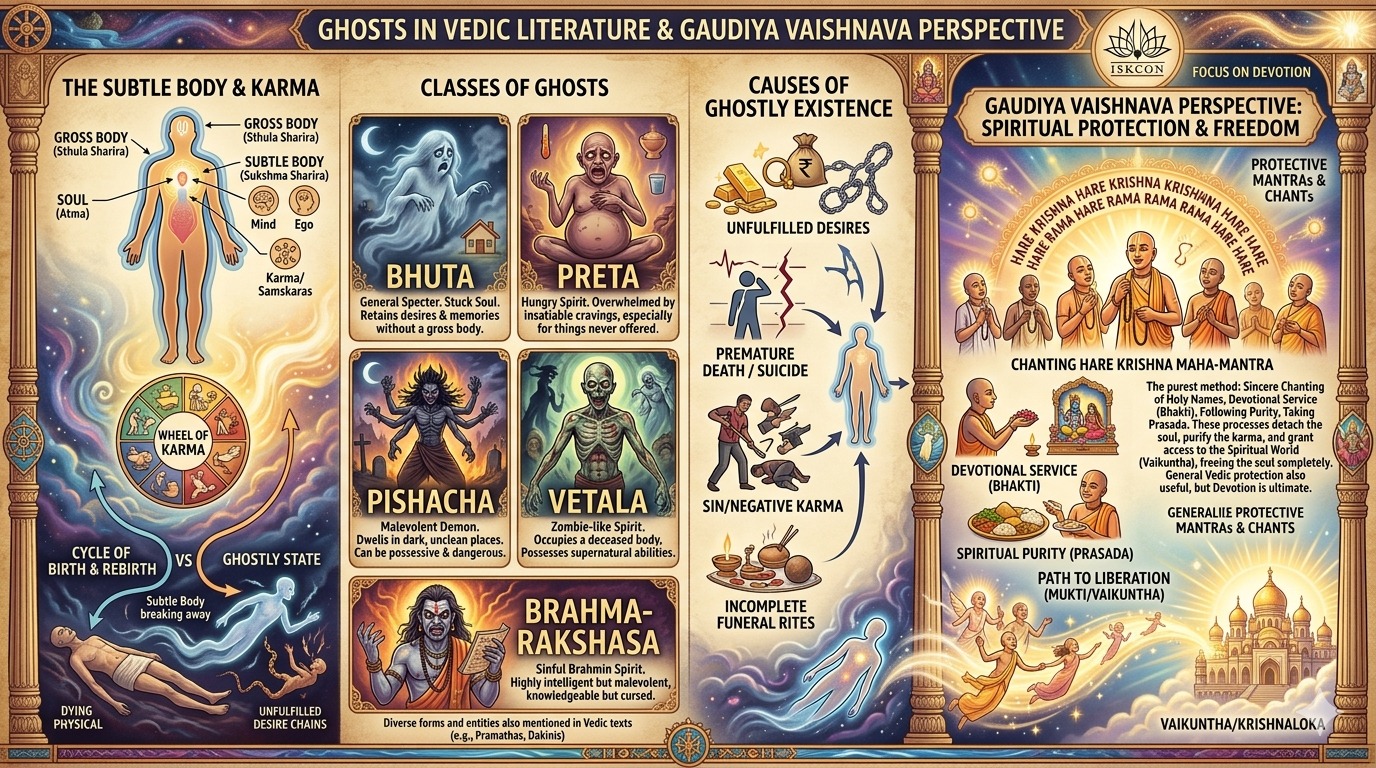
In Vedic ontology, every living being is an eternal soul (atma) covered by two layers:
- Gross body (physical body)
- Subtle body (mind, intelligence, ego)
At death, the soul leaves the gross body and continues its journey in the subtle body.
However, certain souls become trapped in an intermediate condition. They possess the subtle body but lack a suitable gross body. Such beings are commonly referred to as:
- Bhuta
- Preta
- Pishacha
- Vetala
- Brahma-rakshasa
The Garuda Purana, Atharva Veda, Srimad Bhagavatam, Mahabharata, and various Tantras describe these entities extensively.
Sanskrit References About Ghostly Existence
Bhagavad-gita 9.25
yanti deva-vrata devan
pitrn yanti pitr-vratah
bhutani yanti bhutejya
yanti mad-yajino ‘pi mam
“Those who worship the demigods go to the demigods, those who worship the ancestors go to the ancestors, those who worship ghosts and spirits go to such beings, and those who worship Me come to Me.”
This verse explicitly acknowledges the existence of ghostly beings.
The Vedic Understanding of Death and the Subtle Body
The Vedas explain that death is not annihilation. Consciousness continues.
The subtle body carries:
- Desires
- Memories
- Attachments
- Fears
- Karmic impressions
When these become extremely disturbed, the soul may fail to transition properly into the next embodiment.
This creates preta existence.
Analogy from Vedic Teachers
A ghost is often compared to:
- A prisoner without a prison cell
- A person with intense hunger but no mouth
- Someone dreaming but unable to wake up
The suffering is psychological, emotional, karmic, and energetic.
Types of Ghosts in Vedic Literature
1. Preta
The word preta means “departed one.”
A preta is usually a recently deceased soul who has not yet attained the next destination. According to Garuda Purana, improper funeral rites, extreme attachment, suicide, violence, or sinful karma may prolong preta existence.
Characteristics of Pretas
- Restlessness
- Attachment to family or property
- Hunger and thirst
- Emotional agitation
- Inability to communicate normally
Traditional texts describe preta existence lasting until karmic transition or spiritual intervention occurs.
2. Bhuta
Bhutas are more earthbound subtle beings.
They may linger in:
- Abandoned places
- Cremation grounds
- Ruined structures
- Trees
- Isolated areas
Atharva Veda contains mantras dealing with bhutas and negative subtle influences.
Typical Traits
- Disturbance of mental equilibrium
- Fear-inducing atmosphere
- Chaotic energy
- Attraction to tamasic environments
3. Pishacha
Pishachas are considered highly degraded subtle beings.
Vedic texts associate them with:
- Violence
- Addiction
- Sexual exploitation
- Bloodshed
- Extreme ignorance
These beings are often described as feeding on lower vibrations such as intoxication, lust, rage, and cruelty.
Many acharyas explain that excessively tamasic habits make human consciousness resonate with lower subtle entities.
Thus spiritual degradation attracts spiritually degraded association.
4. Vetala
Vetalas are described in classical Sanskrit literature as subtle beings capable of influencing dead bodies or inhabiting liminal spaces.
The famous Vetala Panchavimshati stories revolve around such entities.
These beings are often portrayed as:
- Intelligent
- Mysterious
- Detached from ordinary human morality
- Existing between worlds
5. Brahma-rakshasa
A brahma-rakshasa is a highly learned person who misused spiritual knowledge.
Vedic literature warns that:
- Pride in scholarship
- Misuse of mantra
- Exploitation of disciples
- Offenses against saints
can produce severe karmic consequences.
Such beings are said to possess: - Great intelligence
- Mystical capacity
- Deep suffering
- Powerful subtle influence
Causes of Ghostly Existence According to the Vedas
1. Extreme Material Attachment
A person overly attached to:
- Wealth
- House
- Family
- Status
- Possessions
may resist karmic transition after death.
The subtle body continues clinging to the previous environment.
2. Sudden or Violent Death
Traditional scriptures mention:
- Murder
- Suicide
- War
- Accidents
- Severe trauma
as causes of disturbed post-death transition.
The consciousness exits the body in intense confusion.
3. Excessive Sinful Activities
The mode of ignorance (tamo-guna) pulls consciousness downward.
Activities repeatedly condemned in Vedic texts include:
- Intoxication
- Cruelty
- Illicit violence
- Sexual misconduct
- Black magic
- Abuse of power
Such activities create subtle karmic contamination.
4. Improper Funeral Rites
Traditional Vedic culture emphasizes:
- Antyeshti samskara
- Shraddha
- Tarpana
- Mantra recitation
- Charity in the name of the departed
The Garuda Purana explains that these rituals assist the soul’s onward journey.
5. Deep Hatred or Revenge
Strong unresolved emotions bind consciousness.
A consciousness dominated by:
- Revenge
- Jealousy
- Obsession
- Rage
may remain trapped in lower subtle states.
Ghosts and the Three Modes of Nature
The Vedas describe three gunas:
- Sattva (clarity)
- Rajas (passion)
- Tamas (ignorance)
Ghostly environments are strongly associated with tamas.
Tamasic Environments Include
- Intoxication
- Violence
- Darkness
- Filth
- Chaotic sexuality
- Slaughter
- Depression
- Neglect of sacred life
This is why Vedic culture emphasizes:
- Cleanliness
- Kirtana
- Temple worship
- Sattvic diet
- Sacred sound vibration
These elevate consciousness and reduce lower subtle influences.
Symptoms Traditionally Associated with Negative Subtle Influence
Vedic literature approaches this carefully.
Not every psychological disturbance is possession. Genuine medical and psychological conditions must be treated responsibly.
However, traditional texts describe certain possible indicators:
- Sudden aversion to sacred sound
- Extreme personality shifts
- Attraction to impure environments
- Unusual aggression
- Persistent nightmares
- Disturbance in spiritually contaminated places
- Irrational fear in specific locations
Traditional teachers always caution against paranoia and superstition.
Haunted Places in Vedic Thought
Certain locations are considered spiritually vulnerable:
- Cremation grounds
- Places of violence
- Sites of black magic
- Abandoned ruins
- Areas saturated with tamasic activity
Conversely, spiritually purified environments include:
- Temples
- Holy dhams
- Ashrams
- Places of kirtana
- Homes with deity worship
The Vedic principle is simple:
Consciousness shapes atmosphere.
Can Ghosts Harm Humans?
Vedic literature acknowledges subtle influence but strongly rejects sensational fear.
Fear itself increases vulnerability.
Spiritually strong individuals grounded in:
- Mantra
- Devotion
- Purity
- Sattvic living
- Association with saints
are considered spiritually protected.
The Srimad Bhagavatam repeatedly explains that remembrance of the Supreme Lord destroys fear.
Bhagavatam Principle
Where divine sound vibration exists, lower subtle entities cannot remain comfortably.
This is why:
- Harinama kirtana
- Bhagavad-gita recitation
- Narasimha prayers
- Tulasi worship
- Temple worship
are emphasized in Vaishnava traditions.
Freedom from Ghostly Influence in the Vedas
1. Chanting of Holy Names
The most emphasized solution in Kali-yuga is nama-sankirtana.
Hare Krishna Maha-mantra
Hare Krishna Hare Krishna
Krishna Krishna Hare Hare
Hare Rama Hare Rama
Rama Rama Hare Hare
Vaishnava scriptures explain that transcendental sound purifies both embodied and disembodied beings.
2. Narasimha Prayers
Lord Narasimha is worshiped for protection from:
- Fear
- Negative influences
- Psychic disturbance
- Hostile energies
Traditional Prayer
namas te narasimhaya
prahladahlada-dayine
hiranyakashipor vaksah
shila-tanka-nakhalaye
3. Sattvic Lifestyle
The Vedas emphasize preventive spiritual hygiene.
Recommended Practices
- Vegetarian prasadam
- Early rising
- Cleanliness
- Avoiding intoxication
- Daily mantra meditation
- Association with devotees
- Scriptural study
These stabilize consciousness.
4. Sacred Sound and Kirtana
Loud congregational chanting is repeatedly glorified.
Traditional understanding states that sacred vibration transforms subtle atmosphere.
This is why many traditions perform:
- Bhagavatam recitation
- Kirtana in homes
- Temple festivals
- Yajnas
after death or during disturbances.
5. Proper Funeral and Ancestor Rites
Vedic rituals are meant to:
- Assist transition
- Reduce attachment
- Generate spiritual merit
- Offer prayers for departed souls
This includes:
- Shraddha ceremonies
- Tarpana
- Charity
- Feeding brahmanas and devotees
Ghosts in the Srimad Bhagavatam
The Srimad Bhagavatam repeatedly teaches that material existence itself is ghostlike because the soul falsely identifies with temporary coverings.
Several narratives involve subtle beings, curses, karmic transformations, and liberation through devotion.
Key Philosophical Point
Bhakti is higher than fear.
The Bhagavatam does not encourage obsession with ghosts.
Rather, it redirects consciousness toward:
- Krishna
- Devotion
- Pure consciousness
- Liberation
The deeper message is not paranormal curiosity but spiritual awakening.
Human-Harming or Potentially Dangerous Subtle Beings in Vedic Literature
| Entity | One-Line Description |
|---|---|
| Preta | Recently departed soul trapped in an unstable post-death condition due to attachment or karma. |
| Bhuta | Earthbound ghostly being associated with tamasic places and disturbed subtle energy. |
| Pishacha | Highly degraded flesh- and impurity-associated subtle entity linked with darkness and madness. |
| Vetala | Powerful spirit associated with corpses, cremation grounds, and liminal realms. |
| Brahma-rakshasa | Fallen scholar or priest cursed into a powerful ghostly state due to spiritual misuse. |
| Dakini | Occult female subtle being connected with tantric and cremation-ground energies. |
| Shakini | Esoteric female entity associated with subtle psychic or tantric forces. |
| Kushmanda | Lower astral being believed to feed on fear, disorder, and subtle disturbance. |
| Vinayaka (older usage) | Obstacle-creating subtle entity mentioned in early ritual literature. |
| Yaksha | Powerful nature spirit that may protect treasures but can become dangerous when disturbed. |
| Yakshini | Female yaksha associated with seduction, occult powers, and subtle influence. |
| Rakshasa | Aggressive shape-shifting being hostile to sages, sacrifice, and dharmic life. |
| Rakshasi | Female rakshasa often portrayed as predatory, magical, or illusion-generating. |
| Pisita-ashana | Flesh-eating demonic entity described in Puranic and epic literature. |
| Nishachara | “Night-roaming” being associated with darkness, predation, and occult activity. |
| Asura | Power-seeking anti-divine being opposed to dharmic and devotional principles. |
| Danava | Titanic anti-god being descended from Danu and associated with cosmic hostility. |
| Daitya | Powerful asuric race descended from Diti, often opposed to devas. |
| Kalakeyas | Fierce demonic clan known for violence against devas and sages. |
| Pramatha | Wild spirit attendants of Shiva capable of frightening or disruptive behavior. |
| Bhairava-gana | Terrifying attendant entities connected with fierce Shaiva energies. |
| Vetali | Female vetala-like spirit associated with graveyards and occult practices. |
| Matrika (lower forms) | Certain fierce mother-goddess attendants capable of destructive subtle influence. |
| Graha | Seizing or afflicting entity believed to disturb mind, body, or children. |
| Balagraha | Child-afflicting subtle being described in Ayurvedic and Puranic texts. |
| Skanda-graha | Spirit category associated with fever, possession, or childhood afflictions. |
| Apasmara | Demonification of forgetfulness, epilepsy, ignorance, and spiritual unconsciousness. |
| Kritya | Artificially invoked destructive entity generated through black magic rituals. |
| Abhicharika entities | Harmful occult beings invoked through malicious tantric rites. |
| Maya-rupi beings | Illusion-projecting entities capable of deceptive appearances and psychic confusion. |
| Naga (hostile forms) | Serpentine semi-divine beings capable of revenge when offended or disturbed. |
| Sarpa-rakshasa | Hybrid serpent-demonic being found in certain regional traditions. |
| Bhoota-gana (lower forms) | Unrefined spirit hordes associated with chaotic or impure environments. |
| Pretaraja attendants | Servants of Yama involved in karmic punishment and soul transition. |
| Yatudhana | Sorcery-linked demonic being associated with anti-sacrificial activity. |
| Kimidin | Harmful subtle entity mentioned in Atharva Vedic protective mantras. |
| Kravyada | Corpse- or flesh-consuming demonic being associated with cremation grounds. |
| Shakuni spirits | Omen-bearing harmful entities associated with misfortune in some traditions. |
| Churel / Chudail (folk traditions) | Restless female spirit formed from trauma, betrayal, or disturbed death. |
| Muni-pishacha | Spirit formed from corrupted asceticism or misuse of austerity. |
| Brahma-daitya | Spirit of a learned but materially attached brahmana lingering after death. |
| Pretini | Female preta trapped by emotional suffering, attachment, or tragic death. |
| Mohini spirits (lower folklore usage) | Seductive entities believed to drain vitality through illusion and attraction. |
| Shmashana-vasin beings | Cremation-ground dwelling subtle entities attracted to death-centered energies. |
| Tamasic elemental beings | Lower energetic entities nourished by intoxication, violence, and degradation. |
Theological note: Vedic and Puranic traditions vary considerably by sampradaya, region, Tantra, Purana, and folklore. Some entities are literal beings, some symbolic archetypes, and some ritual-taxonomic categories.
Ghosts and Karma: The Deeper Vedic Message
The ghost condition illustrates an important Vedic principle:
Consciousness at death matters.
Bhagavad-gita 8.6
yam yam vapi smaran bhavam
tyajaty ante kalevaram
tam tam evaiti kaunteya
sada tad-bhava-bhavitah
“Whatever state of being one remembers at death, that state one attains without fail.”
Thus the Vedas emphasize lifelong cultivation of consciousness.
Are All Paranormal Experiences Genuine?
Vedic wisdom encourages discrimination.
Possible explanations may include:
- Psychological conditions
- Neurological disturbances
- Trauma
- Suggestibility
- Environmental factors
- Genuine subtle phenomena
Authentic spiritual traditions avoid both extremes:
- Blind superstition
- Dogmatic materialism
The Vedic approach is nuanced, metaphysical, and psychologically aware.
The Ultimate Solution According to the Vedas
The ultimate Vedic teaching is not merely avoiding ghosts.
It is transcending material bondage altogether.
Every conditioned soul wandering through repeated birth and death is spiritually lost until reconnecting with the Supreme.
Therefore the highest protection is:
- Bhakti
- God consciousness
- Pure chanting
- Association with saints
- Surrender to Krishna
A spiritually awakened consciousness naturally rises beyond lower subtle influences.
Conclusion
Vedic literature presents a sophisticated understanding of ghosts as subtle beings trapped between karmic transitions. Rather than reducing the topic to fear or folklore, the Vedas integrate it into a larger theology of consciousness, karma, reincarnation, and liberation.
The texts explain:
- Different categories of ghostly beings
- Causes of preta existence
- The role of attachment and karma
- Protective spiritual practices
- The purifying power of sacred sound
Most importantly, the Vedic conclusion is deeply hopeful.
No soul is eternally condemned.
Through spiritual purification, divine remembrance, mantra meditation, and devotion to the Supreme Lord, all beings — embodied or disembodied — can ultimately attain peace and liberation.
Frequently Asked Questions About Ghosts in the Vedas
Do the Vedas believe in ghosts?
Yes. Vedic literature such as the Bhagavad-gita, Garuda Purana, Atharva Veda, and various Puranas acknowledge subtle beings like pretas, bhutas, and pishachas.
What causes someone to become a ghost according to the Vedas?
Major causes include extreme attachment, violent death, suicide, sinful activities, unresolved desires, and improper post-death rites.
How can one protect oneself spiritually?
The Vedas recommend:
- Chanting holy names
- Living a sattvic lifestyle
- Hearing sacred scriptures
- Worship of the Supreme Lord
- Association with saintly persons
What is the strongest protection in Kali-yuga?
According to Gaudiya Vaishnava theology, the chanting of the holy names of Krishna is the highest spiritual protection and purification.
Are ghosts permanently trapped?
No. Vedic philosophy teaches that every soul can eventually progress spiritually through karma, purification, divine grace, and devotional practices.