Bhakti-Latāyāḥ Vikāsa-Kramaḥ
Understanding the Inner Evolution of Devotional Consciousness
Bhakti is not a sudden emotional event or a merely ritualistic religion. It is a precise spiritual science describing the gradual transformation of consciousness from conditioned material existence to pure divine love for Sri Krishna.
Among the most important theological frameworks explaining this transformation is the progressive development of devotion beginning with śraddhā and culminating in prema. These stages are foundational to understanding authentic spiritual advancement in the teachings of Sri Chaitanya Mahaprabhu and the Goswamis of Vrindavan.
This article explores the famous progression:
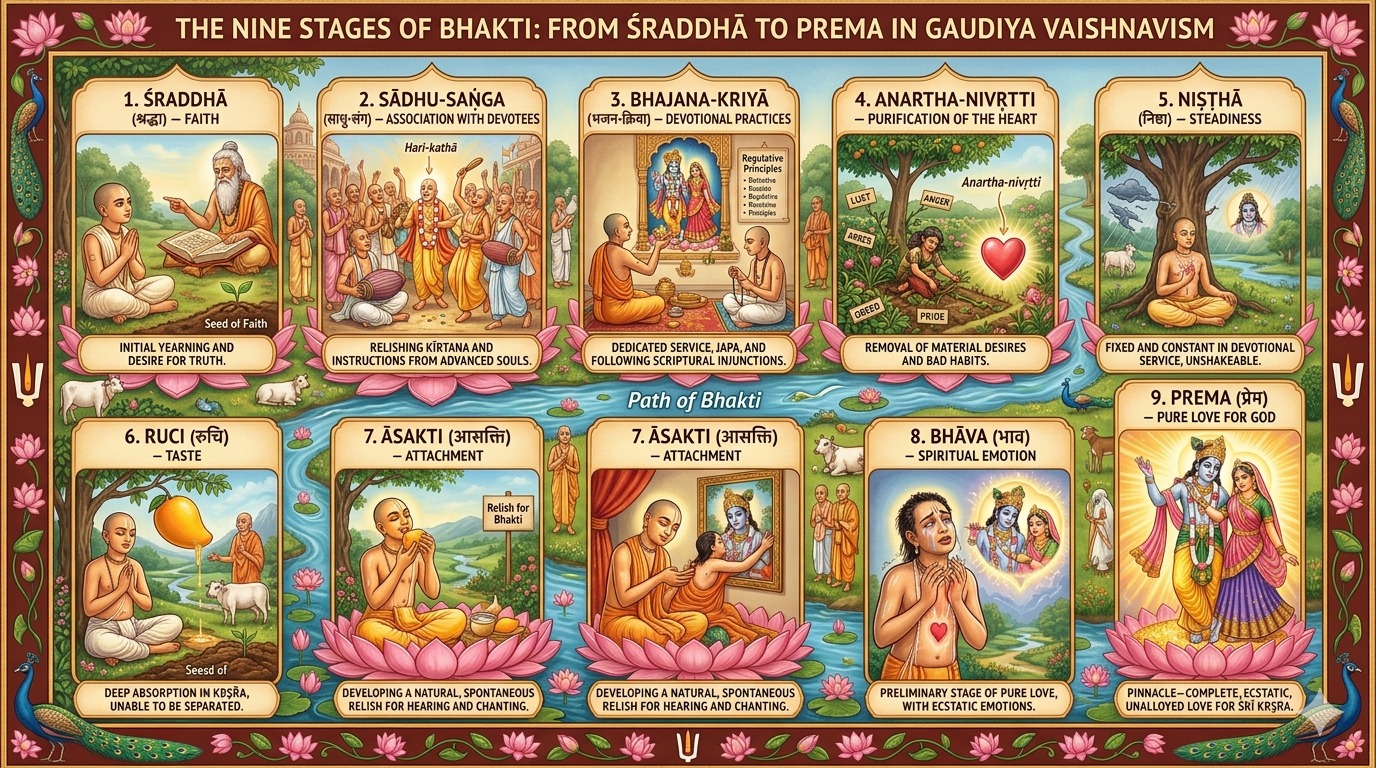
Śraddhā → Sādhu-saṅga → Bhajana-kriyā → Anartha-nivṛtti → Niṣṭhā → Ruci → Āsakti → Bhāva → Prema
These are not merely theoretical categories. They represent observable stages in the awakening of Krishna consciousness.
Scriptural Source of the Nine Stages of Bhakti
The foundational verse describing the evolution of bhakti appears in Bhakti-rasamrita-sindhu by Srila Rupa Goswami.
The Famous Verse
ādau śraddhā tataḥ sādhu-
saṅgo ’tha bhajana-kriyā
tato ’nartha-nivṛttiḥ syāt
tato niṣṭhā rucis tataḥathāsaktis tato bhāvas
tataḥ premābhyudañcati
sādhakānām ayaṁ premṇaḥ
prādurbhāve bhavet kramaḥ
“In the beginning there is faith, then association with devotees, followed by devotional practice. Thereafter unwanted habits are removed, steadiness arises, then spiritual taste develops, followed by deep attachment. From attachment arises bhāva, and ultimately prema manifests. This is the gradual progression of divine love in the practitioner.”
This verse is one of the most important maps of spiritual psychology in the Gaudiya tradition.
1. Śraddhā — The Birth of Spiritual Faith
The journey of bhakti begins with śraddhā, or transcendental faith.
śraddhā does not mean blind belief. It refers to a preliminary conviction that Krishna bhakti is the highest path and that spiritual fulfillment can be attained through devotional service.
śraddhā → sādhu-saṅga
This faith may arise through:
- Hearing hari-katha
- Reading Bhagavad-gita
- Observing saintly devotees
- Receiving spiritual impressions from previous lives
- Encountering the holy name
Śraddhā is subtle yet revolutionary because it redirects the soul’s existential orientation away from materialism toward transcendence.
According to Gaudiya siddhanta, bhakti begins not with intellectual mastery but with spiritual receptivity.
Faith opens the doorway through which grace enters consciousness.
2. Sādhu-saṅga — Association with Advanced Devotees
After faith awakens, the aspirant naturally seeks saintly association.
In Vaishnava philosophy, consciousness is contagious. Association shapes destiny.
Thus sādhu-saṅga becomes the fertile ground in which bhakti develops properly.
True association means more than physical proximity to devotees. It involves:
- Hearing submissively
- Serving advanced Vaishnavas
- Adopting devotional values
- Internalizing spiritual culture
- Receiving guidance in sādhana
Srila Prabhupada repeatedly emphasized that all spiritual advancement depends upon proper association.
Why Sādhu-saṅga is Transformative
A conditioned soul lives within a network of material influences:
- Consumerism
- Ego-centered identity
- Sense gratification
- Competition
- Envy
Sādhu-saṅga gradually replaces these impressions with spiritual samskaras.
3. Bhajana-kriyā — Regulated Devotional Practice
From association emerges commitment to disciplined devotional life.
This stage is called bhajana-kriyā.
The practitioner now actively engages in sādhana-bhakti through regulated spiritual practices.
- Chanting Hare Krishna japa
- Attending kirtan
- Deity worship
- Scriptural study
- Guru-sevā
- Ekadashi observance
- Vaishnava association
- Preaching and seva
In many cases this stage includes formal initiation (dīkṣā).
The Two Phases of Bhajana-kriyā
Gaudiya acharyas describe two important phases:
Aniṣṭhitā-bhajana-kriyā (Unsteady Practice)
The practitioner experiences fluctuations such as:
- Enthusiasm followed by lethargy
- Strong inspiration followed by distraction
- Inconsistency in sādhana
- Emotional oscillation
This stage is extremely common and should not be mistaken for failure.
Niṣṭhitā-bhajana-kriyā (Steady Practice)
Gradually practice stabilizes and becomes disciplined.
The devotee no longer depends entirely upon emotional momentum.
4. Anartha-nivṛtti — Cleansing of Unwanted Habits
As devotional practice deepens, impurities hidden within the heart begin surfacing.
This stage is known as anartha-nivṛtti.
What Are Anarthas?
The term refers to unwanted conditioning such as:
- Lust
- Anger
- Greed
- Pride
- Envy
- Desire for prestige
- Aparadhas (offenses)
- Material attachments
- Hypocrisy
This purification can be psychologically intense because bhakti illuminates subconscious conditioning.
Many practitioners become discouraged during this stage because they become increasingly aware of internal impurities.
However, Gaudiya acharyas explain an important principle:
Exposure of impurity is evidence of purification, not spiritual regression.
Bhakti acts like sunlight entering a dark room. Dust becomes visible precisely because illumination has increased.
5. Niṣṭhā — Steadiness in Devotional Service
After significant purification, devotional life becomes stable.
This stage is called niṣṭhā.
anartha-nivṛtti → niṣṭhā
At niṣṭhā:
- Doubts weaken substantially
- Sādhana becomes consistent
- External disturbances lose power
- Spiritual discipline becomes natural
The practitioner serves Krishna steadily regardless of emotional conditions.
Psychological Characteristics of Niṣṭhā
Niṣṭhā represents a major threshold in spiritual maturity.
The devotee is no longer governed primarily by impulse, social pressure, or temporary inspiration.
Bhakti becomes integrated into identity itself.
6. Ruci — Genuine Spiritual Taste
From steadiness emerges ruci, or spiritual taste.
Previously bhakti was maintained largely through discipline and duty.
Now the practitioner experiences authentic attraction toward devotional activities.
The devotee naturally relishes:
- Hari-katha
- Kirtan
- Japa
- Vaishnava association
- Service
- Holy dhamas
- Deity worship
Bhakti is no longer merely practiced.
It is enjoyed.
7. Āsakti — Deep Attachment to Krishna
Ruci eventually matures into āsakti, profound attachment.
At this stage, attachment shifts from the practices of bhakti toward Krishna Himself.
Difference Between Ruci and Āsakti
Ruci
“I love devotional activities.”
Āsakti
“I cannot live without Krishna.”
The mind spontaneously gravitates toward Krishna throughout the day.
Material attraction significantly weakens.
8. Bhāva — The Dawn of Pure Love
Bhāva is the first sprout of pure prema.
It is a transcendental spiritual condition infused by Krishna’s internal potency (hladini-shakti).
Symptoms of Bhāva
Classical symptoms include:
- Deep humility
- Intense longing for Krishna
- Constant remembrance
- Detachment from material prestige
- Extraordinary compassion
- Spiritual ecstasy
Srila Vishvanatha Cakravarti Thakura compares bhāva to the first rays of the rising sun before full daylight appears.
9. Prema — Pure Love of God
The culmination of all spiritual evolution is prema, ecstatic divine love.
Prema is the supreme goal of life.
Characteristics of Prema
In prema:
- Love becomes unconditional
- Krishna is experienced continuously
- The devotee exists solely for Krishna’s pleasure
- Separation from Krishna becomes unbearable
- Divine relationships fully awaken
The residents of Vrindavan are considered the eternal embodiments of prema-bhakti.
The Uniqueness of the Gaudiya Understanding of Bhakti
Unlike impersonal systems focused upon liberation from existence, Gaudiya Vaishnavism presents divine love as the highest spiritual attainment.
The goal is not merely freedom from suffering.
The goal is loving reciprocation with Krishna.
This makes the bhakti progression deeply relational rather than merely philosophical.
The Role of the Holy Name in Advancing Through the Stages
ISKCON strongly emphasizes the chanting of the Hare Krishna maha-mantra because nāma-saṅkīrtana nourishes every stage of bhakti.
The Maha-mantra
Hare Krishna Hare Krishna
Krishna Krishna Hare Hare
Hare Rama Hare Rama
Rama Rama Hare Hare
According to the teachings of Sri Chaitanya Mahaprabhu, the holy name contains all spiritual potency necessary for attaining prema.
Why Understanding These Stages Matters
The nine stages of bhakti provide practitioners with:
- Spiritual clarity
- Realistic expectations
- Psychological insight
- Theological structure
- Hope during struggle
- Appreciation for gradual transformation
Without understanding this progression, practitioners may:
- Misinterpret purification as failure
- Expect premature spiritual ecstasy
- Become discouraged during anartha-nivṛtti
- Confuse sentiment with realization
The acharyas therefore presented these stages as a roadmap for authentic spiritual development.
Conclusion: Bhakti as the Science of Divine Transformation
The progression from śraddhā to prema represents one of the most sophisticated spiritual psychologies found anywhere in the world’s theological traditions.
It explains how conditioned consciousness gradually becomes spiritually awakened through association, practice, purification, and divine grace.
For the Gaudiya Vaishnava tradition, bhakti is not an abstract philosophy.
It is a living transformation of identity, affection, perception, and existence itself.
The journey begins with a small seed of faith.
It culminates in eternal love for Krishna.