For centuries, science and spirituality were portrayed as enemies.
Science demanded evidence. Spirituality emphasized inner realization. One explored the external universe through instruments and mathematics; the other explored consciousness through meditation, discipline, and transcendence.
But something extraordinary is happening in the modern world.
Neuroscientists are studying meditation. Physicists are questioning the nature of reality itself. Biologists are discovering how trauma travels across generations. Psychologists are exploring altered states of consciousness once described only in mystical traditions.
The deeper modern science investigates reality, the more it encounters ideas that ancient spiritual traditions discussed thousands of years ago.
This does not mean science has “proven religion” in a simplistic sense. Rather, it suggests that many ancient contemplative systems may have understood dimensions of consciousness and existence long before modern laboratories developed the tools to investigate them.
Among the world’s spiritual traditions, Vedic philosophy stands out for its remarkably sophisticated understanding of mind, consciousness, interconnectedness, sound vibration, karma, and the subtle relationship between body and awareness.
Today, a growing number of analytical thinkers, skeptics, neuroscientists, and spiritually curious professionals are beginning to ask:
Could ancient wisdom contain deeper truths about consciousness than modern materialism assumed?
The Neurobiology of Chanting: What Happens to the Brain During Mantra Meditation?
One of the most fascinating intersections between neuroscience and spirituality involves sacred sound.
Across Vedic traditions, mantra meditation and kirtan have been practiced for thousands of years as methods for purification of consciousness, emotional healing, and spiritual awakening.
Historically, skeptics dismissed chanting as merely emotional or ritualistic.
Modern neuroscience is beginning to tell a different story.
The Nervous System Was Designed for Rhythm
The human nervous system responds profoundly to repetitive sound, breath regulation, and synchronized vocalization.
During mantra meditation or kirtan:
- breathing slows
- heart rhythms stabilize
- stress hormones decrease
- attention becomes focused
- emotional turbulence reduces
Researchers studying chanting and meditative repetition have observed increased parasympathetic nervous system activation — the body’s “rest and repair” state.
Central to this process is the vagus nerve.
The Vagus Nerve and Sacred Sound
The vagus nerve is one of the most important communication pathways between the brain, heart, lungs, digestive system, and emotional regulation centers.
When activated properly, it promotes:
- calmness
- emotional resilience
- reduced anxiety
- social bonding
- nervous system regulation
Interestingly, many chanting practices naturally stimulate vagal activity through:
- prolonged exhalation
- vocal resonance
- diaphragmatic breathing
- rhythmic repetition
The vibrations generated during mantra chanting — especially prolonged syllables like “Om” or Hare Krishna maha-mantra recitation — create resonance in the throat, chest, and cranial regions associated with vagal stimulation.
Some neuroimaging studies have shown that repetitive meditative chanting may reduce activity in the brain’s default mode network — the system associated with excessive self-referential thinking and mental rumination.
This explains why deep chanting often produces:
- inner silence
- emotional release
- timelessness
- reduced ego fixation
- feelings of connection and transcendence
Ancient Vedic practitioners described these effects not as neurological anomalies, but as the natural purification of consciousness.
Why Kirtan Feels Different From Ordinary Music
People often describe kirtan as emotionally transformative in a way ordinary entertainment rarely achieves.
Why?
Because sacred sound in Vedic philosophy is not considered merely symbolic.
It is considered vibrationally potent.
The Vedic understanding of sound is radically different from modern material assumptions. Mantras are viewed as carriers of consciousness capable of influencing mental states, emotional patterns, and subtle awareness itself.
Modern neuroscience increasingly acknowledges that sound profoundly affects:
- mood
- memory
- hormonal regulation
- neural synchronization
- emotional processing
Collective chanting also creates synchronized breathing and emotional entrainment among participants, producing unusually strong experiences of unity and belonging.
What ancient yogis called “elevation of consciousness,” neuroscience may describe as large-scale nervous system coherence.
Different language — similar observations.
Quantum Entanglement and the Ancient Idea of Interconnectedness
Modern physics has destabilized many assumptions about reality.
Classical materialism once imagined the universe as a giant mechanical machine composed of isolated objects interacting predictably through physical laws.
Quantum physics shattered that certainty.
At the quantum level, reality behaves in deeply counterintuitive ways:
- particles exist as probabilities
- observation affects outcomes
- locality becomes questionable
- entangled particles influence one another across vast distances
Among the most philosophically shocking discoveries is quantum entanglement.
Two particles that become entangled can remain mysteriously correlated regardless of spatial separation. Changes affecting one appear connected to the other instantaneously.
Even many physicists admit the phenomenon challenges ordinary notions of separateness.
Ancient Vedic Thought and Universal Interconnectedness
Long before quantum theory, Vedic philosophy taught that reality is fundamentally interconnected beneath surface-level appearances.
The apparent separateness of beings is considered partially illusory — a product of limited material perception.
The Sanskrit concept of Brahman describes an underlying spiritual unity pervading existence.
Similarly, the idea of Paramatma describes the Divine presence existing within all living beings simultaneously.
From this perspective:
- consciousness is interconnected
- life forms are interdependent
- actions create subtle ripple effects
- separation is temporary and external
This does not mean ancient sages literally discovered quantum mechanics in a modern scientific sense.
However, modern physics is increasingly moving away from rigid material separateness toward a far more interconnected vision of reality — something contemplative traditions described philosophically long ago.
Consciousness: The Greatest Mystery in Science
Despite extraordinary technological progress, science still cannot fully explain consciousness itself.
How does subjective experience arise from matter?
Why does awareness exist at all?
Why should electrical activity in the brain produce:
- love
- beauty
- suffering
- meaning
- self-awareness
- transcendence
This is often called the “hard problem of consciousness.”
Vedic philosophy approaches the issue differently.
Rather than treating consciousness as a byproduct of matter, it views consciousness as fundamental — with the brain functioning more like a receiver or interface than the ultimate source of awareness.
While modern neuroscience maps correlations between brain activity and experience, the deeper origin of subjective awareness remains unresolved.
This unresolved mystery is causing increasing numbers of scientists and philosophers to reconsider purely reductionist models of consciousness.
Beyond the Chemical Trip: The Psychedelic Renaissance and the Search for Lasting Transformation
Modern culture is currently experiencing what many call a “psychedelic renaissance.”
Substances such as psilocybin, ayahuasca, LSD, and DMT are being studied for:
- depression
- trauma
- addiction
- existential anxiety
- end-of-life distress
Many users report profound mystical experiences:
- ego dissolution
- feelings of unity
- transcendence
- spiritual awakening
- encounters with deeper meaning
For some, psychedelics temporarily break rigid psychological patterns and expose dimensions of consciousness previously ignored.
But an important realization is emerging.
Temporary altered states are not the same as lasting spiritual transformation.
The Difference Between Experience and Realization
Many psychedelic users eventually discover that peak experiences alone do not permanently resolve:
- suffering
- ego instability
- emotional conditioning
- anxiety
- attachment
- spiritual confusion
The experience fades.
Daily consciousness returns.
This has led many seekers toward disciplined spiritual practices that produce stable inner transformation naturally over time.
Practices such as:
- mantra meditation
- kirtan
- breathwork
- yoga
- contemplative prayer
- devotion
- disciplined living
Unlike chemically induced states, these methods gradually reshape consciousness sustainably.
Ancient yogic traditions often warned against dependency on external substances for transcendence. Genuine spiritual realization was seen as arising through purification, discipline, and awakened awareness rather than temporary neurological disruption.
The modern psychedelic movement is therefore unintentionally pushing many people toward ancient spiritual systems.
After tasting altered consciousness artificially, they begin seeking permanent awakening naturally.
The Epigenetics of Karma: Can Trauma Travel Across Generations?
One of the most fascinating modern scientific developments involves epigenetics — the study of how life experiences influence gene expression across generations.
Researchers now know that trauma, chronic stress, famine, violence, and environmental conditions may leave measurable biological effects that influence descendants.
Children and grandchildren can inherit altered stress responses shaped by ancestral experiences.
This discovery has deeply challenged simplistic genetic determinism.
Ancient Karma and Generational Influence
Vedic philosophy long taught that actions create consequences extending beyond immediate circumstances.
Karma is not merely punishment or reward. It is the law of causation operating across physical, psychological, social, and spiritual dimensions.
Patterns repeat across generations because consciousness carries impressions, tendencies, and unresolved conditioning.
Modern epigenetics does not “prove karma” literally.
However, it does reveal something important:
human experiences leave deeper biological and psychological imprints than previously imagined.
Trauma is not always isolated to individuals.
It can become embedded in family systems, behavioral patterns, emotional conditioning, and even cellular regulation.
This parallels ancient observations about inherited suffering and recurring karmic cycles.
Breaking Karmic and Biological Cycles
Both spirituality and modern psychology increasingly agree on one crucial insight:
patterns can be transformed consciously.
Meditation, emotional healing, disciplined behavior, supportive environments, spiritual practice, and intentional living all influence neurobiology and stress regulation.
Emerging evidence even suggests meditation may positively influence:
- inflammatory responses
- stress pathways
- emotional regulation
- neural plasticity
- gene expression related to resilience
In spiritual language, this is purification of karma.
In scientific language, it may involve neuroplasticity, behavioral conditioning, and epigenetic adaptation.
Again, different frameworks are describing overlapping realities.
Why the Science-Spirituality Conversation Matters
Modern society suffers from two extremes.
One side rejects spirituality entirely, reducing humans to biochemical machines.
The other rejects science completely, abandoning rational inquiry.
Neither extreme produces wisdom.
The future likely belongs to integration:
- rigorous science
- deep spirituality
- disciplined inquiry
- contemplative experience
- ethical responsibility
- expanded understanding of consciousness
Ancient Vedic traditions never viewed reality as meaningless matter alone. They saw existence as conscious, interconnected, purposeful, and spiritually dynamic.
Modern science is not fully arriving at the same conclusions.
But it is increasingly encountering mysteries that materialism alone struggles to explain.
And that may be the beginning of a much larger transformation in human understanding.
The Return of Consciousness
The greatest frontier of the 21st century may not be outer space, artificial intelligence, or biotechnology.
It may be consciousness itself.
Humanity is rediscovering that inner experience cannot be dismissed as irrelevant.
The mind affects the body.
Sound affects the nervous system.
Attention shapes reality.
Trauma echoes across generations.
Consciousness remains scientifically mysterious.
And meaning cannot be reduced to chemistry alone.
The ancient sages explored these territories through meditation, mantra, discipline, contemplation, and spiritual realization long before modern laboratories existed.
Now science is beginning — slowly and cautiously — to examine the same terrain from another direction.
And somewhere between neuroscience and meditation,
between quantum physics and metaphysics,
between biology and karma,
a new conversation is emerging.
Not a war between science and spirituality.
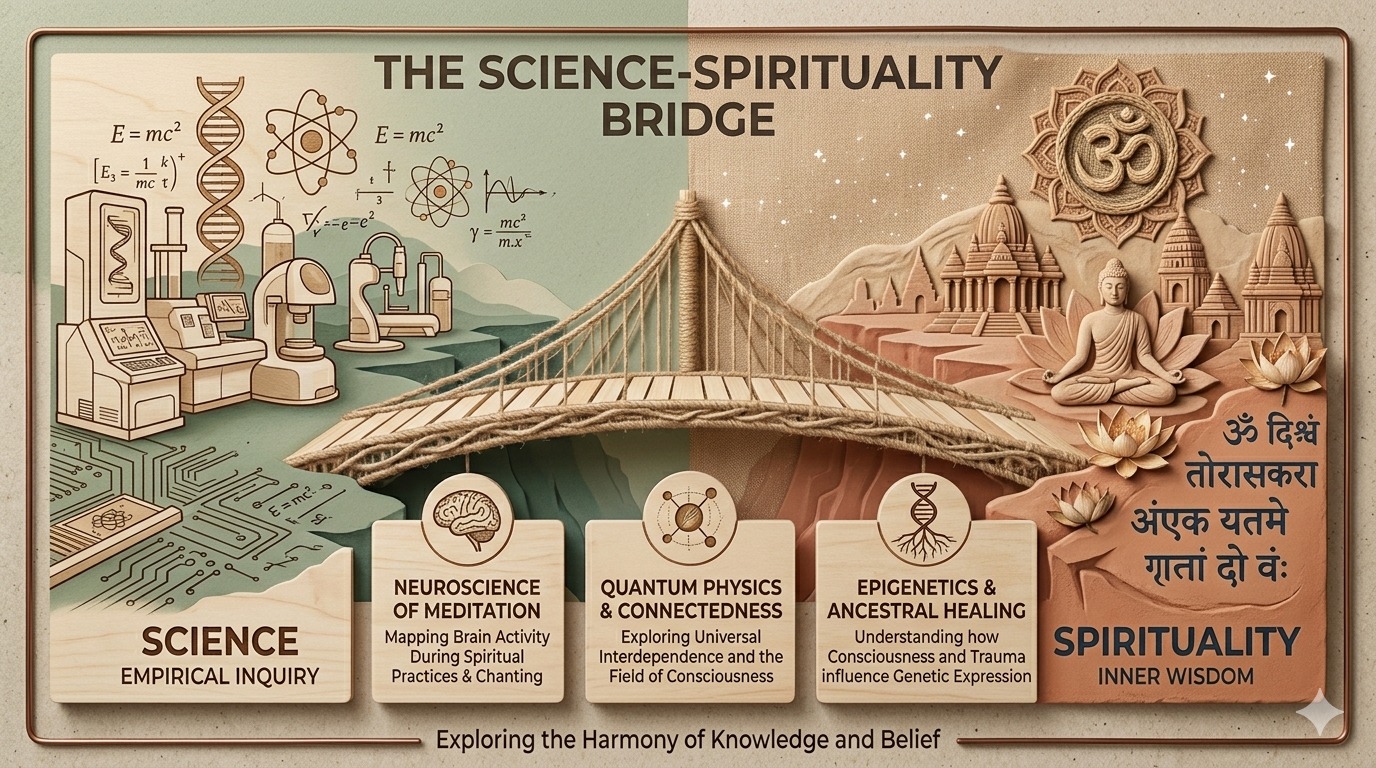
But a bridge.