Understanding Desire Through the Lens of Dharma
Introduction: Why the Kama Sutra Still Fascinates the Modern World
The phrase “Kama Sutra” immediately captures attention. For many people across the world, it has become synonymous with sensuality, relationships, and ancient Indian wisdom. Yet very few understand what the text actually represents within the broader framework of Vedic civilization.
In modern culture, the Kama Sutra is often reduced to a manual of physical techniques. However, the original Sanskrit tradition presents something much broader: a discussion about human desire, social responsibility, psychology, marriage, aesthetics, and regulated living.
From the perspective of Krishna consciousness, this topic becomes even more relevant. Human desire cannot simply be denied artificially, nor can it be allowed to become uncontrolled. The Vedic process teaches transformation — elevating consciousness from kama (self-centered desire) to prema (pure love for Krishna).
What Is the Kama Sutra?
The Kama Sutra is one of the most misunderstood texts of ancient India. Popular media frequently presents it as merely a collection of sensual techniques, but historically the text belongs to a sophisticated civilizational framework dealing with psychology, aesthetics, ethics, domestic life, social interaction, emotional compatibility, and regulated enjoyment.
The Sanskrit word “kama” refers broadly to desire, attraction, pleasure, affection, emotional fulfillment, artistic enjoyment, and sensory experience. In classical Vedic civilization, kama was never treated as independent from dharma. The Kama Sutra is an ancient Sanskrit text traditionally attributed to Vatsyayana, believed to have lived between the 2nd and 4th century CE.
The text attempts to answer practical questions such as:
- How should relationships function within society?
- What qualities sustain marriage?
- How does attraction influence human behavior?
- What creates emotional harmony between partners?
- How should desire be regulated?
- What responsibilities accompany enjoyment?
The Kama Sutra also reflects the urban culture of classical India, discussing etiquette, music, poetry, aesthetics, communication, dress, fragrances, home culture, and refined behavior.
Rather than promoting uncontrolled indulgence, the text belongs to a broader attempt to civilize and regulate human impulses.
Main Areas Discussed in the Kama Sutra
1. Human Psychology and Attraction
The text examines how attraction develops between people, including emotional signals, conversation, personality, confidence, gestures, and compatibility. It recognizes that human relationships involve the mind and emotions, not merely the body.
2. Courtship and Marriage
Large sections discuss:
- choosing compatible partners,
- social customs surrounding marriage,
- responsibilities within household life,
- emotional cooperation,
- trust and mutual respect.
Ancient Indian civilization viewed marriage as both social and spiritual responsibility.
3. Domestic and Family Life
The Kama Sutra contains discussions on household management, family harmony, hospitality, social reputation, and community interaction. This reveals that the work was connected to broader social order rather than isolated sensuality.
4. Aesthetics and Cultural Refinement
The text describes arts considered important in cultured society, including:
- music,
- poetry,
- fragrance preparation,
- decoration,
- conversation,
- drama,
- dance,
- emotional expression.
Pleasure in Vedic culture was linked not only to physical enjoyment but also to beauty, refinement, and cultured living.
5. Emotional Compatibility
The text explores temperaments, preferences, emotional bonding, affection, and communication. This aspect is surprisingly psychological and demonstrates awareness that stable relationships require more than attraction alone.
6. Regulation of Desire
One overlooked feature is regulation. Ancient Vedic civilization understood that uncontrolled desire could destabilize society and consciousness.
Therefore enjoyment was traditionally guided through:
- social ethics,
- dharma,
- responsibility,
- self-control,
- family structure,
- and spiritual culture.
7. Temporary Nature of Material Enjoyment
Although the text discusses worldly pleasure, the larger Vedic worldview always maintained that sensory enjoyment alone cannot fully satisfy the soul.
This point becomes especially important when viewed through the teachings of Bhagavad-gita and bhakti-yoga.
Bhakti Perspective: From Attraction to Divine Love
The Kama Sutra was composed by Vatsyayana around the early centuries of the Common Era. Contrary to popular assumption, the text is not merely about physical intimacy. It belongs to a larger Vedic framework known as the four purusharthas — the four goals of human life:
- Dharma — righteous living
- Artha — economic development
- Kama — regulated enjoyment and desire
- Moksha — liberation
Within Vedic culture, kama was never meant to function independently. Desire was meant to operate under dharma. When disconnected from spiritual principles, desire becomes exploitative, addictive, and destabilizing.
The Kama Sutra itself discusses:
- Marriage and household relationships
- Social conduct
- Emotional compatibility
- Family life
- Aesthetics and culture
- Ethics surrounding relationships
- Regulated enjoyment within society
The reduction of the entire text into sensational imagery is largely a modern commercial phenomenon.
Explicit content
Yes. The Kama Sutra contains discussions on a wide range of human sexual and social behaviors found in ancient society, including topics that modern readers may consider controversial or explicit.
Scholarly translations note that the text includes references to:
- different forms of intimacy,
- kissing and embrace,
- oral practices,
- extramarital relationships,
- courtesans,
- same-sex behavior,
- unconventional practices,
- and certain discussions involving animals.
The traditional explanation is that Vatsyayana was attempting to document and systematize aspects of human social and sensual behavior that already existed in society, not necessarily to spiritually glorify every practice described.
Ancient Indian literature often had a descriptive dimension alongside a prescriptive one. In other words, some texts:
- described what people did,
- analyzed human psychology,
- categorized behaviors,
- and discussed social realities,
without automatically declaring all such behaviors morally ideal.
The Kama Sutra was written for urban household society within the framework of kama-shastra — literature dealing with desire and worldly relationships. Its audience was primarily cultured householders, not renunciants or spiritual seekers aiming for liberation.
Several reasons are commonly given by historians and traditional commentators for why such topics appeared:
- Comprehensive Documentation
Ancient authors often attempted encyclopedic treatment of a subject. Vatsyayana may have intended to catalog the full spectrum of behaviors known in society. - Psychological Observation
The text reflects interest in understanding attraction, desire, temptation, and human conduct realistically rather than idealistically. - Regulation Rather Than Chaos
Some scholars argue that codifying behavior was viewed as a way of regulating social life rather than leaving desire completely uncontrolled. - Reflection of Existing Society
Certain controversial topics likely reflected practices already present in portions of society. Recording them does not necessarily mean endorsing them spiritually.
From a bhakti perspective, however, Gaudiya Vaishnavas would say that merely because something exists in society does not make it spiritually elevating.
The Vedic tradition itself contains different levels of teaching for different levels of consciousness:
- karma-kanda for regulated material life,
- dharma-shastra for social order,
- yoga for self-control,
- and bhakti-shastra for pure devotion.
International Society for Krishna Consciousness generally teaches that scriptures centered on Krishna-bhakti represent the highest spiritual conclusion because they aim not at refinement of sensuality, but transcendence of bodily consciousness altogether.
Thus, from the Gaudiya Vaishnava standpoint:
- the Kama Sutra may be viewed as part of material social literature,
- but not as the ideal guide for spiritual purification.
The higher goal is transformation from:
- kama (self-centered desire)
to - prema (selfless love for Krishna).
The Vedic Understanding of Kama
In Sanskrit, kama simply means desire. Not all desire is condemned in Vedic philosophy.
In the Bhagavad-gita, Lord Krishna states:
“dharmaviruddho bhutesu kamo ’smi”
“I am sex life which is not contrary to religious principles.”
This is a profound statement. Krishna does not deny the existence of human attraction or family life. Rather, He explains that regulated life aligned with dharma can gradually elevate consciousness.
Gaudiya Vaishnava philosophy recognizes that material existence itself is driven by desire. The problem is not desire itself, but misdirected desire.
Material consciousness says:
“How can I enjoy?”
Spiritual consciousness says:
“How can I serve Krishna?”
The transformation from selfish enjoyment to loving devotional service is the heart of bhakti-yoga.
ISKCON’s Perspective on Relationships and Sexuality
The International Society for Krishna Consciousness, founded by His Divine Grace A. C. Bhaktivedanta Swami Prabhupada, emphasizes regulated spiritual life.
ISKCON does not teach hatred toward the body, marriage, or family responsibilities. Instead, it teaches discipline, purity, and spiritual purpose.
Within Krishna consciousness:
- Marriage is considered sacred.
- Relationships should support spiritual growth.
- Lust is recognized as a powerful force that can distract the mind from higher realization.
- Spiritual practices such as chanting Hare Krishna help purify consciousness.
The famous Hare Krishna maha-mantra is:
Hare Krishna Hare Krishna
Krishna Krishna Hare Hare
Hare Rama Hare Rama
Rama Rama Hare Hare
According to Gaudiya Vaishnava theology, the soul is eternally searching for loving connection with Krishna. Material attraction is seen as a temporary reflection of the soul’s deeper longing for divine love.
Lust Versus Love: A Central Teaching in Bhakti
One of the most important distinctions made in Vaishnava philosophy is the difference between lust and love.
Lust
- Centers on personal gratification
- Treats others as objects for enjoyment
- Produces anxiety, attachment, and dissatisfaction
- Increases material bondage
Love
- Centers on selfless service
- Seeks the welfare of others
- Purifies the heart
- Brings spiritual fulfillment
Sri Chaitanya Mahaprabhu and the Gaudiya acharyas explain that pure love reaches its highest expression in devotion to Krishna.
Thus, bhakti does not merely suppress desire; it redirects desire toward its original spiritual source.
Why Modern Society Is Revisiting Ancient Relationship Wisdom
Today, many people feel disillusioned with superficial relationship culture. Despite technological advancement and unprecedented access to entertainment, anxiety, loneliness, instability, and emotional dissatisfaction remain widespread.
This has led many seekers to revisit ancient wisdom traditions.
The popularity of topics like:
- Conscious relationships
- Sacred marriage
- Spiritual intimacy
- Yogic psychology
- Vedic lifestyle
- Mindfulness and self-discipline
shows a growing search for deeper meaning.
The Vedic tradition contributes something valuable here: the idea that pleasure alone cannot satisfy the soul.
Real fulfillment emerges when life aligns with spiritual identity.
The Psychology of Desire in Bhagavad-gita
The Bhagavad-gita gives a sophisticated psychological analysis of desire.
Krishna explains that contemplation on sense objects leads to attachment, attachment leads to desire, and frustrated desire leads to anger, confusion, and suffering.
This sequence remains remarkably relevant in the digital age.
Modern media culture constantly stimulates:
- Comparison
- Artificial fantasy
- Consumerism
- Instant gratification
- Hypersexualization
The result is often mental exhaustion rather than satisfaction.
Bhakti-yoga addresses the root issue by purifying consciousness through:
- Mantra meditation
- Satsanga (spiritual association)
- Regulated habits
- Scriptural study
- Devotional service
- A Krishna-centered lifestyle
Can Spirituality and Family Life Coexist?
Absolutely.
The Vedic tradition contains examples of saintly householders who lived spiritually while fulfilling social and family responsibilities.
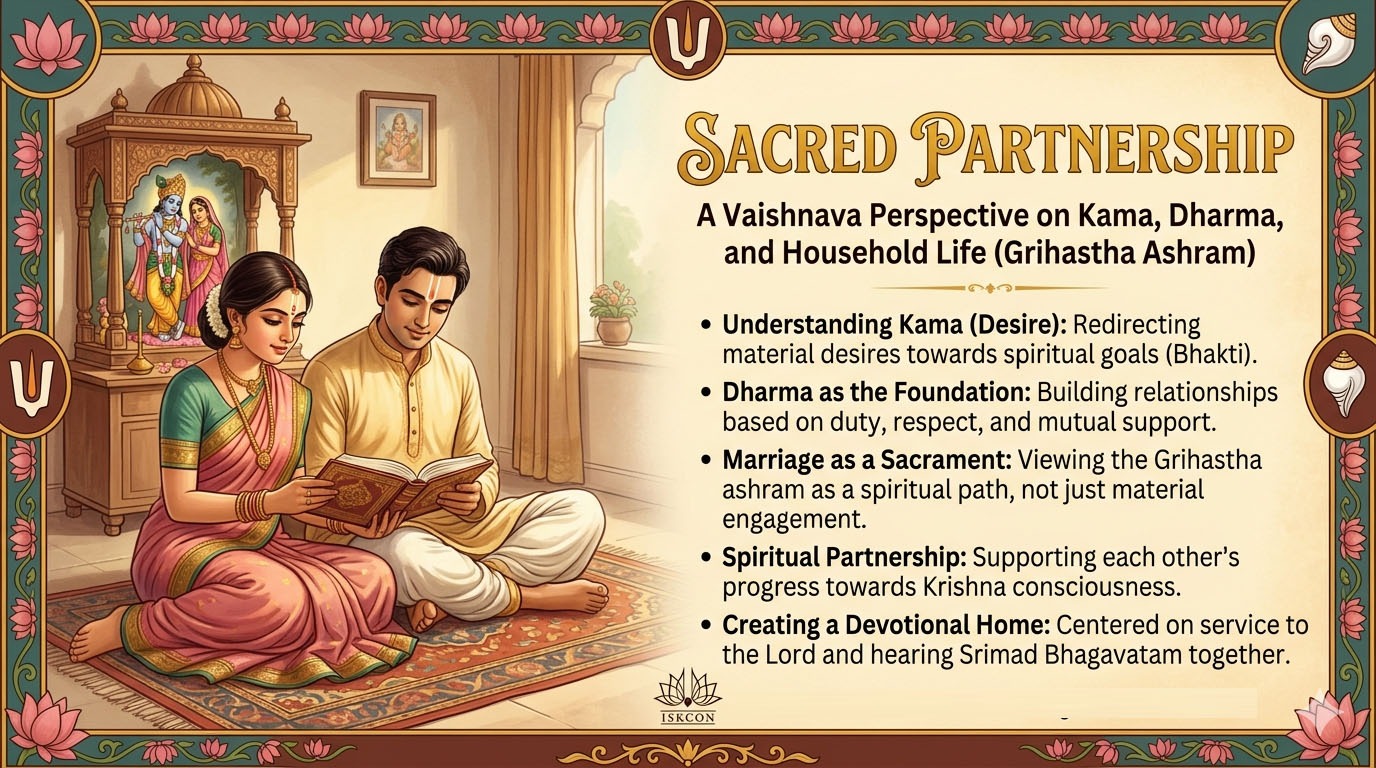
ISKCON encourages responsible grihastha life when centered on Krishna consciousness.
Healthy spiritual family life includes:
- Mutual respect
- Simplicity
- Shared spiritual practices
- Ethical living
- Raising children with values
- Emotional responsibility
- Self-control and compassion
The goal is not repression but purification.
Misunderstanding Indian Spiritual Culture
One major issue surrounding the Kama Sutra is the fragmentation of Indian civilization in global perception.
Ancient India produced:
- Vedanta philosophy
- Yoga systems
- Ayurveda
- Temple architecture
- Sanskrit literature
- Music and aesthetics
- Sciences of logic and consciousness
The Kama Sutra existed within this broader civilizational framework.
When isolated from dharma and spirituality, its meaning becomes distorted.
Similarly, Krishna consciousness cannot be understood merely through ritual or external appearance. It is a deep theological and experiential tradition centered on awakening love for God.
From Kama to Prema: The Journey of Consciousness
Gaudiya Vaishnavism offers one of the most beautiful spiritual transformations described in world theology.
The conditioned soul begins with material desire.
But through:
- chanting Hare Krishna,
- hearing spiritual wisdom,
- serving devotees,
- and practicing devotional life,
the heart gradually changes.
The same energy once expressed as selfish craving becomes purified into divine love.
This transformation from kama to prema is considered the true perfection of life.
Frequently Asked Questions About Kama Sutra and Krishna Consciousness
Is the Kama Sutra forbidden in Hinduism?
No. Traditionally it was viewed as one component of social and household knowledge within the broader Vedic system.
Does ISKCON reject marriage and family life?
No. ISKCON supports responsible spiritual family life centered on Krishna consciousness.
What does Krishna consciousness teach about lust?
Lust is understood as self-centered desire that distracts the soul from spiritual fulfillment.
What is the ultimate goal according to Gaudiya Vaishnavism?
The ultimate goal is prema — pure love of God, especially devotion to Lord Krishna.
Why is the Hare Krishna mantra emphasized?
The mantra is considered a direct spiritual sound vibration that purifies consciousness and awakens devotion.
Conclusion: Rediscovering Sacred Perspective
The modern world often swings between repression and indulgence. Vedic wisdom offers a third path: conscious regulation leading toward spiritual realization.
The Kama Sutra, when properly contextualized, reflects an ancient culture that understood human psychology in a sophisticated way. Yet the Vedic conclusion ultimately points beyond temporary pleasure toward enduring spiritual happiness.
Krishna consciousness teaches that the soul’s deepest longing cannot be fulfilled merely through external stimulation. Lasting fulfillment emerges through reconnecting with Krishna, the source of all beauty, love, and happiness.
The journey from kama to prema is not about denying humanity. It is about elevating consciousness.
And that journey remains as relevant today as ever.