Why Gen Z is Ditching Religion but Obsessing Over the Soul
If you listen to mainstream cultural analysts, you’ll hear a recurring eulogy: “Gen Z is abandoning faith.” Critics point to empty pews, dropping affiliation rates, and a generation that views organized religion with deep skepticism.
But if you look closer—at the communities they build online, the books they read, and the language they use—you see a completely different story. Gen Z isn’t abandoning faith; they are starving for it. They are obsessed with astrology, manifestations, shadow work, ancestral healing, and ancient philosophy.
They are spiritual but not religious (SBNR).
Gen Z hasn’t killed the soul. They’ve simply looked at traditional, institutionalized religion, noticed a profound lack of authentic spiritual substance, and walked out the door. They don’t want a corporate entity managing their relationship with the divine, nor do they want rigid dogmas or fear-based theology. They want an experiential, direct connection with the absolute.
And ironically, this modern existential rebellion perfectly mirrors a radical, thousands-of-years-old Eastern movement: the Bhakti framework.
The SBNR Paradox: Why the Institution Failed
To understand why Gen Z is migrating toward eclectic spirituality, you have to understand what they are running from. This is a generation raised on information transparency. They can spot institutional hypocrisy, performative morality, and corporate gatekeeping from a mile away.
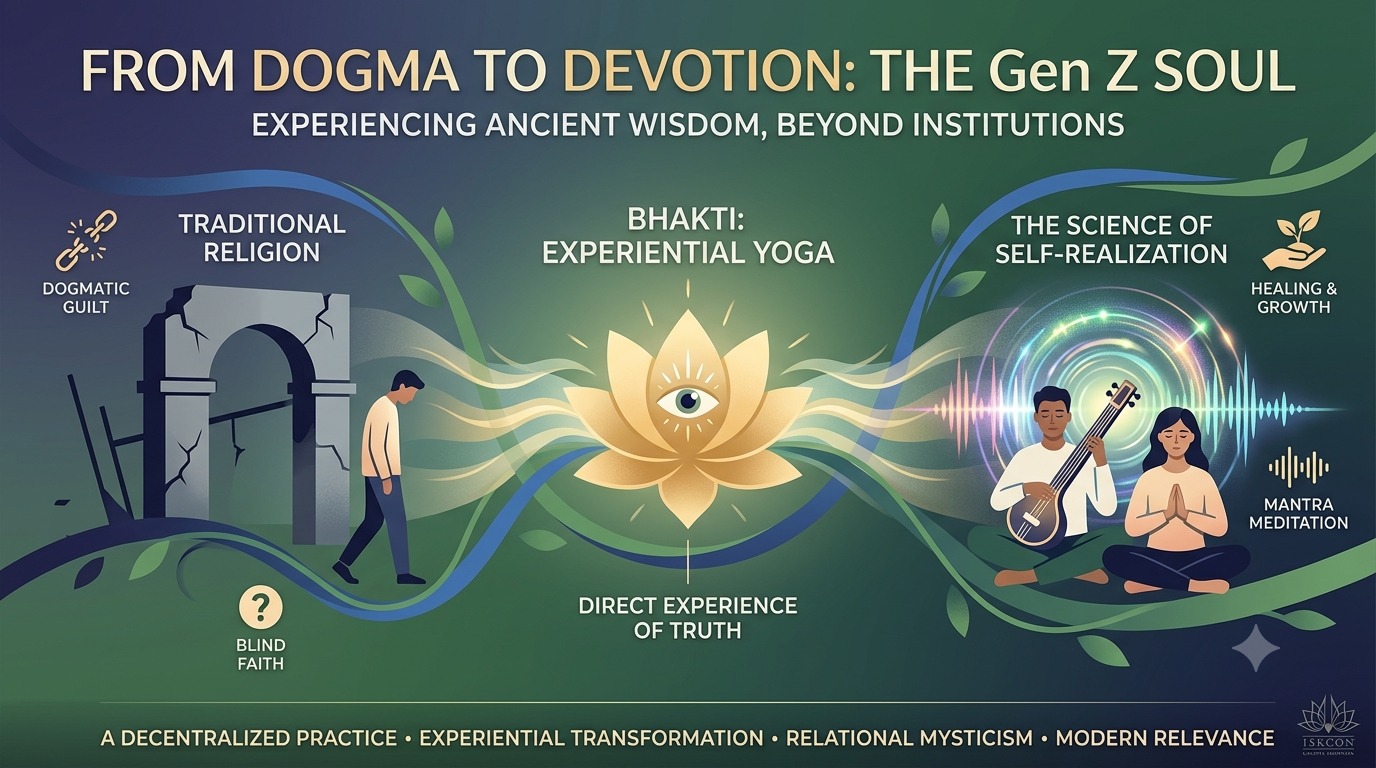
   [ INSTITUTIONAL RELIGION ]             [ ECLECTIC SPIRITUALITY ]
      Blind Faith & Dogma                    Experiential Truth
      Fear-Based "Sin"                       Internal Karma & Healing
      Rigid Hierarchies                      Direct Spiritual Autonomy
For decades, mainstream religious systems relied on a few specific mechanisms to keep people in the seats:
- Dogmatic Guilt & Fear: The idea that you are inherently broken, sinful, or destined for eternal damnation unless you comply with specific earthly rules.
- Blind Faith: A demand to “just believe” and stop asking uncomfortable questions.
- Gatekeepers: The mandate that a middleman—a priest, a clergyman, a physical institution—holds the keys to your spiritual progress.
Gen Z doesn’t buy it. They prioritize mental wellness, radical inclusivity, and personal authenticity. When a religious framework forces them to choose between their ethical values and a dogmatic text, they choose their values.
Yet, humans are hardwired for meaning. Without a spiritual anchor, the modern world feels incredibly isolating, digital, and hyper-commodified. This has left millions of young seekers wandering through a buffet of modern spiritual practices, searching for a framework that actually works without demanding their intellectual compliance.
Enter Bhakti: The Original Spiritual Rebellion
Long before western culture coined the phrase “spiritual but not religious,” the ancient Vedic tradition of India experienced its own massive anti-institutional revolution: The Bhakti Movement.
Centuries ago, spirituality in parts of the East had become rigid, heavily ritualistic, and tightly controlled by elite gatekeepers. Spiritual access was dictated by social hierarchy and strict compliance with complex external rituals.
Then came the Bhakti saints.
They shook up the system by declaring that spirituality doesn’t belong to institutions, elites, or rigid social constructs. It belongs to the soul. Bhakti—which translates to loving devotion or relational mysticism—propounded that the relationship between the individual consciousness (Atma) and the supreme source (Krishna) is direct, intensely personal, and inherently free.
For a generation looking for a structureless, deeply authentic experience of the divine, the Bhakti framework offers an incredible roadmap. It provides a timeless, rigorous philosophy without the corporate religious baggage.
3 Reasons the Bhakti Framework Fits the Gen Z Mindset
If you look past the modern misconceptions of Eastern spirituality, you find that the core mechanics of Bhakti yoga read exactly like a manifest for the modern seeker.
1. From “Blind Faith” to Experiential Science
Gen Z values lived experiences over theoretical assertions. They don’t want to be told that something is true; they want to feel it.
In the Bhagavad Gita, one of the definitive texts on Bhakti, the spiritual path is not presented as a set of rules to blindly accept. It is framed as an active dialogue born from intense, rational doubt. The text describes spirituality as pratyakṣāvagamaṁ—truth that can be directly perceived and realized through experience.
Bhakti doesn’t ask you to park your intellect at the door. It invites you to treat spiritual practices like a laboratory. You apply the technique, observe your consciousness, and judge the validity based on your own internal transformation.
2. Rebranding “Sin” into Sound Psychology
Traditional western frameworks often rely heavily on the concepts of sin, guilt, and divine wrath. Gen Z, highly attuned to emotional health, rejects this because it destroys mental wellness.
The Bhakti framework approaches human flaws differently. It doesn’t view you as an inherently dirty “sinner.” It views you as an eternal spiritual spark currently covered by Anarthas—internal blocks, psychological conditioning, and toxic habits.
| The Old Paradigm | The Bhakti Framework |
|---|---|
| Sin & Damnation | Anarthas (Temporary psychological blocks masking your true nature) |
| Divine Judgment | Karma (The neutral, cosmic law of cause and effect) |
| Religious Conversion | Sadhana (Cleansing the mirror of the mind to reveal your innate love) |
You aren’t a bad person who needs to be saved; you are an eternal soul who has forgotten its true nature, suffering from cosmic amnesia. The goal of Bhakti isn’t to appease an angry deity; it is to heal your own fragmented awareness.
3. Radical Autonomy: No Gatekeepers Required
Gen Z values horizontal networks over vertical hierarchies. They prefer decentralized platforms, peer-to-peer sharing, and community-led movements.
The ultimate expression of Bhakti yoga is entirely decentralized. It centers around Nama-Sankirtan—the meditative chanting of sound vibrations, specifically the Maha-Mantra:
Hare Krishna, Hare Krishna, Krishna Krishna, Hare Hare
Hare Rama, Hare Rama, Rama Rama, Hare Hare
According to Bhakti philosophy, these sound frequencies carry the direct presence of the divine. You do not need a priest to chant for you. You do not need to be inside a sacred building, change your clothes, or buy a membership. You can sit on your bedroom floor, put on a lo-fi beat, chant, and interact directly with the source. It is the ultimate open-source spiritual practice.
The Danger of “A la Carte” Spirituality
While ditching religious dogma is a healthy step toward authenticity, modern eclectic spirituality has a major pitfall: the consumer trap.
When spirituality becomes entirely “a la carte”—picking a little bit of astrology here, a crystal there, a manifestation ritual from TikTok—it can easily turn into a superficial extension of the ego. Without an overarching philosophical framework, spirituality risks becoming narcissistic: “How can I use the universe to get a promotion, look better, or manifest a sports car?”
This is where the ancient roots of Bhakti provide a crucial anchor. It honors your need for freedom while offering a deep, psychologically rigorous foundation. It shifts the question from “How can the universe serve me?” to “How can I align myself with the cosmic whole?”
💡 Try This: A 3-Minute Sound Experiment
If you consider yourself spiritual but not religious, don’t take this article’s word for it. Try a simple experiment in mantra meditation.
Sit comfortably, close your eyes, and take three deep breaths. Repeat the Maha-Mantra softly for three minutes, focusing your attention entirely on the sound vibration. Notice the shift in your mental chatter and internal anxiety. No dogmas, no contracts—just you and the sound.
The Future of Faith is Personal
Gen Z isn’t less spiritual than previous generations; they are arguably more spiritual because they refuse to settle for empty rituals. They are looking for a soul-deep connection that can withstand the anxieties of the 21st century.
By stepping out of institutional confines and exploring the rich, experiential depths of frameworks like Bhakti, young seekers are building something historic: a world where spirituality isn’t about belonging to an organization, but about belonging to yourself, to each other, and to the divine essence that connects us all.
ISKCON does not view the “spiritual but not religious” movement as a threat; rather, they see it as the exact /demographic the tradition was revived to meet.
1. Deep Validation: “You Are Right to Reject Dogma”
ISKCON’s foundational texts, like the Srimad-Bhagavatam and Bhagavad-Gita, actively critique superficial, institutionalized religiosity.
- Rejection of “Cheating Religion”: The Srimad-Bhagavatam (1.1.2) explicitly kicks off by rejecting kaitava-dharma—which translates to “cheating religion” or performative, commercially driven, or fear-based rituals that do not actually awaken love for the Divine.
- The Focus on Essence: ISKCON’s founder, A.C. Bhaktivedanta Swami Prabhupada, frequently stated that it doesn’t matter if someone calls themselves a Christian, a Muslim, a Jew, or a Hindu. The only metric of true religion (dharma) is whether it awakens prema—unconditional, unmotivated love for the Source. If an institution fails to do that, ISKCON agrees that it is completely natural for a seeker to walk away.
2. The ISKCON Clarification: Dharma vs. Religion
ISKCON teachers often address Gen Z by clarifying a crucial linguistic and philosophical shift: Religion is a faith system; Dharma is a fundamental nature.
- Religion is a designation you can change (you can convert from one to another, or drop it entirely).
- Dharma is like the wetness of water or the heat of fire. The Sanatana Dharma (eternal nature) of the soul (atma) is to love and to serve.
Therefore, when Gen Z says they are “ditching religion to find their soul,” ISKCON frames this as shifting away from external designations to discover their actual, constitutional dharma.
3. The Loving Critique: The Danger of “The Spiritual Ego”
While ISKCON completely validates the rejection of rigid institutions, the tradition offers a gentle warning regarding the modern, completely unstructured “a la carte” spiritual culture:
The Trap of Mental Speculation (Mano-dharma):* Without a verified psychological and philosophical map, a seeker can easily fall into *mano-dharma—spirituality dictated entirely by the shifting whims of the mind, feelings, or TikTok trends.
ISKCON points out that true spiritual growth requires a discipline and lineage (parampara)*, just like learning physics or music requires a school and a teacher. Without structure, “spirituality” can accidentally turn into a tool that just feeds the material ego (e.g., *”How can I use crystals or manifestation to get rich or look better?”) instead of actually dismantling it.
4. The Bridge: How ISKCON Adapts to Gen Z
To meet this generation, contemporary ISKCON spaces are heavily leaning into decentralized, low-barrier entry points that don’t feel like “going to church”:
- Lofi Kirtan & Conscious Gatherings: Shifting from formal temple rituals to casual yoga studio kirtans, mantra breathing workshops, and community dynamic groups.
- Bhakti as Lifestyle, Not Membership: Emphasizing that you do not need to “join” anything or alter your external identity. You simply add Sadhana (intentional daily grounding practices) to your existing life.
In short, ISKCON views Gen Z’s spiritual hunger as a highly evolved state of consciousness—one that has outgrown institutional guilt and is finally ready for a genuine, scientific, and relational approach to the soul.