
1. Overview of Cosmic Models
Ancient Indian literature offers two distinct stages of cosmological thought. The early Vedic period relies heavily on ritual metaphors and simple tripartite divisions, while the later Puranic texts (such as the Vishnu Purana and Bhagavata Purana) build an incredibly detailed, highly complex, concentric geographic and cosmic map.
2. Core Contradictions: Textual vs. Empirical Science
The structural frameworks presented in these texts diverge fundamentally from empirical astrophysics across several primary areas:
Geocentric Flat-Earth vs. Heliocentric Oblate Spheroid
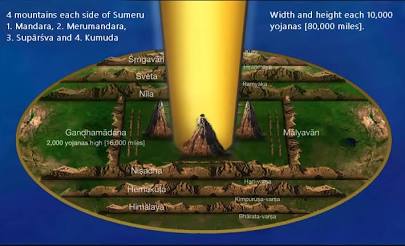
- The Puranic Model: The universe features a central flat disc or plane called *Bhu-mandala, spanning millions of *yojanas (an ancient unit of distance). At its absolute center stands Mount Meru, serving as a cosmic axis. The sun, moon, and stars are described as revolving horizontally around this massive central peak.
- Modern Science: The Earth is an oblate spheroid orbiting the Sun within a heliocentric solar system. Day and night are caused by planetary rotation, not by the Sun hiding behind a massive physical mountain.
The Scale and Nature of Cosmic Bodies
- The Puranic Model: The cosmic landscape features concentric rings of land masses (dvipas) separated by vast oceans composed of unique liquids (salt water, sugarcane juice, wine, clarified butter, curd, milk, and sweet water). Celestial bodies are driven through space by cosmic winds (pravaha) and anchored by invisible ropes of attachment to the polar star.
- Modern Science: Space is a near-vacuum. Celestial motion is governed by gravity and spacetime curvature, as described by Einstein’s General Relativity. Space contains no oceans of liquid substances; matter is organized into stars, planets, gas clouds, and dark matter.
Order and Relative Distance of Planets
- The Puranic Model: The Surya Siddhanta and various Puranas present a specific vertical stacking order of celestial objects relative to Earth:
- The Moon (closest)
- The Sun
- Nakshatras (Constellations)
- Mercury, Venus, Mars, Jupiter, Saturn
- Modern Science: The Moon is indeed closest to Earth, but the Sun is roughly 400 times further away than the Moon. The other planets orbit the Sun at vastly differing distances, and the stars of the constellations exist light-years outside our solar system.
3. Structural Comparison Matrix
| Attribute | Vedic & Puranic Framework | Modern Astrophysics |
|---|---|---|
| Shape of Earthly Plane | Flat, concentric rings (Bhu-mandala) centered around Mount Meru. | Oblate Spheroid drifting in a vacuum. |
| Solar Mechanics | The Sun travels on a chariot around Mount Meru, causing day and night. | Earth rotates on its axis while orbiting the Sun. |
| Lunar Properties | The Moon is positioned above the Sun and shines with its own independent, life-giving light (Soma). | The Moon orbits the Earth below the Sun’s plane and reflects solar light. |
| Eclipses | Caused by the shadow-planets/demons Rahu and Ketu physically swallowing the celestial bodies. | Caused by alignments where one celestial body passes into the shadow of another. |
4. Notable Convergences (The Time Scale Factor)
While the spatial geography of the Puranas contradicts modern observation, their chronological scale is remarkably vast compared to other ancient civilizations.
The Cosmic Day: A single Kalpa (a day of Brahma) equals $4.32 \text{ billion years}$.
This aligns surprisingly well with modern science’s calculation of the age of the Earth ($\approx 4.54 \text{ billion years}$) and the age of the observable universe ($\approx 13.8 \text{ billion years}$), reflecting an early conceptual understanding of deep cosmic time.
5. Methodological Analysis: Literal vs. Allegorical
Scholars and commentators generally evaluate these contradictions through three distinct frameworks:
- The Literal Historical Interpretation: Traditionalists argue these models describe higher-dimensional realities or spiritual geographies imperceptible to ordinary human sense organs.
- The Mathematical Astronomical Shift: Later Indian astronomers like Aryabhata ($476\text{–}550 \text{ CE}$) and Bhaskara II openly recognized the contradictions. They intentionally decoupled mathematical astronomy (Jyotisha) from mythological Puranic geography, correctly calculating that the Earth is a sphere suspended in space without physical support.
- The Symbolic/Psychological Interpretation: Modern academics view these texts as cosmological allegories where structural layers of the universe map directly onto internal meditative states or ritual purifications.
Within the International Society for Krishna Consciousness (ISKCON), cosmology is a major point of discussion, study, and occasionally intense debate. Because ISKCON strictly follows the Bhagavata Purana (Srimad-Bhagavatam) as literal, historical truth, they do not dismiss these descriptions as simple myths or poetry.
Instead, ISKCON explains the contradictions with modern science using a mix of multidimensional geometry, alternative sensory perception, and structural allegory.
1. The Core ISKCON Strategy: Multidimensionality
The foundational argument popularized by ISKCON’s founder-acharya, A.C. Bhaktivedanta Swami Prabhupada, and expanded by ISKCON scientists (like those at the Bhaktivedanta Institute), is that the universe is multidimensional.
- Limited Human Senses: ISKCON teaches that modern scientific instruments can only perceive three spatial dimensions. Bhu-mandala and Mount Meru exist, but they are higher-dimensional structures.
- The Airplane Analogy: Prabhupada often used the analogy of an airplane. To a person on the ground, a plane looks like a tiny speck or disappears entirely. But to the pilot inside, a whole world exists. Similarly, because we lack “spiritual vision” or the karmic qualification, we see space as an empty vacuum, whereas it is actually packed with structure.
2. Reinterpreting the “Flat Earth” (Bhu-mandala)
To reconcile the flat disc of Bhu-mandala with the undeniable reality of a spherical Earth, ISKCON scholars like Sadaputa Dasa (Dr. Richard L. Thompson, a mathematician who wrote Vedic Cosmography and Astronomy) proposed that Bhu-mandala is not a flat planet Earth, but a map of the solar system.
The Ecliptic Mapping Theory: ISKCON researchers argue that if you look at Bhu-mandala as a top-down, two-dimensional projection of the planetary orbits (the ecliptic plane), the relative dimensions and distances of the Puranic “rings and oceans” align remarkably well with the distances of our solar system’s planets.
Under this explanation:
- Our Earth is a tiny, three-dimensional sphere (called Bhula-gola) floating inside one of the vast islands (Jambudvipa) of the larger, higher-dimensional plane.
- The Oceans of Milk and Wine are interpreted as different types of cosmic energies or planetary fields, rather than literal swimming pools of groceries in outer space.
3. How ISKCON Explains Specific Contradictions
| Contradiction | Standard Scientific View | ISKCON / Puranic Explanation |
|---|---|---|
| The Moon is above the Sun | The Moon is much closer to Earth than the Sun. | “Above” does not mean vertical height in a 3D grid. It refers to a higher orbital speed relative to the stars, or a higher hierarchical status in terms of spiritual administration and subtle energy (Soma). |
| Eclipses (Rahu & Ketu) | Caused by the moon blocking the sun, or Earth’s shadow hitting the moon. | Rahu and Ketu are “black planets” or invisible celestial bodies made of subtle matter. They exist in a higher dimension and cast shadows that cause the physical phenomena we observe. |
| Space is a Vacuum | Outer space is mostly empty, cold matter. | Space is filled with a subtle element called akasha (ether) and populated by countless living entities traveling in subtle bodies. Science simply cannot detect this life with material tools. |
4. The Temple of the Vedic Planetarium (TOVP)
To make this cosmology concrete, ISKCON has constructed a massive project in Mayapur, West Bengal: The Temple of the Vedic Planetarium (TOVP).
Inside the main dome of this giant temple hangs a massive, moving 3D chandelier model of the universe based strictly on the fifth canto of the Srimad-Bhagavatam.
- The Goal: The exhibit is explicitly designed to challenge the modern secular worldview.
- The Presentation: It shows the vertical hierarchy of the universe, from the lower hellish planets up through the earthly plane (Bhu-mandala), the resident worlds of the demigods, the polar star (Dhruvaloka), and ultimately the spiritual world outside the material universe.
In ancient Indian literature, the description of the universe undergoes a massive structural shift as you move from the Vedic texts (the oldest layer) to the Pauranic (Puranic) texts (the later encyclopedic narratives).
While the Vedas present a poetic, ritualistic, and split-level universe, the Pauranas build an incredibly detailed, highly organized, and geometric cosmic map.
1. The Vedic Universe: The Three-Tiered World (Triloka)
Primary Texts: Rig Veda, Atharva Veda, and the Brahmanas (c. 1500–500 BCE)
The Vedas do not contain multi-million-mile geographical charts. Instead, they view the universe dynamically through a three-tiered system known as Triloka:
- Prithvi (The Earth): The foundational, steady ground.
- Antariksha (The Atmosphere/Mid-Space): The region of clouds, lightning, and winds where gods like Indra and the Maruts operate.
- Dyaus (The Sky/Heavenly Realm): The realm of pure light, home to the sun (Surya) and dawn (Ushas).
Key Vedic Concepts:
- The Cosmic Egg (Hiranyagarbha):* The *Rig Veda describes the universe emerging from a golden womb or egg floating in primal, dark waters.
- Universal Order (Rita):* The cosmos is not chaotic; it is held together by an inherent moral and physical law called *Rita, which governs the turning of seasons, the path of the sun, and human morality.
- Cosmic Pillars: The sky and earth are often poetically described as being held apart by invisible pillars or by the sheer power of the gods to prevent them from crashing into each other.
2. The Pauranic Universe: The Concentric Mandala
Primary Texts: Vishnu Purana, Bhagavata Purana, Matsya Purana (c. 300–1500 CE)
By the time the Pauranas were written, Indian cosmology had transformed into an intricate, geometric system of nested spheres and concentric rings. The Pauranas describe the universe as a sealed sphere (Brahmanda or “Egg of Brahma”) containing both an earthly plane and vertical dimensional realms.
A. Horizontal Geography: Bhu-mandala & Jambudvipa
The Pauranas state that the earthly realm is a vast flat disc called Bhu-mandala.
- At the center of this disc is Jambudvipa (the island-continent where humans live).
- At the exact center of Jambudvipa stands Mount Meru, a golden mountain acting as the vertical axis of the cosmos.
- Radiating outward from the center are seven concentric islands (dvipas), each separated by a unique cosmic ocean composed of liquids like salt water, sugarcane juice, wine, clarified butter, and milk.
B. Vertical Architecture: The 14 Planetary Systems (Lokas)
The Pauranas expand the simple 3-tiered Vedic system into a highly detailed 14-tier vertical hierarchy inside the cosmic egg. Mount Meru acts as the central pillar connecting them.
              [ HIGHER REALMS ]
Satyaloka     - Realm of Brahma (Highest truth)
Tapoloka      - Realm of ascetic penance
Janaloka      - Realm of pure, liberated saints
Maharloka     - Home of great sages
Svaraloka     - The heavenly paradise (Indra's realm)
Bhuvaraloka   - The semi-celestial atmosphere

              [ THE EARTHLY PLANE ]
Bhuloka       - Our physical plane (Bhu-mandala)

              [ THE LOWER SUBTERRANEAN REALMS ]
Atala, Vitala, Sutala, Talatala, Mahatala, Rasatala, Patala
(Vast, wealthy subterranean worlds often populated by Nagas and Asuras)
(Beneath the lowest Patala loka lie the hellish planetary systems, known as Naraka, where karmic cleansing takes place).
3. The Mechanics of the Pauranic Cosmos
The Pauranas introduce highly specific mechanical concepts to explain how the stars and planets move:
- The Chariot of the Sun: The Sun god travels in a massive chariot drawn by seven horses (representing the seven meters of Vedic poetry or the seven colors of light). The chariot loops around Mount Meru, creating day and night by passing behind the mountain.
- Ropes of Wind (Pravaha):* The Pauranas explain that planets and stars do not float randomly. They are attached to the Pole Star (Dhruvaloka*) by invisible cosmic ropes made of wind, which pull them along their precise circular orbits.
- Time Cycles (Yugas):* The universe operates on cyclical time. It is created, maintained, and destroyed in a recurring loop of four ages: *Satya, Treta, Dvapara, and Kali Yuga. A full cycle lasts 4.32 million human years, and a thousand of these cycles constitute one day of Brahma.
python
Calculate Puranic Time Scales
kali_yuga = 432000
dvapara_yuga = 2 * kali_yuga
treta_yuga = 3 * kali_yuga
satya_yuga = 4 * kali_yuga
maha_yuga = kali_yuga + dvapara_yuga + treta_yuga + satya_yuga
kalpa = 1000 * maha_yuga
print(f”Maha Yuga: {maha_yuga:,} years”)
print(f”Kalpa (Day of Brahma): {kalpa:,} years”)
Let’s calculate elapsed time in current Kalpa according to Surya Siddhanta / Puranas
1 Kalpa = 14 Manvantaras + Sandhi periods.
There are 14 Manvantaras in a Kalpa. Each Manvantara = 71 Maha Yugas.
Total Maha Yugas in 14 Manvantaras = 14 * 71 = 994 Maha Yugas.
The remaining 6 Maha Yugas are distributed as 15 Sandhi periods (each equal to a Satya Yuga = 1.728 million years).
15 * 1,728,000 = 25,920,000 years.
Total Kalpa = (994 * 4,320,000) + 25,920,000 = 4,294,080,000 + 25,920,000 = 4,320,000,000 years.
Current elapsed time in the present Kalpa (Varaha Kalpa):
6 Manvantaras have passed completely.
7th Manvantara (Vaivasvata) is ongoing. Inside it, 27 Maha Yugas have passed completely.
In the 28th Maha Yuga: Satya, Treta, and Dvapara have passed. We are in Kali Yuga (~5127 years elapsed since ~3102 BCE).
sandhi_period = satya_yuga #### 1,728,000
manvantara_duration = 71 * maha_yuga + sandhi_period #### Duration of one Manvantara including its subsequent sandhi?
Standard calculation:
Before 1st Manvantara, there is a dawn sandhi = 1 satya yuga.
Then 6 complete Manvantaras have passed, each with its own sandhi?
Let’s verify the standard text calculation for elapsed time in current Kalpa.
6 Manvantaras passed = 6 * 71 Maha Yugas = 426 Maha Yugas.
Sandhis passed: 1 initial dawn sandhi + 6 sandhis after each manvantara = 7 sandhis.
Plus 27 complete Maha Yugas in the 7th Manvantara.
Plus in the 28th Maha Yuga: Satya (1.728M), Treta (1.296M), Dvapara (0.864M) have passed.
Plus ~5100 years of Kali Yuga.
elapsed_maha_yugas = 6 * 71 + 27
elapsed_sandhis = 7 ## 1 dawn + 6 after each manvantara
elapsed_years = (elapsed_maha_yugas * maha_yuga) + (elapsed_sandhis * sandhi_period) + satya_yuga + treta_yuga + dvapara_yuga + 5127
print(f”Elapsed years in current Kalpa: {elapsed_years:,} years”)
text
Maha Yuga: 4,320,000 years
Kalpa (Day of Brahma): 4,320,000,000 years
Elapsed years in current Kalpa: 1,972,949,127 years
When comparing ancient mythological timelines to modern empirical science, most historical frameworks depict a universe that is only a few thousand years old. The Puranic time scale stands as a stark exception. As the renowned astrophysicist Carl Sagan famously noted in his Cosmos series, it is the only ancient religious tradition whose time scales correspond, by design or coincidence, to the immense timelines of modern scientific cosmology.
Here is a mathematical comparison of Puranic cosmic time units against modern astrophysics’ measurements of the Earth and the Universe.
1. The Mathematical Engine of Puranic Time
Puranic time is completely cyclical, moving through four repeating epochs called *Yugas. The absolute baseline for these calculations is the length of the *Kali Yuga.
$$1 \text{ Kali Yuga} = 432,000 \text{ human years}$$
Using this baseline, the four Yugas scale symmetrically in a $4:3:2:1$ ratio:
- Satya Yuga (Krita): $4 \times 432,000 = 1,728,000 \text{ years}$
- Treta Yuga: $3 \times 432,000 = 1,296,000 \text{ years}$
- Dvapara Yuga: $2 \times 432,000 = 864,000 \text{ years}$
- Kali Yuga: $1 \times 432,000 = 432,000 \text{ years}$
The Maha Yuga and The Kalpa
When you combine all four Yugas, it forms one complete macro-cycle known as a Maha Yuga (or Chaturyuga):
$$1 \text{ Maha Yuga} = 1,728,000 + 1,296,000 + 864,000 + 432,000 = 4,320,000 \text{ years (4.32 million years)}$$
The Puranas define a Kalpa as a single daytime period for the creator deity, Brahma. One Kalpa lasts exactly $1,000$ Maha Yugas:
$$1 \text{ Kalpa} = 1,000 \times 4,320,000 = 4,320,000,000 \text{ years (4.32 billion years)}$$
Brahma’s night is equal in duration to his day, making a full day-and-night cosmic cycle equal to $8.64 \text{ billion years}$.
2. Puranic vs. Modern Scientific Estimates
A. The Age of the Earth vs. A Kalpa
- Modern Science: Radioactive dating of meteorites and the oldest known terrestrial rocks puts the age of the Earth at approximately $4.54 \text{ billion years}$ (with an uncertainty margin of $\pm 50 \text{ million years}$).
- Puranic Correspondence: A single cosmic day (Kalpa) is $4.32 \text{ billion years}$. The mathematical alignment here is incredibly close—differing by less than $5\%$.
Furthermore, according to traditional Puranic astronomical tracking (found in texts like the Surya Siddhanta), the current Earth is roughly halfway through its present Kalpa (the Varaha Kalpa). Calculations show that $6$ Manvantaras (cosmic eras within a Kalpa) and $27$ Maha Yugas have fully elapsed, meaning $1.97 \text{ billion years}$ have passed since the beginning of our current planetary day.
B. The Age of the Universe vs. The Maha Kalpa
- Modern Science: By measuring cosmic microwave background radiation and the expansion rate of space, modern cosmologists estimate the age of the observable universe to be $13.787 \text{ billion years}$ since the Big Bang.
- Puranic Correspondence: A full day-and-night cycle of Brahma ($8.64 \text{ billion years}$) represents one complete breath, or expansion and contraction, of local stellar systems. However, the total lifespan of a single universe is tied to the full life of Brahma (*$100 \text{ Brahma years}$), known as a *Maha Kalpa.
Let’s compute the total Puranic lifespan of a universe:
$$\text{1 Brahma Year} = 360 \text{ Days} + 360 \text{ Nights} = 360 \times 8.64 \times 10^9 = 3.1104 \times 10^{12} \text{ years}$$
$$\text{Maha Kalpa (100 Brahma Years)} = 100 \times 3.1104 \times 10^{12} = 311.04 \text{ trillion years}$$
While $13.8 \text{ billion years}$ (the modern age of the universe) is swallowed completely by this $311.04 \text{ trillion year}$ grand cycle, the Puranic framework handles this discrepancy by presenting a *multiverse model. The texts state that our universe is just one tiny bubble among countless millions of other bubble-universes expanding out from the skin pores of *Maha-Vishnu. Our current observable universe is considered highly youthful within its grand macro-cosmic framework.
3. Mathematical Comparison Matrix
| Cosmic Benchmark | Modern Scientific Calculation | Puranic Textual Calculation | Mathematical Alignment |
|---|---|---|---|
| Age of the Earth | $\approx 4.54 \times 10^9 \text{ years}$ | $4.32 \times 10^9 \text{ years}$ (1 Kalpa) | Remarkably Close ($\approx 95\%$ match) |
| Age of Solar/Stellar Systems | $\approx 4.60 \times 10^9 \text{ years}$ | $8.64 \times 10^9 \text{ years}$ (Full Day+Night) | Same order of magnitude |
| Age of the Observable Universe | $\approx 1.38 \times 10^{10} \text{ years}$ | $3.11 \times 10^{14} \text{ years}$ (Total Universal Lifetime) | Modern universe fits comfortably as a fraction of the Puranic grand cycle. |
| Fundamental Nature of Time | Linear, expanding from a single point (Big Bang). | Cyclical, repeating eternally through birth, expansion, and destruction. | Conceptual divergence on linearity, but convergent on grand scale. |
4. Key Conceptual Differences
While the numbers line up in scale, the underlying physics differs fundamentally:
- Linear vs. Cyclic: Modern astronomy treats time as an arrow moving forward from a singularity toward maximum entropy (heat death). The Puranas treat time as an absolute circle; everything that perishes is mathematically guaranteed to reappear in exact proportions.
- Evolutionary vs. Devolutionary: Modern science tracks an evolutionary universe (simple elements forming complex life over time). The Yuga system is devolutionary—cosmic cycles begin at absolute spiritual and physical perfection (Satya Yuga) and gradually degrade into chaos and shorter lifespans (Kali Yuga) before resetting.