Hoax Debate: Why It Started, How It Was Faked, and the Shocking Vedic Twist
Did we actually put a man on the moon in 1969, or did NASA pull off the most expensive Hollywood production in human history? Decades after Neil Armstrong took his “giant leap,” millions of people still believe the Apollo 11 mission never left low Earth orbit.
Whether you are a hardcore skeptic or a curious observer, analyzing the moon landing conspiracy reveals a fascinating mix of Cold War politics, cinematic trickery theories, and—unexpectedly—ancient Eastern cosmology.
Why the Moon Landing Conspiracy Started
The seed of doubt wasn’t planted by random internet forums; it was cultivated by the intense geopolitical pressure of the 1960s.
- The Cold War Space Race: The United States was losing the space race to the Soviet Union, who had already launched the first satellite (Sputnik) and put the first human (Yuri Gagarin) into space. President John F. Kennedy promised a moon landing before the decade’s end. The immense pressure to deliver created a massive incentive to fake it if they couldn’t make it.
- The Trust Deficit: The early 1970s brought the Vietnam War and the Watergate scandal. For the first time, the American public realized their government was entirely capable of systematic, high-level deception.
- Bill Kaysing’s Catalyst: In 1976, a former Rocketdyne employee (the company that built the Saturn V rocket engines) named Bill Kaysing self-published a pamphlet titled We Never Went to the Moon: America’s Thirty Billion Dollar Swindle. This text became the blueprint for every moon hoax theory that followed.
How It Was Done (According to Theorists)
Conspiracy theorists argue that going to the moon was technologically impossible in 1969 due to intense radiation belts. Therefore, NASA had to stage the entire event on Earth. Here is how theorists claim the illusion was manufactured:
- The Hollywood Soundstage: Theories suggest the entire landing site was filmed inside a highly secure military facility, likely in the Nevada desert or Area 51. Some theories even name legendary director Stanley Kubrick as the mastermind hired by the government to shoot the footage, fresh off his success with 2001: A Space Odyssey.
- The Photographic “Flaws”: Skeptics point to the complete absence of stars in the lunar sky, perfectly crisp shadows pointing in multiple directions (suggesting studio floodlights), and the American flag gently waving in a vacuum environment where no wind exists.
- The Van Allen Radiation Belts: A core scientific argument from the hoax community is that human bodies would have been fatally irradiated while passing through the Van Allen belts—zones of highly charged particles trapped by Earth’s magnetic field.
The Cosmic Twist: The Gaudiya Philosophy Perspective
While Western skeptics focus on film grain and studio lighting, Gaudiya Vaishnavism (an ancient orthodox branch of Vedic philosophy popularized globally by the Hare Krishna movement) offers a completely different, metaphysical take on why the moon landing couldn’t have happened as advertised.
During the height of the Apollo missions, the prominent Gaudiya teacher A.C. Bhaktivedanta Swami Prabhupada famously stated that modern astronauts did not actually land on the moon. His reasoning was rooted in Vedic cosmology rather than political skepticism:
The Dimension Problem: In Gaudiya philosophy, the moon is not a dead, dusty rock. It is recognized as Chandraloka, a higher-dimensional heavenly planet populated by advanced celestial beings (Devas).
According to the Vedic texts, universes are multi-dimensional, and planets exist on different scales of observation. To access a higher realm like Chandraloka, a soul must possess the specific karma and a suitable, subtle body—much like needing a visa and immigration clearance to enter another country.
Gaudiya philosophers argue that trying to reach the real moon via a physical, heavy-material rocket ship is a fundamental misunderstanding of cosmic geography. If astronauts landed on a barren satellite, they merely touched down on a lower-dimensional physical shell or a different cosmic body altogether (like Rahu), completely missing the vibrant, higher-dimensional reality of the true moon.
To understand how a follower of Gaudiya philosophy reconciles this without ignoring modern science, you have to look at the difference between two completely different worldviews:
1. The Microscope Analogy (Different Scales)
Think of a glass beaker filled with a mix of fine black charcoal powder and white chalk powder.
- To the naked eye: The mixture looks entirely grey.
- Under a powerful microscope: The grey completely disappears, and you see only distinct black and white particles.
Which one is the “true” reality? Both are. The reality changes depending on your scale of observation.
Gaudiya philosophy views the cosmos this way. Modern science observes the universe through a gross physical scale (3D material reality). Through that scale, the moon is an empty, dusty rock, and humans absolutely landed on it. Gaudiya cosmology observes the universe through a subtle, multi-dimensional scale. Through that scale, the true moon (Chandraloka) is an invisible, heavenly realm that a physical rocket cannot touch.
2. The Border Control Analogy
When A.C. Bhaktivedanta Swami Prabhupada stated that astronauts didn’t go to the moon, his argument was inherently spiritual and karmic:
You cannot force entry into a higher cosmic realm using a mechanical machine any more than you can illegally cross a country’s border without a visa. To experience the true moon, a soul must have the proper spiritual “credentials” (karma) and a subtle body suited for that dimension.
Therefore, from the Gaudiya perspective, the astronauts didn’t reach the real Vedic moon. They merely landed on the dead, physical “shell” or outer crust of it that is visible to our limited 3D human senses.
| Modern Science | Gaudiya Philosophy |
|---|---|
| Goal: To measure, manipulate, and master the external, physical world. | Goal: To understand the soul, internal self-mastery, and our relationship with the Divine. |
| The Moon: A lifeless, 3D satellite made of rock and dust. | The Moon: Chandraloka, a higher-dimensional realm populated by advanced beings. |
| Verdict: Accurate in describing the physical actions of the Apollo missions. | Accurate within its own metaphysical framework regarding multi-dimensional reality. |
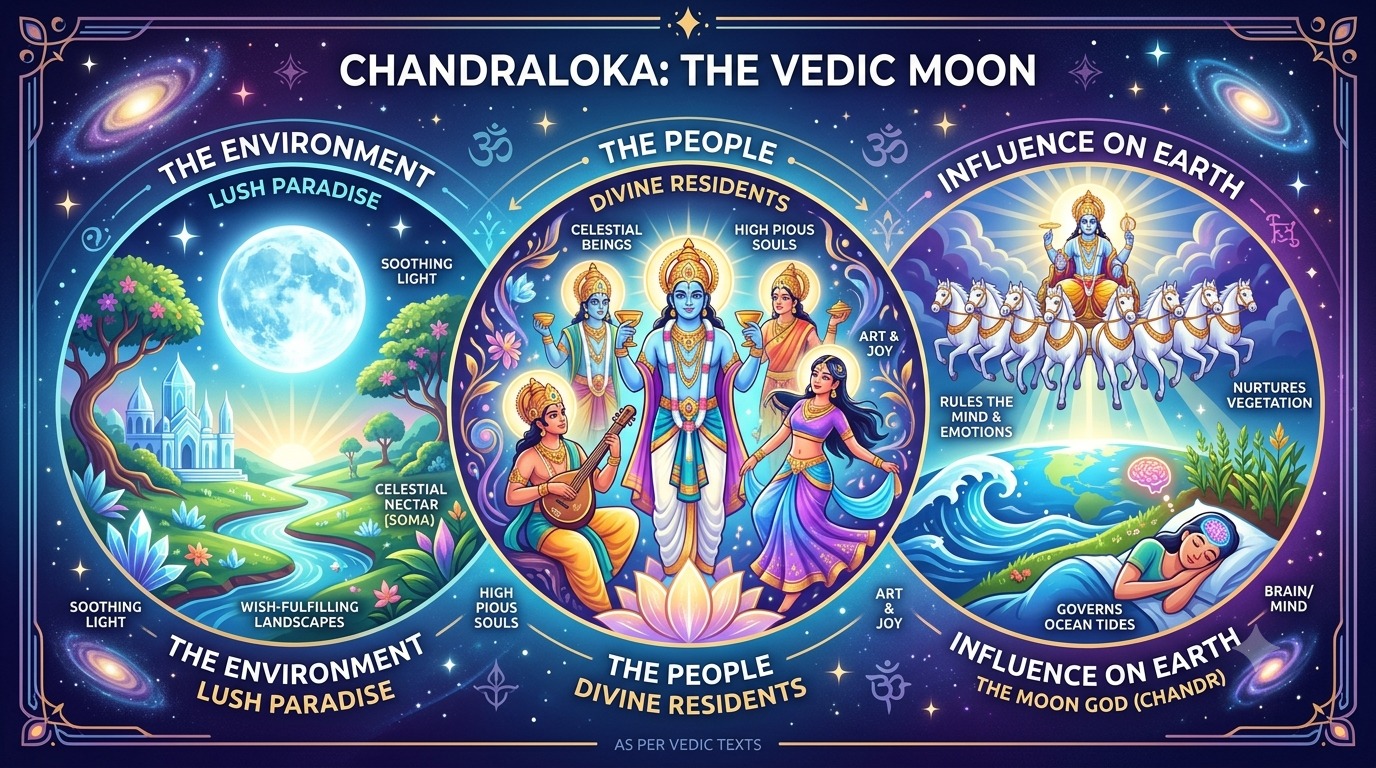
In the Puranas and the Srimad Bhagavatam, the moon is not described as a dead satellite. It is Chandraloka (or Somaloka), one of the vital higher planetary systems (Swargaloka) within our universe.
Vedic cosmology views the moon as a lush, multi-dimensional paradise that operates on a completely different plane of reality than our physical Earth.
1. What is on the Moon? (The Environment)
The environment of Chandraloka is the polar opposite of the dusty, airless rock described by NASA. It is depicted as a realm of immense beauty, soothing temperatures, and celestial luxury.
- The Cool, Radiant Climate: Unlike the blinding heat of the sun (Suryaloka), the moon is a world of soothing, cooling light. Its atmosphere is filled with a refreshing, life-giving mist that nurtures the entire universe.
- The Realm of Soma: The moon is the source of Soma, a celestial, nectar-like substance. In Vedic texts, Soma is both a literal intoxicating beverage consumed by the gods (Devas) for strength and immortality, and a subtle spiritual energy that feeds the universe’s flora.
- Wish-Fulfilling Landscapes: The Puranas describe Chandraloka as being filled with beautiful gardens, crystalline palaces, and rivers of pure water. It hosts Kalpa-vriksha (wish-fulfilling trees) and Kama-dhenu (wish-fulfilling cows), meaning anything a resident desires manifests instantly.
2. Who Lives There? (The People)
The residents of the moon are highly advanced, semi-divine beings living in a state of continuous material enjoyment.
- Chandra / Soma (The Moon God): The ruler of this realm is the deity Chandra (also called Soma), a powerful Deva appointed by Brahma to oversee the tides, timekeeping, and the growth of vegetation. He is described as incredibly beautiful, riding a chariot pulled by ten white horses.
- The Demigods and Highly Pious Souls: The inhabitants are Devas, Gandharvas (celestial musicians), and Apsaras (celestial dancers). Humans on Earth who accumulate massive amounts of good karma through altruism, charity, and specific rituals are promoted to Chandraloka after death.
- Their Lifestyle: The lifespan on the moon is staggering—calculated to be thousands of human years. The residents do not suffer from disease, anxiety, or old age. They spend their days in joy, drinking Soma juice and enjoying arts, music, and divine pleasures. However, it is a temporary heaven; once a soul’s good karma is entirely used up, they must fall back to Earth and take birth as a human again.
3. How the Moon Influences Us on Earth
Vedic texts and Jyotish (Vedic Astrology) view the moon as one of the most powerful forces impacting life on Earth. Its influence is split between physical biology and human psychology:
The Mind and Emotions (Manas)
In Vedic psychology, the Sun represents the Atma (soul/ego), but the *Moon rules the *Manas (the emotional mind, subconscious, and intuition).**
- Because the moon passes through the zodiac so quickly (27.3 days), it governs our shifting moods, gut feelings, and mental stability.
- A strong moon in a person’s astrological chart grants deep inner peace, empathy, and emotional resilience. A weak or afflicted moon is said to trigger anxiety, depression, restlessness, and emotional volatility.
The Nurturer of Vegetation and Health
The moon is considered the life-giver to Earth’s ecosystem.
- Vedic texts state that the moon pours down subtle nutritional juices (Soma-rasa) via its moonlight. This invisible radiation gives flavor to vegetables, activates the healing properties in medicinal herbs, and allows crops to ripen. Without the moon’s subtle light, plants would have no nutritional value or life force (Prana).
- It is also heavily tied to the water element (Jala Tattva), ruling over the Earth’s ocean tides, menstrual cycles, and the fluid systems (blood and hormones) within the human body.
The Cycle of Time: By dividing the month into the Shukla Paksha (bright, waxing fortnight) and Krishna Paksha (dark, waning fortnight), the moon sets the rhythm for Vedic rituals, agriculture, and human energy levels. When it is full (Purnima), creative and emotional energies peak; when it is dark (Amavasya), energy retracts inward toward introspection.