Why Vaishnavas and Ayurveda Reject Onions, Garlic, Chocolate and Eggs
If you’ve ever stepped into an ISKCON temple or dined at a Govinda’s restaurant, you know that Krishna devotees (Vaishnavas) serve up some of the most vibrant, flavorful vegetarian food on earth. But behind the scenes, their kitchen rules are incredibly strict.
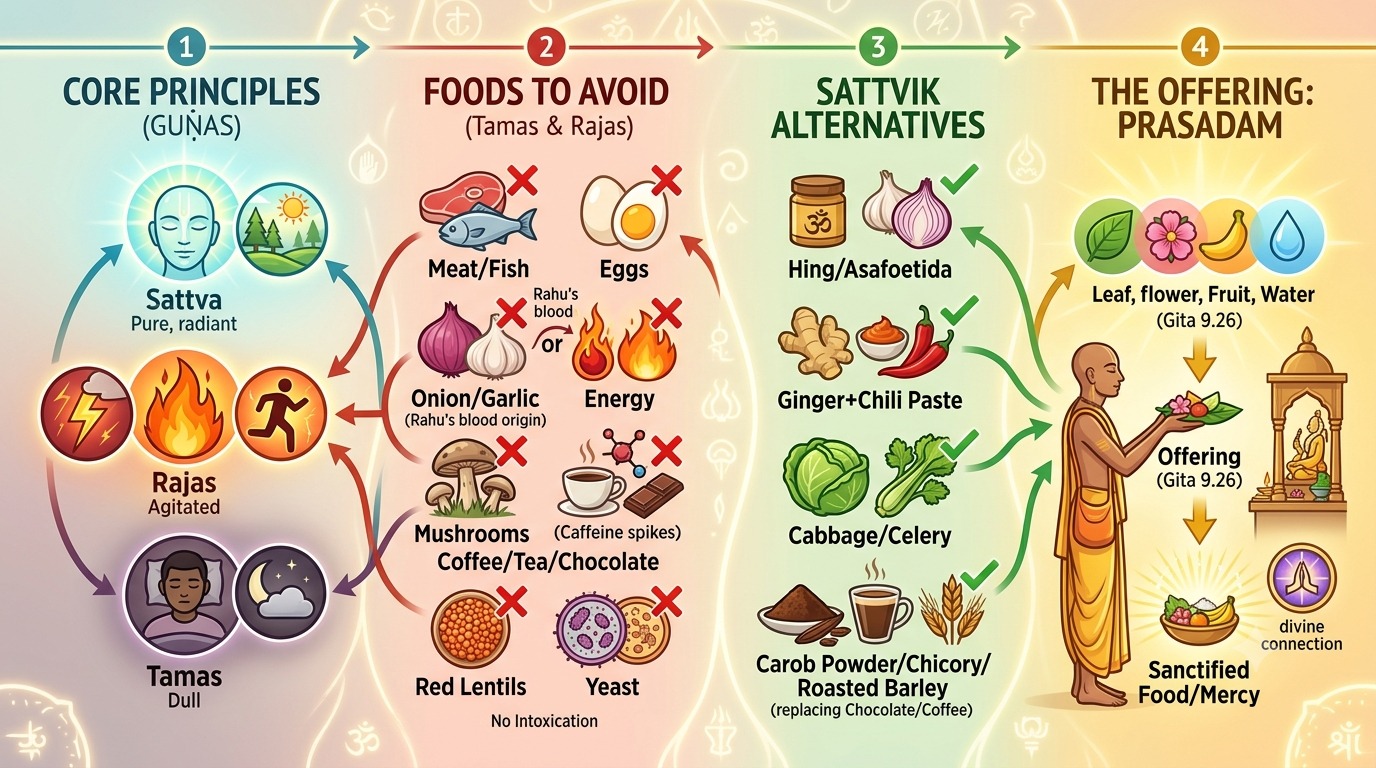
It’s not just a standard vegetarian diet. Vaishnavas completely ban meat and fish—but they also cut out eggs, onions, garlic, mushrooms, coffee, tea, chocolate, red lentils, and yeast-fermented foods.
To an outsider, this looks like an impossible, highly restrictive list. But to a practitioner of Bhakti yoga (the path of devotion), every single omission serves a highly strategic spiritual, biological, and energetic purpose.
1. The Core Philosophy: The Three Gunas (Modes of Nature)
To understand the Vaishnava diet, you must understand the concept of the Three Gunas from the Bhagavad Gita. Everything in the material world—including the food we eat—falls into one of three cosmic categories:
- Sattva (Goodness): Pure, clean, life-giving, promoting clarity, peace, and spiritual growth.
- Rajas (Passion): Over-stimulating, fiery, driving intense desire, agitation, and mental restlessness.
- Tamas (Ignorance): Stale, decomposing, heavy, inducing laziness, sleep, and mental darkness.
Krishna devotees explicitly eat a Sattivik diet. Why? Because your consciousness matches the vibration of the food you digest. You are, quite literally, what you eat.
2. The Hit List: Why These Specific Foods are Banned
Meat, Fish, and Poultry (The Law of Karma and Ahimsa)
The ban on animal flesh is rooted in Ahimsa (non-violence) and the law of Karma.
- The Spiritual Cost: Every living entity has a soul. Taking an animal’s life unnecessarily creates a massive karmic debt.
- The Subtle Energy: Vedic texts mention that when an animal is slaughtered, its final moments of terror, adrenaline, and cortisol are chemically and energetically locked into the meat. Consuming it fills the mind with fear, aggression, and Tamas (darkness).
Eggs (The Principle of Potential Life)
Many Westerners view eggs as vegetarian, but Vaishnavas do not. Eggs are classified as Tamasic. Even if unfertilized, an egg is biologically the embryonic form of life and carries the material energy of birth and decay. Eating them clouds the refined intellect needed for deep meditation.
Onions and Garlic (The Passion and Ignorance Traps)
This is usually the biggest shocker for foodies. If onions and garlic are plants, why are they banned?
- The Puranic History: According to Vedic texts (specifically the Varaha Purana), when the demon Rahu’s head was severed after he tried to steal the nectar of immortality (Amrita), drops of his blood fell to the earth. Onions and garlic grew from those spots. Thus, while they have medicinal properties (like antibiotics), they carry a demonic, aggressive energy.
- The Biological Effect: Onions and garlic are heavy central nervous system stimulants. They excite the lower chakras, intensely boosting Rajas (passion/sexual desire) and Tamas (ignorance/lethargy). For a monk or devotee trying to calm the mind for meditation, they act like a mental disruptor.
Mushrooms and Fungi (The Energy of Decay)
Mushrooms do not photosynthesize via sunlight; they grow in dark, damp environments by feeding on dead, decaying organic matter. Because they thrive on decomposition, they are purely Tamasic. They carry the energetic frequency of ignorance and decay, making them unfit for offering to Krishna.
Coffee, Tea, and Chocolate (The Intoxication Rule)
One of the four core regulative principles of a Vaishnava is no intoxication.
- Caffeine and Theobromine: Coffee, black/green tea, and cacao (chocolate) contain stimulants that artificially hijack the nervous system.
- The Spiritual Conflict: True spiritual bliss (Ananda) must come from the soul’s connection to God, not from a chemical spike. Relying on caffeine creates a dependency that agitates the mind and pulls a devotee away from steady, natural mental clarity. Pro-tip: Herbal teas like chamomile, peppermint, or rooibos are completely fine because they are caffeine-free.
Red Lentils (Masoor Dal)
While Vaishnavas eat tons of lentils (like yellow moong or chana dal), red lentils (masoor dal) are strictly forbidden.
- According to Ayurveda and ancient texts, red lentils absorb a high amount of ironic or non-sattvik properties from the soil and turn a dark blood-red color when cooked.
- They are biochemically known to heat the body excessively, stimulating aggressive, passionate traits (Rajasic) rather than peaceful ones.
Yeast and Fermented Foods (The Alcohol Byproduct)
Traditional Vaishnavas avoid commercial yeast-raised breads and heavily fermented foods.
- Fermentation is a process of decomposition driven by microorganisms.
- Large-scale fermentation naturally produces microscopic traces of alcohol and lactic acid associated with decay (Tamas). Instead, devotees prefer unleavened flatbreads like chapatis, rotis, or puris.
The Ayurvedic Catch: They are Drugs, Not Daily Food
In Ayurveda—the ancient Indian system of medicine—onion (Palanandu) and garlic (Lashuna) are highly respected, but they are viewed through a lens of strict functional utility. They are considered powerful, heavy medicines, not daily dietary staples.
Because onion and garlic are so chemically potent, Ayurveda treats them like *pharmaceuticals. You do not eat antibiotics with every single meal when you are healthy; if you do, you cause long-term imbalances (like aggravating *Pitta, causing inflammation, hyperacidity, and blood impurities). Therefore, Ayurveda recommends using them primarily when a specific pathology or illness is being treated.
The Agitation of Rajas (Passion)
Onion and garlic are intensely Rajasic. They over-stimulate the nervous system, fire up the lower chakras, and trigger the ego.
- The Spiritual Block: To practice meditation, japa (chanting), or deep prayer, the mind must be calm, clear, and steady (Sattvik).
- Rajasic foods introduce mental restlessness, anxiety, shifting focus, and a sudden surge in material and sexual desires. It becomes incredibly difficult to sit still and focus on the divine when your nervous system is artificially stimulated.
The Clouding of Tamas (Ignorance)
Both plants are simultaneously classified as Tamasic. Because garlic grows entirely underground away from sunlight and onion induces sleepiness, they carry a heavy, grounding, binding energy.
- The Spiritual Block: Tamas causes lethargy, mental fog, and spiritual apathy. While a heavy Tamasic food like onion is great for an insomniac who needs to be knocked out, it is detrimental to a yogi who needs to wake up at 4:00 AM (Brahma Muhurta) with a sharp, vibrant, and awake consciousness.
The Ultimate Ayurvedic Verdict
Ayurvedic texts summarize this beautifully: What heals the body can sometimes harm the mind.
If you are a householder dealing with a severe Vata illness, high blood pressure, or a weak immune system, onion and garlic can act as a divine medicine. However, if your ultimate goal is spiritual liberation, mental purity, and deep devotion (Bhakti), you must phase them out. You cannot build a peaceful temple of the mind using bricks of passion and ignorance.
Is Egg vegetarian?
This is one of the most fiercely debated topics in modern nutrition. A massive group of people—including many Western vegetarians, bodybuilders, and grocery stores—classify unfertilized eggs as vegetarian because they don’t contain a developing embryo. There is no “meat” or face to speak of.
But from the perspective of a Krishna devotee, a yogi, or traditional Vedic culture, that logic falls apart.
1. The Biological Argument: It is Still an Animal Byproduct of Birth
The argument that an unfertilized egg is vegetarian is based entirely on a materialist, physical definition: “If it doesn’t have a heartbeat and cannot hatch into a chicken, it’s just a protein capsule, like milk.”
The Vaishnava Counter-Argument:
An egg is fundamentally different from milk.
- Milk is naturally produced by a mother cow out of love to nourish an existing life. In Vedic culture, the cow gives her excess milk willingly when she is protected and happy.
- An Egg, fertilized or not, is an unevolved reproductive product generated by the internal reproductive tract of a hen. It is biologically destined to be the vessel for a new body. Even if it lacks a soul (atma), it is constructed entirely from the cells and energy of the bird’s reproductive system. Eating it means consuming the literal energy of animal reproduction and menstruation.
2. The Guna Argument: It is Pure Tamas (Ignorance)
Even if we look past the biology, the biggest reason a Hare Krishna won’t touch an egg comes down to subtle energy and the Three Gunas.
As established earlier, foods are categorized by how they affect your mind. Fruits and milk are Sattva (pure, light, life-affirming). Onions are Rajas (fiery, agitating).
Eggs are classified as heavily Tamasic (associated with darkness, lethargy, and decay).
- An egg is sealed and designed to sit in dark, stagnant conditions.
- Consuming it dulls the buddhi (the refined spiritual intellect). It creates mental heaviness, sleepiness, and a spiritual fog that makes early-morning meditation or focusing on sacred chants incredibly difficult. You cannot build a highly sensitive, spiritually awake consciousness using foods grounded in the energy of darkness.
3. The Modern Reality: The Violence in the Industry (Ahimsa)
Even if someone argues that a backyard hen lays unfertilized eggs naturally and safely, the commercial egg industry violates the core Vaishnava principle of Ahimsa (non-violence) on a massive scale.
- The Fate of Male Chicks: Because male chicks cannot lay eggs and are not the right breed for meat, the commercial egg industry culls (kills) millions of newborn male chicks on their first day of life.
- The Treatment of Hens: Factory-farmed egg-laying hens are kept in cramped cages, structurally manipulated, and slaughtered the moment their egg production drops.
By purchasing or consuming eggs—even unfertilized ones—a person financially supports a cycle of immense systemic violence. According to the law of Karma, anyone who buys, cooks, or eats a product born from such suffering shares a portion of that negative karmic reaction.
The Bottom Line: If your goal is just “meatless” eating for weight loss or basic environmental reasons, unfertilized eggs fit the bill. But if your goal is spiritual purity, mental clarity, and offering love to the Divine, an egg fails the test. It belongs to the animal kingdom, carries a heavy energetic footprint, and cannot be offered on Krishna’s altar.
The Ultimate Secret: Prasadam (Beyond Organic)
The restrictions make sense once you understand the final, most crucial element of the Vaishnava lifestyle: Prasadam.
Devotees do not simply cook for themselves. They cook out of pure love for Krishna. When the meal is prepared with strict cleanliness and devotion, it is offered to the deity on an altar. Krishna accepts the love behind the offering and infuses the food with His divine energy.
Once offered, the food changes from material nourishment to Prasadam (meaning “mercy”).
The Golden Rule: You cannot offer impure, violent, or highly stimulating items (Rajasic/Tamasic) to God. You can only offer Him what He asks for in the Bhagavad Gita (Chapter 9, Verse 26): “If one offers Me with love and devotion a leaf, a flower, a fruit or water, I will accept it.”
By eating only Prasadam, Vaishnavas believe they are systematically cleansing their hearts, reducing material desires, and accelerating their spiritual journey. It’s not about restriction—it’s about elevation.