Decoding 300 Years of Indian Resilience, Search Intent, and Modern Bhakti
From the 1700s colonial awakening to today’s AI-native economy—requires mapping how physical realities, psychological drivers, spiritual anchors, and technical capabilities dictate intent, trust triggers, and conversion behaviors.
When targeting Indian demographics across these historical arcs, generic marketing fails. You must understand the underlying levers that drive search and consumption.
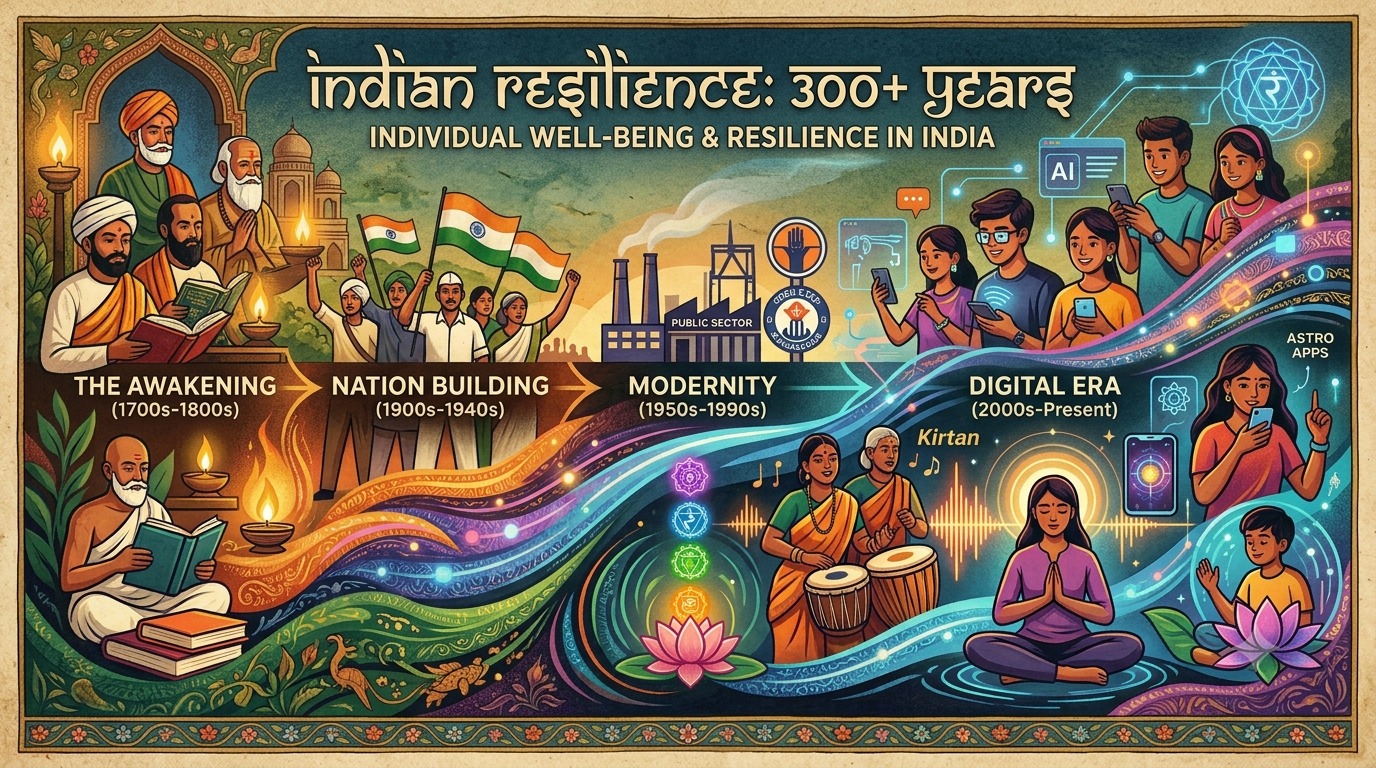
The Historical & Generational Cohorts (1700 – Present)
1. The Colonial Awakening Era (1700–1850s)
- Historical Context: Bengal Renaissance, East India Company expansion, breakdown of feudal structures, early print culture.
- Physical: Agrarian/handicraft mobility, localized urban centers (Calcutta, Bombay, Madras), physical print and pamphlet distribution.
- Psychological: Survival, identity preservation against colonial disruption, emerging intellectual curiosity, dual identity (traditional home vs. colonial workplace).
- Spiritual: Reformist spirituality (Brahmo Samaj, revival of Vedic philosophy to counter missionary critique, Bhagavad Gita re-interpretations).
- Technical: Early print presses, lithography, vernacular news sheets, formal postal networks.
- Historical / Archival / Search Strategy: Search intent centers on local history, lineage, property records, and classical language texts. High-intent triggers focus on institutional legitimacy and heritage verification.
2. The Freedom & Nation-Building Cohort (1860s–1947)
- Historical Context: Nationalist movement, industrial beginnings (Tata, Birla), formal education expansion, Partition trauma.
- Physical: Early rail connectivity, urban migration, physical endurance through scarcity, swadeshi (local) production emphasis.
- Psychological: Civic duty, collective sacrifice, anti-colonial pride, high thrift mindset, extreme risk aversion.
- Spiritual: Faith as political mobilization (Lokmanya Tilak’s public Ganesh Utsav, Gandhi’s Ahimsa and Satyagraha), syncretic national ethics.
- Technical: Telegraph, national radio (AIR), mass print journalism, early industrial machinery.
- Legacy / Institutional Search Strategy: Intent revolves around institutional trust, historical archives, legal precedents, and educational foundations. Content strategies leverage authoritative, encyclopedic schema and civic history keywords.
3. The Post-Independence “License Raj” Cohort (1948–1990)
- Historical Context: Nehruvian socialism, Green Revolution, state-controlled economy, public sector dominance.
- Physical: Tier-1/Tier-2 urban migration, government housing colonies, reliance on state infrastructure and physical banking.
- Psychological: “Government job” security addiction, extreme frugality, scarcity mindset, deep respect for formal degrees (Engineering/MBBS).
- Spiritual: Institutionalized religious practice, pilgrimage tourism, rise of televised epics (Ramayan/Mahabharat), ritualistic stability amidst economic stagnation.
- Technical: Terrestrial TV (Doordarshan), landline telephony, early mainframe computing in state institutions.
- Search Intent Focus: High volume for government exam portals (UPSC, Banking, Railways), public health, and fixed-deposit/savings guides.
- Conversion Levers: Official seals, government accreditations, strict cost transparency, and zero-risk guarantees.
4. The Liberalization & IT Boom Cohort / India’s Millennials (1991–2015)
- Historical Context: 1991 economic reforms, Y2K IT wave, global outsourcing, middle-class explosion, early smartphone adoption.
- Physical: Suburban IT corridors (Bengaluru, Hyderabad, Gurgaon), international travel, urban high-rise living, sedentary lifestyle diseases (type-2 diabetes, stress).
- Psychological: Aspirations for global standards, first-generation upward mobility, “work hard, spend hard,” dual pressure of supporting aging parents while raising children.
- Spiritual: Blended spirituality—seeking corporate mindfulness, yoga as wellness, visiting modern spiritual hubs (Art of Living, Isha Foundation) alongside traditional family rituals.
- Technical: Desktop web to 3G/4G mobile shift, Google Search, Facebook, LinkedIn, e-commerce adoption (Flipkart, Amazon India).
- Search Behavior: High transactional and comparative intent (“best home loan interest rates”, “IT job vs MBA ROI”, “property in Noida vs Gurgaon”).
- SERP Real Estate: Dominate comparison tables, review aggregators, structured product schema, and long-form authority articles.
5. The Mobile-First / AI-Native Cohort / Gen Z & Gen Alpha India (2016–Present)
- Historical Context: Jio 4G price war, UPI digital payment revolution, D2C brand boom, sovereign AI/tech ambitions, global diaspora impact.
- Physical: Hyper-connected across Tier-1 to Tier-4 towns; high urbanization, rapid adoption of wear-ables and fast-fashion, quick-commerce infrastructure (10-minute delivery).
- Psychological: Creator economy ambitions, side-hustle culture, imposter syndrome, high mental health awareness, impatience with slow interfaces.
- Spiritual: “Unbundled” spirituality—astrology/tarot apps (Astrotalk), neo-Vedanta, climate anxiety grounding, digital ritual streaming, active religious pride combined with modern social views.
- Technical: Short-form video (Instagram Reels, YouTube Shorts), UPI-integrated shopping, voice search in regional languages (Hindi, Tamil, Telugu, Marathi), LLMs/AI search (ChatGPT, Perplexity).
- Social & Voice Search Optimization (SSO): Target conversational, multi-lingual voice queries (“paas ka best dermatologist”, “UPI cashback offer today”).
- Visual & Short-Form Dominance: Capture Google Video Carousels and social search with product-led vertical video content.
- GEO (Generative Engine Optimization): Direct, entity-based answers structured for AI Overviews and chat assistants.
Evaluating the “quality” of today’s younger generation (Gen Z and Gen Alpha)—their overall well-being, mindset, and societal impact—reveals a stark paradox: they are the most hyper-aware and self-reflective generation in history, yet they are navigating an unprecedented crisis of well-being.
In historical generational terms (like the Strauss–Howe cycle), today’s youth are coming of age during a “Fourth Turning”—a period defined by institutional decay, rapid AI disruption, climate anxiety, and economic strain.
The defining traits of today’s generation break down across four core dimensions:
1. Mental & Emotional Reality: Overwhelmed yet Active
- The Overwhelm Paradox: According to global youth studies by UNICEF and Gallup, nearly 60% of Gen Z report feeling chronically overwhelmed by global news, climate fears, and economic uncertainty. General life satisfaction is at a generational low.
- Radical Self-Awareness: Unlike older cohorts who grew up under “suck it up” cultural norms, today’s youth have high mental health literacy. They actively discuss anxiety, boundary-setting, and trauma, and are far more likely to seek therapy or mindfulness tools.
- The Loneliness Epidemic: Despite being digitally connected 24/7, young people report experiencing regular social isolation at nearly double the rate of older generations.
2. Economic Mindset: Unfiltered Pragmatism
- Death of the “Corporate Dream”: Seeing Millennials burn out in traditional corporate ladders, Gen Z and Alpha have low trust in traditional employer loyalty.
- Side-Hustle Culture & Financial Realism: They are hyper-focused on financial sovereignty, side hustles, quick-commerce, and practical skills. They view job security not through a single company, but through personal agency, adaptability, and tech fluency.
3. Spiritual & Institutional View: “Unbundled” Truth
- Institutional Skepticism: Whether it is traditional religion, legacy media, or corporate marketing, young people reject rigid dogmas.
- Personalized Believing: As covered earlier, they “unbundle” spirituality—blending mental health practices, ancient philosophy, regional traditions, and personal ethics into an individualized worldview rather than blindly following inherited institutions.
4. Technical Trait: Native AI & Fast Validation
- AI as a Co-Pilot: While Millennials adapted to the internet, Gen Z and Alpha are the first AI-native generations. They expect frictionless, instant, conversational answers and intuitive interfaces.
- Peer Proof Over Corporate PR: They ignore polished corporate messaging. They measure quality and truth through raw user-generated video, peer reviews (Reddit/TikTok/YouTube), and creator proof.
The Big Picture: Today’s generation is not “fragile”—they are pragmatically resilient. They have been stripped of the illusion that global systems automatically work for them, forcing them to build their own systems, boundary lines, and communities from the ground up.
Gaudiya Vaishnavism—the tradition established by Chaitanya Mahaprabhu in 16th-century Bengal—is grounded in the philosophy of Achintya-Bheda-Abheda (inconceivable, simultaneous oneness and difference between the soul and God) and centered on Bhakti Yoga (devotional service, specifically kirtan and nama-smarana).
The core understanding of Gaudiya Vaishnavism can be directly mapped to the modern human condition, alongside strategic directions for its future.
1. The Core Gaudiya Vaishnava Understanding
The Nature of the Soul (Jiva-Tattva)
Gaudiya theology defines the individual soul (jiva) as an eternal spark of divine consciousness (sanatana).
- The Root Cause of Suffering: Suffering occurs when the jiva forgets its innate identity as an eternal servant (dasa) of the Divine and tries to become an independent master or consumer of the material world (maya).
- Modern Parallel: This matches the identity crisis faced by Gen Z and Gen Alpha today—high tech-connectivity coupled with existential isolation, anxiety, and burnout caused by constant self-promotion.
The Remedy: Sankirtan as Relational Healing
Unlike meditative paths (Jnana or Raja Yoga) that demand solitude or intense physical discipline, Gaudiya Vaishnavism posits that in the current age (Kali Yuga), the most direct path to self-realization is congregational chanting (Nama-Sankirtan).
- It frames spirituality not as individual withdrawal, but as relational connection—using sound, music, community (sangha), and food (prasadam) to revive dormant spiritual affection (prema).
Philosophical Synthesis (Achintya-Bheda-Abheda)
Gaudiya philosophy avoids rigid extremes:
- It rejects total isolation from the world (Maya-vada / extreme world-renunciation).
- It rejects total material absorption (Karma-vada / pure materialism).
- Instead, it practices Yukta-Vairagya: using everything in the material world (technology, art, intellect) in the service of the Divine rather than for selfish exploitation.
2. Strategic Suggestions for the Future
To remain deeply relevant to upcoming generations (Gen Z, Gen Alpha, and beyond) without diluting its core theology, the Gaudiya Vaishnava tradition can focus on five key evolutions:
I. Shift from Dogmatic Rules to “Root Theology”
Modern youth are quick to reject external compliance (“do this because it’s forbidden otherwise”).
- The Future Shift: Reframe devotional disciplines (Sadhana) through a lens of *spiritual hygiene and mental liberation. Explain *why principles like a vegetarian diet or avoiding intoxication exist—not as punitive rules, but as practical ways to clear mental fog, practice compassion, and build deep focus.
II. Address Modern Mental Health & Trauma
Older generations often separated faith from mental healthcare. For younger generations, spirituality and mental wellness are inextricably linked.
- The Future Shift: Integrate psychological literacy into devotional spaces. Gaudiya texts (like the Bhagavata Purana) are filled with examples of raw human emotion, grief, and emotional process. The tradition should create safe, emotionally intelligent spaces where young practitioners can bring their authentic anxiety, trauma, and doubts without being told to “just chant more.”
III. Elevate Yukta-Vairagya in the AI & Tech Era
As AI and virtual realities blur the lines between authentic and synthetic experiences, young people crave real, grounded truth.
- The Future Shift: Leverage digital media, AI tools, and creative production to distribute high-level philosophy, artistic kirtan, and philosophical dialogues. Rather than fearing digital tech, view it through Yukta-Vairagya—as a tool to build digital satsangs (spiritual communities) for isolated youth worldwide.
IV. Eco-Bhakti & Compassionate Action
Gen Z and Alpha carry intense climate anxiety and deeply care about social ethics.
- The Future Shift: Re-emphasize Jiva-Daya (compassion for all living beings). The Gaudiya tradition has rich roots in environmental reverence (e.g., the sacred ecosystems of Vrindavan and Mayapur). Establishing sustainable eco-villages, cruelty-free farming, and active humanitarian programs anchors spiritual philosophy into tangible, real-world action.
V. Focus on Authentic Kirtan Culture
Kirtan is one of the most accessible spiritual practices for modern youth. It breaks through cultural, linguistic, and generational barriers without requiring prior philosophical knowledge.
- The Future Shift: Expand open, non-judgmental kirtan spaces in urban centers and music platforms—giving people an immediate taste of spiritual elevation (Rasa) before diving into complex metaphysical study.
Summary: The strength of Gaudiya Vaishnavism lies in its sweetness (Madhurya) and its focus on personal love over cold ritual. By speaking directly to the modern human need for emotional grounding, community, and existential purpose, the tradition remains an accessible, living framework for the modern world.