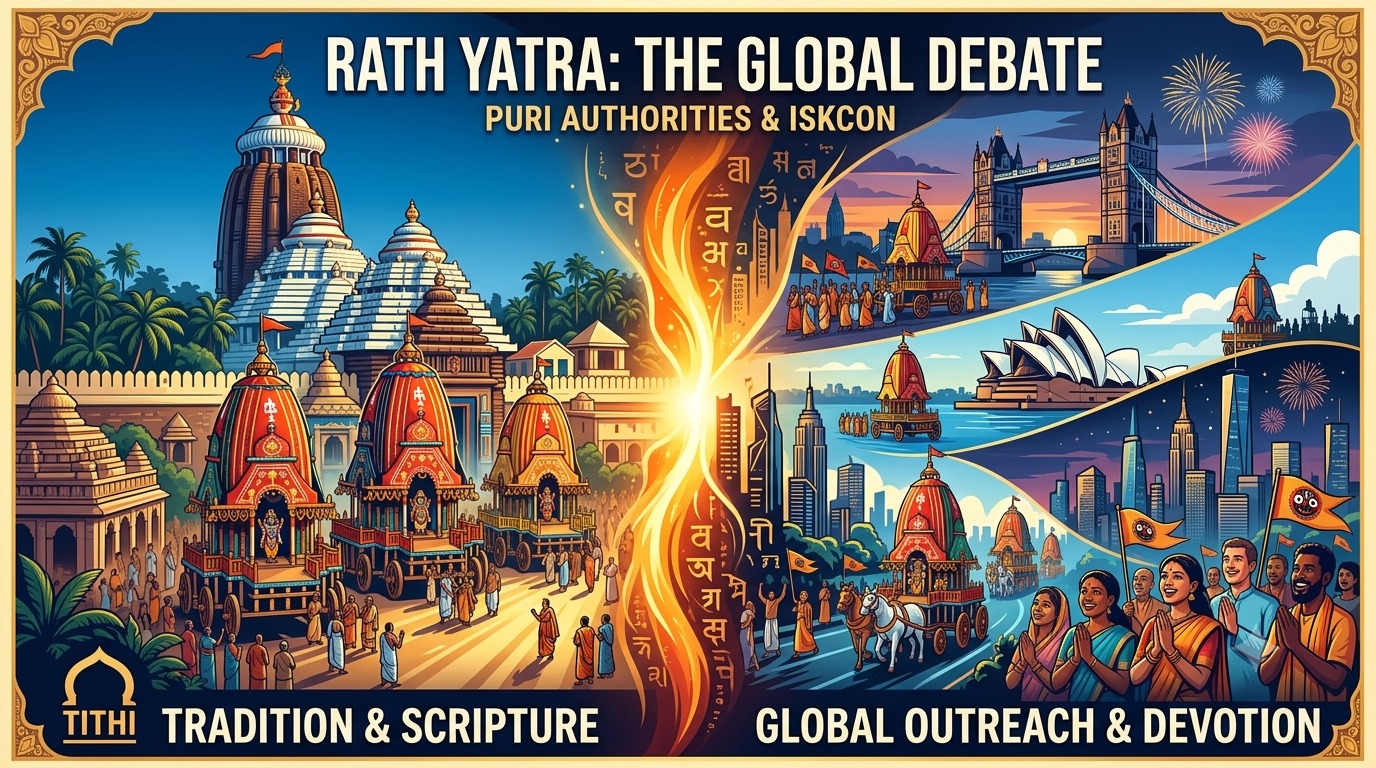
The debate over Lord Jagannath’s Rath Yatra between the Shree Jagannath Temple Administration (SJTA) in Puri and the International Society for Krishna Consciousness (ISKCON) revolves around religious tradition, scriptural adherence, and global outreach.
At its core, the confrontation pits centuries-old orthodoxy against global institutional pragmatism.
1. The Core Dispute: Timing & Tithis
The Puri Stance (Orthodoxy & Scriptural Injunction)
- Strict Date Adherence: The SJTA, Gajapati Maharaja Dibyasingha Deb (the titular king of Puri), the Mukti Mandap Pandita Sabha, and the Shankaracharya of Govardhan Peeth insist that Snana Yatra and Rath Yatra must only be celebrated on their scripturally mandated tithis (lunar dates). Rath Yatra begins specifically on Ashadha Shukla Dwitiya of the Hindu calendar.
- Integrity of Ritual Context: Puri authorities argue that changing the date alters the very identity of the festival. They argue that while desha-kala-patra nyaya (adapting to local time and place) allows minor operational changes, the underlying tithi is non-negotiable. Holding “unseasonal” (adinia) Rath Yatras is viewed as violating Lord Jagannath’s scriptural directives and misleading devotees globally.
The ISKCON Stance (Global Outreach & Pragmatism)
- Logistical & Overseas Constraints: ISKCON organizes hundreds of Rath Yatras worldwide annually. They contend that strict adherence to the Hindu lunar calendar is frequently impossible overseas due to city permits, police logistics, road closure rules, and extreme weather/climatic conditions.
- Public Participation & Mission: ISKCON maintains that Srila Prabhupada introduced Rath Yatra to the West as a means of spreading devotion to Lord Jagannath globally. To maximize public participation, events are often held on weekends or during seasons suitable for massive outdoor processions.
2. Key Flashpoints & Arguments
| Dimension | Puri Temple Authorities & Sevayats | ISKCON (Global Movement) |
|---|---|---|
| Authority | The SJTA, Mukti Mandap, and Puri King are the ultimate custodians of Jagannath Culture. | Guided by Srila Prabhupada’s vision for worldwide preaching and outreach. |
| Scriptural Basis | Cites Skanda Purana, Brahma Purana, and tradition stating rituals cannot exist outside their tithi. | Argues that the spirit of devotion (bhakti) and spreading Jagannath’s name globally takes precedence over rigid dates. |
| Recent Escalation | Accused ISKCON of spreading false narratives regarding debates between Puri scholars and ISKCON scholars. Appealed to government leadership (including President and PM of India) to intervene. | Apologized for any hurt sentiments in Odisha, clarifying that ISKCON inside Odisha adheres to Puri dates, while global chapters face unique constraints. |
3. Escalation and Official Actions
- Letters to National Leadership: The Gajapati Maharaja of Puri escalated the matter by writing directly to President Droupadi Murmu and Prime Minister Narendra Modi, asking for intervention to prevent unseasonal celebrations and protect the traditional scriptural identity of the festival.
- Rejection of ISKCON Arguments: Formal theological discussions between SJTA scholars and ISKCON representatives led to SJTA explicitly rejecting ISKCON’s scriptural justifications for holding out-of-season Rath Yatras.
- Public Protests: The controversy has triggered local anger in Odisha, leading to protests by local residents, cultural organizations, and socio-religious groups near the Gundicha Temple and across the state demanding that unseasonal processions be stopped entirely.
When the dispute over out-of-season (adinia) Rath Yatras is analyzed through the writings and actions of Srila A.C. Bhaktivedanta Swami Prabhupada (the founder-acharya of ISKCON), both sides of the argument draw upon different aspects of his legacy:
1. The Preaching Principle (Yena Tena Prakarena)
The core basis for ISKCON’s historical practice of hosting Rath Yatras outside the standard Ashadha Shukla Dwitiya date comes from Prabhupada’s emphasis on global preaching over rigid ritualistic rules.
- Adaptation for the West: When Prabhupada organized the first Rath Yatra outside India in San Francisco (July 1967), his main objective was introducing Lord Jagannath to the Western world. To make the festival feasible under local city laws, permit regulations, and weather constraints, he permitted flexibility in timing so thousands of people could participate.
- Preaching Priority: In ISKCON’s philosophical framework, Prabhupada operated on the Chaitanya Mahaprabhu directive: Yena tena prakarena manah krshne nivesayet (“By any means necessary, fixed one’s mind on Krishna”). In his view, bringing thousands of citizens into contact with Lord Jagannath on a sunny weekend took precedence over calendar alignment in foreign jurisdictions.
2. The Preservation Principle (“Do Not Change the Principle”)
At the same time, Puri scholars and traditionalists point to Prabhupada’s explicit warnings against altering established Vedic principles.
- “American Disease” Letter (1974): In a famous letter to his disciple regarding the Chicago Rath Yatra (September 1974), Prabhupada explicitly wrote:
“Regarding the Ratha Yatra Festival, keep it always gorgeously alive, but do not change the principle. The principle should go on as usual… Don’t change from this to that. That is your American disease. This is very serious that you always want to change everything.”
- Respect for the Holy Dham: Traditionalists note that while Prabhupada permitted initial flexibility in the late 1960s to establish the infant movement, he never intended for institutional convenience to override fundamental scriptural rules permanently or create disrespect toward Jagannath Puri Dham.
3. How the Controversy Stands Today
Because Prabhupada gave directives supporting both preaching flexibility abroad and strict maintenance of foundational principles, the debate hinges on how to balance these two imperatives:
              ┌──────────────────────────────────────────┐
              │   Srila Prabhupada's Dual Perspective    │
              └────────────────────┬─────────────────────┘
                                   │
        ┌──────────────────────────┴──────────────────────────┐
        ▼                                                     ▼
┌──────────────────────────────┐                       ┌──────────────────────────────┐
│     Preaching & Outreach     │                       │     Authenticity & Rule      │
├──────────────────────────────┤                       ├──────────────────────────────┤
│ Allow date flexibility so    │                       │ "Keep old system strong;     │
│ millions worldwide can take  │   VS.                 │ do not change the principle" │
│ darshan of Lord Jagannath.   │                       │ (Letter, 1974).              │
└──────────────────────────────┘ └──────────────────────────────┘- Puri Administration’s View: The SJTA and Gajapati Maharaja maintain that true reverence for Srila Prabhupada means honoring the original rules of Puri Dham, meaning Rath Yatra must only be held during the sacred 9-day tithi window.
- ISKCON’s Evolving Response: While the GBC (Governing Body Commission) historically relied on preaching pragmatism, recent pressure from Odisha has led certain ISKCON factions and leaders to reconsider, agreeing that holding Rath Yatras strictly within the traditional nine-day window honors both Puri Dham and Prabhupada’s deeper respect for Vedic tradition.
Alternate Dates
Both sides cite scriptures and Puranas, but draw very different conclusions:
1. ISKCON’s Argument: Alternative Dates & Scriptural Provision (Vikalpa)
The ISKCON India Scholars Board (IISB) released a detailed rebuttal to the SJTA citing specific scriptures that permit flexibility and alternative dates for chariot processions:
- *Prasna Samhita & Skanda Purana: ISKCON scholars argue that texts like the *Prasna Samhita and passages in the Skanda Purana contain references allowing alternative timings for Rath Yatra under special circumstances, considering it a legitimate scriptural option (vikalpa) rather than a violation.
- Pancaratrika vs. Swayambhu Deities: ISKCON differentiates between the original svayambhu (self-manifested) deities residing in Puri and Pancaratrika installed deities in temples worldwide. They argue that deities installed via Pancaratra Agamas outside Puri operate under different ritual guidelines tailored to local conditions (desha-kala-patra).
- *Yena Tena Prakarena (Preaching Imperative): Citing broad Vaishnava scriptural principles, ISKCON contends that enabling public participation and devotional remembrance (*manaḥ kṛṣṇe nivesayet) supersedes rigid calendar constraints when local legal or climatic obstacles prevent celebrations on the exact tithi.
2. Puri Temple’s Response: Fixed Injunctions (Niyama)
The *SJTA, Gajapati Maharaja Dibyasingha Deb, and the *Mukti Mandap Pandita Sabha (governed by the Shankaracharya of Govardhan Peeth) reject alternative date interpretations:
- *Purushottama Kshetra Mahatmya (Skanda Purana): Puri authorities contend that Lord Jagannath Himself specified the exact timing of His festivals. The scriptures explicitly mandate that Snana Yatra must take place on *Jyeshtha Purnima and Rath Yatra must begin specifically on Ashadha Shukla Dwitiya.
- *Narada Purana Injunctions: Puri scholars cite the *Narada Purana, arguing that the prescribed tithi (lunar date) is an essential, inseparable part of the ritual itself.
- *Limits of *Desha-Kala-Patra:* While Puri authorities agree that operational methods (like chariot construction materials or route logistics) can adapt to local conditions, they maintain that the sacred *tithi is non-negotiable under any circumstances.
Summary of the Theological Stand-Off
| Dimension | Puri Temple & Traditional Pandits | ISKCON Scholars Board (IISB) |
|---|---|---|
| Primary Scriptures Cites | Skanda Purana (Utkala Khanda), Narada Purana. | Prasna Samhita, Skanda Purana passages, Pancaratra Agamas. |
| Interpretation of Dates | Fixed & immutable (Niyama). The tithi defines the ritual. | Flexible alternative options (Vikalpa) based on circumstance. |
| Deity Classification | All Jagannath deities worldwide must follow Puri’s scriptural calendar. | Pancaratrika installed deities outside Puri have local ritual leeway. |