Demystifying the Reality of Village Deity Possession in India. Psychology of Trance and Possession, Regional Beliefs and Gaudiya Perspective
Yes, this is a very prominent and living tradition in India, often referred to generally as *deity possession, **divine channeling, or locally by names like **Jagran, **Chhau, **Darshan, or *Gara.
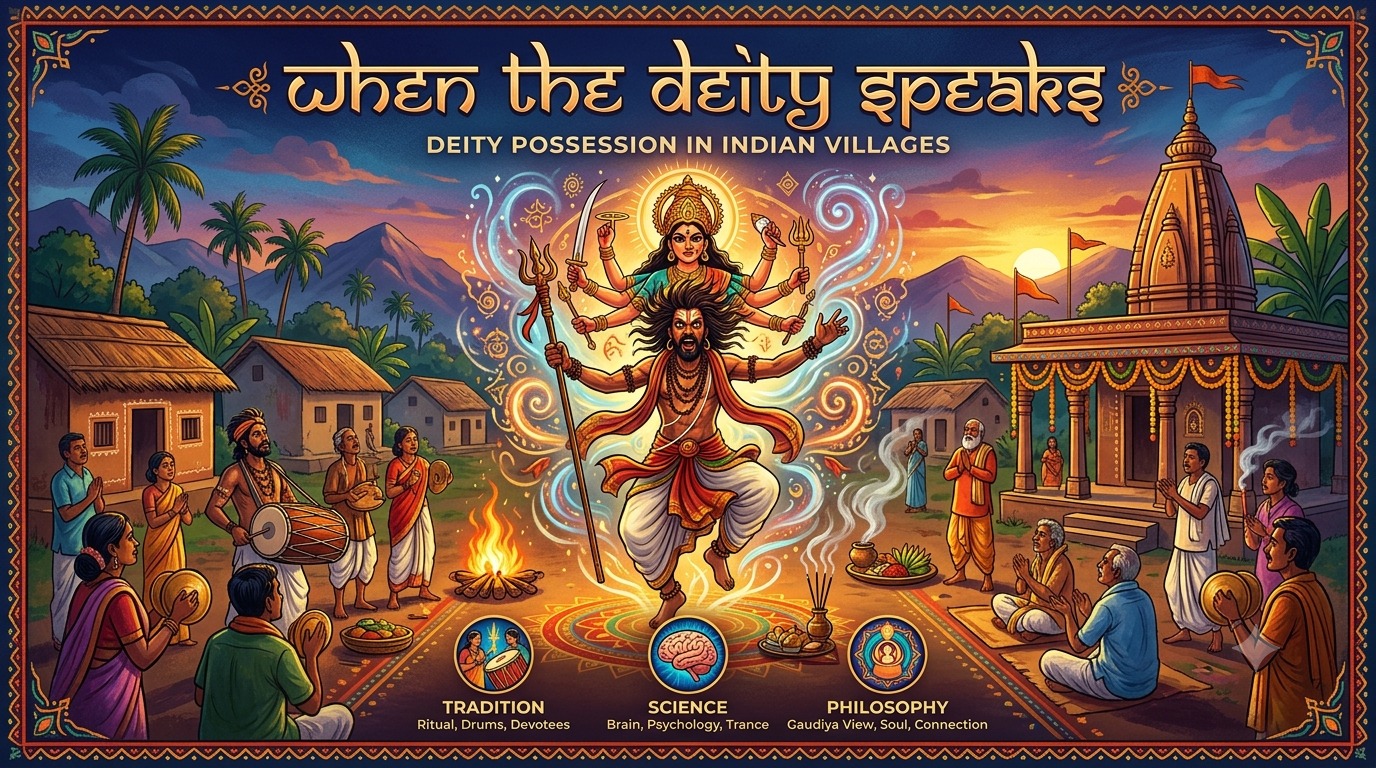
In many rural and tribal areas, village deities (Gramadevatas or Kula-devatas) are believed to protect the community from diseases, bad harvests, and evil spirits. The phenomenon where a deity temporarily enters the body of a priest or a chosen medium to communicate is deeply woven into the social and religious fabric.
Here is a quick breakdown of how this usually works:
1. The Chosen Medium
The person through whom the deity speaks isn’t always the main temple priest. They are often a specific individual from the village recognized as the medium or vessel (sometimes called a Bhagat, Bhopa, Gurav, or Kodan depending on the region).
2. The Ritual and Trance
The process rarely happens randomly; it is usually triggered during a festival, a special puja, or in response to a village crisis.
- The Build-up: It begins with intense, rhythmic drumming, the playing of traditional instruments (like the dhak or shehnai), chanting, and the burning of heavy incense.
- The Trance: The rhythmic environment helps induce a trance-like state. The medium’s body language changes drastically—they might sway violently, dance, or exhibit immense physical strength.
3. Purpose of the Communication
Once the deity “arrives,” the villagers don’t just watch; they actively interact with the deity to seek guidance. Typical reasons include:
- Resolving Disputes: The deity acts as a supreme judge for land or family disputes that the village panchayat cannot settle.
- Healing and Predictions: Villagers ask about unexplained illnesses, when the monsoon rains will arrive, or how to cure a failing crop.
- Warnings: The deity might chastise the village for neglecting local traditions or moral boundaries, demanding a specific ritual to restore balance.
Regional Variations
This tradition goes by many different names across the country, each with its own unique flavor:
| Region | Local Name / Tradition | Description |
|---|---|---|
| Karnataka | Bhuta Kola / Daiva Aradhane | Highly stylized ritual where channeled local spirits (Daivas) solve community problems. |
| Kerala | Theyyam | Performers embody powerful deities through spectacular makeup, dance, and blessings. |
| Garhwal / Kumaon (Uttarakhand) | Jagar | A ritual folk song session meant to wake up local gods and ancestors to seek their justice. |
| Rajasthan | Bhopa | Priests who channel folk deities like Pabuji or Devnarayan to heal the sick. |
| Andhra Pradesh / Telangana | Bonalu (Swaroopam) | During the festival, women or priests enter a trance to foretell the future of the village (Rangam). |
It is a fascinating aspect of faith where the divine isn’t seen as distant or abstract, but as a direct, accessible member of the community who can be spoken to face-to-face.
Whether it is “real” depends entirely on how you define reality.
If you look at it through the lens of faith, science, or psychology, you get very different—but equally fascinating—answers. Here is how the different perspectives break it down:
1. The Psychological Reality: The Trance State is Real
From a scientific and psychological standpoint, the priest or medium is not faking it. They are experiencing a genuine, documented altered state of consciousness known as a dissociative trance.
During the ritual, the combination of exhausting physical movement, sensory overload (ceaseless, heavy drumming, flashing lights, thick incense), and intense mental focus causes the brain to enter a deep trance.
- Neurochemistry: In this state, the brain releases endorphins and alters its typical activity, quietening the part of the brain responsible for self-awareness and ego.
- The Result: The person temporarily “steps aside” from their own identity. They genuinely do not feel pain (which is why some can walk on hot coals or pierce their skin without flinching) and often have total amnesia about what they said or did once they snap out of it.
2. The Cultural Reality: Social Catharsis
Anthropologists view this tradition as a highly functional, real-world mechanism for rural communities. [refer book, Untouchable Bodies, Resistance, and Liberation, Author: Joshua Samuel ]
In a village, a normal person cannot just stand up and openly criticize the wealthy landlord, solve a bitter family land dispute, or demand that people change their behavior. But when that person is possessed, it is the deity speaking. The “deity” can bypass social hierarchies, deliver justice, and allow the community to vent anxieties about failing crops or disease. It acts as a form of collective psychological therapy and a local court system rolled into one.
3. The Devotional Reality: A Matter of Faith
For the villagers who participate, the experience is completely divine and literal. They are not looking at the brain chemistry; they are looking at the outcome.
- When the medium—who might be uneducated or completely unaware of a family’s private matters—suddenly reveals a hidden secret or perfectly settles a decades-old boundary dispute, the villagers see it as undeniable proof of the Devi or Devata’s presence.
- To the devotees, the physical changes in the medium (the sudden deep pitch of the voice, the superhuman stamina, the shift in gaze) are the physical manifestations of the divine.
The Bottom Line
Are there occasional fraudsters who mimic the behavior for money or power? Yes, and villagers are often surprisingly sharp at spotting and gossiping about “inauthentic” mediums.
But for the vast majority of traditional village rituals, the phenomenon is real. The priest is not acting; they have entered a very deep, powerful state of altered consciousness that allows them to embody the voice of the community’s highest power.
In Gaudiya Vaishnavism (the tradition following Chaitanya Mahaprabhu and represented widely by ISKCON and the Gaudiya Math), the practice of village deities (gramadevatas) speaking through a priest or medium is viewed through a specific theological lens.
Gaudiya theology acknowledges that these events happen, but it categorizes them carefully and urges devotees to aim higher. Here is how the tradition understands and approaches this activity:
1. Recognition of Āveśa (Empowered Possession)
Gaudiya theology acknowledges that higher beings can enter a human body. This is referred to as Āveśa (possession or divine entry).
- Demigods and Spirits: Gaudiya texts explain that Upadevatas (sub-deities), Yakṣas, Bhūtas (spirits), or Devatas (demigods like local forms of Chandi or Bhairava) possess certain material capabilities. They can momentarily enter a person who has opened themselves up to it (via specific rituals, lineage, or mental states) to give prophecies, demand offerings, or cure minor ailments.
- Not the Supreme Lord: Gaudiya acharyas emphasize that the Supreme Personality of Godhead (Krishna or Vishnu) does not generally possess a person in this trance-like, erratic manner. The entities entering mediums are demigods or local spirits operating within the material world (Māyā).
2. Category of Worship: Devatā-antaranga vs. Suddha-Bhakti
In the Bhagavad Gita (which Gaudiya Vaishnavism considers foundational), Krishna mentions that people worship demigods (devatas) according to their modes of nature (sattva, rajas, or tamas):
“Those whose intelligence has been stolen by material desires surrender unto demigods…” — (Bg. 7.20)
Because these village rituals usually revolve around material concerns—asking the deity to cure a sick child, bring rain, bless a crop, or reveal a thief—Gaudiyas view this as Sakāma-Bhakti (devotion mixed with material desires) rather than Śuddha-Bhakti (pure, unmotivated love for God).
3. The Distinction Between Avesa and Prema-Āveśa
There is a critical distinction in Gaudiya literature between:
- Material Trance / Possession (Bhūta-Āveśa or Deva-Āveśa):** A local spirit or demigod takes control of a person’s body and mind, often leaving the host exhausted, shaking, or unconscious afterward.
- Ecstatic Divine Love (Prema-Āveśa):* When great Vaishnava saints (like Chaitanya Mahaprabhu or his associates) entered divine “trances,” it was not a spirit invading their body. Instead, their soul (*jīva) was overwhelmed by intense, pure love for Krishna. They remained spiritually conscious, and the symptoms were purely of spiritual bliss, not force or control.
4. How Gaudiya Devotees are Taught to Treat This
Gaudiya Vaishnavas do not necessarily mock or reject these village traditions as total fakes, but they view them with specific boundaries:
- Respect, but Do Not Worship: A Gaudiya Vaishnava respects the demigods (Devatas) as powerful servants of Lord Vishnu/Krishna. However, they do not approach a possessed priest to ask for material boons or prophecies.
- No Need for Mediums: Gaudiya philosophy teaches that Krishna is directly accessible to everyone through the chanting of the Mahamantra (Hare Krishna). You do not need a priest to enter a trance state to hear God’s message; God’s message is already fully given in the scriptures (Srimad Bhagavatam, Gita) and accessed through a genuine guru.
- Potential for Distortion: Gaudiya scholars warn that because the medium is a conditioned soul (jīva), the “messages” coming through can often be mixed with the medium’s own mind, desires, or lower subtle entities taking advantage of the trance state.
Summary
To a Gaudiya Vaishnava, village deity possession is a real phenomenon involving subtle spirits or demigods, but it belongs to the realm of local material karma and lower spiritual dimensions. Rather than seeking guidance from local spirits or demigods acting through a medium, the Gaudiya path encourages focusing directly on the Supreme Lord (Svayam Bhagavan) through direct, conscious devotion (Bhakti).