The Dark Psychology and Spiritual Truth Behind India’s Relationship Crimes. Root Causes, Solutions, and the Vedic View
To understand why India is witnessing a rise in high-profile cases of people getting involved in illicit affairs and murdering their partners (Intimate Partner Homicide, or IPH), we have to look at the intersection of psychology, systemic legal failures, and a rapidly modernizing society clashing with deep-rooted traditions.
Why Is This Happening? The Root Causes
Intimate partner violence escalating to murder in India is rarely a sudden, impulsive act. Sociologists, psychologists, and criminologists point to several interconnected triggers:
1. The Clash of Modernity vs. Rigid Tradition
India is a society experiencing immense transitions. With the rise of smartphones, dating apps, and financial independence, younger generations are seeking greater personal autonomy in their relationships. However, this often collides with rigid traditional expectations. When a partner seeks independence, ends a relationship, or is suspected of an extramarital affair, it is frequently viewed by the other partner not just as a personal rejection, but as a severe blow to “honor” and patriarchal control, sometimes triggering violent retaliation.
2. The Lack of Safe Exit Ramps (The Divorce Taboo)
In India, marriage is widely treated as an inviolable, lifelong bond.
- Social Stigma: Divorce carries heavy societal shame, especially for women, and families often pressure couples to “make it work” despite severe incompatibility or abuse.
- Judicial Delays: The legal system is notoriously slow. A contested divorce can drag on for years, if not decades.
This dual pressure traps individuals in toxic, combustible environments. When people feel they cannot legally or socially escape a dead or abusive marriage, some resort to extreme, illicit, and illegal measures to “get rid” of their partner.
3. “Sexual Jealousy” and Suspected Infidelity
Police data consistently shows that “sexual jealousy” or suspected illicit affairs are among the leading motives in domestic homicides. Infidelity triggers extreme emotional responses—shame, rage, and betrayal. In environments where emotional regulation or mental health support is lacking, this rage can escalate into fatal violence.
4. Coercive Control and Abuse Escalation
Many cases of partner murder are the final, tragic stage of long-term domestic violence. Research shows that when a victim tries to permanently leave an abusive relationship, the danger of lethal violence peaks as the abuser realizes they are losing total control.
Is It a Global Trend, or Just Hyper-Hyped Media Sensation?
The short answer is both.
The Global Reality vs. The Indian Context
Intimate partner homicide is not uniquely Indian; it is a global crisis. According to the United Nations Office on Drugs and Crime (UNODC), tens of thousands of women globally are killed by their intimate partners or family members every year, making the home one of the most dangerous places for victims of domestic abuse.
However, the nature of these crimes in India is heavily shaped by unique cultural factors, such as:
- Dowry-related disputes.
- Family interference and caste hierarchies.
- The extreme difficulty of obtaining a “no-fault” divorce.
The Media “Hyping” Effect
While the undercurrent of domestic violence is a widespread statistical reality (with the National Family Health Survey-5 reporting that nearly 30% of married women in India have faced spousal violence), the actual occurrence of gruesome, pre-planned partner murders remains statistically rare.
The perception that there is a sudden “epidemic” of partner murders is heavily amplified by 24/7 news cycles and social media algorithms.
- Sensationalist, high-profile cases (like the Shraddha Walkar case, where a partner chopped her body into pieces, or cases involving complex conspiracies with lovers) get relentless, voyeuristic coverage.
- Media coverage often focuses on the gruesome details of the crime rather than the underlying systemic issues (such as mental health, domestic abuse, and legal reform). This creates a “moral panic,” making rare, extreme anomalies feel like a daily, nationwide trend.
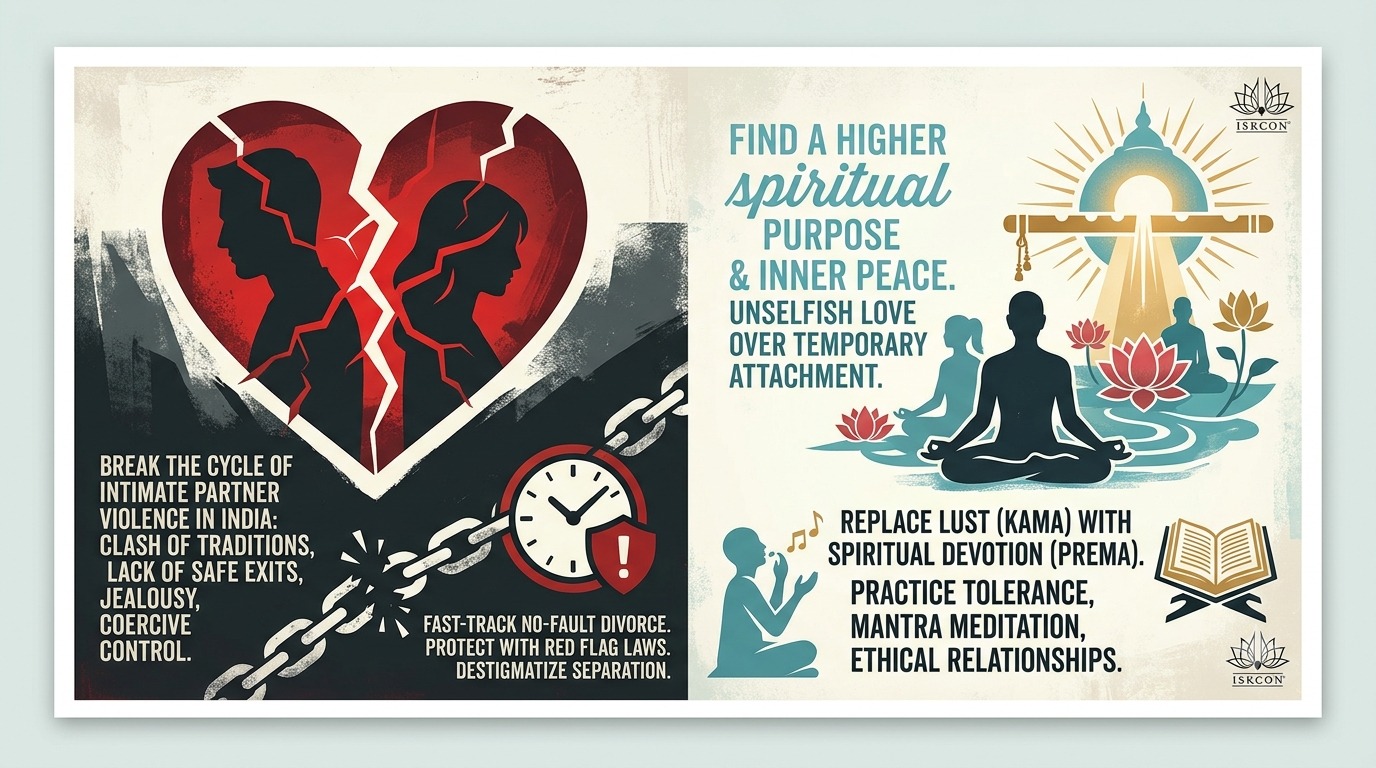
To address this deeply complex, tragic aspect of human relationships, we have to look at the situation from two distinct angles: the practical, Legal solutions needed to stop this cycle, and the spiritual framework of the ISKCON (International Society for Krishna Consciousness) perspective, which traces the root of these crimes back to the soul’s loss of spiritual direction.
Part 1: The “Practical Legal” Solutions
If we strip away the sociological academic talk, preventing toxic relationships from escalating into fatal violence requires sharp, direct, and pragmatic systemic interventions:
1. Normalize “No-Fault” Divorce and Rapid Legal Exits
As long as divorce is treated as an impossible, decades-long battle of mudslinging, spouses who desperately want to escape will feel cornered.
- The Solution: India needs fast-track family courts and a streamlined legal process for mutual-consent and “irretrievable breakdown” divorces. If people have a clean, swift exit ramp, they will take the legal door instead of resorting to horrific “solutions.”
2. De-stigmatize Separation
Families must stop telling victims of domestic abuse to “adjust” or “compromise” for the sake of family honor.
- The Solution: Parents and society must prioritize their children’s safety over societal reputation. The phrase “log kya kahenge” (what will people say) has indirectly sent many victims to their graves.
3. Immediate Police Enforcement on “Red Flag” Abuse
In almost every case of intimate partner homicide, there was a paper trail of prior domestic abuse, threats, or harassment that was ignored by authorities as “family matters.”
- The Solution: Immediate, zero-tolerance enforcement for domestic violence complaints. Restraining orders must be legally binding with heavy penal consequences for violations.
4. Financial and Relational Literacy
Many partners stay trapped because they are financially dependent, while others resort to violence because they lack basic emotional intelligence to handle rejection.
- The Solution: Comprehensive relationship education starting in college (focusing on boundaries, handling rejection, and emotional regulation) alongside financial independence programs for women so they never have to rely on an abuser for survival.
Part 2: The ISKCON / Vedic Perspective
ISKCON, founded by *Srila Prabhupada, views these violent domestic tragedies as the ultimate symptom of a spiritually diseased society. In Vedic philosophy, the degradation of relationships is analyzed through the lens of *karma, lust (kama), and the loss of spiritual values.
            [ The Downward Spiral of Lust ]

               Forgetfulness of God (Krishna)
                            │
                            ▼
               Material Lust (Kama) as "Love"
                            │
                            ▼
           Frustration & Unfulfilled Desires
                            │
                            ▼
             Blinding Wrath & Violence (Krodha)
1. The Confusion of “Lust” (Kama) for “Love” (Prema)
In the Gaudiya Vaishnava tradition, true love (prema) is completely unselfish and centered on the spiritual well-being of the other. What modern society calls “love” is often categorized as kama (lust)—the desire to exploit another person for one’s own physical, emotional, or mental satisfaction.
The ISKCON View: When a relationship is built purely on mutual sense gratification, it is inherently unstable. The moment one partner ceases to satisfy the other’s senses, or when an “illicit affair” promises a “better” source of pleasure, the false foundation of the relationship crumbles.
2. The Danger of “Illicit Sex” and the Breakdown of Dharma
To a practicing ISKCON devotee, “no illicit sex” is one of the four core regulative principles. Illicit sex—defined as sexual relations outside of a religiously sanctioned marriage—is seen as highly destructive to the human psyche and societal order.
- Entanglement: ISKCON teachings state that illicit relationships pollute the consciousness, leading to extreme possessiveness, deceit, lying, and intense sexual jealousy.
- The Karmic Cost: The scriptures (like the Srimad-Bhagavatam) state that those who violate the sanctity of marriage and cheat on their partners generate severe negative karma, trapping them in deep mental suffering, guilt, and violent reactions in this life and the next.
3. The Root Cause: “Krodha” (Wrath) Born of Frustration
The Bhagavad Gita (Chapter 2, Verse 62-63) perfectly maps out how a person reaches the point of murdering their partner:
$$\text{Contemplation of Objects} \rightarrow \text{Attachment} \rightarrow \text{Lust (Kama)} \rightarrow \text{Anger (Krodha)} \rightarrow \text{Delusion} \rightarrow \text{Loss of Reason} \rightarrow \text{Ruin}$$
When a partner cheats, or when the illusion of control over a partner is shattered, the kama (lust/attachment) turns into intense krodha (wrath). Under the delusion of this anger, a person loses all cognitive reasoning, treating their once “beloved” partner as an obstacle to be brutally eliminated.
4. The Spiritual Solution: Finding the “Higher Taste”
ISKCON argues that secular laws, policing, and moral policing alone cannot stop partner violence, because you cannot suppress the strong urges of the mind through force alone.
- The Remedy: Instead of looking for perfect satisfaction in another flawed human being, individuals must redirect their innate need for love toward the Divine (Krishna).
- By experiencing a “higher spiritual taste” (param drstva nivartate) through mantra meditation, chanting (Hare Krishna), and spiritual lifestyle, the mind naturally becomes peaceful, tolerant, and free from the violent grip of lust, jealousy, and anger.