The Six Divine Opulences of Bhagavan (With Slokas & Examples)
Introduction: What Does “Bhagavan” Really Mean?
In everyday devotional language, we casually call Krishna “Bhagavan.” But Sanskrit is a precise language, and this title is not a vague honorific — it is a technical term with an exact definition rooted in scripture. The concept that defines it is called Shad-Aishvarya (षड् ऐश्वर्य), literally “the six (shad) opulences (aishvarya).”
According to the Vaishnava tradition, a being who fully and simultaneously possesses six specific divine qualities, without limit and without decline, is alone entitled to the name Bhagavan. Krishna, according to the Bhagavata Purana, is not merely an incarnation possessing a portion of these qualities — He is described as Krishnas tu bhagavan svayam, “Krishna is Bhagavan Himself,” the full and original possessor of all six opulences in their complete, unlimited form.
This article breaks down each of the six opulences, the classical sloka that defines them, and real examples of how each one is displayed in Krishna’s life and pastimes (lilas).
The Foundational Sloka: Defining Bhaga
The definition of Shad-Aishvarya comes from the Vishnu Purana (6.5.74), and is repeated by later acharyas including Srila Jiva Goswami and quoted extensively in the Chaitanya Charitamrita:
aiśvaryasya samagrasya vīryasya yaśasaḥ śriyaḥ
jñāna-vairāgyayoś caiva ṣaṇṇāṁ bhaga itīṅganā
Translation: “Complete wealth (aishvarya), complete strength (virya), complete fame (yasha), complete beauty (shri), complete knowledge (jnana), and complete renunciation (vairagya) — these six qualities, when possessed together in full, are called bhaga. One who possesses all six is called Bhagavan.”
This single verse is the theological backbone of the entire concept. It tells us that opulence alone doesn’t make one Bhagavan — nor does knowledge alone, nor strength alone. It is the simultaneous, complete, and unlimited possession of all six together that distinguishes Bhagavan from every other exalted being, including powerful devas or liberated souls.
Let’s now examine each of the six one at a time.
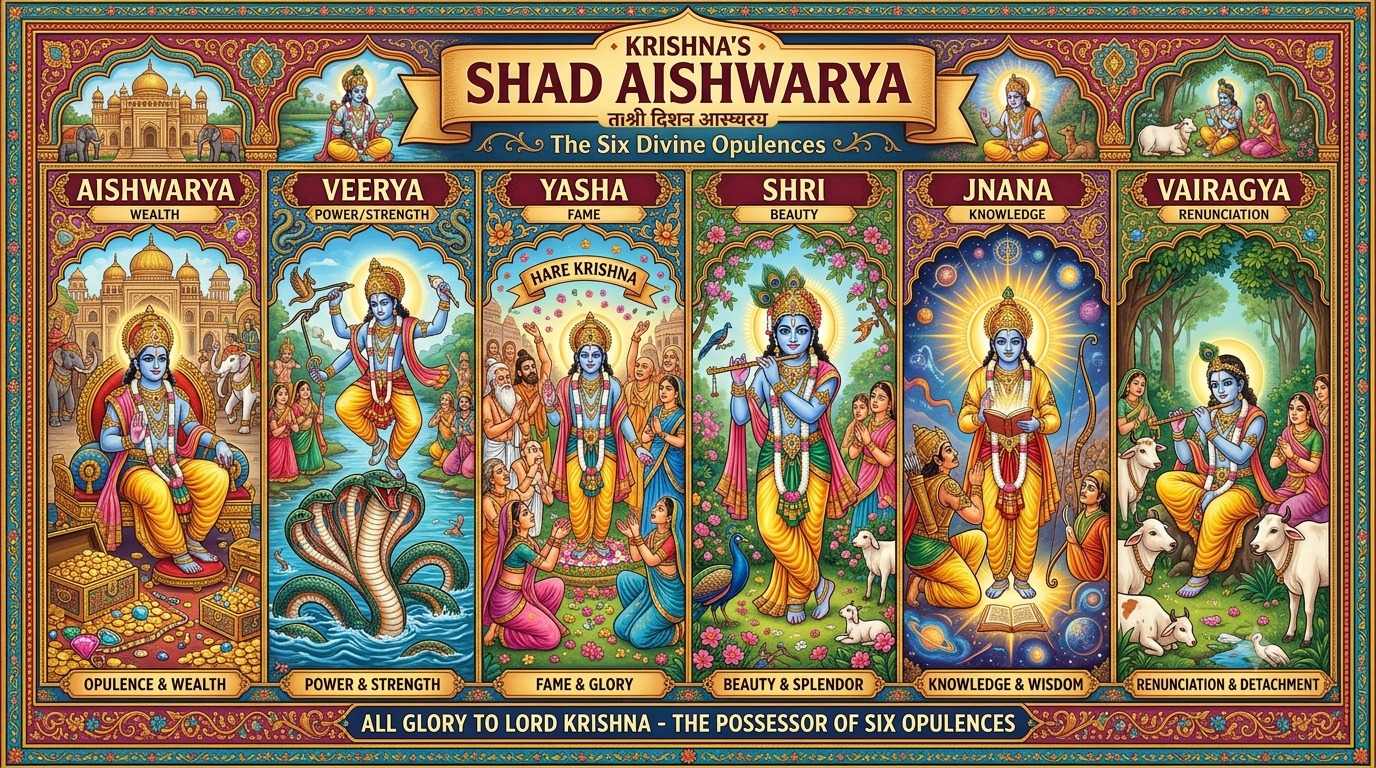
1. Aishvarya — Wealth and Opulence
Meaning: Unlimited riches, sovereignty, and lordship over all creation.
Krishna’s wealth is not merely material; it is the opulence of one who owns and controls all universes. The Bhagavad Gita captures this cosmic ownership directly:
ahaṁ sarvasya prabhavo mattaḥ sarvaṁ pravartate
iti matvā bhajante māṁ budhā bhāva-samanvitāḥ
(Bhagavad Gita 10.8)
Translation: “I am the source of all spiritual and material worlds. Everything emanates from Me. The wise who know this perfectly engage in My devotional service.”
Example from Krishna’s life: As the ruler of Dwarka, Krishna is described in the Bhagavata Purana as living in a city built of gold, with 16,108 palaces, each maintained for His queens, each palace filled with celestial opulence beyond the imagination of even the demigods. Yet He accepted a handful of flattened rice (chipped rice) from His poor friend Sudama with as much delight as any royal offering — showing that His aishvarya was never for self-indulgence, but existed alongside the other five qualities in perfect balance.
2. Virya — Strength and Potency
Meaning: Unlimited power, both physical and spiritual — the capacity to perform the impossible effortlessly.
Example from Krishna’s life: As a mere seven-year-old child, Krishna lifted Govardhana Hill on the little finger of His left hand for seven days and nights, holding it aloft to shelter the residents of Vrindavan from Indra’s torrential storm. This single pastime is the most iconic display of virya in the entire Krishna literature — a child performing what no army of demigods could achieve.
Other examples include His subduing of the poisonous serpent Kaliya in the Yamuna, and His effortless slaying of the powerful wrestlers Chanura and Mushtika, and ultimately King Kamsa, in the arena at Mathura — all performed by a teenager against opponents trained for war.
3. Yasha — Fame
Meaning: Unlimited, pure glory that spreads across time and space without tarnish.
Example from Krishna’s life: Few names in human history are chanted, sung, painted, and worshipped as widely and continuously as “Krishna.” From the battlefield of Kurukshetra where He spoke the Bhagavad Gita to Arjuna, to temples across the globe today, His fame has traveled through five thousand years without dimming. The Gita itself acknowledges the eternal nature of this glory:
yadā yadā hi dharmasya glānir bhavati bhārata
abhyutthānam adharmasya tadātmānaṁ sṛjāmy aham
(Bhagavad Gita 4.7)
Translation: “Whenever and wherever there is a decline in religious practice, and a predominant rise of irreligion — at that time I descend Myself.” This promise of repeated, purposeful appearance is itself what has cemented Krishna’s yasha across millennia of devotional memory.
4. Shri — Beauty
Meaning: Unmatched, transcendental physical and spiritual beauty.
The Brahma Samhita (5.30) offers perhaps the most celebrated poetic description of Krishna’s beauty:
veṇuṁ kvaṇantam aravinda-dalāyatākṣaṁ
barhāvataṁsam asitāmbuda-sundarāṅgam
kandarpa-koṭi-kamanīya-viśeṣa-śobhaṁ
govindam ādi-puruṣaṁ tam ahaṁ bhajāmi
Translation: “I worship Govinda, the primeval Lord, who is adept at playing on His flute, whose eyes are like lotus petals, whose head is bedecked with a peacock feather, whose figure of beauty is tinged with the hue of blue clouds, and whose unique loveliness charms millions of Cupids.”
Example from Krishna’s life: During the Rasa Lila, when Krishna danced with the gopis of Vrindavan in the moonlit forest, the Bhagavatam describes how even nature itself paused — the rivers slowed their flow, the trees showered flowers, and the gopis, upon merely hearing His flute, abandoned their household duties in astonishment at His beauty and charm.
5. Jnana — Knowledge
Meaning: Complete, perfect, and unlimited knowledge of all things — material and spiritual, past, present, and future.
Example from Krishna’s life: The entire Bhagavad Gita, spoken on the battlefield of Kurukshetra, is a direct display of this opulence. In just eighteen chapters, Krishna expounds the nature of the soul, the workings of karma, the paths of devotion, knowledge and action, the structure of the universe, and the ultimate goal of life. He declares the completeness of His knowledge plainly:
mattaḥ parataraṁ nānyat kiñcid asti dhanañ-jaya
mayi sarvam idaṁ protaṁ sūtre maṇi-gaṇā iva
(Bhagavad Gita 7.7)
Translation: “O conqueror of wealth, there is no truth superior to Me. Everything rests upon Me, as pearls are strung on a thread.”
6. Vairagya — Renunciation
Meaning: Complete detachment, even while possessing everything — the opposite of the material tendency to cling to what one owns.
This is perhaps the most paradoxical and profound of the six opulences, because it exists simultaneously with unlimited wealth (aishvarya). Krishna owns everything, yet is attached to nothing.
Example from Krishna’s life: Despite ruling as king of Dwarka with unimaginable riches, Krishna Himself lived without material attachment, ever engaged in the welfare of His devotees rather than personal enjoyment. In the Gita, He teaches Arjuna the very principle of detached action that He Himself embodies:
karmaṇy evādhikāras te mā phaleṣu kadācana
mā karma-phala-hetur bhūr mā te saṅgo ‘stv akarmaṇi
(Bhagavad Gita 2.47)
Translation: “You have a right to perform your prescribed duty, but you are not entitled to the fruits of action. Never consider yourself the cause of the results of your activities, and never be attached to not doing your duty.”
Even His departure from Vrindavan — leaving behind Radha and the gopis who loved Him more than their own lives — to fulfil His mission of ridding the earth of demoniac kings, is read by Vaishnava commentators as vairagya in action: complete internal detachment even amid the deepest bonds of love.
Why Only Krishna Is Called “Bhagavan Svayam”
The Srimad Bhagavatam makes a striking distinction between Krishna and other incarnations of Vishnu:
ete cāṁśa-kalāḥ puṁsaḥ kṛṣṇas tu bhagavān svayam
(Srimad Bhagavatam 1.3.28)
Translation: “All the incarnations listed are either plenary portions or portions of the plenary portions of the Lord, but Krishna is the Original Personality of Godhead Himself.”
Other avataras like Rama, Narasimha, or Varaha display these six opulences in their pastimes too — but according to Gaudiya Vaishnava philosophy, they manifest a portion suited to their mission. Krishna alone is described as manifesting all six opulences in their absolute totality, without limit, simultaneously — hence the exclusive title “Bhagavan Svayam,” Bhagavan Himself.
Summary Table: The Six Opulences at a Glance
| Opulence (Sanskrit) | Meaning | Key Example |
|---|---|---|
| Aishvarya | Wealth | Golden palaces of Dwarka; 16,108 queens |
| Virya | Strength | Lifting Govardhana Hill |
| Yasha | Fame | Eternal glory of the Bhagavad Gita |
| Shri | Beauty | The Rasa Lila with the gopis |
| Jnana | Knowledge | Teachings of the Bhagavad Gita |
| Vairagya | Renunciation | Detached action amid unlimited possession |
Conclusion
Shad-Aishvarya is far more than a theological checklist — it is a lens through which devotees understand why Krishna, among all divine personalities described in Vedic literature, is worshipped as Bhagavan in the fullest sense of the word. He is simultaneously the wealthiest, strongest, most famous, most beautiful, most knowledgeable, and most detached being in existence — six qualities that would seem contradictory in any ordinary person, yet flow together effortlessly in Krishna’s character.
Understanding these six opulences transforms the way one reads the pastimes of Krishna in the Bhagavata Purana and the Bhagavad Gita — every lila becomes not just a story, but a direct demonstration of what it truly means to be Bhagavan.