In the Gaudiya Vaishnava Tradition: The Path of Selfless Action Toward Krishna
Introduction: What Is Karma Yoga?
Karma yoga, the “yoga of action,” is one of the oldest and most practical spiritual paths described in Vedic literature. At its heart lies a simple but profound idea: every action can become a doorway to the divine when performed without selfish attachment to its fruits. It is a preparatory stage, a purifying current that eventually merges into the ocean of bhakti, or loving devotional service to Krishna.
This distinction matters. While many yoga traditions treat karma yoga as a complete path in itself — one that leads to liberation (moksha) through detachment — Gaudiya Vaishnavism views it as a stepping stone. Action without selfish motive purifies the heart, but the ultimate goal is not merely freedom from karma; it is the awakening of pure love for Krishna. Understanding this nuance is essential to grasping how karma yoga functions within Chaitanya Vaishnava theology. For the Gaudiya Vaishnava tradition — founded on the teachings of Sri Chaitanya Mahaprabhu and rooted in the Bhagavad Gita, Srimad Bhagavatam, and the writings of the Six Goswamis of Vrindavan — karma yoga is not an isolated discipline.
The Foundation: Karma Yoga in the Bhagavad Gita
The Bhagavad Gita, spoken by Krishna to Arjuna on the battlefield of Kurukshetra, is the primary scriptural source for karma yoga. Arjuna, paralyzed by grief and moral confusion, wishes to abandon his duty as a warrior. Krishna’s response forms the philosophical backbone of karma yoga.
Sloka 1 — Bhagavad Gita 2.47
karmaṇy evādhikāras te mā phaleṣu kadācana
mā karma-phala-hetur bhūr mā te saṅgo ‘stv akarmaṇi
This verse establishes the core principle: one has the right to perform one’s prescribed duty, but never a claim to the results that duty produces. One should never consider oneself the cause of the results of action, nor should one become attached to inaction.
Gaudiya commentators, particularly Srila Baladeva Vidyabhushana in his Gita-bhushana commentary, explain that this verse does not advocate indifference to outcomes out of stoic detachment alone. Rather, it redirects the working principle of action away from personal gain and toward duty performed as an offering. This redirection is the seed from which bhakti later blossoms.
Sloka 2 — Bhagavad Gita 3.19
tasmād asaktaḥ satataṁ kāryaṁ karma samācara
asakto hy ācaran karma param āpnoti pūruṣaḥ
Krishna instructs that one should perform prescribed duties without attachment, because a person acting without attachment attains the Supreme. Here, the “Supreme” (param) is understood by Gaudiya acharyas not as an impersonal liberation but ultimately as Krishna Himself, when action is coupled with devotion.
Sloka 3 — Bhagavad Gita 18.66
sarva-dharmān parityajya mām ekaṁ śaraṇaṁ vraja
ahaṁ tvāṁ sarva-pāpebhyo mokṣayiṣyāmi mā śucaḥ
This is the Gita’s climactic instruction: abandon all varieties of duty and simply surrender unto Krishna. For Gaudiya Vaishnavas, this verse reveals the destination toward which karma yoga has been quietly leading all along. Karma yoga purifies; surrender to Krishna fulfills.
Karma Yoga as a Ladder, Not a Destination
Srila Rupa Goswami’s Bhakti-rasamrita-sindhu offers a well-known threefold classification of consciousness on the spiritual path:
- Karma-kanda — action performed for material results (wealth, heaven, sense gratification)
- Karma yoga / Jnana-misra bhakti — action performed without attachment to results, often mixed with a desire for liberation or purification
- Shuddha bhakti — pure, unmotivated, uninterrupted devotional service to Krishna, free from the desire for either material enjoyment or impersonal liberation
Karma yoga occupies the crucial second stage. It is far superior to karma-kanda because it does not bind the soul to further material entanglement. But Gaudiya theology insists it is still incomplete, because detachment alone does not engage the heart’s deepest faculty: love. A person can renounce the fruits of action and still remain spiritually dry, focused on “what I am not doing for myself” rather than “what I am doing for Krishna.”
This is why Chaitanya Vaishnavas transform karma yoga into what is called *bhakti-misra karma yoga, or more precisely, they absorb it entirely into *karma-yoga as an aspect of bhakti — action performed specifically as an offering to Krishna, not merely action performed without selfish desire.
The Gaudiya Refinement: From Nishkama Karma to Krishna Karma
Sloka 4 — Bhagavad Gita 9.27
yat karoṣi yad aśnāsi yaj juhoṣi dadāsi yat
yat tapasyasi kaunteya tat kuruṣva mad-arpaṇam
Krishna tells Arjuna: whatever you do, whatever you eat, whatever you offer in sacrifice, whatever you give away, whatever austerities you perform — do all of it as an offering to Me.
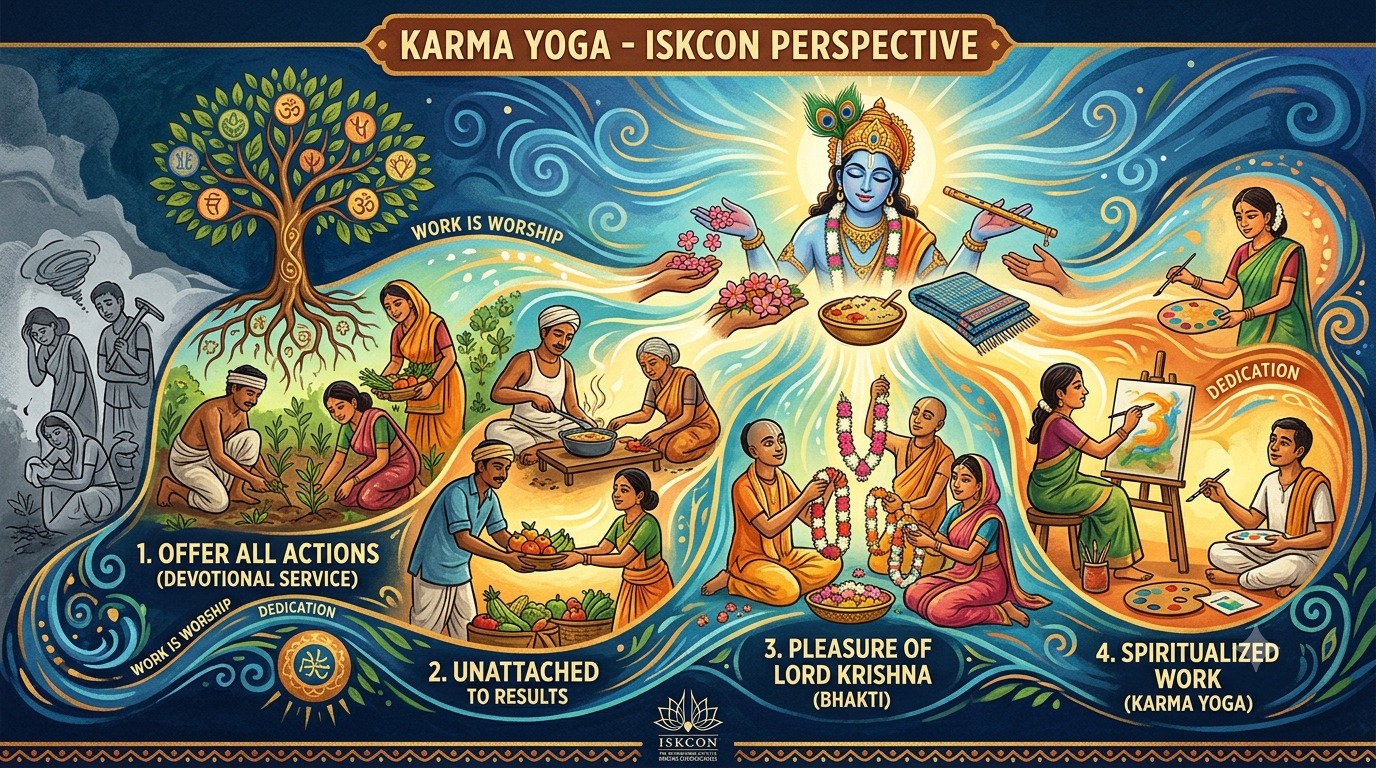
This verse is central to how Gaudiya Vaishnavas practice karma yoga in daily life. It is not enough to act without craving results; the action must be consciously dedicated to Krishna. This transforms ordinary karma yoga (nishkama karma, or desireless action) into karma performed in bhakti, which Srila Bhaktivinoda Thakura describes as the real fulfillment of the Gita’s teaching.
Srila Prabhupada, founder-acharya of ISKCON and a prominent modern exponent of Gaudiya Vaishnavism, emphasized that simply “doing one’s duty without attachment” is not the final word — the purpose behind the detachment matters. Detachment aimed at self-purification for one’s own liberation is still subtly self-centered. Detachment aimed at pleasing Krishna is bhakti, and this is the goal toward which karma yoga should evolve.
Illustrative Examples from Scripture
Arjuna on the Battlefield
Arjuna’s own transformation is the Gita’s central example of karma yoga in action. He begins wanting to withdraw from his duty out of personal sentiment. Krishna does not tell him to become a renunciant monk; instead, He tells him to fight — but to fight as an offering, without personal stake in victory or defeat, fame or blame. Arjuna’s warriorship becomes worship.
King Janaka
Janaka, the philosopher-king of Videha, is repeatedly cited in Vaishnava literature as the ideal karma yogi. He ruled a kingdom, managed treasuries and armies, and fulfilled all royal duties, yet remained internally unattached, his consciousness fixed on the Supreme. His example shows that karma yoga does not require external renunciation of the world — it requires internal renunciation of selfish desire within the world.
The Gopis and the Cowherd Community of Vrindavan
While the gopis and Krishna’s cowherd associates exemplify pure bhakti more than technical karma yoga, Gaudiya literature often points to their daily activities — churning butter, tending cows, cooking, cleaning — as instructive. Every mundane task performed in Vrindavan is depicted as saturated with loving service to Krishna, illustrating the ideal end-point toward which karma yoga aims: ordinary work transformed entirely into loving devotional service, or seva.
A Modern-Day Example
Consider a devotee working an ordinary job — an accountant, a teacher, a shopkeeper. In the karma yoga framework, this person performs their professional duties diligently and honestly, without obsessing over promotions, profit margins, or recognition. In the Gaudiya refinement, this same person goes a step further: they mentally offer the fruits of their labor to Krishna, perhaps donating a portion of their income to devotional causes, treating their workplace as a field for practicing honesty and compassion, and remembering Krishna through japa (chanting) before and after work. The job itself does not change; the consciousness behind it does.
Karma Yoga and Varnashrama Dharma
Traditional Vedic society organized karma yoga through the varnashrama system — social and spiritual occupational duties based on one’s nature (varna) and stage of life (ashrama). A brahmana’s karma yoga looked different from a kshatriya’s or a vaishya’s, yet each could purify themselves through their respective prescribed duties performed without attachment.
Sloka 5 — Bhagavad Gita 18.47
śreyān sva-dharmo viguṇaḥ para-dharmāt sv-anuṣṭhitāt
svabhāva-niyataṁ karma kurvan nāpnoti kilbiṣam
It is better to perform one’s own prescribed duty imperfectly than to perform another’s duty perfectly. By acting according to one’s own nature, a person does not incur sinful reaction.
Gaudiya Vaishnavas generally teach that in the current age (Kali-yuga), the strict varnashrama system is difficult to implement in its traditional form, and the more accessible and universal path is direct engagement in Krishna consciousness — chanting the holy names, hearing scripture, serving devotees, and offering one’s work to Krishna — regardless of one’s social position. This is sometimes called daiva-varnashrama, a spiritually oriented rather than birth-based application of the same principle.
Yukta-Vairagya: The Gaudiya Formula for Action
Perhaps the most distinctive Gaudiya contribution to the theology of action is Srila Rupa Goswami’s concept of yukta-vairagya, or “appropriate renunciation,” described in his Bhakti-rasamrita-sindhu:
Sloka 6
anāsaktasya viṣayān yathārham upayuñjataḥ
nirbandhaḥ kṛṣṇa-sambandhe yuktaṁ vairāgyam ucyate
This verse teaches that things favorable to Krishna’s service should be accepted for that purpose, without being attached to them for personal enjoyment, and this is called proper (yukta) renunciation. Rather than rejecting the world outright, one uses whatever resources — wealth, talent, time, relationships — in service to Krishna. This is karma yoga fully matured: not the rejection of action, and not action for its own sake, but action consecrated entirely to devotional purpose.
Comparing Karma Yoga With Other Paths
| Path | Core Method | Goal | Gaudiya View |
|---|---|---|---|
| Karma-kanda | Ritualistic action for results | Heavenly enjoyment | Binds the soul further; discouraged |
| Karma yoga | Action without attachment to results | Purification, sometimes liberation | Valuable but incomplete without devotion |
| Jnana yoga | Philosophical discrimination, renunciation of the world | Impersonal liberation (moksha) | Dry without love for Krishna; can lead to bhakti if humility is present |
| Ashtanga yoga | Meditation, breath control, physical discipline | Union with the Supersoul | A gradual process; bhakti is the swiftest and most complete |
| Bhakti yoga | Loving devotional service to Krishna | Pure love of God (prema) | The goal of all other yogas; complete in itself |
Practical Applications for Daily Life
- Offer the fruits of your work. Before beginning any task, mentally dedicate its outcome to Krishna’s pleasure rather than personal gain.
- Practice honesty in your profession. Karma yoga is meaningless if the action itself is dishonest or harmful; right conduct (dharma) is the foundation.
- Reduce the sense of doership. Recognize that talents, opportunities, and even the capacity to act come from a higher source.
- Combine action with remembrance. Chanting the Hare Krishna maha-mantra during work, keeping scripture nearby, or pausing for short prayers helps keep consciousness anchored.
- Serve without seeking credit. Whether at home, work, or in community service, performing duties quietly and without expectation of praise is a direct application of nishkama karma.
- Support devotional causes with resources. Directing a portion of one’s earnings, time, or skills toward temple service, scriptural distribution, or helping devotees is considered a natural extension of yukta-vairagya.
Frequently Asked Questions
Q1. Is karma yoga the same as bhakti yoga?
No. Karma yoga is action performed without attachment to its results, which purifies the heart. Bhakti yoga is loving devotional service to Krishna performed for His pleasure alone. Gaudiya Vaishnavism treats karma yoga as a preparatory stage that finds its completion in bhakti.
Q2. Can a working person practice karma yoga without renouncing their job or family?
Yes. This is one of karma yoga’s central teachings. Renunciation in the Gita and in Gaudiya theology refers primarily to internal detachment from selfish motives, not necessarily external abandonment of responsibilities. A person can remain a professional, parent, or householder while practicing karma yoga sincerely.
Q3. What does “offering the fruits of action to Krishna” actually mean in practice?
It means performing one’s duties with excellence and honesty, without personal craving for reward, while mentally and practically dedicating the results — whether success, income, or recognition — to Krishna’s service, such as through charitable giving, temple support, or simply an internal attitude of gratitude and surrender.
Q4. Does karma yoga require following the traditional varnashrama occupational system?
Not necessarily in the present age. While varnashrama dharma provided the classical context for karma yoga, most Gaudiya teachers emphasize that engaging in Krishna consciousness — chanting, hearing scripture, and dedicating one’s existing occupation to Krishna — is more accessible and effective for people today.
Q5. How is Gaudiya karma yoga different from karma yoga in more impersonalist schools of thought?
Impersonalist interpretations often treat karma yoga as leading toward merging with an undifferentiated Absolute. Gaudiya Vaishnavism holds that the Absolute Truth is ultimately a person — Krishna — and that karma yoga’s purification should lead toward loving relationship and service to Him, not dissolution of individual identity.
Q6. What is yukta-vairagya and why does it matter for karma yoga?
Yukta-vairagya, “appropriate renunciation,” taught by Srila Rupa Goswami, means using one’s resources and abilities in Krishna’s service rather than either indulging in them selfishly or rejecting them altogether. It refines karma yoga from mere detachment into positive, purposeful engagement dedicated to Krishna.
Q7. Is it possible to fail at karma yoga?
Krishna addresses this directly in the Gita (2.40), assuring that even a little effort on this path protects one from great danger, and no sincere effort is ever lost. Gradual, imperfect practice is considered far more valuable than inaction or abandonment of the attempt.
Conclusion
Karma yoga, as understood through the Gaudiya Vaishnava lens, is far more than a philosophy of detached efficiency or stoic duty. It is a living bridge between the material world of obligation and the spiritual world of loving service. By performing one’s responsibilities without selfish attachment, and — crucially — by dedicating those actions to Krishna, a practitioner gradually transforms ordinary work into worship. The Bhagavad Gita lays the foundation; Sri Chaitanya Mahaprabhu and the Goswamis of Vrindavan complete the structure, showing that every act of one’s life, however small, can become an offering of love. In this way, karma yoga does not disappear as one advances spiritually — it is fulfilled, becoming indistinguishable from bhakti itself.